
加载中...
共找到 16,685 条相关资讯

In May 2024, Blackstone led a $7.5 billion private debt facility to CoreWeave, the AI cloud company, secured against Nvidia chips and customer contracts. It was at the time among the largest private credit deals ever signed.

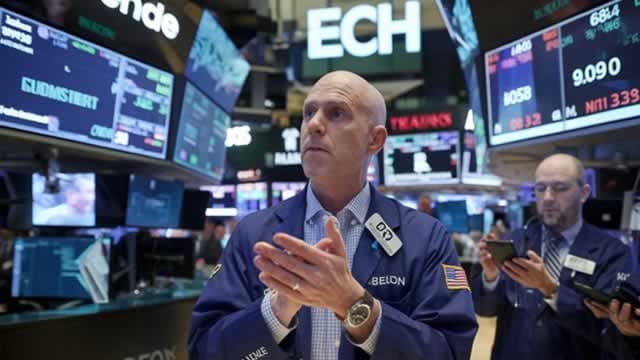
CNBC's Jim Cramer said the data center and artificial intelligence boom is spreading to every corner of the market. Cramer referenced Nvidia CEO Jensen Huang's framework that describes the AI economy as a "five-layer cake".

The SEC proposed allowing publicly traded companies to switch from quarterly to semiannual reporting using a new Form 10-S, offering more regulatory flexibility.

Momentum and growth had something to say about the shift to value/quality investing in April. The two factors dominated last month, accounting for a total return of 19.3% in the S&P 500 Momentum index and 16% in the S&P 500 Pure Growth index based on data from S&P Global.

"There's a lot of attractive opportunity to invest," Pimco CEO Emmanuel Roman says while discussing data center financing and the company's debt deal pipeline at the Milken Institute Global Conference in Beverly Hills, California. -------- More on Bloomberg Television and Markets Like this video?

A troubling fiscal picture for the U.S. government should give bargain-hunters pause.

Intel soared 13%, while oil slipped on hopes for easing Mideast tensions.

US stocks closed higher on Tuesday, with all three major indexes advancing as easing oil prices and a strong earnings backdrop lifted investor sentiment despite ongoing geopolitical tensions in the Middle East. The Dow Jones Industrial Average rose 356 points, or 0.7%, while the S&P 500 gained 0.8% after hitting an all-time intraday high.

Christina Minnis, Goldman Sachs global head of the Alternatives Origination Group, discusses the transformative impact of AI on both private and public markets during an interview at the Milken Institute Global Conference in Beverly Hills, California.

Zed Francis breaks down what's driving the ongoing rally in semiconductor stocks, highlighting the contrast between less cyclical leaders like Nvidia (NVDA) and more volatile memory names. He explains how rising market confidence is extending earnings "cliffs," driving sharp gains while emphasizing the importance of volatility trends across the sector.

Markets are being reshaped by artificial intelligence. Geographic power is shifting.

Aluminum prices have soared since the U.S.-Iran war began. Ford, Molson Coors and many other companies are grappling with the cost pressures.
Operator: Good day, and welcome to the AGCO 2026 Q1 Earnings Call. [Operator Instructions] Please note, this event is being recorded. I would now like to turn the conference over to Greg Peterson, AGCO Head of Investor Relations. Please go ahead. Greg Peterson: Thanks, and good morning. Welcome to those of you joining us for AGCO's First Quarter 2026 Earnings Call. We will refer to a slide presentation this morning that is posted on our website at www.agcocorp.com. The non-GAAP measures used in the slide presentation are reconciled to GAAP measures in the appendix of the presentation. . We'll make forward-looking statements this morning, including statements about our strategic plans and initiatives as well as our financial impacts. We'll address demand, product development and capital expenditure plans and timing of those plans, and our expectations concerning the costs and benefits of those plans and timing of those benefits. We'll also cover future revenue, crop production and farm income production levels, price levels, margins, earnings, operating income, cash flow, engineering expense, tax rates and other financial metrics. All of these forward-looking statements are subject to risks that could cause actual results to differ materially from those suggested by the statements. These risks are further described in the safe harbor included on Slide 2 in the accompanying presentation. Actual results could differ materially from those suggested in these statements. Further information concerning these and other risks is included in AGCO's filings with the SEC, including its Form 10-K for the year ended December 31, 2025, and subsequent Form 10-Q filings. AGCO disclaims any obligation to update any forward-looking statements, except as required by law. We will make a replay of this call available on our corporate website later today. On the call with me this morning is Eric Hansotia, our Chairman, President and Chief Executive Officer; as well as Damon Audia, Senior Vice President and Chief Financial Officer. With that, Eric, please go ahead. Eric Hansotia: Thank you, Greg, and good morning, everyone. AGCO delivered very solid results in the first quarter, reflecting effective execution against our strategy and the growing impact of the actions we've taken over the recent years to streamline our cost structure. Net sales were approximately $2.3 billion, up 14% year-over-year. driven primarily by stronger performance in [indiscernible] compared to the challenging prior year period. With differing industry conditions across regions, the year-over-year improvement highlights our ability to perform consistently and deliver solid results across varied demand environments. Operating income increased more than 60% year-over-year to $80.7 million with reported operating margin expanding 100 basis points to 3.4%. On an adjusted basis, operating margin improved 50 basis points to 4.6% driven by better volume leverage and ongoing benefits from business optimization initiatives, partially offset by higher cost inputs, including tariffs. These results underscore the pragmatic focused manner in which we are operating the business. Over the past 2 years, we have taken deliberate actions to simplify and focus our operations and sharpened execution, including a leaner cost structure, more disciplined production planning and improved channel alignment. The performance delivered this quarter supports the increased durability and resilience of our earnings model. While near-term demand remains uneven across regions, we continue to believe the business is operating around the trough of the cycle, with inventories normalizing and underlying conditions beginning to set the stage for the next phase of recovery. Adjusted operating income increased nearly 30% and adjusting EPS more than doubled year-over-year to $0.94, highlighting the operating leverage inherent in the business from lower cycle levels as well as a lower adjusted tax rate in the quarter. We also continue to emphasize structured working capital management and inventory alignment. Dealer inventories improved in the first quarter. positioning us in a more balanced position to support customers while maintaining better operational stability through the remainder of the year. We are encouraged by the progress delivered this quarter and remain fully focused on executing our plans to drive sustainable margin enhancement, cash generation and long-term value creation. Slide 4 details industry unit retail sales by region for the first quarter. While fleet ages continue to increase, farmer purchasing activity reflects a measured and thoughtful approach shaped by the current macro environment, trade policy dynamics, higher interest rates and input costs tighter credit conditions and currency volatility are influencing buying decisions globally, particularly for larger equipment. In North America, overall industry tractor volumes trended lower relative to the prior year with the most pronounced weakness in higher horsepower tractors. Farmers continue to defend more capital-intensive purchases amid current farmer economics, evolving grain export demand and elevated input costs. In Western Europe, industry tractor sales increased compared to softer prior year period with growth across most of Western European markets. Combined demand; however, remain cautious as farmers wave financing conditions and capital allocation decisions. In Brazil, industry retail demand moderated across both tractors and combines with larger equipment most affected by higher interest rates, credit availability and currency effects, while demand for smaller and midsize equipment remain relatively more resilient. Against the evolving macro backdrop, farmer purchasing decisions remain deliberate with customers balancing operational requirements, alongside financing costs and broader economic conditions. Investment activity continues to prioritize solutions that deliver clear productivity gains and cost benefits, including precision agriculture and technology upgrades while larger equipment replacement decisions are sequenced thoughtfully. This environment continues to support disciplined production planning and inventory alignment across the industry. AGCO's factory production hours are shown on Slide 5. First quarter production hours increased 15% year-over-year, reflecting a lower level of production in the first quarter of 2025. The year-over-year increase was driven primarily by Europe, where production levels rebounded from a particularly reduced first quarter 2025 base. Importantly, first quarter 2026 production was aligned with our operating plan and reflected intentional timing and product mix rather than a change in underlying demand trends. Full year 2026 production hours are still planned to be broadly flat to modestly lower than 2025. We are executing a deliberate and measured step down in production as the year progresses. This approach reflects our continued focus on inventory optimization in North America and Latin America, active support of dealer destocking and close alignment of output and market demand. Turning to regional inventories. In Europe, dealer inventory months of supply improved modestly to just under 4 months aligned with our target. This reflects effective execution across the channel with sent operating below the regional average in MessyFerguson Valter modestly above. This well-balanced position provides operational flexibility across product categories and supports continued focus on margin quality and mix optimization in our largest and most profitable region. In Latin America, dealer inventories moved to 4 months of supply from 5 months at year-end, continuing progress toward our 3-month target. Dealer inventory units declined approximately 10% during the quarter, reflecting disciplined coordination of shipments and production with a slightly softer industry outlook. In North America, dealer inventories closed the quarter at approximately 7 months of supply, consistent with our year-end levels and slightly above our 6-month target. Large egg units decreased sequentially and but were offset by the normal increase in the low horsepower segment this quarter in anticipation of the spring retail selling season. Production continues to be managed intentionally with a clear priority on channel health, and long-term stability. Slide 6 highlights our strategy to outpace the market and drive margin improvement to our adjusted operating margin target of 14% to 15% at mid-cycle over time. What is increasingly evident is that AGCO is delivering stronger and more resilient financial outcomes across a range of demand conditions compared to prior cycles. The structural actions implemented over recent years are translating into a more durable margins, improved earnings stability and higher quality cash generation, demonstrating the effectiveness of our evolved operating model. Our 3 growth levers: high-margin products, technology-driven differentiation and a growing higher-value aftermarket business continue to provide meaningful support in the current environment. each lever contributes distinct value and together, they reinforce a business model that is less reliant on unit volumes and more centered on value creation. This foundation underpins our ability to consistently deliver mid-cycle adjusted operating margins in the 14% to 15% range over time. It reflects a structurally improved AGCO more focused on higher-value revenue streams, more disciplined on costs and investment and increasingly driven by technology solutions and services. Importantly, this operating model also supports strong cash generation with free cash flow conversions of approximately 75% to 100% through the cycle. That financial flexibility enables continued investment in innovation and business advancement, while supporting capital returns to shareholders as evidenced by our recent increased dividend and share repurchase announcements. Taken together, these elements highlight why AGCO is operating today from a more favorable and resilient position and why our business is well positioned to deliver consistent performance across future market cycles. Turning to Slide 7. We are seeing a series of tangible strategy wins as we execute against our farmers first priorities. These actions demonstrate how we're building a durable competitive advantage by combining engineering leadership with increasingly advanced digital and enabled capabilities. Our approach reflects a focus on prioritizing growth while also delivering efficiency, as we apply AI where it delivers measurable value for farmers and strengthens business performance through better decisions and execution. AI is increasingly becoming a significant enabler in that road map and across the organization to support long-term value creation and differentiation. AI solutions on the farm and in our products are designed to help farmers to achieve more with fewer inputs such as land, labor, fuel and chemicals. Solutions, including Symphony Vision use intelligent cameras intended to optimize precision application in real time, improving effectiveness and helping to reduce waste. At our PTX Winter Conference, we introduced AI-enabled innovations, including Symphony Vision Dual and AROTube to advance real-time precision applications and automated seed placement. These innovations reinforce our position in high-value technology-enabled solutions. We use AI in customer support and service to connect machine data, customer needs and AGCO expertise to reduce downtime and strengthen long-term customer relationships. It is transforming how we work with thousands of parts leads generated for dealers and tools like product information assistant to more closely connect dealers and farmers. And third, AI inside AGCO is improving efficiency, quality, cost and speed. Use cases range from AI-powered financial forecasting to AI-driven market analytics that automate used equipment price analysis and free up experts to focus on more value-driven actions. These capabilities are being deployed in a structured and purposeful manner to support margin expansion and growth. We are seeing strong and growing demand from our employees to leverage and deploy VVI solutions to better support our dealers and farmers. We view this momentum, along with our project reimagine run rate cost savings as a clear opportunity to drive measurable efficiency gains and productivity improvements across the organization over time. In short, we are taking an enterprise view with AI using human in the loop oversight and aligning with the evolving regulatory frameworks to support trusted, responsible and scalable usage. On Slide 8, we also continue to see strong external validation of our innovation and technology leadership. Our outrun mixed fleet retrofit technology are in the prestigious Davidson Prize for the second consecutive year. This time for them is tillage, reflecting our step-by-step progress towards our ambition for full firm autonomy by 2030. Our AGCO Parts shop received the Digital Engineering Award for a next-generation unified B2B platform that improves dealer efficiency, order accuracy and visibility at scale, which supports aftermarket growth and reinforces our farmer first focus on uptime. As EGCOPower's Core [indiscernible] 0 was named Diesel Engine of the Year, reinforcing our continued leadership in efficient powertrain innovation. The family of core engines were designed to run on an array of fuel options, helping them deliver the performance our farmers' demand around the world. I want to recognize and thank the teams across AGCO whose work continues to set a high bar for our industry. With that, I'll turn it over to Damon to walk through the financial results for the quarter. Damon Audia: Thank you, Eric, and good morning, everyone. Slide 9 provides an overview of regional net sales performance for the first quarter. Net sales increased approximately 5% in the first quarter compared to the prior year period, excluding the favorable impact of currency translation. By region, the Europe/Middle East segment delivered a 9% increase in net sales on a constant currency basis, higher sales resulted from increased unit volumes compared to the first quarter of 2025, which included dealer inventory destocking. Sales growth in Germany and the United Kingdom was partially offset by lower activity in Turkey and France. The increase was driven by strong growth in high horsepower tractor sales. North American net sales also increased 9%, excluding currency impacts. Higher unit sales compared to the prior year, together with positive share growth supported the increase. The most significant gains were in high-horsepower tractors, hay equipment and sprayers highlighting continued customer investment in productivity-enhancing solutions. Net sales in Latin America were 30% lower on a constant currency basis, reflecting very measured purchasing activity across virtually all product categories as the environment in Brazil and Argentina remain challenging in the quarter. Asia Pacific Africa net sales increased more than 20%, excluding currency impacts, driven by higher sales in Australia and South Africa partially offset by lower sales across most Asian markets. Consolidated replacement part sales were approximately $447 million in the first quarter, increasing 3% year-over-year on a reported basis and down nearly 6%, excluding favorable currency translation. Results reflected wet weather in Europe early in the quarter that limited parts consumption. And in North America, where dealers remain focused on inventory optimization amid continued cautious farmer sentiment. Turning to Slide 10. Adjusted operating margin was 4.6% in the first quarter, an improvement of 50 basis points year-over-year. This reflects strong execution in the Europe, Middle East region, once again, combined with continued operational and cost discipline across the broader organization. By region, Europe, Middle East income from operations increased by over $104 million compared to the first quarter of 2025 with operating margins exceeding 16%. These strong results were driven by sales growth, a richer mix and increased production compared to the prior period. North America income from operations reflected an approximately $27 million year-over-year reduction with operating margins remaining below breakeven. Results heavily reflect the year-over-year impact of tariff-related costs along with factory under absorption associated with our disciplined approach to reduce production levels. Latin America operating income decreased roughly $47 million year-over-year with results below breakeven, driven by several factors, including significantly lower sales volume and negative pricing. Asia Pacific Africa operating income increased about $7 million in the first quarter, supported by higher sales and increased production during the quarter. Slide 11 outlines our first quarter cash performance and full year estimated free cash flow. Free cash flow represents cash used and are provided by operating activities less purchases of property, plant and equipment. Free cash flow conversion is defined as free cash flow divided by adjusted net income. We used $455 million of cash in the first quarter of 2026 reflecting the normal seasonal inventory build, consistent with our operating cadence. The prior year quarter reflected unusually low production levels, mainly in Europe that limited inventory investment and reduced cash usage. Our 2026 production schedule reflects a return to our typical seasonal patterns, resulting in higher inventory investment and cash usage early in the year. This profile was fully aligned with our plan and remains consistent with achieving free cash flow in a targeted range of 75% to 100% of adjusted net income for the full year. Our approach to capital allocation remains disciplined and consistent, prioritizing reinvestment in the business, maintaining an investment-grade balance sheet, pursuing targeted acquisitions that accelerate technology adoption and returning capital to shareholders. This framework continues to guide both our decision-making and the sequencing of capital deployment. As part of this approach today, we announced that we are evolving our long-standing AGCO Finance U.S. and Canadian joint ventures to better align with increasing regulatory and compliance requirements on enhancing capital efficiency. On April 30, the company executed various agreements with wholly owned subsidiaries of Rabobank to sell AGCO's 49% equity interest in its U.S. and Canadian joint ventures for approximately $190 million, while establishing new financing framework agreements that are intended to strengthen the strategic and commercial benefits of these partnerships. AGCO Finance remains the predominant financing partner for AGCO and our customers. This structural evolution strengthens AGCO's farm refer strategy by ensuring continued access to competitive finance offerings. These actions optimize regulatory capital deployment, strengthen our commitment to providing competitive financing solutions to our farmers and dealers and bolster our financial flexibility. The proceeds from these transactions are incremental to free cash flow and are being used to support capital returns to shareholders. Building on both our record free cash flow generation in 2025 and these proceeds AGCO has increased our capacity to return capital to shareholders. We continue to execute share repurchases under our $1 billion authorization. Following the initial $300 million announcement in October last year, we are initiating an additional $350 million in repurchases during the second quarter of 2026. In addition, the Board of Directors also improved an increase in our regular quarterly dividend to $0.30 per share, up from $0.29. At this rate, annualized dividends would total [ $1.20 ] per common share. Collectively, these actions demonstrate a continued focus on disciplined capital deployment, balancing enhancing near-term shareholder returns with long-term financial flexibility. Turning to Slide 12, which summarizes our 2026 market outlook across our 3 major regions. Global agricultural markets entered 2026, reflecting conservative purchasing behavior shaped by high borrowing costs, extended margin compression and evolving policy and trade dynamics. Recently, geopolitical developments have contributed to higher fertilizer and fuel costs, reinforcing cautious behaviors across the industry. Current conditions point to a gradual and uneven recovery, rather than a near-term rebound. We are maintaining our forecast for North America and Western Europe and adjusting our Latin American forecast from flat to down modestly in 2026. In North America, farm income dynamics and increased input costs continue to shape demand, particularly for large equipment. Deal activity continues to focus on managing used inventories and limiting new commitments, which is weighing on large tractors and combined purchases. Higher fertilizer and diesel cost tied to recent geopolitical developments have added to grower caution heading into the planting season, further limiting discretionary capital spending. Smaller equipment continues to demonstrate relatively stable demand compared to large ag supported by livestock and hay related demand. While performance has improved year-over-year, early year activity has been more modest than anticipated amid recent macro events, reinforcing our views that upside remains limited for the remainder of the year. Overall, we expect the North American large ag equipment market to be down around 15% below 2025 levels with the small ag segment modestly higher. In Western Europe, near-term demand has demonstrated select areas of strength. At the same time, confident remains fragile. Farmer profitability challenges, increased input costs evolving regulatory uncertainty and prudent capital spending behavior continue to weigh on sentiment. Recent geopolitical developments, including the development in the Middle East have added to this environment, particularly around energy cost despite near-term demand strengths. Subsidy frameworks and relatively favorable interest rate dynamics continue to provide a stabilizing foundation for the region. Taken together, we still expect Western Europe to be up modestly in 2026. In Brazil, in broader Latin American region, interest rates and tighter credit conditions continue to influence purchasing patterns, particularly for large machinery. Increasing input costs and financing dynamics are guiding investment decisions, contributing to equipment demand variability. Brazilian retail tractor volumes in '26 are now projected modestly below 2025 levels, but with long-term fundamentals remaining relatively constructive. Overall, the agricultural equipment cycle in '26 reflects discipline, selective purchasing and delayed replacement activity. As financing conditions normalize, input cost pressures moderate and grain prices improve, the aging fleet and structural foundation supporting recovery remain in place with regional timing varying by market and segment. Slide 13, highlights the key elements underlying our full year 2026 outlook. Global industry demand in 2026 is now positioned in line with prior year levels, operating at approximately 86% of mid-cycle demand, consistent with the stabilization phase of the cycle. Our sales plan reflects continued market share gains, pricing in the range of 2% to 3% and roughly a 3% foreign currency benefit. While pricing helped moderate the impact of material inflation and tariff-related costs, the incremental increases in these pressures from events in the first quarter will now more than offset pricing actions resulting in margin dilution and lower profitability in 2026. Inventory management remains a priority in 2026, particularly in North America and Latin America, supporting our ongoing dealer inventory alignment and a balanced demand-driven go-to-market approach. Our outlook reflects the current tariff environment and our established mitigation actions, including cost initiatives and pricing. Since the fourth quarter earnings call, the tariff environment has evolved with the Supreme Court ruling related to EPA tariffs as well as new guidance on the calculation methodology related to Section 232 tariffs. We now expect tariff costs of approximately $135 million in 2026, which is around $90 million increase from 2025 and $25 million higher than our previous estimate. These estimates could change as things evolve during the year. Our adjusted operating margin and earnings per share outlook do not assume any refunds related to the [ EPA ] tariff. We are currently evaluating the impact to our business and the ultimate timing and amount of any potential refunds remain uncertain. We are prepared to adjust our outlook should tariff or trade policy conditions change. Engineering expense is planned at around 5% of sales in 2026, representing an increase of nearly $40 million year-over-year, supporting innovation across the portfolio while maintaining investment discipline. Operational efficiency initiatives are increasing and we now expect them to deliver approximately $60 million to $70 million of benefit in 2026, up from $40 million to $60 million, reinforcing our ongoing transformation progress. Production hours in 2026 are expected to be flat to slightly down compared to 2025 with a measured step down as the year progresses to support inventory normalization and demand alignment. Based on these assumptions, adjusted operating margin is still targeted in the range of 7.5% to 8% reflecting structural portfolio improvements and cost actions, partially offset by price cost pressures, increased tariff costs as well as increased freight costs. Finally, although our effective tax rate was 24% in the first quarter, we still expect our effective tax rate for 2026 to be in the range of 31% to 33%. Turning to Slide 14 for 2026 outlook. We have modestly tightened our full year net sales outlook to $10.5 billion to $10.7 billion, reflecting improved performance in certain regions slightly higher foreign exchange effects and continued execution, partially offset by ongoing market volatility. Adjusted earnings per share are targeted at approximately $6 supported by continued strong cost discipline and execution consistency. This revised outlook reflects our strong first quarter performance, along with the incremental tariff costs and other cost headwinds I mentioned previously. The current earnings per share outlook also assumes approximately $0.15 per share benefit associated with the share repurchase announced today. Capital expenditures are planned at around $350 million, positioning the company for future demand while preserving investment discipline. Free cash flow conversion remains targeted at 75% to 100% of adjusted net income, supported by strong working capital management and ongoing inventory efficiency. Second quarter net sales are targeted between $2.7 billion and $2.8 billion. Second quarter earnings per share are targeted between $1.35 and $1.40, reflecting the alignment of production with demand cost execution and timing of efficiency initiatives. The second quarter EPS target excludes any impact from the potential [ IEP ] tariff refunds or the sale of our equity interest in the AGCO Finance U.S. and Canadian joint ventures. The AGCO Finance transaction in North America will accelerate cash flows from the existing portfolio and result in a second quarter earnings lift. However, for the full year, we do not expect a meaningful change in the portfolio's earnings contribution. Slide 15 outlines the details for our 2026 tech data be held near Chicago, Illinois. A strategic business update will be held on October 6, followed by a live field demonstration of our precision agricultural stack and farmer core initiative on October 7. We look forward to hosting you just outside of Chicago. With that, I will turn the call over to the operator to begin the Q&A. Operator: [Operator Instructions] The first question is from Jamie Cook with Truist. Jamie Cook: I guess 2 questions. Damian, just unpacking how we think about -- I mean we had losses in North America and in Latin America in the first quarter. Just trying to understand, in particular, it was like the restatement with Mexico, how do we think about the full year potential loss in cadence, I guess, of earnings throughout the year, I guess, would be my first question. And then my second question, can you just dig a little deeper on some of the pricing commentary that you referred to like by region. You know what I mean, I guess I was impressed that we actually held the 2% to 3% price increase. Unknown Executive: Sure. So I think if we look at the cadence here with the incremental tariff costs that we alluded to in the scripted remarks, we're going to see North America sort of stay at this sort of the mid-teens margin loss for the balance of the year here. despite the solid pricing, that incremental $25 million is going to really be concentrated in North America, as you would expect. It will fluctuate a little bit in the quarter with volume here. But generally, you're looking at sort of an earnings kind of in that negative 10%, negative 12% for the full year. South America, we had a challenging first quarter -- or at -- excuse me, we had a challenging first quarter see that sort of rolling into the second quarter here with a slight breakeven, the slight loss likely in Q2. And then as we hopefully see the industry recover, we've talked about the election year some of the incentives as we get to the FINAME funding in the middle of the year, we see that turning certain positive. I think net for the full year, when you look at the first half headwinds second half opportunities probably closer to a breakeven business for Latin America as we look at the full year. I think, Jamie, on the second question on pricing, again, we did reaffirm the 2% to 3%. When I look at how pricing panned out in the first quarter, overall, I would say total company, it was modestly a little bit better than what we had expected. Now we saw stronger performance in pricing in North America and in Europe and then we saw a significantly weaker pricing in the Latin American region. So for total company, again, I still feel good that we're in that 2% to 3% range. But as I look at how things are unfolding, so far, I would say it's going to be a little bit stronger coming from North America and Europe and a little bit weaker coming out of the Latin American region, at least to start the year. Operator: Next question is from Kristen Owen with Oppenheimer. Kristen Owen: Damon, you walked through a lot of puts and takes on the guidance. It's easy to look at it and say, okay, you beat by $0.50 in the first quarter, so we're going to raise the guidance by $0.50. But it sounds like there's a lot more to it than that. So maybe just help us with the bridge on the updated guidance, what got better, what got worse? And then I have a follow-up on some of the cost-related items. Damon Audia: Yes. Sure, Kristen. So I think if you look at our prior guidance, we were $5.50 to $6. So we'll use the midpoint there. We rolled through the $0.50 beat in the first quarter. I alluded on the call, tariffs are around a $25 million incremental headwind, so call that around $0.25 of a headwind. Kristen, we tweaked our volumes, our industry outlook for South for Latin America and a little bit, I would say, in Eastern Europe, Turkey mainly. So the industry being a little bit softer for the balance of the year, that's around a $0.20 headwind. We've had incremental freight costs as we look at diesel fuel, ocean freight charges, other costs that we're seeing given the Middle East conflict, that's around a $0.20 headwind flowing into our cost of goods sold. To offset that, we included the share repurchase. We've estimated that at around $0.15 of a positive for the full year. And then we've also increased our restructuring savings outlook, which was $40 million to $60 million. We now have that at $60 to $70 million. So that, coupled with a little bit of other cost of goods sold savings opportunities, that's around a $0.20 positive relative to our original outlook. And so when you put those together, you get around $6. Kristen Owen: Fantastic. So the restructuring savings then the $40 million to $60 million now, $60 million to $70 million. In some of the prepared remarks, you talked about some of the internal initiatives. Can you maybe help us understand how much of that is just an acceleration or maybe a pull forward of the bridge that gets us to 14% to 16% by the end of the decade? Or how much of that is sort of incremental upside that maybe gives you greater confidence in that mid-cycle margin target? Damon Audia: Yes. So I'd say, Kristen, it's probably about 50-50. So we did have some savings that was planned more into the Q3, Q4 time frame. Given the industry, we've been able to pull as we did a little bit last year, we pulled some of that ahead. So if you remember on the fourth quarter call, we said we were run rating at around $190 million. I would tell you now after the end of the first quarter, we're run rating just a little bit over $200 million. So part of that was pulling some things ahead. But in this environment, as we leverage technology, more of the teams are seeing more opportunities. So there is some incremental long-term savings. So again, for this year, I would say it's kind of split between a pull ahead and an incremental. So that will carry over to some incremental savings as we get into 2027 given the annualization. But generally, I'd say we're run rating a little bit north of $200 million now. Operator: The next question is from Mig Dobre with Baird. Unknown Analyst: This is Peter Kalanarian on for Mig this morning. I guess I have one on Europe here. How confident are you in the relative strength in Europe holding through the remainder of the year? It's my understanding that EU farmers maybe don't preorder their inputs to the same extent as we see in North America. So could you maybe help me understand the dynamics there, what you're seeing in terms of farmer health? And then second part of the question on margin progression for Europe, I believe it's previously been a pretty steady mid-teens through the year. Is there any change there that we should be aware of? Eric Hansotia: Yes, I'll start off with that answer. So if you think about the crops that are planted in Europe, the biggest crop planted is wheat, and it's often -- it's a winter wheat predominantly. So that's planted in the fall. It starts growing over the winter and then it continues to grow in the spring and in the summer and is harvested early summer. So the cycle is a little different than what we think about in North America of most of the planting happening in the spring because of the mix of grains that they put in. So that's one dimension. They still do prebuy a fair amount, not quite as much as North America, but a fair amount. And so I think it really comes down to how long is this war going to last and how big of an impact is the increase in cost for fertilizer. Fertilizer is up somewhere between 35% and 50%, but it all depends on if that lasts through the rest of the year. Most predictions right now, of course, this is unpredictable, but many folks are using the assumption that this war is not going to last in terms of quarters, it's going to last in terms of several more weeks in terms of cutting off the street. So if that's true, then flow can normalize in time for the next big use of fertilizer in the Northern Hemisphere, which is more weighted toward the fall. Damon Audia: And then, Peter, if I -- in answer to your second question about the European margins and the cadence, again, Europe continues to be very strong for us if I think about the margins. generally speaking, likely in the mid-teens for each of the remaining 3 quarters, a little bit lower here in the second quarter as we'll have some of that incremental engineering expense. Remember, we have a high concentration of engineering expense in Europe. I'd say probably closer to flat to last year's margins and then picking up modestly here in the back half of the year as we introduce some new products and some of that new product pricing kicks in. But generally speaking, kind of in those mid-teens here for the balance of the year. Unknown Analyst: Awesome. And then a quick follow-up here on Latin America. How many -- do you have the pricing in place you feel to clear the channel here in the next couple of quarters? Or do you think that price will have to come down even further -- and I guess, tangential to that question, how many quarters of destock do you think we have left before inventory can get down to that target level of, call it, 3-ish months? Damon Audia: Yes. I think, Peter, for us, we're always looking market back from a pricing standpoint and our relative value to the farmers and also relative to the competition. I don't see a significant change in pricing, but again, subject to market conditions. I think we're trying to be much more proactive on our side. We will have inventory -- production will come down probably around 20% year-over-year in Q2 as we look to better adjust the production schedule. We made great progress on the dealer inventories this last quarter. As I mentioned in my part of the remarks, units were down around 10% -- so we are taking the units out. We're reducing the production here. We'll reduce it again another 20%, trying to get closer to that 3-month target here, hopefully by the end of the second quarter. But again, remember, for us, when we give you the dealers' month of supply, that's a 12-month forward look. So as that industry is changing either positively or negatively, that 12-month forward calculation can also influence even though the units may come down. So I feel good about what the team is doing in managing a very challenging situation. We know South America is likely the most susceptible to the diesel fuel cost, the fertilizer increases that Eric just alluded to. So the team is doing a good job sort of managing the production schedule to try to keep the retail and production as closely aligned as possible, but at the same time, getting the dealer inventory levels down, but still servicing the demand we're seeing. So a lot of work down there, but we feel good about how the team is managing it. Eric Hansotia: Maybe one more thing on Brazil. It's a very, very tight presidential race. And last week was AgrShow. There was a lot of talk at AgrShow about favorable terms coming into the market from the government. Unfortunately, there's no detail on what those terms are going to be, but certainly a lot of talk about they're coming. And so farmers, I think, to some degree, are a bit on hold until they get clarity on what that environment will be. But if you anticipate the chapter we're in right before an election is probably going to be something positive for farmers. Just don't have any clarity on it yet. Operator: The next question is from Steve Volkmann with Jefferies. Stephen Volkmann: I apologize if I missed this, Damon. I think you said that '26 production hours are going to be flat to slightly down, but it sounds like they're going to be down quite a bit in the second quarter, and you obviously reduced inventory in the first. So is the cadence that we're going to have like some big increases in the second half? Just how does that sort of play out? Damon Audia: Yes, Steve. So we had the big increase here in the first quarter. It was heavily in Europe because of the year-over-year comparison. It wasn't that we were running in excess. If you remember last year, we had a slow start as we were sort of destocking a little bit in Europe. If I look at Q2 here, you're looking at North America is likely going to be relatively flat to year-over-year. The big change will be the South American market. We'll be slowing production there in Q2 and likely in Q3 based on the current industry outlook. But as Eric just alluded to, such a volatile market or uncertain market there, we manage it one quarter at a time. But at least our outlook right now, this flat to down guide assumes more underproduction in the Latin American region, but relatively stable production in Europe and in North America for the balance of the year. Stephen Volkmann: Okay. I see. And then just anything to call out relative to your view of kind of how Precision ag sales kind of flow this year? Is there any upside or downside to your views there? Damon Audia: I don't think there's any upside or downside. Again, the first quarter was very much in line with our expectations. I think the sales for PTX as a whole were relatively flat year-over-year. So I think, Steve, when you look at the industry being down here in North America, down in the challenge in South America, the fact that PTX delivered relatively flat sales year-over-year is a testament to the retrofit market and how well that business is doing. For the full year, we still expect it to be flat to modestly up for the full year. Operator: The next question is from Joel Jackson with BMO Capital Markets. Joel Jackson: I wonder if you can provide any -- like we're talking about traversing the bottom here, things getting better as the year progresses. Do you have any updated views on what you think this cycle will look like in the next year or 2 as we get back into growth and maybe compare that to prior cycles? Eric Hansotia: Yes, it's a pretty uncertain environment we're in, but I would say we expect that -- you look at what are the drivers of cycles. And the primary one I'd look at is the age of the existing fleet in the farm. And in all of our regions, it's at peak levels. So when the farmer looks out into their machine shed, they see old equipment and they see a lot of technology coming into the market. And so there's a draw or replacement demand. that's going to happen. And there's other turbochargers that could happen and could boost that. Brazil is putting a lot more of their corn into ethanol. The U.S. ethanol blend may move from 10% to 15% may move to year around. I don't know yet, but that's under a heavy discussion. Biofuel policy and sustainable aviation fuel are getting a lot of attention right now. There's more protein demand with Li and the GLP drugs. So you combine all of those things, and those all give us -- those are the ones we've been talking about for several years. Those are natural tailwinds for this industry to recover tactically because of the fleet age and more strategically because of these macro drivers. And we see all of those as playing for the farmer. They need some more certainty. They need the straight to open up. They need their cost to settle back down and they need the trade flows to open up, which is a relatively short-term thing. Once that happens, I think the cycle will progress like it usually does. We've been 2 to 3 years now at the bottom, and then it usually works its way back up. It's depending on the situation, 7- to 10-year overall cycle. So we expect a migration back up to mid-cycle volumes and then hopefully above mid-cycle after that. Joel Jackson: Going in the background. I apologize for the noise. And just my second question, the buyback less announced, would that be very upfront like the buyback last year or more spare? Damon Audia: Yes, normally, we do the buyback in the form of an ASR. There is a portion that is directly done with TaFI, our largest shareholder. So you can assume that 85% of it directionally is done through the form of an ASR and then the balance comes from Tafi at a later date. Operator: The next question is from Kyle Menges with Citigroup. Kyle Menges: This is Randy on for Kyle. It would just be great to get some more color on some of the changing tariff dynamics as it relates to your outlook, maybe bifurcating between impacts from the IEPA overturn, the new Section 232 ruling. And then any color on how you're thinking about what potential Section 301 impacts could be would be helpful. Damon Audia: Yes, Randy. So with the IEPA ruling, we have now taken that out of our guidance and factored in the new cost calculation for 232. When we look at the net of those 2, that's around a $24 million headwind relative to our prior guidance. And so that's sort of been factored into our outlook. as I mentioned in my pre-scripted remarks, we've not assumed any refund or anything related to the IEPA in our current EPS outlook. If something was to be monetized, that would be incremental. As it relates to the pending 301 tariffs, again, we have not assumed anything beyond what's currently in place today into our outlook. I think it's important to remember, though, as if there is something that comes as a result of 301, the question of when do those take effect when do they hit our inventory and then when does that flow through cost of goods sold. So as we think about something maybe coming this summer, the reality of that hitting 2026 is quite low, just given the flow of inventory and finding its time to our cost of goods sold. So again, we're monitoring the situation. The teams are doing a great job in trying to mitigate these tariffs, looking for offsets or ways to ship directly to Canada, which historically we would have flown those European products into the U.S. and then up to Canada. So looking for ways to avoid some of these where possible to limit the impact on our dealers and our farmers. But overall, as I said, around $25 million is the net headwind this year. Operator: The next question is from Kevin from Wells Fargo. Unknown Analyst: Can you talk about what you're seeing in terms of used inventory destocking in North America during the quarter? And what do you expect in terms of the pace going forward? Damon Audia: Yes, Kevin, I think overall, we don't have as much visibility as maybe some of our competitors do on the used. But overall, generally speaking, it's not as big of an issue for our dealers versus the new. We're probably directionally about maybe a month in a better position than we are in the news in the new. So overall, not a huge issue, but something that we're watching closely. Unknown Analyst: Got it. And then maybe switching gears, how should we think about the sales of the stake in the joint ventures in terms of the impact on the equity income line on a go-forward basis? Damon Audia: Yes. I think the -- so Kevin, thanks for asking the question. I guess the way to think about this is the $190 million of cash that I mentioned is reflective of the equity value and the cash flow considerations of the existing portfolio as of April 30. So if you think about that, the transaction, it's going to accelerate the cash flows from the existing portfolio, and that's what's going to result in this Q2 earnings benefit. But on the full year basis, the contribution from the portfolio hasn't really changed. So that's the way to think about it here in 2026. As I think about '27 and beyond, what's happened that equity and earnings is now going to disappear for those 2 entities, and you're going to see that show up at a smaller percentage, but show up as a reduction in sales discount. So it will be slightly accretive to the operating margin and a little bit negative from an earnings per share perspective. Operator: The next question is from Angel Castillo with Morgan Stanley. Angel Castillo Malpica: This is Esther on for Angel. I just had a question around North America market share. Can you unpack a bit more about what you're seeing in North America and just provide a little bit more color on the market share gains? Also curious to know if farmers are telling you anything that's driving the switch of brands and whether there are any particular regions in the U.S. where you're seeing this? Eric Hansotia: Yes, I'll take that one. So globally, we had our highest market share. We grew again market share in quarter 1. We've now got our all-time record highest market share for the company globally. And a big driver of that is North America. We're getting market share gains in both of our brands, Massey Ferguson and Fendt in terms of machinery brands. And essentially, we've gone through a few phases here. The first phase was getting our parts and service performing at a record level, and that's been done for several years now. Then getting our product portfolio to the best in the industry. We've got that in place solidly. And now we're working with our dealers to really raise their performance. That's the focus of this chapter, working with all of our dealers to implement farmer Core, which is a changing of the distribution model where they do the work on the farm. They move from reactive to proactive, monitoring the machinery on the farm and doing everything proactively instead of having the customer having to come to the brick-and-mortar store, we come to the farmer, way more convenient, way more proactive. So this establishment of the world's best products has been done. Now we're working on the world's best distribution and service support that can be delivered to the farmers. And we're seeing once farmers experience that. They love it. They love the convenience of having everything done with them and on their location. So that's the primary thing. It's more of a large ag focus. You asked kind of where is it happening? It's more large ag than small ag because it's -- that's the focus of Farmer core. But it's geographically, I wouldn't say that there's a specific area in the country. Did I capture all your points? Or was there anything... Angel Castillo Malpica: Just like a quick follow-up. Just like what you laid out, is there any concerns about any like aggressive pricing from competition just due to the market share gains that you're seeing? Eric Hansotia: Well, we always have to keep our eyes on that. But in general, I think we're all public companies, disciplined players and working on generating value as opposed to trying to take margin hits to go after price discounts. We've not seen that in the past on any kind of broad scale, not saying it can't ever happen, but we haven't seen it in the past, and we're not seeing it now. Operator: The final question today is from John Peter with Bernstein. Unknown Analyst: This is filling in for Chad. Can we double-click on your order book by region, please? Damon Audia: Yes, sure. I'll take care of that. So for North America, our order board is kind of in the range of 2 to 4 months depending on the product type. I would say for the lifestyle or the rural lifestyle, so the lower horsepower, we're about 2 months. As I mentioned in my remarks, we're into the spring selling season right now, so very customary to see the order board at the low point. For Fendt, we're probably closer to 4 months. In Europe, we're at 3 to 4 months, so relatively consistent to where we've been for the last several quarters. And in Latin America, if you remember, we only opened the order board up 1 quarter in advance. And so we're sitting at around 3 months of orders in South America. So again, fairly consistent as to where we've been in the last few months -- last few quarters, excuse me. Operator: This concludes our question-and-answer session. I would like to turn the conference back over to Eric Hansotia for any closing remarks. Eric Hansotia: Thank you for joining us today for our continued -- and your continued interest in AGCO. The first quarter highlights our continued progress in building a more focused and resilient AGCO, executing with discipline and staying anchored to what we control while advancing our Farmer First strategy. The performance delivered this quarter reflects the effectiveness of actions taken over several years, including portfolio sharpening, execution enhancement and improved earnings durability. We remain focused on delivering for all of our stakeholders. For our farmers, we continue to invest in practical innovation spanning precision agriculture and AI-enabled solutions, service and uptime. -- all designed to help them operate more productively and profitably. We've achieved the highest Net Promoter Score for quarter 1 in the history of our company and have a record high market share globally with big gains in North America. For shareholders, our record 2025 cash generation enables balanced capital deployment, including increased dividends and ongoing share repurchases alongside continued investment. Looking ahead, we remain focused on cost management, production alignment, technology advancement and market share growth, positioning the company to perform effectively through the current environment and capture opportunity as demand grows over time. Thank you for your continued support for AGCO. We value your partnership and look forward to building long-term value together. Operator: Thank you for joining the AGCO earnings call. The call has concluded. Have a nice day.

Operator: Good day, and welcome to the MSA Safety First Quarter 2026 Earnings Conference Call. [Operator Instructions] Please note, this event is being recorded. I would now like to turn the conference over to Larry De Maria. Please go ahead. Lawrence De Maria: Thank you. Good morning, and welcome to MSA Safety's First Quarter 2026 Earnings Conference Call. This is Larry De Maria, Executive Director of Investor Relations. I'm joined by Steve Blanco, President and CEO; Julie Beck, Senior Vice President and CFO; and Gustavo Lopez, Vice President, Product Strategy and Development. During today's call, we will discuss MSA's first quarter 2026 financial results and provide an update on our full year 2026 outlook. Before we begin, I'd like to remind everyone that the matters discussed today during this call may include forward-looking statements within the meaning of the Private Securities Litigation Reform Act of 1995. Forward-looking statements include, but are not limited to, all projections and anticipated levels of future performance. Forward-looking statements involve a number of risks, uncertainties and other factors that may cause our results to differ materially from those discussed today. These risks, uncertainties and other factors are detailed in our SEC filings. MSA Safety undertakes no duty to publicly update any forward-looking statements made on this call, except as required by law. We've included certain non-GAAP financial measures as part of our discussion this morning. These non-GAAP reconciliations are available in the appendix of today's presentation. The presentation and press release are available on our Investor Relations website at investors.msasafety.com. Moving on to today's agenda. Steve will first provide an update on the business. Julie will then review our first quarter 2026 financial performance and 2026 outlook. Steve will then provide closing remarks. He will then open the call for your questions. With that, I'll turn the call over to Steve Blanco. Steve? Steven Blanco: Thanks, Larry, and good morning, everyone. Again, we appreciate your continued interest in MSA Safety. I'd like to start with a brief comment on the conflict in the Middle East, which I'll discuss in more detail in a few minutes. While the situation remains volatile, our top priority is the health and safety of our associates in the region. We have an outstanding team, and I'm pleased to report that our employees are safe, and we remain close to our customers to ensure their safety needs. We'll continue to prioritize our team's safety while serving our customers and managing the inherent business risks. I'm on Slide 6. The team achieved a solid start to the year as we continue to execute and deliver on the commitments outlined in our Accelerate strategy. Our first quarter results included consolidated reported sales growth of 10% with a 3% organic increase and adjusted earnings per share of $1.99, up 18% from last year. Organic sales performance in the quarter was driven by high single-digit performance in the Americas, which was partially offset by a decline in the International segment. Geographically, we saw strong growth in North and Latin America and weakness across our European and Middle Eastern markets. Our results reflect the resilience of our diversified business despite the lower growth environment in Europe and the potential impact due to the Middle East conflict. Looking at sales by product category, organic sales in Detection were consistent with the prior year as double-digit growth in portable gas detection was offset by double-digit declines in fixed monitoring solutions in International. This decline reflects the impact of softer European and Middle Eastern markets. The M&C TechGroup acquisition contributed $15 million to the quarter. Organic sales in fire service increased 3% year-over-year, driven by strength in the Americas. As we expected, SCBA sales partially benefited from AFG funding related to the U.S. government shutdown in late 2025. Organic sales of industrial PPE were up 7% on continued momentum in fall protection and growth in industrial head protection, reflecting healthy performance in our short-cycle businesses and nice momentum in our new H2 hard hat. In international, growth in protective ballistic helmets provided additional tailwinds. Organic orders were also healthy and in line with normal seasonality and book-to-bill was above 1. We're pleased to see the reopening of the Department of Homeland Security, which should further enable fire departments to access the AFG grants that were approved in 2025. Strength was notable in our industrial PPE business, supporting broad-based strength across our short-cycle businesses. Moving to Slide 7. We continue to execute our Accelerate strategy to drive value for our stakeholders and serve our mission. We're encouraged by the solid start to the year, especially given the challenging operating environment in certain areas of the world. The business demonstrated resilience through top line growth and margin expansion with Americas strength outpacing international results. We also achieved positive price/cost in the first quarter. I'd now like to provide some context on the impact of the conflict in the Middle East. While we've not seen any meaningful business cancellations in the short term, it's been affecting customer order and delivery patterns in the region. While the Middle East is a long-term growth market for the MSA, for reference, sales represent about mid-single-digit percentages for our overall business. Now let's pivot to discuss a few strategic highlights from the start of 2026. We continue to innovate and bring industry-leading products and solutions to market. We began shipping our newly launched ALTAIR io 6 portable gas detector, which joins the io 4 for expanding our MSA+ connected ecosystem. The io 6 is a long-term growth opportunity for the business. We continue to see strong demand for both traditional and connected portable offerings. We also announced the launch of the Bacharach X30 and X50 refrigerant monitoring solutions. These fixed gas detectors were designed to help customers comply with regulations around refrigerant gas monitoring and leak detection. The launch of these new solutions expand upon our end-to-end refrigerant management and monitoring offerings in the HVAC-R market. From a financial perspective, we announced a new $500 million share repurchase authorization in February, which we began to execute on in the first quarter. This authorization reflects our commitment to our disciplined and balanced capital allocation strategy. Finally, I recently attended the Fire Department Instructors Conference, FDIC, in Indianapolis, where it was my pleasure to interact with our customers, channel partners and the MSA Fire Service team. It was inspiring to showcase MSA's extensive solutions for the fire service and our commitment to continued innovation through the connected firefighter platform of the future. Along with our Globe apparel business and Cairns Protective helmets, we once again demonstrated the strength of our market-leading head-to-toe fire service solutions. Industry feedback was excellent. Moving to Slide 8. I'm pleased to share that we've signed a definitive agreement to acquire Autronica Fire & Security in a transaction valued of $555 million. We expect the deal to close in the third quarter. Autronica is a leader in fire and gas detection systems and is highly complementary to our existing fixed detection portfolio. The acquisition is well aligned with MSA's mission and Accelerate strategy, including our financial and strategic M&A objectives. With a history of mid-single-digit plus sales growth, the company generated 2025 sales of approximately $160 million and adjusted EBITDA margins of about 20%. Through numerous synergy opportunities, we expect to increase adjusted EBITDA margin to meet or exceed the corporate average over the next several years. From a balance sheet perspective, the transaction implies pro forma net leverage of approximately 2x at close, well within our target range. We expect to finance the acquisition through a combination of cash on hand and our revolving credit facility. And we remain well positioned to invest in our business and delever post close while maintaining a healthy M&A pipeline. Strategically, this business is a great fit with our existing fixed detection platform. It is accretive to growth and enhances MSA's ability to participate earlier in project design to deliver more integrated fixed gas and flame detection solutions. It also expands our addressable market by $3 billion and is similar to our existing detection business from a customer, technology, distribution and regulatory perspective. Moving to Slide 9. Autronica is a leader in mission-critical gas and flame detection technologies used across diverse end markets, including critical infrastructure, energy and marine. Headquartered in Trondheim, Norway, the company was founded in 1957 and is known for its technology leadership and growth mindset, deep customer intimacy and a large installed base, underpinned by a mission of safety. These attributes align closely with MSA's culture and our strategy. Autronica serves markets around the world with a strong footprint across the Nordic countries and the rest of Europe with other businesses across the globe. And it complements and strengthens our global footprint with its world-class brands. And like M&C, we expect to enable growth in markets where MSA is stronger, most notably in the Americas by leveraging distribution and relationships. I look forward to welcoming the Autronica team to the MSA family upon closing the deal sometime in the third quarter. With that, I'd like to turn the call over to Julie to walk us through the financial results for the first quarter in more detail and our 2026 outlook. Julie Beck: Thank you, Steve, and good morning, everyone. We appreciate you joining the call this morning. Starting on Slide 11 with the quarterly financial highlights. First quarter sales were $464 million, an increase of 10% on a reported basis over the prior year. Sales were up 3% on an organic basis, while currency translation was a 4% tailwind, and M&C added 3% to overall growth. The foreign exchange benefit was primarily related to the euro, Mexican peso and Brazilian real. As expected, GAAP gross margins improved, rising to 47.4%, an increase of 50 basis points sequentially and 150 basis points over the prior year. Year-over-year gross margin reflects strong operational performance from our team, including strategic pricing, productivity, as well as positive mix and favorable transactional foreign exchange, which offset pressures from tariffs and inflation. On an adjusted basis, gross margin increased 170 basis points year-over-year to 48.1%. GAAP operating margin was 20.1%, a 160 basis point increase driven by the gross margin expansion. Adjusted operating margin was 21.8%, up 100 basis points over last year, with an adjusted incremental operating margin of 32% within our annual target range. We continue to invest in our innovative safety products and solutions with R&D expenses of $16 million in the quarter. SG&A increased from the prior year due to the addition of M&C as well as foreign exchange. Quarterly GAAP net income increased 20% to $71 million from the prior year, while diluted earnings per share increased 21% to $1.83. Revenue growth and margin expansion were primary drivers of earnings per share growth with incremental benefits from foreign exchange, M&C, share repurchases and a lower year-over-year effective tax rate. On an adjusted basis, diluted earnings per share were $1.99, up 18% from last year. Now I'd like to review our segment performance. In our Americas segment, sales increased 11% year-over-year on a reported basis, 7% of that was organic. We delivered broad-based organic growth across our product categories with high single-digit contributions from fire service and detection, along with mid-single-digit performance in Industrial PPE. M&C contributed 2 points to total growth and currency translation added a 2% tailwind. The adjusted operating margin was 30.2%, a 340 basis point increase compared to the previous year. The margin improvement was primarily due to strong execution from the team, including strategic pricing, productivity, favorable transactional foreign exchange and positive mix. In our International segment, sales increased by 8% year-over-year on a reported basis with an 8% contribution from M&C and a 7% tailwind from foreign exchange. Organic sales declined 7% on a double-digit contraction in detection and fire service, partially offset by double-digit growth in Industrial PPE. Organic growth headwinds, especially in detection, were primarily attributable to softer economic conditions in Europe and headwinds associated with the Middle East conflict. Fire service was temporarily unfavorably impacted by order timing. Growth in industrial PPE was primarily due to strength in fall protection and protective ballistic helmets. Adjusted operating margin was 10.5%, 410 basis points below last year. Margin contraction was mainly due to inflation, tariff pressures and lower volumes, partially offset by strategic pricing and favorable transactional foreign exchange. Now turning to Slide 12. We generated free cash flow of $65 million, which was 91% of earnings, marking a 28% increase in free cash flow generation compared to a year ago. Free cash flow was strong relative to normal first quarter seasonality, driven primarily by the year-over-year increase in net income. Returning capital to our shareholders is an important part of our disciplined capital allocation. We returned $71 million to shareholders via $50 million of share repurchases, fully offsetting expected dilution for the year and $21 million of dividends. Capital expenditures returned to a more normalized level of $11 million. In addition to repurchasing shares, we also announced the authorization of a new $500 million share repurchase program in February, our largest ever. The program replaces the previous $200 million program authorized in 2024. There is no set termination date and $475 million remains under the new program as of quarter end, with half of our repurchases in the first quarter under the prior authorization. Yesterday, we also announced our 56th consecutive annual dividend increase. We ended the quarter with net leverage of 0.9x and a weighted average interest rate of 3.8%, both consistent with fourth quarter levels. Our strong balance sheet and ample liquidity of $1.2 billion at quarter end continue to provide significant strategic capital allocation optionality within the framework of our Accelerate strategy. As Steve discussed with the acquisition of Autronica, we are actively deploying capital as part of our M&A strategy. We expect our pro forma weighted average interest rate post-acquisition to be approximately 4.5%. We expect the $555 million acquisition to add approximately 1 turn of net leverage and be accretive to adjusted earnings per share in year 1. Following the transaction, we expect net leverage to be approximately 2x. With Autronica, our 2025 pro forma detection revenues increased to approximately 45% of our total sales mix. The acquisition adds scale to our European business and is accretive to our international adjusted EBITDA margin. We expect to begin realizing the benefits of the synergies in the second half of the first year of ownership with a full run rate value to be realized over the next 3 years. Let's turn to our 2026 outlook on Slide 13. Our outlook does not reflect any impact from the Autronica acquisition. Given the solid start to the year and the overall health of our business, we are reaffirming our mid-single-digit organic sales growth outlook for 2026. Broadly speaking, our full year assumptions remain unchanged from the outlook we provided in February. However, we do recognize and are proactively managing the potential challenges posed by the volatile tariff, geopolitical and macroeconomic landscape. While we are encouraged by the reopening of the Department of Homeland Security, we are mindful that AFG grants previously awarded to our fire service customers were suspended during the shutdown and may face continued short-term delays as DHS reopens. That being said, our outlook assumes continued strength in our Americas segment and an improvement in our international results from the first quarter. Our outlook is supported by a mid-single-digit year-over-year order increase and a double-digit backlog increase sequentially in our International segment. For modeling purposes, below-the-line items also remain unchanged from our previous outlook. In conclusion, although the macro and geopolitical environment backdrop remains fluid and continues to shape a dynamic operating environment, we executed well to begin the year and remain laser-focused on delivering our traditional growth algorithm, including mid-single-digit organic sales growth in 2026, consistent with our Accelerate strategy. With that, I'd like to pass it back to Steve. Steven Blanco: Thank you, Julie. I'm on Slide 15. To close, I'm proud of our team's execution to begin the year and thank all of our associates for their continued commitment to serving our customers. With that, I'll turn the call back over to the operator for Q&A. Operator: [Operator Instructions] And the first question will come from Tomo Sano with JPMorgan. Tomohiko Sano: Congrats on the quarter. Steven Blanco: Thanks, Tomo. Tomohiko Sano: And could you talk about the guidance regarding the mid-single-digit organic growth? For the remainder of the year, do you expect the strong momentum in the Americas to continue? Or will the recovery in international be necessary to achieve your full year guidance, please? Steven Blanco: Yes. Thanks for the question. I think you'll see both of those businesses perform. If you think of international, as Julie said in the prepared remarks, the fire service piece was really planned given tender timing. The major market activity in the pipeline comes in the second half of the year. Certainly, the detection with what's going on in the Middle East and Europe was challenged. But even that, you look at the Middle East, our incoming business is higher through April this year than last year. It's just a matter of us getting that invoiced. So we expect that to turn. And by and large, we're expecting a nice recovery in the international markets while we continue to see Americas perform. So I think it's going to be broad-based across the business and the incoming supports that to date. Tomohiko Sano: And then just one follow-up on the acquisitions of Autronica. How do you assess the cultural fit between MSA and Autronica? And what measures are you taking to ensure successful integrations, both operationally and culturally, please? Steven Blanco: Yes. Thanks for the question. So that's critically important to us. If we look back even last year, we -- as we got close to some opportunities, culture was so important to us. It's not just about looking at the business growth. It's really about how do we fit for the long term because this is a long term -- we like to use the term New Member Of The Family, and how they integrate culturally is just as important as how the business looks. We feel really good. The team was just super stoked about what we saw there, the leadership there, their engagement and their focus on safety, Tomo, it's really nice. I would also add, if you think about how we look at the synergies here and we look at the forward multiple, we're looking at that, that's cost only. But most of our upside, which we haven't modeled in that, frankly, is what we see in the revenue side. So long term, we expect this business to grow, help MSA grow, and we expect it to be a nice fit. And if you look back as you talk about our success or how effectively -- confidence, I guess, in effective execution, we've done a really nice job with M&C, which obviously, we've done nice on some acquisitions previous to that. But I think the business system really comes alive with these acquisitions. And we saw that with M&C, we'll see that with Autronica. Operator: The next question will come from Quinn Fredrickson with Baird. Quinn Fredrickson: First, just on fire service. Any way to quantify how much recapture the deferred fourth quarter sales you saw this quarter? Just wondering how much of that $20 million recapture opportunity remains? And then perhaps any color you can give us on the near-term outlook as well since you mentioned some order timing influences from the DHS shutdown? Steven Blanco: Yes, sure. So again, thanks for the question. But if we look at fire, it was solid. We only realized roughly 1/3 of the AFG-related delayed orders coming through. So that implies a little over 2/3 are left. And that expected timing, we had hoped kind of the first half, we expect some in the second quarter. But certainly, with the government shutdown, that has put some pressure on them getting access to their grants. Probably plays out in late the second quarter into the third quarter at this point. So you'll see, I think, that 2/3 kind of play out in those 2 quarters. That's how we're seeing it right now. Quinn Fredrickson: Okay. Julie, one for you. I think you mentioned being positive price/cost in the quarter. Just any way to quantify? And then for the year overall, do you now anticipate being price/cost positive? Julie Beck: We're on track. We talked about sequential margin improvement, which we saw, and we continue to expect margins to improve. We reaffirm our 30% incrementals and I think it's going to be a nice year for us. Operator: The next question will come from Steve Volkmann with Jefferies. Unknown Analyst: This is James on for Steve. I wanted to touch on the acquisition. You talked about there is a potential for revenue synergy, which is not baked in. But can you kind of just talk about the mechanism there? And on the cost synergy, what's the kind of timing of realization after close? Steven Blanco: I'll let Julie jump into the cost. I mean it's a multiyear plan. But I think when you think of the acquisition broadly, it really helps us. It expands our capability to participate earlier in designs. You think about the engineering design work that goes on very early that fire detection is integral for, that's key in our view. It's a business that's highly engineered and they really are in a highly regulated business, not dissimilar to us, but they have a solution for complex applications with their product portfolio. So I think for us, it's the ability to participate in markets where we're strong and they're not. So we can take those solution sets and expand that into those markets. That's part of that addressable market we talked about. If you think about a couple of markets we have real strength, one in the Americas, where they don't. I mean they just don't have that coverage there. They want to, and we're going to help them do that. And the Middle East, which they're starting to grow in, we're very strong in those. And that's representative of over 2/3 of that addressable market growth we talked about. So you think their solution set, you combine that with ours, you now have the full suite that our end customers really look for, and we can get earlier access when they're really designing out based on the regulatory requirements, they're designing out that platform for fire and gas detection. We think that's going to be a real big win here. Julie Beck: And just a follow-up on the cost synergies. Just we see those starting maybe in the second half of the first year of ownership, and we expect to fully realize them all within about 3 years. They consist of various things, typical operational and supply chain items, maybe a little bit of back office but it's those types of things, and we're just really excited about the potential and margin expansions going forward. Unknown Analyst: Great. And I guess I wanted to touch on the international detection here. Again, kind of -- I mean, organic sales came in weaker and you talked about like the weakness in Middle East and Europe. So like what's embedded in guidance? Like when do you think those will normalize? And kind of what gives you confidence that they will normalize kind of going forward? And I think also there was kind of onetime like large detection orders in Latin America that gave a tough comp. So can you also size that like for us so that we can kind of think about like the impact by components? Steven Blanco: Certainly. So last year, we did have -- we had a couple of points of what would have been 2026 growth, which we executed in '25 based on the customer funding availability. And so they pulled that forward. So it is certainly a tough comp there because that gave us, I think, 12% growth overall. But when you look at '26 as we are in now, we still expect nice growth overall. The first quarter with what's happened with the conflict and really some of the related pausing that we saw in Europe certainly put a bit of a crimp for a quarter. But as I noted, we're seeing some nice incoming and the pipeline is really strong. What's happened is you've seen a delay and slowdown in project business. So the project awards have really slowed. So that's affected certainly the Middle East, but also Europe. And even though Asia Pacific performed well in the first quarter, their detection business was affected to some degree because of those projects. What I would say is the Middle East adds uncertainty, certainly, and we know that. And most importantly, I would note that for our employees and customers and all there, our thoughts and prayers are with them. But our expectations is if we get past this by midyear, we have pretty good line of sight for the year and confidence with where we're at. Julie Beck: And just to add just a point of clarification, the large order that Steve was referring to is in the Americas segment, not in the International segment. Steven Blanco: Yes, right, the Latin America. Operator: [Operator Instructions] The next question will come from Brian Brophy with Stifel. Brian Brophy: Just following up on the Middle East discussion. I guess we've heard anecdotally about some damaged equipment over there in need of a replacement. Are you guys having conversations with customers on the topic -- on this topic at this point? And how should we be thinking about this potentially translating into a tailwind for your business at some point in the future? Steven Blanco: Yes. Thanks for the question. Well, I think, broadly speaking, it has been difficult for our end customers to operate on a normal condition. with what you talked about. And certainly, that damage is part of it and just the normal operation. We've seen the day-to-day business and replacement component business in the Middle East really slowed down in the first quarter, which is indicative of what you just talked about. We are certainly staying close to the customers and ensuring that we are ready and able to support them as they come back up to speed. And obviously, they're already trying to figure out how to do that. And that's part of what we hope to see some of that. There might be some tailwinds in the second half of the year as we try to support that, and we'll be prepared for that. At this stage, that's an added piece to the business. But at this stage, I would say it would be upside. Brian Brophy: Yes. That's helpful. And then just wanted to ask about gross margins. Obviously, some nice improvement from the first quarter a year ago. I guess I'm curious how much -- yes, how much of the benefit was transactional FX related? Was this really more just a price/cost tailwind? And just any updated thoughts on how you're thinking about gross margins this year? Julie Beck: Yes. Thanks for the question. Yes, I would say that the gross margin expansion is really a bulk of it comes from price/cost but we also saw some nice productivity and some nice initiatives from our ops folks contributing as well. And the FX piece is a smaller portion of the total pie. It really was operational primarily. Steven Blanco: Yes, Brian, if you remember, what we talked about last year is that we were going to manage these inputs and combine our productivity with the appropriate strategic pricing to help manage our customers' needs and impacts with the value. And that's exactly what the team has done. So getting those efficiencies and productivity flow through along with the pricing actions have resulted in what we had expected and certainly where we're at. Julie Beck: Yes. And we're on track for those 30% incrementals and gross margins in that 47%, 48% range for the year, just to follow up. Operator: The next question will come from Jeff Van Sinderen with B. Riley FBR. Jeff Van Sinderen: Let me add my congratulations on the Autronica acquisition. It sounds great and I understand it's a multiyear plan. Just wanted to clarify, should we anticipate that it would be dilutive to consolidated EBITDA margins in the first few quarters? Or how should we think about that? Julie Beck: Yes, slightly. Yes. Yes. Their margins are -- we disclosed it approximately 20% EBITDA margins, slightly under but they will improve over time, and we'll have gross margin expansion there as well. Jeff Van Sinderen: Okay. And then just thinking about that, do you think we're looking at -- I realize there's a lot of inputs there, but do you think we're looking at something that's like a few hundred basis points or because there's a pretty sizable gap between the 20% and where you guys are running. I'm just wondering sort of order of magnitude we should anticipate? Julie Beck: Not terribly much, point or something like that, 50 basis points, not a huge impact. Jeff Van Sinderen: Okay. That's helpful. Terrific. And then just, I guess, kind of looking at the supply chain, I know there's disruption, there are certain supply chain things that are a challenge for some folks. Just wondering kind of considering the geopolitical backdrop and so forth, and where there are some constraints out there, are you guys seeing any of that, anything that's challenging that you're watching for supply chain? Steven Blanco: We certainly are. And I would say that, that's likely to continue. We've actually -- in some of our inventory positions, we've added on an electronic basis to protect ourselves. Supply chain hasn't -- I don't think we've had any normalization of supply chain since COVID. But we have seen some. We haven't seen it to have a material impact on the business. I mean we've had costs that we're watching and managing from a logistics perspective, especially with what's going on in the Middle East, which may necessitate some pricing actions, but we're watching that closely. Julie Beck: The other thing that we would have an impact on is resins, just to add to that, that we're watching those as well. Operator: Showing no further questions, this will conclude our question-and-answer session. I would like to turn the conference back over to Larry De Maria for any closing remarks. Lawrence De Maria: Thank you. We appreciate you joining the call this morning and for your continued interest in MSA Safety. If you missed the portion of today's call, an audio replay will be made available later today on our Investor Relations website and will be available for the next 90 days. We look forward to updating you on our continued progress again next quarter. Operator: The conference has now concluded. Thank you for attending today's presentation. You may now disconnect.
Operator: Hello. Thank you for standing by. Welcome to Sunoco LP and Sonoco Corp. Q1 2026 Earnings Conference Call. [Operator Instructions] I would now like to hand the conference over to Scott Grischow, you may begin. Scott Grischow: Thank you. Good morning, everyone. On the call with me this morning are Joe Kim, President and Chief Executive Officer; Karl Fails, Chief Operating Officer; Austin Harkness, Chief Commercial Officer; Brian Hahn, Chief Sales Officer; and Dylan Bramhall, Chief Financial Officer. Today's call will contain forward-looking statements that include expectations and assumptions regarding Snokolp's future operations and financial performance. Actual results could differ materially, and we undertake no obligation to update these statements based on subsequent events. Please refer to our earnings release as well as our filings with the SEC for a list of these factors. During today's call, we will also discuss certain non-GAAP financial measures, including adjusted EBITDA and distributable cash flow as adjusted. Please refer to the Sunoco LP website for a reconciliation of each financial measure. The partnership started off 2026 with a strong quarter, delivering adjusted EBITDA of $867 million, excluding approximately $9 million of onetime transaction expenses. The first quarter benefited from a onetime gain on a sale of inventory of approximately $102 million. With the acquisition of Parkland Corporation here and the elevated commodity price environment in the first quarter, we proactively optimized our inventory levels, which resulted in this onetime gain. Karl will provide more detail on the impact from these inventory reduction efforts and discuss segment performance in his remarks. We continued our growth efforts in the first quarter with the closing of the Tank wood acquisition on January 16. Following the acquisition, Sunoco is Germany's largest independent terminal operator with a network of 16 assets across Germany and Poland. We expect this acquisition to be immediately accretive to distributable cash flow per common unit in 2026. During the quarter, we spent $106 million on growth capital and $93 million maintenance capital. First quarter distributable cash flow as adjusted was $535 million. On April 21, we declared a distribution of $0.9899 per common unit for both Sunoco LP common units and Sunoco Corp. shares. This 6.25% increase represents a onetime step-up of 5% and a quarterly increase of 1.25%. This distribution represents an increase of over 10% versus the first quarter of 2025 and as the result of Sunoco's continued financial stability, execution of highly accretive acquisitions and growth projects and confidence in future distribution increases. Our trailing 12-month coverage ratio was 1.9x, and we continue to target a multiyear distribution growth rate of at least 5%. Our balance sheet and liquidity position remains strong. We had $2.2 billion in availability under our revolving credit facility at the end of the quarter and leverage at the end of the quarter was approximately 4x, in line with our long-term target. In summary, our financial position continues to strengthen, which will provide us with continued flexibility to pursue high-return growth opportunities while maintaining a healthy balance sheet and a secure and growing distribution for our unitholders. With that, I'll now turn it over to Karl to walk through some additional thoughts on our first quarter performance. Karl Fails: Thanks, Scott. Good morning, everyone. Our results this quarter continued the trend of accretive and sustainable growth for Sunoco. As we benefited from a full quarter of operations from Parkland and the closing of our Tank wood acquisition in Europe. Each of our segments delivered strong performance in the first quarter, and they are all well positioned to contribute meaningfully toward achieving our 2026 EBITDA guidance. Starting with our fuel distribution segment. Adjusted EBITDA was $538 million, excluding $9 million of transaction expenses. This compares to $391 million last quarter, excluding transaction expenses and $220 million in the first quarter of 2025. This growth reflects continued strength in our legacy Sunoco operations, coupled with a full quarter of operations from Parkland. It is also supported by our ongoing gross profit optimization and growth strategies both through roll-up acquisitions and growth capital. As Scott mentioned in his remarks, these results also include a onetime benefit of inventory reduction. The level of fuel inventory we hold is always a trade-off between holding more to provide reliable supply and carrying less to deliver better returns on capital. This is especially true as we grow our fuel distribution business. Naturally, our inventory also grows, but we frequently look to optimize our inventory levels to ensure we are delivering on our target returns. This quarter, as a result of inventory reductions we delivered a $92 million benefit in this segment, unlocking additional cash to reinvest in future growth. While the size of the benefit was clearly impacted by market prices during the quarter, this was a result of active management of our inventory to a level that is sustainable on an ongoing basis. We distributed 3.8 billion gallons, up 15% versus last quarter, up 82% versus the first quarter of last year. We continue to see volume growth in our legacy Sunoco business with an increase of almost 6% and over prior year compared to a relatively flat U.S. demand profile. This growth is a result of effectively deployed capital via our growth capital plan and roll up M&A transactions. We continue to work on optimizing our volumes in the legacy Parkland assets as we implement our gross profit optimization approach that we've evolved over the years. Reported margin for the quarter was $0.17 per gallon compared to $0.177 per gallon last quarter and $0.115 per gallon for the first quarter of 2025. There were many factors influencing our margin this quarter with the 7-Eleven makeup payment, the gain on inventory reduction and the return of market volatility compensating for the margin compression experienced with dramatic increases in commodity prices during the quarter. For reference, RBOB futures increased over $1.60 a gallon during the quarter with diesel futures increasing over $2 a gallon. In our Pipeline Systems segment, adjusted EBITDA for the first quarter was $179 million compared to $187 million last quarter and $172 million in the first quarter of 2025. On the volume side, we reported 1.3 million barrels per day of throughput, slightly down from the seasonally strong throughput last quarter and slightly up from the same quarter last year. This segment continues to provide steady and stable income. Moving on to our Terminals segment. Adjusted EBITDA for the first quarter was $107 million. This compares to $87 million last quarter and $66 million in the first quarter of last year. We reported around 1 million barrels per day of throughput, which is up from both last quarter and the first quarter of last year. Growth in both earnings and volumes in this segment were supported by the inclusion of Tank wood and a full quarter of legacy Parkland operations. This segment continues to deliver stable results that predictably and accretively grow as we add to the portfolio. Turning to our refining segment. Adjusted EBITDA for the first quarter was $43 million compared to $41 million last quarter. There was a $10 million benefit in this segment from our inventory reduction efforts that I discussed earlier. Refinery throughput was 22,000 barrels per day compared to 50,000 barrels per day last quarter. As we shared previously, throughput was down as a result of a planned 50-day maintenance turnaround that began at the end of January, which was completed on time and on budget. During the turnaround, we continue to meet regional demand by sourcing supply through our refinery tank farm. The refining margin was strong during the periods of refinery operation and that continues into the second quarter. To provide more clarity to the market on our refinery performance, we posted an updated indicator crack on our website yesterday and expect to post updates at the beginning of each month. This calculation is intended to be an indicator of general profitability for the refinery using market prices. Before I wrap up, I wanted to make a few comments on the integration of the recent Parkland acquisition. The balance sheet has returned to our long-term target. We are already delivering on synergies, both expense and commercial, which puts us well on track to deliver on 10-plus percent accretion before our year 3 commitment. In summary, we continue to build on the strong momentum over the past few years. Each of our segments is delivering, and we will continue to remain focused on safe and reliable operations, expense discipline and accretive growth. I will now turn it over to Joe to share his final thoughts. Joe? Joseph Kim: Thanks, Karl, and good morning, everyone. Every quarter presents a new set of challenges. This first quarter provided more than most. Obviously, the events in the Middle East created a volatile market. Costs and prices rose dramatically and at times fell and went back up. Furthermore, normal supply patterns were disrupted specifically within Sonoco, we completed a turnaround at our Burnaby Refinery and made significant progress on the Parkland integration. And despite all these events, we still delivered an outstanding first quarter. More importantly, we're confident that we'll deliver on our full year EBITDA guidance even without the onetime gain from optimizing our inventory. Operationally, our refining team completed the turnaround on budget, our fuel distribution and midstream teams maintain reliable supply for our customers. And finally, we're on track to deliver 10% plus accretion from the Parkland acquisition. We have proven year after year and crisis after crisis that we can distinguish ourselves in challenging environments. And thus, we have gained a reputation as a strong defensive play. However, we're also a proven growth play. Already this year, we closed on the Tank wood acquisition in Europe, a multi-island acquisition in the Caribbean and various smaller field distribution bolt-on acquisitions in the U.S. We're on track to complete over $500 million of bolt-on acquisitions in 2026. Separately and in totality, these are immediately accretive while maintaining our balance sheet target. When you combine our ongoing accretive growth with the resilient-based business, we're stronger than any point since the establishment of Sunoco LP. As a result, we're able to announce a meaningful increase in our quarterly distribution 2 weeks ago. The decision to materially increase the distribution had to meet the following criteria: maintain a strong coverage ratio, protect our balance sheet, remain a growth company and finally, provide a clear path to increase distributions quarter after quarter over a multiyear time frame. We're confident the answer is yes on all these factors. Operator, that concludes our prepared remarks. You may open the line for questions. Operator: [Operator Instructions] Our first question comes from the line of Justin Jenkins with Raymond James. Justin Jenkins: I guess maybe just to start on a housekeeping item here, the inventory gain. You gave us a lot of detail on the impact here in the quarter. And I think, Karl, you suggested you're at an overall level you're comfortable with, but does that inventory level fluctuate with where commodity prices sit -- or how should we think about the moving pieces going forward here? Karl Fails: Yes. Thanks, Justin. This is Karl. Yes, as I talked in my prepared remarks, inventory decisions are really a trade-off between supply reliability and return on capital. And as part of that inventory management, we use derivatives to hedge inventory in the normal course of business. So as you mentioned, based on market conditions, we actively manage those inventory positions. So in periods of high prices and steep backwardation like we've had in the past few months will typically draw. And then in the less frequent periods of contango, we would build and our hedging practices are set up accordingly to make sure we can optimize that. I think if you look at what we reported in the first quarter, that's just a larger step we took as a result of a lot of the growth that we've done over the last 6 to 9 months, including the recent Parkland acquisition. So the level that we reduce our inventory, too, we feel is responsible and we could stay there for a long time some of those minor optimizations that I talked about base to market conditions, yes, we'll continue to do regularly. But this $100 million was sized and impacted by the higher prices, but it's something that we would have done regardless to manage our business. And it does differ from some of the other companies that have reported so far in the quarter, talking about timing-related inventory impacts because like I said, we're confident we can operate at this level going forward, and there is no symmetric risk if and when prices fall, that this gain is reversed. Justin Jenkins: That's helpful. Second question here on the distribution. Certainly, the step-up in the quarter very well received. I guess, how does this play into your overall views on capital allocation for the long term? And then maybe for 2026, more specifically, Joe, you hinted at this, but presumably, this shows a very high degree of confidence in your outlook for the year, even if it might be just a little too soon to update the guidance. Is that right? Joseph Kim: Justin, this is Joe. Just to build off on Carlson, I'll take your first question first. On the inventory optimization, that was just a result of gossip and good timing. With that said, the recent 5% step up, we would have done with or without the inventory optimization. As far as kind of giving you some better background as to our step up in our capital allocation, think maybe kind of talking through how we made this decision would be helpful. Our past investments have paid off, especially the NuStar acquisition we did 2 years ago in the Parkland acquisition we did last year. And just as importantly, our base business has proven to be year after year very resilient. As a result, our DCF per common unit has grown materially, and we believe a step-up followed by continued quarterly distribution increases would be highly valued by our unitholders. As far as the step-up, we wanted that step-up to be material. But at the same time, we didn't want to affect our ability to increase distributions over a multiyear period nor affect our ability to continue to grow. And we think that the actions that we've taken recently have put us in a very good position to achieve these goals. As far as -- I think, Justin, if I understand you correctly, the second part of the question was really more about guidance. Is that how I should read it? Justin Jenkins: Yes. Yes. Joseph Kim: The 1 key message that I hope that you and the rest of the people on this call take away from today is that we're going to have an outstanding year and deliver on guidance. That's even after you take out the onetime inventory optimization. Our established practice is not to give guidance after the first quarter unless there's a major acquisition. So is the question -- is there upside, of course. However, the amount is still to be determined, and our history shows that we're good at capturing the upside as well as protecting the downside. Operator: Our next question comes from the line of Spiro Dounis with Citigroup. Charles Douglas Bryant: This is Chad on for Spiro. Just starting off, could you provide an update on how the conflict in the Middle East is impacting your business and trends today? And have you started to see any demand impacts from the higher prices yet? Unknown Executive: Yes. Chad. Yes, let me -- I'll answer your questions kind of in order there in terms of impact to our operations given the current market volatility and then I can touch on margins and demand separately. If you take a step back, given our scale, supply chain optionality and logistics capabilities, it's really -- the business really shines during these types of periods of extreme market volatility. Just to give you 1 example, we normally supply our Hawaii business out of South Korea. What we're finding though right now is it's actually economical to load vessels out of the U.S. Gulf Coast and supply the business via the Panama Canal. I share that because that's really only a move that's available if you have our scale and logistics capabilities. There's literally countless other examples of how our operations have been impacted by some of the global disruption of product flows, but that's not always a bad thing. In fact, in our world, a lot of times, that can mean value creation. Just quickly touching on margins. We've always talked about flat price volatility, being bullish for margins in the long run. But the way that you get there is margins compress as flat prices on the way up, but then it widens disproportionately on the way down. And I'd say you get an overall kind of net bullish margin environment. If you were to pull an RBOB or ULSD chart for year-to-date, I think what you'd find is we've been on a pretty sharp up and to the right for -- essentially through the first 4.5 months or 4 months in a week of the year. Despite that, we just closed out a really strong first quarter for the segment. The second quarter is off to a great start. And we haven't even gotten to the part of the story where flat price comes off and margins widen. So we feel really good about where we're positioned there. And then I think you mentioned a question around impact to consumer demand. We haven't seen any evidence of demand destruction yet. I say that because it's kind of a function of how high flat prices go and for how long they remain there. That said, I think those of you who follow our story know that if we do encounter a scenario where there's demand destruction that creates a really strong margin environment as retailers are forced to respond to rising breakeven by taking price. So all that said, we're out of the gate really strong to start the year, and we feel really good about both the second quarter and delivering on an outstanding 2026. Charles Douglas Bryant: Okay. Got it. That's very helpful. And just wanted to get your thoughts on kind of your M&A outlook with the current macro environment in 2 quarters of sort of the pro forma business. it sounds like you're tracking the $500 million of annual M&A cadence this year. But has there been any changes in the way that you view M&A as a cadence or a scale standpoint from your business yet? Joseph Kim: Chad, this is Joe. The simple answer is no. We view it exactly the way that we outlined it late last year and early this year. So just to kind of give you an update if you take a step back and you look at all the recent acquisitions that we've done, we've greatly expanded our scale and our geographic footprint. It wasn't too long ago that we were a U.S.-only business predominantly on the East Coast and in the South. Now we have investment opportunities in the U.S., Canada, Latin America, Greater Caribbean and Europe. And so to give you an example, already this year, we have almost $200 million of bolt-on M&A that are either closed or signed are going to be closed in the very near future. And this doesn't include the $500 million plus tank with acquisition that we started the year with. So the $500 million a year plus bolt-on acquisition is very reasonable for us. And bottom line, we're in a good position to deliver on an attractive long-term growth story. Operator: Our next question comes from the line of Theresa Chen with Barclays. Theresa Chen: First question is related to the Burnaby Refinery. Post your planned turnaround, how are operations trending at this point? And given the significant disruption to the liquids markets over the past 2 months plus following the Middle East conflict -- can you talk about your ability to capture these elevated margins not only on the West Coast of North America, but broadly across the Pacific Basin into Asia and Australia, given your fleet of assets from an infrastructure perspective as well as the refining facility at Burnaby. Karl Fails: Yes, Theresa. Thanks for the question. This is Karl. As Joe and I mentioned in our prepared remarks, the team and the refinery did a great job delivering on the turnaround on time and on budget, and that really allowed us to restart the refinery in the back part of the quarter into the higher cracks that were in the market. Our -- we've used this phrase a lot, but our crystal ball is in perfect as far as how long those refining margins will last. But I think the possibility of a period of longer cracks is reasonable and would be a tailwind for overall results. If you look at that, the refinery business, it really is a foundational piece of our overall business in British Columbia. And most of the refinery production goes into that market in British Columbia, -- and so I think that's a tailwind for that overall business that we'll be able to see the results as we go through the year. Now clearly, so far into the year, the refinery is outperforming assumptions we made for the Parkland acquisition or even the midpoint of our guidance, as Joe talked about. The refinery is an important part of the portfolio. not a large part of the portfolio. It's our smallest segment, but it fits well into our overall business. When there are big price movements, and we have the higher cracks that can help offset some of the margin compression that Lawson talked about in our fuel distribution business and the opposite is also true. And as far as your broader question for the rest of the Pacific I think Austin has come do a great job of looking at what the market is giving us and supplying as an example of how we supply Hawaii, of choosing the options we have to supply our base business in the most economical way possible and then finding additional opportunities to supply fuel to new customers. So yes, I think there's going to be opportunity. Theresa Chen: And going back to your earlier comments about synergies post the acquisitions and the broader more comprehensive set of assets you have under 1 portfolio now. Can you speak to the progress made both on the commercial side as well as any existing cost synergies still to be harvested at this point and what your outlook is for that? Karl Fails: Yes, I think the outlook is good. You know us, and we've looked backwards on various acquisitions we've done. We start the synergy process even before we close, and that was true in the Parkland acquisition. So there were changes that we made, particularly on the expense side as soon as we took ownership in the fourth quarter, and those are continuing. I think the breadth of the Parkland portfolio means that, that runway of getting to the end result on the expense side takes a little longer than some of the other deals we've done, but that work is all going well. I think on the commercial side, there are significant commercial synergies that we outlined over the last year since we announced the Parkland deal and many of those have already been delivered. Many are in flight, and there are some still to come. So our guidance was based on $125 million of in-year synergies and to be able to hit that number, we needed to exit the year much higher than that, and we're still on pace with that and expect that to continue and us to the final kind of run rate of $250 million plus, we feel very comfortable with, and that should be a floor. You bet. Operator: Next question comes from the line of Gabriel Moreen with Mizuho. Gabriel Moreen: Can I maybe just ask for an update on sort of the midstream side of things and to the extent you're planning to spend on the capital there this year. I noticed that your parent announced an expansion in the Bayou Bridge going into same game. So just curious if maybe that would necessitate more storage there, for example.. Karl Fails: Yes, Gabe, this is Karl again. Clearly, our midstream portfolio, we really like, whether it's the pipeline systems assets, our terminal network. Joe talked about, we're excited to have tanked as part of that portfolio. So -- we spend capital on those, whether it's maintenance capital to keep our tanks ready to go when market opportunities come or some growth capital. I think our current portfolio is we're always looking for opportunities for larger projects. But as we sit here right now, I think our sweet spot is kind of the these small to midsize projects. And so we have a portfolio of those and then really looking for accretive M&A and any projects we do in the midstream space would be to optimize and to help us gain synergies on the M&A. So that -- as we sit here today, that can change down the road, but that's our current plan. Gabriel Moreen: And then maybe I can follow up. I think 7-Eleven is doing a bit of portfolio repositioning in terms of their store base. Can you just talk about whether there's any implications at the 7-Eleven from any of those moves? Joseph Kim: Gabe, it's Joe. As far as -- we've got a great relationship with 7-Eleven. So as far as the supply agreement we have with them, nothing changes on that one. That's a rock solid take-or-pay contract with highly profitable investment-grade company. So we feel good on that one. As far as the 7-Eleven doing portfolio optimization, obviously, with our scale and our geographic footprint, anytime there's anything on the market, I think we're a viable partner for a lot of people that are looking to exit and we -- with the synergies we bring to the table, we're always going to be competitive. Gabriel Moreen: Joe, maybe if I just squeeze 1 more in, the M&A question from a different angle. Is the current volatile backdrop making it easier to transact in your mind or harder. I'm just curious what your thoughts are on there. Joseph Kim: Yes. harder, easier, I would probably say all things equal, maybe harder overall may be more opportunistically better for Sunoco. I think we have -- we know what we're good at and scale and geographic diversity -- and given our midstream assets, especially on the term level, we're in a good position. So I think from that standpoint, it's not going to affect us. As far as now that we're more than just a U.S. company and we're in various geographies. As far as opportunities in foreign markets, there's always going to be some level of tension between countries. The extent of it and Magia always kind of evolving. But the 1 thing that we do believe in is that cross-border foreign investment is going to continue across the world, and we're in a good position to find the right assets wherever it may be. And with the synergies that we bring to the table, we're going to be in a good position to be highly competitive. Operator: [Operator Instructions] Our next question comes from the line of Ned Baramov with Wells Fargo. Ned Baramov: Could you maybe talk about the interplay between Burnaby refining margins and the margins on the fuel distribution side in British Columbia. Does the higher crack spread imply lower potential FD margin? Or is this market also not seeing any change in demand from higher fuel prices as you commented earlier. Karl Fails: Yes, Ned, this is Karl. I'll try to pull together to answer your question, a couple of points that Austin made in his overall answer on margins. and then some of the things I talked about at Burnaby. The short answer is -- as far as the refinery margin, the fuel distribution margin, as we look at it, we use internal transfer prices like most people do, and those are based on the market. So as most we can run the business while we like having the integrated margin, and we're always making choices to optimize the overall result for Sunoco, as we're looking at those 2 businesses, we also look at them independently. And so I think on the overall margin and consumer demand question, I think Austin hit the nail on the head that those margins will adjust -- and I would expect that the overall fuel gross profit and the EBITDA that we get in British Columbia should stay the same or grow over time the refining margin is going to vary more, right? That's going to really flow based on supply/demand going on in the world. And so right now, we're in a period of higher cracks, but -- while we manage that supply chain as an integrated supply chain. I wouldn't necessarily imply that when refinery cracks are high, that the fuel distribution margins are low, sometimes they're both higher together. Hopefully, that answers the first question. Ned Baramov: Yes, very clear. And then second 1 on the housekeeping side. Was the Burnaby turnaround spending included in your $93 million of maintenance CapEx for the quarter? Karl Fails: Yes. And there was some component of growth CapEx there as well that was included in our reported capital. Operator: Ladies and gentlemen, I'm showing no further questions in the queue. I would now like to turn the call back over to Scott for closing remarks. Scott Grischow: Well, thank you for joining us on the call today and for your continued interest in Sunoco. As we said, there's a lot of great things to look forward to in 2026, and we look forward to updating you across the year. Please reach out if you have any questions. Thanks for tuning in, and I always appreciate your support. Operator: Ladies and gentlemen, that concludes today's conference call. Thank you for your participation. You may now disconnect.
Operator: Good day, and welcome to the Solid Power, Inc. Q1 2026 Earnings Conference Call. All participants will be in listen-only mode. Should you need assistance, please signal a conference specialist by pressing the star key followed by zero. After today's presentation, there will be an opportunity to ask a question. To ask a question, you may press star then 1 on your touch-tone phone. To withdraw your question, please press star then 2. Please note this event is being recorded. I would now like to turn the conference over to Charlie Van Goetz, Investor Relations. Please go ahead. Charlie Van Goetz: Thank you, operator. Welcome, everyone, and thank you for joining us today. I am joined on today's call by Solid Power, Inc.'s President and Chief Executive Officer, John Van Scoter, and Chief Financial Officer, Linda C. Heller. A copy of today's earnings release is available on the Investor Relations section of Solid Power, Inc.'s website at solidpowerbattery.com. I would like to remind you that parts of our discussion today will include forward-looking statements as defined by U.S. securities laws. These forward-looking statements are based on management's current expectations and assumptions about future events and are based on currently available information as to the outcome and timing of future events. Except as otherwise required by applicable law, Solid Power, Inc. disclaims any duty to update any forward-looking statements to reflect future events or circumstances. For a discussion of the risks and uncertainties that could cause results to differ materially from those expressed in today's forward-looking statements, please see Solid Power, Inc.'s most recent filings with the Securities and Exchange Commission, which can be found on Solid Power, Inc.'s website at solidpowerbattery.com. With that, I will turn it over to John Van Scoter. John Van Scoter: Thank you, Charlie, and thank you all for joining us today. We delivered a productive first quarter, marking steady progress across our key operational and strategic priorities. Starting with our partnership with SK On, we completed site acceptance testing in early April, marking the final milestone of the line installation agreement for SK On. We believe achieving this milestone underscores our commitment to supporting our partners’ ASSB efforts. With this accomplishment, we are very pleased that there are now cell production lines using our technology on three continents: here at our facilities in Colorado, BMW's facility in Germany, and SK On's facility in Korea. We also continue to support our customers and partners in their development efforts through delivery of our electrolyte. We provided Samsung SDI with electrolyte under our three-way joint evaluation agreement with BMW and continued sampling with other customers during the quarter. Turning to our electrolyte development roadmap, we believe installation of our continuous electrolyte manufacturing pilot line will represent a critical inflection point on our path to commercialization and a clear differentiator for Solid Power, Inc. With factory acceptance testing for all key equipment complete and construction underway, we are laying the groundwork for commercial-scale production. Once installed, this line will enable our transition from batch to continuous processing, supporting near-term customer programs and driving expected cost savings relative to today’s processes. The line is designed to allow us to de-risk and optimize processes in advance of full commercialization. Importantly, we believe our wet processing methodology for electrolyte production offers scalability, yield, and capital efficiencies relative to traditional dry process methods. We also continue to explore potential partners with processing, scaling capabilities, and capital to support construction of a 500 metric ton electrolyte production facility. We anticipate additional demand for sulfide electrolyte in Korea and are considering a potential partnership for commercial-scale production in Korea. We are evaluating multiple potential partners and are pleased with our progress to date. With respect to our final development goal, we continue to leverage our Electrolyte Innovation Center, or EIC, and cell capabilities for product and process development during the quarter. Through this development work, we are executing against our objective to continually deliver differentiated electrolyte products and secure long-term customers. I will now turn the call over to Linda C. Heller for the financial results. Linda C. Heller: Thank you, John. I will start with our first quarter results. Beginning with revenue, during the quarter we generated revenue and grant income of $3.1 million, driven primarily by progress toward the site acceptance testing milestone under our line installation agreement with SK On and performance on our assistance agreement with the U.S. Department of Energy. Operating expenses were $29.4 million for the quarter, compared to $30 million in 2025. This decrease was driven by timing of supplier and material shipments relating to our development activities. Operating loss was $26.3 million, and net loss was $13 million, or $0.06 per share. Capital expenditures totaled $1.7 million during the quarter, primarily representing costs for construction of the continuous electrolyte production pilot line. Turning to our balance sheet and liquidity, Solid Power, Inc.'s liquidity position remains strong. We ended the quarter with total liquidity of $435.3 million, due to the net proceeds after fees and expenses of $121.3 million raised through a registered direct offering in January. In addition, contract assets and accounts receivable were $12.7 million, and total current liabilities were $17.1 million. Overall, we remain focused on maintaining financial discipline while continuing to invest appropriately in our technology development and process improvements, and we believe we are well positioned to support our strategic priorities throughout the year. I will now turn the call back to John. John Van Scoter: Thank you, Linda. In closing, I want to thank our employees, partners, and stakeholders for their continued commitment and support. We are executing on our objectives with focus, and I am confident we are well positioned to deliver meaningful progress through 2026. We will now open the call for questions. Operator: We will now open the call for questions. To ask a question, you may press star then 1 on your touch-tone phone. If you are using a speakerphone, please pick up your handset before pressing the keys. If at any time your question has been addressed and you would like to withdraw your question, please press star then 2. At this time, we will pause momentarily to assemble our roster. Our first question comes from Colin Rusch with Oppenheimer & Co. Colin Rusch: Thanks so much, guys. Could you talk a little bit about the potential for partnerships in North America that you are starting to see move forward, given the amount of capacity that is underutilized right now for the auto space and substantial legislation and government involvement in terms of tariffs and the NDAA clients for military applications? I am sure you are seeing some level of demand for that at this point, but just curious about the potential for you to look at partnerships and potentially start bringing something forward that we may not be thinking about just yet. John Van Scoter: Afternoon, Colin, and thank you for that deep question. I will be honest with you, the demand that we see right now is really coming off of the peninsula in Korea. We have yet to see, despite all the things that you described, anything really substantial here in the States. If we go back a couple of years, that was very different. We actually planned to do our original DOE plant here in North America, but with the changes in the landscape here in North America, we shifted to just the SP2.5 and then shifted to partnerships in Korea. We certainly are well positioned, should that change, to come back and revisit that. We would very much like to invest here in North America, but right now, we just do not see the demand. Colin Rusch: Okay, perfect. And then can you talk a little bit about the capital efficiency that you are enabling for your customers at this point? I know it is substantial, but would love to get any detail you might be able to share on that. Linda C. Heller: Hi, Colin. The capital efficiency has really a two-pronged approach to it. First and foremost on SP2.5, that is bringing the continuous processing, which is necessary for commercialization down the road, to a commercialization scale. So we are shifting from batch to continuous processing, and we expect that line to be commissioned by the end of the year, and we are on track for that. The second is the actual processing technology that you use for electrolyte, and we use something known as wet process technology. There are a variety of advantages to it, from dry room utilization to size of the equipment, that all lead to a very significant capital expenditure reduction by using that, as well as yield and other improvements. So between that, and with electrolyte production versus cell production, that in itself has tremendous capital efficiencies. Among those three, we feel we are very well positioned to be able to drive costs at the commercial scale. John Van Scoter: The only thing I would add, Colin, is around the wet processing. That is one of the reasons we are getting, I think, such a strong uptake with potential JV partners in Korea. They see the advantage that Linda just described in terms of the capital efficiencies and so forth, so I think that is a leading indicator of the advantage we have with our process. Colin Rusch: Perfect. Thanks so much, guys. Operator: The next question comes from Ahmed Dayal with H.C. Wainwright. Ahmed Dayal: Hi, guys. Good afternoon. Thank you for taking my questions. Linda, sorry if I missed this, but can you maybe walk us through the CapEx for 2026? Linda C. Heller: We actually do not break out in our guidance the CapEx individually. We did for Q1; our CapEx was $1.7 million. That also includes the amount of the reimbursement from DOE that would be considered, so it is actually larger, but the net impact would be $1.7 million. The largest capital expenditure that we are making in 2026 is our SP2.5, which we do have the grant money that goes against that on our financial statements. Ahmed Dayal: Understood. Thanks for that. And then what are the next steps with SK On from here? Post site acceptance, how should we expect things to proceed from this point? John Van Scoter: Good afternoon, Ahmed. It is John here. We view our relationship with SK On as a long-term relationship, like our others with BMW and so forth. It is a multiyear relationship as we go forward, but we will be transitioning to supporting them running the line from this point forward. To this point, prior to SAT completion, we were running the line in their facility. Now they have taken that over, and they are running the line, but we will bring in our experts as we need to support their development efforts—their cell moving through this year and on into next—and then transition to ultimately a electrolyte supplier agreement with them. We do have an R&D electrolyte supply agreement as part of the three-part agreement we did in 2024, but we would expect once that is completed that we would transition to a long-term supply agreement with SK On. Ahmed Dayal: Okay. And then on the electrolyte supply agreement, John, what is the timeline? Is it six to nine months, or a little bit sooner than that? John Van Scoter: It is multiyear. It actually goes out through 2027. It is for a total of 8 metric tons, so however long it takes them to consume that is the way I would encourage you to look at it, as opposed to a set time frame. Ahmed Dayal: Okay. Understood. Thank you for that. Operator: That is all the time we have for questions. This concludes our question-and-answer session. I would like to turn the conference back over to John Van Scoter for any closing remarks. John Van Scoter: Thank you for joining the call today and for your interest in Solid Power, Inc. We look forward to updating you again next quarter. Operator: Thank you. The conference has now concluded. Thank you for attending today’s presentation. You may now disconnect.
Operator: Good afternoon. My name is Joe. I will be your conference operator today. At this time, I would like to welcome everyone to Live Nation Entertainment, Inc.'s first quarter 2026 earnings call. I would now like to turn the call over to Ms. Amy Yong. Thank you, Ms. Yong. You may begin. Amy Yong: Good afternoon and welcome to the Live Nation Entertainment, Inc. first quarter 2026 earnings conference call. Joining us today is our President and CEO, Michael Rapino, and our President and CFO, Joe Berchtold. I would like to remind you that this afternoon's call will contain certain forward-looking statements that are subject to risks and uncertainties that could cause actual results to differ, including statements related to the company's anticipated financial performance, business prospects, new developments, and similar matters. Please refer to Live Nation Entertainment, Inc.'s SEC filings, including the risk factors and cautionary statements included in the company's most recent filings on Forms 10-Ks, 10-Qs, and 8-Ks for a description of risks and uncertainties that could impact the actual results. Live Nation Entertainment, Inc. will also refer to some non-GAAP measures on this call. In accordance with SEC Regulation G, Live Nation Entertainment, Inc. has provided definitions of these measures and a full reconciliation to the most comparable GAAP measures in our earnings release. The release and reconciliation can be found under the financial information section on Live Nation Entertainment, Inc.'s website. We will now open the call for questions. Operator? Operator: Thank you. The first question comes from the line of Brandon Ross with LightShed Partners. Please proceed. Brandon Ross: Hey, guys. Thanks for taking the questions. First, you call out timing shifts in fan count due to venue mix in the release. Can you first explain why this year looks different than most, and then how that translates to AOI phasing throughout the year? Joe Berchtold: Sure, Brandon. What is going on with timing is we have very strong growth globally in stadiums and strong growth in amphitheaters in the U.S. Those tend to skew more towards Q3 from a calendar standpoint. Most of the summer months are in Q3. We were calling out that as you think about the weighting of the different quarters this year, while we have strong growth across all of the pieces, that growth is really going to come more strongly in Q3 than it would in previous years. That will translate into stronger AOI for Q3 and, on the margin, also shape up to have a very strong Q4. Brandon Ross: Okay. And then speaking of amphitheaters, I guess the big stumble last year was in AMPs really on the supply side, and it seems that you have made up or more than made up for that this year. How sure are you that the demand is there on the AMPs to fill that supply? The leading indicators seem great, but AMPs are more of a real-time purchase, and every time there are elevated gas prices, there is a little more worry about amphitheater performance. And there have also been some cancellations late as there are every year, but if you could address that too. Michael Rapino: Let us start with cancellations and work backwards, because I know that I saw some of those articles. This year will be no different than any other year. We always have a few cancellations. To give you perspective, we tend to have a 1% to 2% cancellation rate historically, both at Ticketmaster across the industry and at Live Nation Entertainment, Inc. We are tracking slightly below the industry, so we see no challenges at all in that. To give you perspective, we have about 15 thousand shows on sale; 100 will be canceled. That would be typical. We see nothing about cancellations in the 2026 full calendar that would be extraordinary. There is always a tour or two that does not work out. On amphitheaters, as you said, we are having a strong 2026, focused the team on the supply to make sure we have the show count. We definitely have that this year. And we know sitting in May, on the demand side, we would know by this time of the year how we are filling up for the summer. It is not last minute. It is on sale, and as you see from the numbers in our release, we are tracking ahead of last year on show count and on ticket sales, up over double digits. We see a strong year in amphitheaters. We think they are a great product; demand will always be there. They tend to be lower priced than arenas and stadiums, a lower cost entry point to come in. It is a volume game, and on-site just started. We are days into the season; we see positive numbers so far. Our premium sales, our on-site, and our demand indicate we are going to have a strong 2026 in AMPs. Operator: The next question comes from the line of Analyst with Goldman Sachs. Please proceed. Analyst: Hey, guys. Thanks for taking the questions. Michael, maybe just broaden out the question around supply this year. In the release you highlighted concert bookings pacing up across stadiums, arenas, and AMPs. Would be curious if you could talk a little bit more about how touring activity is shaping up for this year, where in the slate you are seeing the strongest inflections year-over-year in supply, and then where there might still be opportunity to add event supply as we make our way into the summer concert season over the next couple of months? Michael Rapino: If we step back, as we discussed in our Investor Day on supply, there are more bands on the road on a global basis, so the pie is growing. Our job is to keep making sure we maintain our market share and grow with that expanding pie of supply. We are seeing this global supply of artists continually grow. That will mean ultimately more bands on the road. They will be filling all levels from the club up to the stadium, which we are seeing this year. Most of the supply is coming from the growing market on a global basis across all levels of supply. We think that will happen for many years to come as the world has flattened and bands from all over—from Latin America to K-pop to Colombia to India—are now on the road and able to travel and tour in all of the different venues and festivals around the world. We are seeing strong supply across the globe right now. Our international business is strong, maybe even stronger than America in terms of growth. Latin America is on fire, small to big to festivals. We are seeing great global supply and demand, as we predicted in our Investor Day, coming to life this year. Analyst: That is great. Thanks for that. And then, Joe, maybe on regulatory, I think this is the first time we have connected since the settlement on the federal side and then the ruling on the state case. Could you provide an update on where we stand today in that process, where you feel like your views still differ from how the rulings played out, and how investors should expect the process to play out from here? Joe Berchtold: There is a day in court on Thursday where there will be a discussion on the process. Three key elements here: one is we have a few motions that we made as it related to some of the evidence and how that proceeds, and we need a ruling on that. Two is the judge determining the process for the review of the settlement with the Department of Justice. And third is the remedies portion of the trial that just concluded. We have views on how we think it should proceed, but the judge will decide that, and that will define the timing and the exact pieces. Until then, we have to wait and see how he lays it out. Operator: The next question comes from the line of David Karnovsky with JPMorgan. Please proceed. David Karnovsky: Hey, thank you. Joe, in the 10-Q, there is some detail on a venue securitization transaction. Could you walk through the structure at a high level? And then how does this play into your Venue Nation plans over the long term as far as buying or building locations? Joe Berchtold: Sure. This is a great vehicle that the team developed to think about how we fund the venue side of the business going forward. I have talked before about how, in my mind, there is a little bit of a propco/opco two-business model that we have here, and there is an opportunity with the propco to effectively have a synthetic component of the balance sheet, while still keeping it all under one roof for flexibility and control. Effectively, think about it as having a propco that you can have more leverage on, which is collateralized by all your venue holdings. We have an initial raise that we did of just over €600 million using some of the venues as collateral. As we grow the venue portfolio, we can take the venues that we add and put those in as additional collateral, which lets this component of our balance sheet continue to grow as we build out the venue portfolio. That is being kept separate and not being used to securitize the more opco side of the business. This is an innovative financing that we came up with, which we think works very well in giving us the first step to really enable our funding and continue to build out the venue side of the business. David Karnovsky: Okay. And then maybe just sticking on Venue Nation. Earlier this year, you announced in Argentina an agreement with Club Athletico for certain booking and naming rights as it relates to the stadium there. I am curious how replicable this model is—meaning partnerships with sports teams in Latin America or even other regions where you are expanding venues—where maybe there are existing properties sitting there in need of capital or a refresh that you can enter as partner? Michael Rapino: We love that deal, and we absolutely think on a global basis it is something we can replicate. Lots of these stadiums around the world are not NFL-activity kind of venues, so they do not have as much activity going on. We are a great partner to help make sure we can put some shows in there, bring some sponsorship expertise, and some capital if we have to. We have a similar arrangement in Argentina with River Stadium. On a global basis, we like building arenas, but on the stadium side we like partnering with them. It is less capital intensive but locks up a lot of the revenue streams. Operator: The next question comes from the line of Cameron Mansson-Perrone with Morgan Stanley. Please proceed. Cameron Mansson-Perrone: Two on the ticketing business, if I could. Michael, could you update us on what you and Sam are focused on from a product perspective with Ticketmaster? And then in the past, you have talked about driving ancillaries at Ticketmaster. Do you see that as an increasingly important factor for that business going forward given what seems like increased sensitivity around fees? And then one more. Michael Rapino: I will start, then Joe will jump in. We are thrilled in general with our new hire, a strong product engineer. Joe and I have ongoing dialogue with him on the product roadmap on a global basis, how to inject AI in the consumer side and the B2B side. Our top priority is to make that on-sale smooth, more transparent, and to drive as much consumer confidence as we can in the process. He is doing a lot of work on that right now—identifying and building out our face value exchange program to be much more robust for artists to use, giving them more tools in general for the on-sale. That is our biggest pain point. We have made great progress in the last few years and are the best in the business at it, but we will continue to make that a better process with more tools for artists and fans. That is the front end. Joe will fill you in on the wider perspective. Joe Berchtold: On the back end, the biggest unlock that Sam is bringing is how we think about a lot of the new markets we are going into. The strategies he has been developing for Latin America and Asia, particularly for Japan, figure out how we are not locked into some of our legacy constraints of great platforms built in a time before we needed the flexibility we need today. In part using some AI tools and other innovative approaches, he is rapidly accelerating the pace at which we are moving into those markets with the ticketing solution. That is the big back-end piece. And then, absolutely, we are continuing to be very focused on how we use the platform to continue to drive additional economics from the scale of what we are doing. We know that the venue clients we have that are really keeping the bulk of the service fee will continue to keep the bulk of the service fee, and we need to continue to find ways that we can build value off the platform and keep our fair share of that. Cameron Mansson-Perrone: Thanks. That is helpful and interesting. My follow-up was on headwinds you call out in terms of the mid-single-digit headwind at the ticketing segment this year. Could you remind us what exactly is incorporated in that, and any guidance or expectation with regard to how you see the legal expenses that are running through ticketing? Should we expect that run rate through the remainder of the year, or any color there would be helpful? Joe Berchtold: Those mid-single-digit headwinds are really talking about steps that we have taken in the secondary, that we announced earlier—some pretty dramatic steps that limit the broker inventory being put on the Ticketmaster system—that we said would be a step down, a structural step down, that would have that level of impact. That is a one-time thing. As we grow to offset that this year and still expect to have some growth at Ticketmaster for the year, that weight we comp and it is no longer an issue as we move forward into the future. As it relates to some of the one-time expenses, I do not think we will continue to have this level of elevated expenses. We will continue to have some expenses on the legal side related to the FTC and some other activities. They should moderate over the next few quarters from where they are today. Operator: The next question comes from the line of Analyst with Wolfe Research. Please proceed. Analyst: Hi. Two for Joe, if I may. One on the velocity of new venue openings. In the last three years ending in 2025, your CapEx rose from $400 million a year to $600 million to $1 billion last year. It would be equal or higher this year. I am wondering about the dollar value of venues opening in 2026 and 2027. Are we right to assume that 2027 ought to be a bigger opening year, in terms of dollar value and revenue, than 2026 was? And then a longer-term question about your cash flow: if the business were not expanding capacity, what do you think Live Nation Entertainment, Inc. could generate in terms of free cash flow as a percentage of EBITDA? What do you think the free cash flow margin of this business is at steady state? Joe Berchtold: Algebra test in real time. I am not going to try to give you exact numbers. If we stopped investing this $1 billion and stopped buying venues, we are going to be able to throw off a lot of cash. The Ticketmaster business today is an extremely high cash flow conversion business. We have been using a lot of that cash to drive growth on the venue side, but it would be throwing off a tremendous amount of cash. On the concert side, maintenance capital is really only a couple hundred million dollars, so you would be throwing off pretty healthy cash on the concert side as well. That said, we still see a long runway of opportunities for venues. We do expect to see acceleration in their opening. I am not going to give you the exact 2027–2028 timing. The venues that we have under construction are all multiyear construction projects. The ones that we started last year and this year will take a few years, and we are opening a couple great amphitheaters this year, as well as a number of other theaters and other venues. We expect that to accelerate as we get out into 2027 and 2028. Operator: The next question comes from the line of Batya Levi with UBS. Please proceed. Batya Levi: Great. Thank you. Follow-up on the ticketing side: adjusting for that legal spend, it looks like margins were up nicely year-over-year. Can you talk about where the outperformance came from? Are you seeing benefit of these AI tools already flowing through? And on the concert side, can you talk a bit about the outperformance despite tough comps that you had in LatAm? Any regions that you would call out for the rest of the year? Joe Berchtold: I will start with the ticketing side. We are giving you the volume here: ticketing sales are up nicely. We continue to grow the business notwithstanding some of the headwinds on the secondary side because of the actions we have taken there. A lot of the growth on the Ticketmaster side is coming from additional concert tickets being sold. The business operationally and its fundamentals continue to be in good shape. We are adding more clients globally and selling more tickets. The underlying business is working very well and setting this up nicely as we go into the latter part of this year and into next year. On the concert side, there is a lot of bouncing around quarter to quarter. It was a very good quarter in Latin America, which drove both concerts and sponsorship performance. Some festivals there did well. Going forward, we see both North America and international markets performing very strongly this year. Michael talked earlier: stadiums are up globally, up in the U.S. despite a very strong year last year, and up strongly in international markets. Amphitheaters and arenas are up nicely in the U.S. That should drive solid growth throughout North America. You have Latin America, Europe, and parts of Asia; we are seeing very strong global demand for concerts, which is then translating into the sponsorship and ticketing businesses. Operator: The next question comes from the line of Ian Moore with Bernstein Research. Please proceed. Ian Moore: Hi, thanks. The secondary ticketing business is clearly undergoing a number of changes to further mitigate scalping and bot activity. In the past, you have sized secondary as a low double-digit percent of fee-bearing GTV. But given the sustainability of primary ticketing growth, where do you see secondary share of fee-bearing GTV going as those changes play out? Is it high singles or mid singles? Joe Berchtold: I think it is probably a gradual decline. Notwithstanding some of the changes we are making this year, there will be a structural drop, and I think over time primary will win. Content will control its tickets, and it will be a slow decline. We have long said we consider this to be a feature, not a standalone product. While secondary is being offered, we want to make sure fans can come to our site for a safe exchange and get tickets they know will be delivered. It is there because it is part of the ecosystem, and we do not have a strategy to grow it. If we are successful, it will decline into the single digits over the next several years. Operator: The next question comes from the line of Kutgun Maral with Evercore ISI. Please proceed. Kutgun Maral: Thanks for taking the questions. First, I know Live Nation Entertainment, Inc. is really a supply-driven business, but I did want to follow up on the demand side given investor focus. Underneath the surface, are you seeing any differences by geography, income cohort, venue type, or price points? And given the broader macro and geopolitical volatility, including the disruption in the Middle East, is there anything you are seeing in either the U.S. or international markets that could affect demand, routing, or fan behavior as we move throughout the year? Second, I wanted to ask about premium hospitality within Venue Nation. The release called out the ongoing rollout of the Vinyl Room, for example, with on-site spending at the Hollywood Palladium already over $100 per fan, which is encouraging. How applicable is that playbook across the broad venue portfolio, and as you scale these types of premium hospitality concepts globally, how meaningful can they become as a driver of per-fan monetization and Venue Nation AOI over the next few years? Michael Rapino: I will start with the Middle East since you brought it up. It does not affect our business today. The Middle East is a very small touring market overall, so it would have no material effect on our business. We expect that over the long term it will be a touring region, but it does not affect routing today. We had no tours or shows planned in that market right now. On the demand side, we have ongoing reports; we understand fan demographics and who is coming to our shows. It is very broad, as you can imagine. Concerts appeal from 12 to 90 years old depending on the artist and where they are playing. We see no slowdown in any genre or demographic. Whether it is an amphitheater in Indianapolis or an expensive stadium show in New York, we have seen no demand pullback anywhere. Same thing in the rest of the world—from Argentina to Milan to Singapore—we do not see any pullback. Consumers still consider the live show very important in their social calendar for the year. Whether they are going to one, two, or three shows a year, it is paramount that they get to that show. We have seen broad, strong demand across the board on all genres at all venue sizes. On premium, we think in general the music business, venues, and festivals can do a better job of providing a better service and product. Historically, the concert has been about 99% GA and 1% premium. We now see that people will pay for a better experience. I was in a building meeting this morning looking at two new arenas we are building, and our goal there is to have up to 30% of that house in a premium capacity so we can have a better experience where fans want to come to the night and upgrade and sit in a better suite or box or have better hospitality. A lot of the CapEx we spend at our amphitheaters is doing that. We have outfitted three this summer—Indianapolis and Dallas—where we took the existing business and added upscale premium offerings like a Vinyl Room that we have scaled or similar clubs like the Back Lot. We are taking those amphitheaters from 1%, 2%, 5% premium up to 25% premium. It is a long haul to get there; it is easier when you are building from scratch. We believe there is a lot of opportunity in premium and a better experience. It is not just about being premium. Consumers will pay for a shorter line, better parking, better hospitality. We are looking at that much like sports arenas have done over the last 10 to 15 years. Operator: The next question comes from the line of Jason Bazinet with Citi. Please proceed. Jason Bazinet: I remember back in November when you gave the Venue Nation fan count of 5 million and it sort of disappointed folks. I think in the release today you took that number up. Is that M&A happening more rapidly or building happening more rapidly, and should we take the 2029–2030 numbers up, or is it more a function of front-loading the Venue Nation fan count relative to what you said in November? Joe Berchtold: We said we are expecting to grow the Venue fan count this year by double digits. Previously it was 5 million on 65 million, so 65 million to 70-plus million tells you it is going to be somewhat more. It is probably pretty evenly distributed between increased performance at our existing venues that we are operating and what we have been adding. We feel good about this year. I do not think we are ready quite yet to start contemplating exactly what we are going to add in 2027, 2028, and 2029, but we think this year shows the power of what we are doing with the venue strategy. Michael Rapino: I agree. Operator: Thank you. Ladies and gentlemen, this concludes the question and answer session. I would like to turn the call back to Michael Rapino for closing remarks. Michael Rapino: Thank you, everyone, for your support. We are looking forward to a great summer, and we will talk to you in August. Operator: Thank you. This concludes today's conference. You may disconnect your lines at this time, and we thank you for your participation.
Operator: Good day, everyone, and welcome to the Mercury Systems, Inc. Third Quarter Fiscal 2026 conference call. Today's call is being recorded. At this time, for opening remarks and introductions, I would like to turn the call over to the company's Vice President of Investor Relations, Tyler Hojo. Please go ahead, Mr. Hojo. Tyler Hojo: Good afternoon, and thank you for joining us. With me today is our Chairman and Chief Executive Officer, William L. Ballhaus, and our Executive Vice President and CFO, David E. Farnsworth. If you have not received a copy of the earnings press release we issued earlier this afternoon, you can find it on our website at mrcy.com. The slide presentation that we will be referencing is posted on the Relations section of the website under Events and Presentations. Turning to slide two in the presentation, I would like to remind you that today's presentation includes forward-looking statements, including information regarding Mercury Systems, Inc.'s financial outlook, future plans, objectives, business prospects, and anticipated financial performance. These forward-looking statements are subject to future risks and uncertainties that could cause our actual results or performance to differ materially. All forward-looking statements should be considered in conjunction with the cautionary statements on slide two in the earnings press release, and the risk factors included in Mercury Systems, Inc.'s SEC filings. I would also like to mention that, in addition to reporting financial results in accordance with generally accepted accounting principles, or GAAP, during our call we will also discuss several non-GAAP financial measures, specifically adjusted income, adjusted earnings per share, adjusted EBITDA, and free cash flow. A reconciliation of these non-GAAP metrics is included as an appendix to today's slide presentation and in the earnings press release. I will now turn the call over to Mercury Systems, Inc.'s Chairman and CEO, William L. Ballhaus. Please turn to slide three. William L. Ballhaus: Thanks, Tyler. Good afternoon. Thank you for joining our Q3 FY '26 earnings call. We delivered Q3 results that were ahead of our expectations, with significant year-over-year growth in backlog, revenue, and adjusted EBITDA. Strong demand signals and solid execution contributed to better-than-expected organic growth and margin expansion this quarter. Today, I will cover three topics. First, some introductory comments on our business and results. Second, an update on our four priorities: performance excellence, building a thriving growth engine, expanding margins, and driving free cash flow. And third, performance expectations for the balance of FY '26 and longer term. Then I will turn it over to Dave, who will walk through our financial results in more detail. Before jumping in, I would like to thank our customers for their collaborative partnership and the trust they put in Mercury Systems, Inc. to support their most critical programs. I would also like to thank our Mercury team for their dedication and commitment to delivering mission-critical processing at the edge. Please turn to slide four. Our Q3 results reflected robust organic growth and margin expansion. Record bookings of $348.3 million and a 1.48 book-to-bill resulted in a record backlog approaching $1.6 billion; revenue of $235.8 million, up 11.5% organically year over year; adjusted EBITDA of $36.1 million and adjusted EBITDA margin of 15.3%, up 46% and 360 basis points, respectively, year over year; and free cash outflow of $1.8 million, meaningfully outperforming our expectations. We ended Q3 with $332 million of cash on hand. These results reflect ongoing focus on our four priority areas, with highlights that include solid execution across our broad portfolio of production and development programs; backlog growth of 18% year over year and a sequential increase of twelve-month backlog of 10.3%; a streamlined operating structure enabling increased positive operating leverage and significant margin expansion; and continued progress on free cash flow drivers with net working capital down 4.1% year over year. Please turn to slide five. Starting with our four priorities and priority one, performance excellence, where we are focused on sound execution on development programs, accelerating deliveries for our customers broadly across our portfolio, and ramping the rate on numerous programs transitioning to higher-volume production. We accelerated progress across a number of programs and generated approximately $25 million of revenue, $15 million of adjusted EBITDA, and $25 million of cash all primarily planned for the fourth quarter. This acceleration, enabled by our efforts to align our supply base to yield faster backlog conversion, contributed to top-line growth, adjusted EBITDA margin, and free cash flow that exceeded our expectations for Q3 and will also factor into our outlook for Q4, which I will speak to shortly. Our strong bookings and record backlog combined with our ability to more rapidly convert backlog is translating into organic growth exceeding our expectations coming into FY '26. Notably, our domestic revenue, representing 88% of our Q3 revenue, generated 17% year-over-year growth. Beyond this solid performance, we progressed on a number of actions in the quarter to increase capacity, add automation, and consolidate subscale sites in our ongoing efforts to drive scalability and efficiency. Notably, we added capacity to our highly automated manufacturing footprint in Phoenix, Arizona, and initiated operations within our additional 50,000 square feet of factory space to support ramped production for our common processing architecture programs and to allow for efficient scaling. In the quarter, we also completed the acquisition of critical manufacturing process technology provider integral to a number of our key ramping programs. These are among a number of actions we have taken, along with prior investments across a number of critical technology developments that are driving our ability to accelerate delivery of vital capabilities to our warfighters and our allies. Please turn to slide six. Moving on to priority two, driving organic growth. We believe that our near-term organic growth will be driven by increased volume on existing production programs and the ongoing transition of a number of development programs to production. Additionally, we expect possible upside tied to potential tailwind from customer-driven acceleration and increased quantities across a broad set of production programs in our portfolio. Lastly, we are excited about new development programs and the potential of the production volume associated with those wins. In Q3, we delivered a record quarter with $348.3 million of bookings resulting in a book-to-bill of 1.48 and a record backlog approaching $1.6 billion. Our trailing twelve-month bookings are a record $1.23 billion. Q3 bookings were driven largely by follow-on production orders reflecting strong customer demand across core franchise programs. This bookings mix reflects the transitioning of our business toward higher-rate production and we believe does not meaningfully capture the potential incremental tailwinds we see in the market. The largest bookings in the quarter were across several missiles, C4I, and space programs. In addition, the quarter featured the strongest bookings of the fiscal year for solutions that leverage our common processing architecture. Finally, we secured a follow-on development award on a strategic program that has the potential to proliferate across multiple platforms. Beyond our backlog growth, we continue to see the potential for higher demand on multiple programs across our portfolio, driven by increased defense budgets globally and domestic priorities like Golden Dome. I remain optimistic that these potential market tailwinds may have a positive impact on our demand environment if funding is allocated across certain program priorities to our customers over the next several quarters and beyond. Please turn to slide seven. Now turning to priority three, expanding margins. In our efforts to progress toward our targeted adjusted EBITDA margins in the low- to mid-20% range, we are focused on the following drivers: backlog margin expansion as we convert lower-margin backlog and add new bookings aligned with our target margin profile; ongoing initiatives to further simplify, automate, and optimize our operations; and driving organic growth to increase positive operating leverage. Q3 adjusted EBITDA margin of 15.3% was ahead of our expectations and up 360 basis points year over year. Gross margin of 29.3% was up 230 basis points year over year, consistent with our expectation that average backlog margin will continue to increase as we convert legacy lower-margin backlog and bring in new bookings that we believe will be in line with our targeted margin profile. Operating expenses are down year over year, both on an absolute basis and as a percent of sales, reflecting our focus on continuously driving cost structure efficiencies to enable significant positive operating leverage as we accelerate organic growth. Please forward to slide eight. Finally, turning to priority four, improved free cash flow. We continue to make progress on the drivers of free cash flow, and in particular, reducing net working capital, which, at approximately $4.344 billion, is down $18.7 million year over year. Net debt was $259.7 million at the end of Q3. We believe our continuous improvement related to program execution, accelerating deliveries for our customers, demand planning, and supply chain management will continue to yield a strong balance sheet that provides sufficient flexibility for us to pursue and capture potential market tailwinds. Please turn to slide nine. Looking ahead, I am very optimistic about our team's performance, strategic positioning, the market backdrop, and our expectation to deliver results in line with our target profile of above-market top-line growth, adjusted EBITDA margins in the low- to mid-20% range, and free cash flow conversion of 50%. We believe our strong year-to-date results show meaningful progress toward this target profile, with an aggregate 1.3 book-to-bill, 9% top-line growth, 15% adjusted EBITDA margins, 400 basis points of EBITDA margin expansion year over year, and free cash flow of $39.5 million. Coming out of Q3, we are raising our expectations for FY '26. We believe our efforts to stage material earlier have improved revenue linearity and increased forecast visibility, and that progress is now reflected in our updated expectations for FY '26. As a result, our outlook incorporates backlog conversion that historically may have materialized in accelerations and results above forecast. Our Q4 bookings have the potential to be the strongest of the year, based on a pipeline of opportunities that is more robust than our Q3 pipeline, which we believe could be an indicator of increased top-line growth and further margin expansion beyond FY 2026. We now expect annual revenue growth for FY '26 approaching mid single digits, up from low single digits. We expect full-year adjusted EBITDA margin of mid teens, up from approaching mid teens. Finally, with respect to free cash flow, we expect free cash flow to be positive for Q4. In summary, with our positive momentum year to date, and coming out of a very solid Q3, I expect FY '26 performance to deliver a significant step toward our target profile. Additionally, I am gaining optimism regarding the potential tailwinds associated with increased global defense budgets and domestic priorities like Golden Dome to materialize and drive upside bookings to our plan over time. With that, I will turn it over to Dave to walk through the financial results for the quarter, and I look forward to your questions. Dave? David E. Farnsworth: Thank you, Bill. Our third quarter results reflect continued solid progress toward our goal of delivering organic growth and expanding margins. We still have work to do to reach our targeted profile, but we are encouraged by the progress we have made and expect to continue this momentum going forward. With that, please turn to slide 10, which details our third quarter results. Our bookings for the quarter were approximately $348 million, with a book-to-bill of 1.48. A record backlog of nearly $1.6 billion is up $240 million, or 17.9%, year over year. Revenues for the third quarter were nearly $236 million, up approximately $24 million, or 11.5% organically, compared to the prior year. During the third quarter, we were again able to accelerate progress on a number of customers' high-priority programs worth approximately $25 million of revenue primarily planned for FY '26. Gross margin for the third quarter increased approximately 230 basis points to 29.3% as compared to the same quarter last year. The gross margin increase during the third quarter was primarily driven by lower net EAC change impacts of nearly $2 million and lower net manufacturing adjustments of approximately $4 million. These increases were partially offset by higher inventory reserves of approximately $3 million. As Bill previously noted, we expect to see an improvement in our gross margin performance over time as the average margin in our backlog improves and through our continued focus to simplify, automate, and optimize our operations. We expect average backlog margin to continue to increase as we convert lower-margin backlog and bring in new bookings that we believe will be in line with our targeted margin profile. Operating expenses decreased approximately $11 million, or 14.3%, year over year. The decrease in operating expenses was driven primarily by lower restructuring and other charges, selling, general and administrative expenses, and research and development costs of approximately $5 million, $4 million, and $1 million, respectively. These decreases reflect the efficiency improvements and headcount actions we have previously discussed to align our team composition with our increased production mix, driving improved operating leverage. GAAP net loss and loss per share in the third quarter were approximately $3 million and $0.04, respectively, as compared to GAAP net loss and loss per share of approximately $19 million and $0.33, respectively, in the same quarter last year. Adjusted EBITDA for the third quarter was approximately $36 million, up $11 million, or 46.2%, as compared to the same quarter last year. The increase was partially driven by enhanced execution and improved operating leverage. Adjusted earnings per share was $0.27 as compared to $0.06 in the prior year. The year-over-year increase was primarily related to our improved execution and increased operating leverage in the current period as compared to the prior year. Free cash flow for the third quarter was an outflow of approximately $2 million as compared to an inflow of $24 million in the prior year. As we noted last quarter, we did expect to see a free cash outflow in the third quarter; however, we were able to successfully mitigate a large portion of that outflow through improved collections on billed receivables. Slide 11 presents Mercury Systems, Inc.'s balance sheet for the last five quarters. We ended the third quarter with cash and cash equivalents of $332 million, which represents an increase of approximately $62 million, or 23%, from the same period in the prior year. This increase was primarily driven by the last twelve months' free cash flow of approximately $73 million, which was partially offset by $15 million of shares repurchased and retired from our share repurchase program earlier this fiscal year. Billed and unbilled receivables decreased sequentially by approximately $10 million and $4 million, respectively. We continue to expect to allocate factory in the fourth quarter to programs with unbilled receivable balances, which will help drive free cash flow with minimal impact to revenue. Inventory increased sequentially by approximately $12 million. The increase was driven primarily by work in process as we bring product to its final state in support of our increased proportion of point-in-time revenue on many of the company's production programs. Prepaid expenses and other current assets decreased sequentially by approximately $10 million primarily due to insurance proceeds and normal operating expenses. Accounts payable decreased sequentially by approximately $2 million, driven primarily by the timing of payments to our suppliers. Accrued expenses decreased approximately $3 million sequentially, primarily due to the payments of a legal settlement and restructuring activities we announced earlier this fiscal year. Accrued compensation increased approximately $2 million sequentially, primarily due to our incentive compensation plans. The amount due to our factoring facility decreased sequentially by approximately $18 million, primarily due to the timing of payments from our customers due back to our counterparty. Deferred revenues decreased sequentially by approximately $11 million, primarily driven by execution across a number of programs during the period. Working capital decreased approximately $19 million year over year, or 4.1%. Our continued working capital improvement year over year, which is evidenced by our strong balance sheet position, has enabled us to make a $150 million payment against our revolver during the fourth quarter. This continues to demonstrate the progress we have made in reversing the multiyear trend of growth in working capital, resulting in a reduction of approximately $225 million, or 34%, from the peak net working capital in Q1 fiscal 2024. Our balance sheet provides sufficient flexibility for us to pursue and capture potential market tailwinds. Turning to cash flow on slide 12. Free cash flow for the third quarter was a slight outflow of approximately $2 million as compared to an inflow of $24 million in the prior year. We continue to expect free cash flow to be positive for the year, with positive cash flow expected in the fourth quarter, as Bill previously noted. We believe our continuous improvement in program execution, hardware deliveries, just-in-time material, and appropriately timed payment terms will lead to continued reduction in working capital. In closing, we are pleased with the performance in the third quarter and the higher level of predictability in the business. With that, I will now turn the call back over to Bill. William L. Ballhaus: Thanks, Dave. With that, operator, please proceed with the Q&A. Operator: We will now begin the question and answer session. Please limit yourself to one question and one follow-up. If you would like to ask a question, please press 1 to raise your hand. To withdraw your question, please press 1 again. We ask that you pick up your handset when asking a question to allow for optimum sound quality. If you are muted locally, please remember to unmute your device. Please stand by while we compile the Q&A roster. Your first question comes from the line of Kenneth George Herbert. Your line is now open. Kenneth George Herbert: Good afternoon, Bill and Dave. Really nice results. Bill, maybe just to start on implied margins in the fourth quarter. Seasonally, you typically have a nice step up into the fourth quarter. The revised outlook for the full year implies more modest margin expansion into the fourth quarter. Maybe you can just talk about some of the puts and takes into the fourth quarter and then, I guess more importantly, not to get too far ahead, but how much of the move towards the longer-term target up into the low 20s could we expect to see in fiscal '27? David E. Farnsworth: Hey, Ken. If it is okay, I will start, and then Bill can jump in. As far as the sequential growth in margin, we have seen that in the past, and it is accompanying a real significant change in the linearity of our business. As you recall, in the fourth quarter, we have typically seen a higher level of revenue, and the mix has been a bit different. One of the things we have been able to do this year is start to flatten out that linearity a little bit. So a stronger Q3 and with stronger margins accompanying Q3 as well. Where in the past we have seen a step up of potentially a couple hundred basis points, it was from a much lower starting point normally. We do not expect to see that rate of a jump up in the fourth quarter—more of a gradual trend—but we feel good about the total year. And as Bill said, mid teens around the margin for the year. We do feel we are headed in absolutely the right direction and in keeping with our expectation of getting towards our target margins. William L. Ballhaus: What I will add is what Dave highlighted just reflects this smooth transition of the business from this high mix and concentration of development programs a couple of years ago, to completion of those programs, transition into low-rate production, and then increased levels of production. What we have been expecting to see as we have evolved was a combination of increasing top-line growth and then further acceleration of the bottom line. If you adjust for some of what we pulled forward from last year into Q4, what that has translated into is a relatively smooth progression to mid single-digit top-line growth last year and now to high single-digit top-line growth, with nice margin expansion on the bottom line, and some recent indicators of that continuing as we move forward. A couple of things that I would point to would be the growth in our domestic business in Q3, which was up 17% year over year, and then in the quarter, a really nice step up in our next-twelve-months backlog, up 10% from Q2 to Q3. So more than anything, Ken, I think Dave's point around linearity is that we are just seeing a nice smooth progression of the business. Kenneth George Herbert: That is great. Appreciate that, Bill. Maybe for either Dave or Bill, as we think about the strong bookings in the quarter—you called out missiles, C4I, and some space programs—are there any particular programs within those broader buckets you are comfortable calling out or you would specifically highlight as significant sources of bookings? William L. Ballhaus: One of the real strengths of our business is the diversification across our portfolio—no real concentration. No one program makes up more than 10%. The strong bookings really just reflect strong demand across our portfolio in areas like space, C4I, and missile defense, and we think that is a real strong attribute of our business. No single program, no real lumpiness in the bookings—just a strong indication of demand across our broad portfolio. It really is, as we have been talking about— David E. Farnsworth: As we look, there is not one area that we would say is an area you would not focus too much energy on because it is either declining or flat. All the areas from a bookings standpoint are seeing solid activity, and it is in keeping with what the market is doing. To a large degree, these are the production efforts we have been talking about, and this is gearing up more production on those same programs that we have been working. William L. Ballhaus: It really reflects, again, that transition from a heavy concentration of development to the follow-on production, with a nice progression in the quarter. Operator: Thank you for your question. Your next question comes from the line of Peter John Skibitski. Your line is now open. Peter John Skibitski: The book-to-bill, which is really strong this quarter, and it seemed like just the tone of your commentary was more positive in terms of the sales outlook. You have raised the guide here to the mid single-digit range. Even looking at that guide, the fourth quarter revenue looks like it would imply to be down year over year. I just wanted to know if there is continued conservatism there in the guide or if there is just a large percentage of unbilled receivable-type work in the fourth quarter relative to the third quarter. Or maybe something else? William L. Ballhaus: One way that you could think about it is, aside from the $30 million that we accelerated from FY '26 into Q4 of last year, the year-over-year growth comparison in top-line growth looks pretty consistent with what Q1, Q2, and Q3 look like. Again, it more reflects a steady progression of our business to mid single digits last year and then high single digits this year, with some real positive indicators again based on the book-to-bill, the continuing growth of our backlog—which we expect to continue to grow—and then, in particular, the portion of our backlog that we expect to convert over the next twelve months. Peter John Skibitski: And then just on the unbilled receivables, they were down only modestly this quarter. What is the right way to think about that? Does that mean some of these cycles are just going to take a lot longer? I am a little confused as to why we did not see a bigger step down in the receivables. David E. Farnsworth: Some of what is reflected in there and in our inventories is a bit of the up cycle we are seeing in terms of production coming in. There is always a bit of a timing phenomenon. There was a much more significant decline, but there were things added in as we were ramping up on new activities. Nothing more than the timing of things; I would not read anything else into it. We are still focused on burning down some of our older unbilled balances. But as we ramp up revenue, there will be new unbilled balances—certainly better than the terms were in the past—but there will be some from a timing standpoint. Nothing different than what we have been saying. We are still focused on working through the older balances and getting them cleared from our books, so we have the capacity to do all the new work that we see. William L. Ballhaus: There are definitely more dynamics under the hood than you would see if you just looked at the quarter-to-quarter number. And then, Pete, the other thing that I would point out is close to 12% growth year over year and the net working capital coming down year over year despite that growth, which reflects the progress that we are continuing to make and the increased efficiency of our net working capital. Operator: Thank you for your question. Your next question comes from the line of Austin Moeller from Canaccord Genuity. Austin, your line is now open. Austin Moeller: Hi. Good afternoon. Are you looking at the IBAS defense industrial base investments within the fiscal year 2027 budget? And do you see any opportunities to get incremental investments from that program to expand your capacity? William L. Ballhaus: Hey, Austin. Thanks very much for the question. We have had interactions with IBAS. We have programs that are funded by IBAS, and that continues to be an area where we look for opportunities to go after things that they are interested in investing in and that we think can increase our capacity, our efficiency, and our innovation. So, yes, definitely something that is in front of us. Austin Moeller: Great. And just my next question, do you see more contract opportunities within Golden Dome or within the Defense Autonomous Working Group within the fiscal year '27 budget request? William L. Ballhaus: We definitely see opportunities across the board. That is not only in our existing portfolio of programs but also tied to administration priorities like Golden Dome, missile defense, and armaments—across the board right now we are seeing opportunities. We feel like our capabilities are really well aligned with the administration's priorities broadly. One of the things that we have said before and think is unique about our positioning is we have exposure to a broad set of tailwinds across the market. That is what we are focused on capturing right now. Austin Moeller: Excellent. I will pass it back there. Thank you. William L. Ballhaus: Thanks, Austin. Operator: Thank you for your question. Your next question comes from the line of Sheila Kahyaoglu from Jefferies. Sheila, your line is now open. Analyst: Hi, guys. This is Egan McDermott on for Sheila. Maybe just building off of the missile questions that have been asked. Curious, one, if you could sort of size how big Mercury's missile exposure is as a percent of sales, even roughly, and two, with a few large LTAMDS contracts out there of late—you know, thinking like the $8 billion FMS to Kuwait—how would you think about what an order of that magnitude means for your business? William L. Ballhaus: Thanks very much for the question. We do not size up the missile portfolio publicly, but we do have a number of programs with exposure to missiles for sure. Relative to LTAMDS, we typically do not comment on any one program or go into much detail. I will say that it is publicly available that there are conversations around increased demand and increased quantities on LTAMDS, and that really has not factored into any of our bookings to date, but certainly would be a positive if there were increased quantities and accelerations of deliveries. It is one of the potential tailwinds that we are keeping our eye on as we are looking forward. Analyst: Thank you. And maybe just a follow-up on that. Is it fair to think that margins on an order like that out of Kuwait or other FMS would differ from U.S. orders at all or be at all higher? David E. Farnsworth: For us, it is typically something that we work with the prime on, and so we would work with them as to what pricing makes sense and how it makes sense. Typically, the higher margin rates are on foreign direct versus FMS contracts at the prime level. I think that is something you would have to have that conversation broadly with the prime. Operator: Thank you. Analyst: Thank you. Operator: Thank you for your question. Your next question comes from the line of Jonathan Frank Ho from William Blair. Jonathan, your line is now open. Analyst: Hi. This is Garrett Berkham on for Jonathan, and thanks for taking the question. It is nice to see the strong results, and it sounds like demand is strong and relatively broad-based across the board. Are there any areas where you see the most opportunity for reordering and restocking over the near term, just given the ongoing geopolitical conflicts? Thanks. William L. Ballhaus: Thanks for the question. To break down our growth vectors, first and foremost, the primary driver of our near-term organic growth is the transition of our business from a really high concentration of development programs—and it is dozens of programs, not one or two—to the low-rate production phase and then the higher-rate production phase. We are seeing that start to manifest in '25 to '26 and expect our organic growth to continue to accelerate based on those programs ramping up. That really does not have anything to do with tailwinds that we see in the market. Beyond the existing portfolio, we are continuing to win new development programs that are really exciting, where we are bringing together technology and innovation across our portfolio, doing things that nobody else can do and winning new development programs that, over time, are going to add to that production content. Beyond those two items, we do see a number of potential tailwinds tied to a number of different factors: the size of the domestic budgets, the size of the global budgets, and other tailwinds like Golden Dome and rearmament of munitions. We are starting to see those tailwinds manifest in the form of multiyear strategic agreements at increased quantities and increased deliveries with the primes. Right now, none of those tailwinds are reflected in any of our bookings, and we view them as all additive to the target profile that we have talked about and are converging on. We have said for a couple of quarters now that we think that some of those tailwinds could start to manifest likely by the end of calendar 2026 but potentially as early as our fourth quarter, which is our current quarter. We are watching those items as they progress in our pipeline with a lot of excitement. Beyond that, there is a broad set of demand and a lot of tailwinds that we have exposure to, and we are looking forward to seeing how that all plays out over the next quarter and beyond. David E. Farnsworth: On the current business—what we are executing on today—when you look at the queue, you will see the areas that have significant growth in the revenue. Space is up significantly for us. Radar is up, as you would expect. Other sensors and effectors—if you think effectors—that is up significantly in our revenue so far this year. Those are things that the customer needs delivered as fast as possible. You will see that across our entire portfolio of roughly 300 programs. William L. Ballhaus: One of the best indicators of that is, again, if you look at our domestic business, how it is up 17% year over year. A couple of years ago, this is where a lot of our development programs existed in the portfolio, and you can really see now the phenomenon of us having completed the development programs, transitioning into low-rate production, and now starting to ramp up. There are a lot of things that we are seeing in the portfolio and the business that we are excited about. Analyst: That is great. Thank you. Operator: Thank you for your question. At this time, we would like to remind you, if you would like to ask a question or an additional follow-up, please press star 1 to raise your hand. To withdraw your question, please press star 1 again. There are no further questions at this time. Oh, pardon me. Next question comes from the line of Peter J. Arment from Baird. Peter, your line is now open. Peter J. Arment: Hey. Thanks. Good afternoon, Bill, Dave, Tyler. Nice results. Tyler Hojo: Hey. Peter J. Arment: Bill, it has been a common theme the last few quarters that you have talked about the ability to stage material earlier and better align your supply base that is leading to better performance on the top line. Could you give a little more insight into that staging or a little more color around it? William L. Ballhaus: I think it has been one of the big improvements in the business, and we are not done—we still have work to do on this front—but you can see the impact of our efforts in this quarter, the linearity, and our outlook for the year. If we go back close to three years ago, we really swung the pendulum hard on our material focus to a just-in-time delivery model. This was largely because of the buildup in our net working capital and our need to address that. We swung the pendulum hard, and the upside is we have been able to reduce our net working capital by about $250 million over the last couple of years. But it introduced some constraints in being able to accelerate our backlog conversion. It was not so much that availability of material or items in our supply chain were hard to get; it was that we staged the delivery to the right because of the net working capital buildup in the business. Over time, we have worked to accelerate the delivery of material, which has led to accelerations that we cited into past quarters. But that led to a bathtub in the future quarters that made it hard for us to forecast what those quarters would look like because we had a lot of unknowns associated with filling the bathtub and trying to accelerate more material. Over the last several quarters, we have focused on pulling our supply chain to the left—bringing the due dates for material ahead of our need date—so that we have more flexibility and more degrees of freedom in how we convert our backlog. That has translated into a higher organic growth rate and our ability to convert backlog faster than we thought we would be able to coming into the year. It is a great shift in the business. We are really excited about it. We have more work to do, but for future quarters it gives us much better visibility into our deliveries, and we can incorporate that into our forecast. That is a pivot and a transition that we have made this quarter. Hopefully, that is helpful in explaining the dynamics. Peter J. Arment: Very helpful. And you mentioned you had the strongest bookings quarter for the CPA—the Common Processing Architecture—so it sounds like momentum is really building there. What other color can you give us around the CPA that you are seeing with customers? William L. Ballhaus: We have a number of different degrees of freedom to drive there. We have always said that as we increase production, the follow-on bookings would come, and we certainly are seeing that—this quarter was evidence of that. We are seeing strong demand for our current products, and this is an area where we have differentiation in the market. There are certain security standards that we are the only ones that can meet, so we have a nice moat around this business. As we have made progress on the development programs, it has given us the opportunity to focus on the next set of innovations we want to bring to the market. That is showing up as higher performance for our current form factors—getting the latest processing and memory capabilities into the hands of our customers with our common processing architecture wrapped around it. Maybe even more exciting, we are driving into smaller form factors and secure chiplets, which we think opens up a big TAM for that capability. There has been a lot of progress over the last couple of years on our development programs and our technology. The production follow-on orders are coming as a result of that, and we see a lot of room to run into different form factors to open up the market. Eventually, over time, as we take our mission-critical processing to the edge and increase performance while driving to smaller form factors, we see ourselves providing the compute infrastructure needed to have AI distributed across the battlespace. That is where we see being able to take this capability in the future. Operator: There are no further questions at this time. I will now turn the call back to William L. Ballhaus, CEO, for closing remarks. William L. Ballhaus: With that, we will conclude our call. We really appreciate everybody's participation and interest and look forward to getting together next quarter. Thank you.
Operator: Ladies and gentlemen, good day, and welcome to the Leonardo DRS First Quarter Fiscal Year 2026 Earnings Conference Call. [Operator Instructions] As a reminder, this event is being recorded. I would now like to turn the call over to Steve Vather, Senior Vice President, Corporate Development and Investor Relations. Please go ahead. Stephen Vather: Good morning, and welcome, everyone. Thank you for joining today's quarterly earnings conference call. With me today are John Baylouny, our President and CEO; and Mike Dippold, our CFO. They will discuss our strategy, operational highlights, financial results and outlook. Today's call is being webcast on the Investor Relations section of the website, where you can also find the earnings release and supplemental presentation. Management may also make forward-looking statements during the call regarding future events, future trends and the anticipated future performance of the company. We caution you that such statements are not guarantees of future performance and involve risks and uncertainties that are difficult to predict. Actual results may differ materially from those projected in the forward-looking statements due to a variety of factors. For a full discussion of these risk factors, please refer to our latest Form 10-K and our other SEC filings. We undertake no obligation other than as may be required by law, to update any of the forward-looking statements made on this call. During this call, management will also discuss non-GAAP financial measures, which we believe provide useful information for investors. These non-GAAP measures should not be evaluated in isolation or as a substitute for GAAP performance measures. You can find a reconciliation of the non-GAAP measures discussed on this call in our earnings release. With that, I will turn the call over to John. John? John Baylouny: Thank you, Steve, and welcome, everyone. We appreciate you joining us to discuss our first quarter 2026 results. This morning, we're pleased to report strong quarterly results and an excellent start to 2026. The team's steadfast execution is translating into tangible financial outperformance as results clearly demonstrate. Revenue for the first quarter was up 6% year-over-year. Adjusted EBITDA grew 28% year-over-year, allowing us to deliver adjusted diluted EPS of $0.26 a share. Importantly, we're delivering these results while maintaining healthy levels of organic investment in R&D and capital expenditures. This disciplined approach reflects our commitment to meeting both current and future customer needs as we continue to build on our foundation of growth. Let me share a few performance highlights from the quarter. Robust customer demand drove our 17th consecutive book-to-bill of at least 1x revenue, bolstering our funded backlog to new company records and enhancing visibility and growth for the full year. That momentum, coupled with favorable material receipt timing, accelerated revenue growth and enabled outperformance against our expectations in Q1. Increasing volume, favorable program mix and solid operational execution unlocked higher profitability and margin expansion. Overall, the strength delivered in the first quarter gives us confidence to raise our expected growth and profitability for the full year. Our differentiated technology portfolio and exceptional people are foundational to these results. I want to thank the entire team for their dedication and unwavered commitment to our customers, partners and shareholders. The global threat environment remains elevated with limited signs of near-term easing. Against that dynamic backdrop, our focus remains on delivering differentiated technologies that drive overmatch and mission success for our customers. Our customers are operating with a clarity of a full year appropriations for fiscal year '26. Additionally, there are indications that supplemental defense funding enacted through last summer's reconciliation package will be deployed this fiscal year, accelerating the procurement of critical capabilities. The overall funding and budget environment continues to be favorable. Last month, the administration released its fiscal year '27 budget request, proposing $1.5 trillion in total defense spending. As usual, Congress will consider and negotiate the final funding allocations. Importantly, we remain strongly aligned with our customers' spending priorities, including shipbuilding and industrial base resiliency, layered air and missile defense, counter UAS, unmanned systems, space and missile replenishment. Furthermore, the recent tensions in the Middle East, along with ongoing conflict in Ukraine continue to reinforce several key lessons shaping requirements and budgets. First, missiles and one-way drones are now so widespread that attacks that were once anomalous are expected at scale and are proliferating. This reality is fundamentally reshaping requirements and the nature of warfare. Layered air defense and counter UAS are no longer optional. They are now required. Second, adversaries are increasingly targeting large radars and other high-value assets to degrade infrastructure, sensing and defensive capabilities to quickly create exploitable vulnerabilities. This is accelerating the shift towards distributed, resilient and modular sensing and battle management architectures that can be rapidly proliferated, replaced and scaled. We are already seeing this trend in space with the shift from geosynchronous to low earth orbit satellites and is also beginning to manifest in the ground and naval arenas, where unmanned vessels can be utilized as sensor and effector equipped perimeters deployed around manned platforms. Third, volume scalability and effector cost symmetry are essential to counter growing threats. Magazine depth and munition stockpiles are a key factor in operational endurance. We are supporting production ramps across several weapon systems, advancing seeker capabilities for improved sensing on next-generation missile platforms and introducing lower-cost seekers to enable more symmetric countermeasures. Each of these trends represents a fundamental shift and plays directly to DRS' strengths. DRS is a market leader in tactical radars, and our technology continues to deliver significant operational and mission impact. Additionally, our tactical radars continue to see immense global demand, and we are aggressively increasing throughput and production capacity to satisfy that appetite. Recent hostilities have again demonstrated that force protection cannot be confined to fixed sites. It must also be embedded in maneuver units and proliferated at scale. Our force protection solutions span multiple domains. In the quarter, we received a $533 million production contract IDIQ with the Distributed Aperture Infrared Countermeasure System, or DAIRCM for aircraft survivability. DAIRCM combines both missile warning and infrared countermeasures into one system and leverages multiple sensors to provide a 360-degree threat picture, each with a laser director to defeat increasingly capable missiles that threaten aircraft. As recent operations have demonstrated, both rotary and fixed wing platforms without this capability are vulnerable in contested airspace. Across our portfolio, our capabilities are modular and platform agnostic, optimized for size, weight, power and cost to meet customers' specific needs. Let me illustrate that with a few examples. We can deploy power and propulsion technologies on a platform as compact as a medium unmanned surface vessel and scale all the way to the Columbia class submarine. That modularity approach is one we strongly advocate for as the Navy considers future service combatant platforms. Similarly, our infrared sensing capabilities span deployment from attritable Class 1 drones to the most sophisticated ground combat vehicles. And because our technologies are domain agnostic, that same sensing capability can be deployed across ground, air, sea and space. We also stand to benefit as customers accelerate modernization and expand production rates, a tailwind evident throughout our portfolio. We're investing in both research and development and capital against that broader demand. Overall, we view these trends as part of an enduring structural shift, and they align directly with our core strengths. The business continues to perform well, and we remain focused on 3 key strategic priorities: innovation, growth and execution. The diversity and differentiation of our portfolio creates multiple growth avenues. Our increased investment in innovation is evident through the accelerated pace of procurement-ready prototypes that meet the needs of our customers. Those capabilities include next-generation multi-domain counter UAS solutions, key technologies underpinning next-generation command and control architectures and cutting-edge space sensing capabilities, among others. In the quarter, we demonstrated counter UAS mission execution from both unmanned ground and unmanned naval platforms, further validating our platform-agnostic approach where our enabling technologies can be integrated into virtually any platform. We also released THOR, a tactical high-performance embedded computing product. THOR is an open architecture, rugged chassis designed to deliver high-density processing at the tactical edge with native support for AI-enabled operations and multi-sensor data fusion. We remain deeply committed to a truly open architecture approach. giving our customers the flexibility to deploy best-of-breed hardware and software solutions, not locked to a single provider. Our approach is open, flexible, modular and affordable, enabling customers to scale sustainably. Our capabilities extend beyond hardware into integration and software. We apply the same open and modular philosophy to software as we do hardware. A platform level operating system, SAGEcore accelerates data fusion across disparate sensor and effective solutions, converting that data into actionable intelligence for improved and faster decision-making. SAGEcore is a key component of the integrated counter UAS solution being tested with our customers today. Our innovation and growth initiatives are backstopped by customer trust earned through consistent execution. As we add new efforts to the portfolio, including the SDA tracking layer Tranche 3 program, we're applying the same operational rigor that guides execution across the company. Our customers operate in some of the most demanding and consequential environments in the world and earning their trust requires more than great technology. It requires consistent, reliable delivery and partnership. We take that mandate seriously, and our ultimate measure of success is ensuring that our customers have what they need when they need it. We believe that solid execution enables growth and that philosophy and that philosophy is embedded in everything that we do. With that, I'll turn it over to Mike to walk through the financials. Michael Dippold: Thanks, John. John covered the strategic backdrop and why our portfolio remains well positioned. Let me walk through first quarter results by key metric and then discuss our revised 2026 outlook. Overall, our first quarter results were well above the framework we provided on our last call as both revenue and profitability came in stronger than expected. Revenue in the first quarter was $846 million, up 6% year-over-year. Quarterly revenue exceeded expectations on favorable receipt timing and the year-over-year growth came from programs related to tactical radars, infrared sensing and electric power and propulsion. The strong contribution from tactical radars and infrared sensing was evident in the increased ASC segment revenue. In IMS, Q1 revenue growth was more modest as electric power and propulsion strength was offset by a tough compare in force protection program, mostly attributed to timing. Moving to profitability. Adjusted EBITDA was $105 million in the first quarter, representing year-over-year growth of 28%. Adjusted EBITDA margin was 12.4%, reflecting 210 basis points of year-over-year margin expansion. The increased adjusted EBITDA and margin came from strong program execution across the business, favorable mix and operational leverage from higher volume. Shifting to the segment view. In Q1, ASC adjusted EBITDA was up 48% with margin expanding by 290 basis points, reflecting improved execution, better mix and operational leverage. For IMS, adjusted EBITDA growth of 8% outpaced the top line with margin expanding 90 basis points driven by strong program execution, including on the Columbia Class. Turning to the bottom line metrics. First quarter net earnings were $62 million and diluted EPS was $0.23 a share, up 24% and 21%, respectively. Our adjusted net earnings of $69 million and adjusted diluted EPS of $0.26 a share were up 28% and 30%, respectively. The favorable year-over-year compares were driven primarily by strong operating profitability and lower net interest expense. Moving to free cash flow. Free cash flow in the quarter reflected typical seasonality with a modest outflow. However, relative performance improved meaningfully versus last year. Higher profitability, better working capital management and solid program execution drove the improvement. We are only 1 quarter into the year. Our strong start to that year gives us confidence to increase our full year outlook across metrics. We are increasing our range for revenue to $3.9 billion to $3.975 billion, implying strong year-over-year organic revenue growth of 7% to 9%. Our funded backlog continues to provide healthy visibility into growth. That said, the timing and level of material receipts, pace of program execution and the capture of book-to-bill revenue remain as the primary drivers behind the variability in the range. Additionally, we are increasing the range of adjusted EBITDA to between $515 million and $530 million, which also assumes an improved margin expectation over our prior guide. As you know, we do not provide granular guidance on our segments, but to help with your modeling, let me provide some directional color. We continue to expect strong revenue growth from both our segments. Adjusted EBITDA dollar growth is expected across both segments, but the margin improvement over the as-reported 2025 will come from IMS. The stronger operational execution, combined with reduced assumptions for net interest expense is flowing through to our bottom line metrics. We are now projecting adjusted diluted EPS to be in the $1.26 to $1.30 per share range. Our underlying assumptions for tax rate and diluted share count for the year remain unchanged at 18.5% and 269 million, respectively. We are now targeting free cash flow generation at approximately 75% of adjusted net earnings for the year. Despite the lighter capital expenditures in the quarter, we still expect increased capital investment for the balance of the year. The slight revision to our free cash flow conversion for the year is largely driven by increased assumption for working capital investment to fund future growth. Finally, let me give you some color on our current expectations for the second quarter. We expect revenue to trend around $900 million and adjusted EBITDA margin should be comparable to Q1 in the mid-12% range. Additionally, we expect to be modestly free cash flow positive in the quarter, alleviating some of the cash generation load from the second half. Let me turn the call back over to John for closing remarks. John Baylouny: Thanks, Mike. I want to recognize our team for the dedication and mission focus they bring every day in support of our customers and the nation's most important security priorities. Our team understands the stakes. Our nation is at war and our service members are counting on the technology and products that we deliver. That's why we're operating on a wartime footing across the company. Our first quarter performance, along with the progress we've made over the last several years, highlights the quality of our portfolio and validates the strategy we've been executing. We're starting this year from a position of strength, and we intend to build on that momentum, driving meaningful growth in the near term, while continuing to develop the longer horizon opportunities that will shape the next phase of DRS. We're investing in innovation and capacity at the moment when the demand for these capabilities is both urgent and enduring. Looking forward, our priority is clear: provide differentiated next-generation solutions with speed, quality and the ability to scale so we can deliver the consistent performance our customers and shareholders have come to expect. With that, we're happy to take your questions. Operator: [Operator Instructions] And your first question comes from the line of Peter Arment from Baird. Peter Arment: John, Mike, Steve, nice results. John, maybe just to kick things off at a high level. We've gotten a lot of materials out from the budget and the request. Obviously, you mentioned the reconciliation bill and opportunities there. But when you look across kind of some of those details on the fiscal '27 request, anything that jumps out at you, whether the opportunities that you're seeing for DRS and space or force protection or maybe you just want to comment on broadly the portfolio. John Baylouny: Yes. Thanks, Peter. I appreciate the question. First, the budget request represents a very high priority for defense in the United States, the $1.5 trillion. The budget is very clearly rich with opportunity and with urgency, as you probably know. Obviously, Congress will need to weigh in on the overall budget and the budget level. What I want to highlight, though, is the most important element of that budget is really what's inside it. And the prioritization of the elements that are in there really align very nicely with DRS' capabilities. For instance, shipbuilding, air missile defense, counter UAS unmanned, space and missiles are all very prevalent in the budget. So we see a huge alignment between where we are and where that budget is. And each of those elements is growing. It's growing very quickly. Again, we'll have to see what Congress does with the overall funding levels, but we're encouraged by the prioritization that's inside that budget. Peter Arment: Got it. And then just quickly, Mike, as a follow-up, CapEx to start the year started a little light. Any change? Or just how should we think about kind of cadence of CapEx for this year? Michael Dippold: Yes. I would say the light CapEx in Q1, Peter, was attributed to timing. You're going to see that pick up over the subsequent quarters. And as we laid out in our last call, kind of that 5% of sales threshold is where we anticipate being at the end of the year. So no real change, just kind of ramping up as we go across the year. Operator: Your next question comes from the line of Seth Seifman from JPMorgan. Alexander Ladd: This is Alex on for Seth today. I wanted to ask kind of on the IMS margin specifically. I mean, it got off to a good start here in Q1 at 14.6%. It comes off of Q4, where if you kind of adjust out that one-timer, it kind of ends up in the high teens range. Curious kind of if you guys could elaborate a little bit more on the recent momentum you've been seeing with IMS profitability. Has there been any sort of unlock with respect to maybe the Columbia class program specifically? And I know you guys talked about the IMS margin expansion kind of expected to drive the overall company's margin expansion for the rest of the year. So curious if you guys could kind of elaborate a little bit more on that. Michael Dippold: Yes, sure. I'll take that, Alex, and thanks for the question. The IMS margins were notably strong, really execution based across the segment. but the largest contributor being Columbia Class. So we're continuing to see strong execution on that program. The team is performing very well, and that continues to be the catalyst for the margin expansion within the segment. But more broadly than that, we did see program level efficiency throughout the segment. We managed costs well, and I think that's what's driving the EBITDA growth. I think you should think about this segment being kind of in this range as we progress throughout the course of the year. I think this is a good kind of revised baseline for the segment. Alexander Ladd: Okay. Great. That's very helpful. And then maybe kind of for this next question, focus a little bit more on ASC. I certainly appreciate you guys are kind of at a record backlog level and the overall company's book-to-bill has been one-time or greater for the past 17 quarters. So if we kind of look at the book-to-bill specific for ASC over the past couple of quarters, it looks like it's dipped below 1x. Kind of curious if you guys can maybe provide a quick update on what you're seeing in the order environment there. Michael Dippold: Yes. I wouldn't be too overly concerned with the kind of the quarterly trend here that you see -- saw last quarter and now this quarter from an ASC perspective. If you kind of zoom out a little bit on the time period, the segment over the last 12 months is right around 1:1. But I think more importantly, as John kind of went through on the call, we continue to see solid demand signals from the customer. Our tactical radars are continuing to see global demand and how they're important in the air defense domain. John mentioned a $500 million DAIRCM IDIQ contract that we haven't started to see order flow come through on. If you couple that with some of the next-gen sensing programs where we have just recently been awarded some IDIQ contracts and also what's happening in space, I think the book-to-bill trend is one that's going to reverse pretty quickly in a favorable manner. Operator: Your next question comes from Andre Madrid from BTIG. Andre Madrid: I wanted to talk a bit more about capital deployment and more specifically about what you guys are seeing on the M&A front. I know you talked last quarter about M&A being mainly focused on closing specific technology gaps. With -- can you maybe talk about the current M&A pipeline with that context? Operator: This is the operator. You have your question repeated for them, please? Andre Madrid: Yes, sure, sure. I was just pointing out like I think M&A focus last quarter was said to be mainly on closing technology gaps. With that in context, I mean, can you maybe talk about what the pipeline currently looks like? John Baylouny: Yes, Andre, thanks for the question. We have a little bit of a gap in your question, but I think we got it. Look, our primary focus for capital deployment is really, as we've talked about before, organic. We're spending more on R&D, more on CapEx, focusing a lot on building capability inside the business. That said, we are still looking for technology gap fulfillment and kind of tuck-ins in the M&A pipeline. That pipeline does span the gamut of capabilities from hardware to software, where we see areas of growing demand and growing market pull, if you will, as well as aligning with gaps and -- and when I talk about gaps, I'm talking about areas where -- for want of a piece of technology, we could provide a solution to the customer. And so those are the kinds of things that we're looking for. Typically, we do a lot of partnerships for fulfilling those kind of gaps, but we look for them in the M&A market as well. Hopefully, that answers your question. Andre Madrid: Yes. Yes. No, that's definitely helpful. And I guess on that point, you mentioned the organic investments you're making, higher IRAD spend. I guess when you look at IRAD, like what is most of your attention going towards? If you can maybe provide like a top 3 kind of areas in which you're looking to invest specifically through the balance of '26? John Baylouny: Well, what I would tell you that those -- our focus -- our investment is definitely focused in areas of highest demand. And when I say highest demand, I'm talking about growth, right? So if you go back to that -- the budget request, you kind of see that shipbuilding, you're seeing missiles, and we provide seekers for missiles, counter UAS, where you're seeing kind of in the $14 billion, $15 billion in the request for counter UAS. Those capabilities are really well aligned. Our investments are really well aligned to those growing demand, space, et cetera. That's where we're putting our money. Operator: And your next question comes from Austin Moeller from Canaccord Genuity. Austin Moeller: So just my first question here. The adjusted EBITDA margin improvement within ASC, is that partially being driven by improvement in germanium availability and supply? Is it being driven by any inflation cost escalators or renegotiations of contracts? Or is it just more favorable mix of tactical radars and DAIRCMs and volume moving through the factory? Michael Dippold: Yes, Austin, thanks for the question. I would say that the margin expansion, first and foremost, is driven by the favorable mix coming out of the tactical radar piece that we had and demand we saw there. Also, we're starting to see the operational leverage materialize as the IRAD wasn't a headwind to margin. So that certainly helped the margin expansion. But the last point of the margin expansion is where you directed the question. We certainly have had a better result on the margin side because of the raw material costing, especially germanium. So that helped the segment outperform the prior year. Austin Moeller: Okay. And I think you guys said in your prepared remarks, you alluded to underwater platforms or counter UAS for underwater platforms. Could you elaborate on that a little bit more? Is that radar? Is that Sonar? Is that like the tactical MHRs? How should we think about that? John Baylouny: Yes, Austin, we were referring to unmanned surface vessels. And what we've done is we've taken our counter UAS mission equipment package, really kind of taking it off a tank and putting it on -- we did unmanned surface vessels and we put it on unmanned ground vehicles. So we believe that the future of warfare is increasingly going to be robotic. So you're going to have unmanned platforms out in front, protecting manned platforms. And so what we've done is we put these on the ground vehicle side, on the surface side, we put it at sea, and we demonstrated this capability. Again, there's a lot of money that the Navy will spend on unmanned surface vessels. The money is in the reconciliation bill from '26. The question is, what are they going to do with the unmanned surface vessels. We believe that there's a market here for counter UAS. That's why we went and did this demonstration as part of our IRAD to put that to see. So I think really an incredible capability. Our team really did a great job here. If you look at some of the LinkedIn post, you can see the pictures of that platform. Operator: Your next question comes from Jon Tanwanteng from CJS Securities. Jonathan Tanwanteng: Really nice quarter and outlook there. I was wondering if you could give us an update on the status of your radar operations in Israel, if you're seeing any disruptions there just from the conflict and if there's any resolution to that as you move forward? John Baylouny: Well, first and foremost, our -- the backlog and the revenue there is rising pretty quickly. The demand for those capabilities is nearly insatiable. We're investing in infrastructure to be able to increase production at a very high rate. The team is doing a great job of doing that. We -- of course, some of our employees have to do some reserve duty and things like that. That hasn't really impacted us in any material way. And I think the team is doing a great job of increasing production. So -- but the demand is there for sure. Jonathan Tanwanteng: Got it. That's good to hear. And then I was also wondering if you could talk about maybe your expectations for this fall and what happens if Congress changes hands. Would you expect to see friction or vulnerability in any specific parts of the budget or overall? And where would you expect to see continued strength? John Baylouny: Yes, it's a great question. Look, I'm not going to kind of predict what happens to the overall to Congress or to the budget. But I would just go back to the point of what's in the budget. I think that the prioritization of capability that we provide is clear in that budget request. No matter what happens on the Hill, no matter what happens with the funding level, first of all, there'll be an increase in budget, whether it goes to $1.5 trillion or not is another question. But there'll be an increase. But the more important point is that the focus of attention and the prioritization in that budget is aligned to DRS and aligned to our capabilities. Operator: And your next question comes from Alexandra Mandery from Truist Securities. Alexandra Eleni Mandery: Nice results. Given the strong defense demand environment across domains, how are you prioritizing resources internally given opportunities across naval, ground, space and in the air? And where do you expect the most growth in 2026 and into 2027? John Baylouny: It's a great question. We're really prioritizing our internal capital based on growth rates, on market growth rates. And so the areas that we're focusing attention, which I mentioned already, shipbuilding and air and missile defense, counter UAS, unmanned space and missiles are all prioritized in our internal efforts. I think we're going to see growth in all of those areas of our plan -- of our portfolio. I wouldn't want to guess as to which one is going to win, but we certainly run a competition here. So we'll see which one wins. Alexandra Eleni Mandery: Great. And can you provide additional color on what drove improved execution and operations in the quarter? Michael Dippold: Yes. I would -- I'll take that. I'll say one of the major elements was what I alluded to earlier on the call, which is we've got a little bit more line of sight for what we've done from a raw material and supply perspective. So the material favorability that we've seen, both from a timing perspective, driving the revenue as well as from an execution perspective helped on the margin side there. The other elements were really more attributed to the actual volume of revenue and the operational leverage driving that additional revenue and gross margin contribution down to the bottom line as the IRAD spend and the G&A spend were much less of a headwind in Q1 of '26 than they were in the prior year. Operator: [Operator Instructions] And your next question comes from Ron Epstein from Bank of America. Alexander Christian Preston: This is Alex Preston on for Ron today. If we could start maybe on shipbuilding, right, output continues to expand. At the same time, outsourcing is expanding as well and the supply base seems to be making, call it, slow and steady progress. Can you just update us maybe on any options or discussions to expand content or second sourcing perhaps in addition to what's already in progress at Charleston? John Baylouny: Yes, sure. Let me take that. First of all, we are working with our customer on second sourcing the steam turbine generators for the submarine industrial base. We're seeing that, look, at the end of the day, the Navy deserves to have at least 2 sources for these capabilities. Right now, they have one. We're starting to see some of the money move out of the reconciliation bill out of OMB to the customer set. Some of that money has made its way to us already. So this is one area of focus for us is to continue growing content to be a steam turbine generator second source. Another area that I'll point you to is the Navy is focused on a battleship. And one of the things that we believe is that whatever the Navy ends up trying to design in a next-generation surface combatant, they need to have an electric propulsion system. That electric propulsion system is really necessary to be able to move power around within the ship. We know that those ships are going to have to fight from a longer distance because the anti-ship missiles are -- have a greater range today. And so having an electric propulsion system allows those ships to provide power to radars for longer-range radars for directed energy weapons for electronic warfare for a longer range. And so we believe that's the architecture of the future. Going one step further than that, we believe that the Navy should be focused on a modular architecture, an architecture that would provide the capability from -- all the way from a battleship down to a cruiser to a destroyer or a frigate or a corvette, even a USV, medium-sized USV. And so when the Navy would design an architecture once and then move forward. So we're investing in these components, power components that would provide that flexibility for the Navy to basically build whatever they want to build once they've designed and tested an architecture. And so we're focused there on providing that capability for the Navy. We think that the Navy is moving in that direction. We're helping them with some ideas here on how to do that. And so we'll -- I think that's another big vector for us, and that's where we're investing some money. Alexander Christian Preston: Got it. And then I know the budget has been brought up a couple of times, but maybe to ask a question from a slightly different angle. I'm curious if you can talk maybe more specifically about your assumptions between the base and reconciliation budgets into '27, right? Some of the largest items in reconciliation seem maybe more relevant to DRS. I'm curious if reconciliation is sort of considered upside for you or in your plans and maybe broadly how that's influencing your planning into '27 and beyond. John Baylouny: It's a great question, Alex. I think that as you look at the bill, a lot of the reconciliation elements are things that are needed right now. And I think that the administration did that purposely. So -- but I would say that if you looked at the base budget, they have the same kind of prioritization that aligns well with DRS' capabilities. Certainly, our capabilities are applicable to the reconciliation portion of the bill, but very well aligned to the base bill as well. I would tell you that our plan does not include -- it's not dependent on a $1.5 trillion budget. We're -- I wouldn't say we're expecting, but this isn't -- we're not dependent on a $1.5 trillion budget. So whatever comes out of the hill on the other side is going to have the same prioritization that, that base bill has, which aligns directly with DRS' capabilities. Operator: There are no further questions at this time. And now I would like to turn the call back over to John Baylouny, Chief Executive Officer, for the closing remarks. Please go ahead. John Baylouny: Well, I want to thank everyone for joining today's call. This quarter underscores the momentum in our business, strong profitability, sustained organic growth and a disciplined approach to investing. We're off to a strong start in 2026. Our execution and visibility support raising our full year outlook. As I discussed earlier, we continue to see a rapid rate of change in the nature of warfare, and we believe the theme of capability proliferation is enduring and it's driving the shift toward distributed, resilient, modular architectures that can be quickly replaced and scaled. DRS has a strategic advantage because we provide enabling technologies and we pair that with deep integration expertise and growing software capabilities. As our funded backlog reaches new company records, we continue to invest in innovation and capacity to execute on the clear multiyear demand in front of us. If you have any further follow-up questions, Steve and the team will be available after the call. And we appreciate your time and continued interest in DRS. We look forward to updating you again next quarter. Thank you. Operator: Ladies and gentlemen, thank you all for joining, and that concludes today's conference call. All participants may now disconnect. Stephen Vather: Thanks for your help today. John Baylouny: Really appreciate it very much. Operator: Thank you very much as well. And I hope everyone will have a good day ahead of them. Stephen Vather: Thank you. Have a good one. Bye. Operator: Thank you. Bye-bye.
Operator: Good afternoon and welcome to the Curaleaf Holdings, Inc. First Quarter 2026 Conference Call. All participants will be in a listen-only mode. After today's presentation, there will be an opportunity to ask questions on your touch-tone telephones. To withdraw your questions, you may press star and 2. Please also note today's event is being recorded. At this time, I would like to turn the floor over to Camilo Russi Lyon. Sir, please go ahead. Camilo Russi Lyon: Good afternoon, everyone, and welcome to Curaleaf Holdings, Inc. first quarter 2026 conference call. Today, I am joined by Chairman and Chief Executive Officer, Boris Jordan, President, Unknown Speaker, and Chief Financial Officer, Edward Kremer. Before we begin, I would like to remind everyone that the comments on today's call will include forward-looking statements within the meaning of Canadian and United States securities laws, which by their nature involve estimates, projections, plans, goals, forecasts, and assumptions, including the successful integration of acquisitions, and are subject to risks and uncertainties that could cause actual results or outcomes to differ materially from those expressed in the forward-looking statements on certain material factors or assumptions that were applied in drawing the conclusion or making a forecast in such statements. These forward-looking statements speak only as of the date of this conference call and should not be relied upon as predictions of future events. We undertake no obligation to update or revise any forward-looking statements, whether as a result of new information, future events, or otherwise, except as required by applicable law. Additional information about the material factors and assumptions forming the basis of the forward-looking statements and risk factors can be found in the company's filings and press releases on SEDAR and EDGAR. During today's conference call, in order to provide greater transparency regarding Curaleaf Holdings, Inc.'s operating performance, we will refer to certain non-GAAP financial measures and non-GAAP financial ratios that involve adjustments to GAAP results. Such non-GAAP measures and ratios do not have a standardized meaning under U.S. GAAP. Any non-GAAP financial measures presented should not be considered to be an alternative to financial measures required by U.S. GAAP, should not be considered measures of Curaleaf Holdings, Inc.'s liquidity, and are unlikely to be comparable to non-GAAP financial measures provided by other companies. Any non-GAAP financial measures referenced on this call are reconciled to the most directly comparable U.S. GAAP financial measure under the heading Reconciliation of Non-GAAP Financial Measures in our earnings press release issued today and available on our Investor Relations website at ir.curaleaf.com. I will now turn the call over to Chairman and CEO, Boris Jordan. Boris Jordan: Thank you, Camilo. Good afternoon, everyone, and thank you for joining us to discuss our first quarter results. 2026 is off to a strong start across macro, fundamental, and regulatory landscapes, and more importantly, we are seeing a clear shift in the trajectory of our business and the industry. The macro headwinds that constrained growth over the past three years are now beginning to turn into meaningful tailwinds. In the U.S., consumer spending remained healthy in the first quarter; however, we are closely monitoring current inflationary pressures. Stronger income tax refunds versus last year have supported spending power to the benefit of robust cannabis sales, reinforcing the resilience of underlying demand even in the face of higher gas prices. At the same time, we believe the anticipated hemp ban is already benefiting the regulated market. Alcohol retailers have begun destocking hemp-derived products, and we expect that trend to accelerate as we approach the November 11 implementation deadline, driving consumers back into the regulated channel, increasing traffic, and further strengthening the position of scaled operators like Curaleaf Holdings, Inc. From a fundamental standpoint, our strategy is delivering. The investments we have made in the core pillars of our Built for Growth framework—customer centricity, brand building, and operational excellence—are translating directly into tangible P&L performance. First quarter revenue of $324 million grew 6% year-over-year, exceeding both our guidance and internal expectations. Our domestic and international segments grew 2% and 35%, respectively, underscoring the durability of our core business and the strength and scalability of our global platform. Without question, Curaleaf International is a key differentiator and an increasingly important driver of long-term value. Gross margin was 49%, and adjusted EBITDA was $63 million, or a 20% margin, including a 170 basis point drag from our international segment as we continue to invest in driving growth and market share gains abroad. We ended the quarter with $106 million in cash on the balance sheet. Net income from continuing operations was $70 million, or $0.09 per share, compared to a net loss of $50 million, or $0.09 per share last year. We also continued to strengthen our balance sheet. We reduced our acquisition-related debt by $9 million and successfully refinanced our $475 million senior secured note with an oversubscribed $500 million three-year facility backed by strong demand from both new and existing investors. This transaction is a clear signal of investor confidence in our strategy, execution, and credit profile. Additionally, we completed the buyout of the remaining 45% minority interest in our German subsidiary Four 20 Pharma, bringing our ownership of Curaleaf International to 100%. Based on a recent comparable public market transaction, the implied value of Curaleaf International is approximately $1 billion, highlighting the significant embedded value within our global platform that we believe is not yet fully reflected in our current valuation. The U.S. cannabis industry has now entered what we believe is the most important regulatory inflection point in 55 years. Two weeks ago, under the direction of President Trump, Acting Attorney General Todd Blanche rescheduled medical cannabis from Schedule I to Schedule III, while simultaneously restarting the broader rescheduling process, with an ALJ hearing set to commence on June 29 and conclude no later than July 15. This dual-track approach is deliberate, designed to move with urgency while ensuring a durable and legally sound outcome. The practical and financial implications are highly transformative to the industry. First, federal funding for medical research will be allowed. Our U.K. team has been conducting research in concert with Imperial College London on cannabis-derived solutions for neuropathic pain. We plan to share this research with the DEA and FDA while also leveraging our partnership with the University of Pennsylvania, whose cannabis research we also support under our special research license. Access to cannabis research should shed light on the medicinal properties of the plant, and further remove the stigma that cannabis carries. Second, the removal of 280E taxation on medical cannabis, expected to be retroactive to at least January 1, immediately unlocks meaningful balance sheet benefits. 60% of Curaleaf Holdings, Inc.'s business is medical and stands to get substantial 280E relief. When the adult-use process concludes, which we expect later this summer, these benefits should extend across the adult-use portion of our business as well. The remaining open question relates to the IRS look-back period for retroactive 280E relief, and we expect further clarity in due course. Equally important, the DOJ's order opens an unexpected step that reforms medical cannabis beyond Schedule III. The order provides that we can get DEA licenses for our medical cannabis businesses, which would make our business fully legal under the CSA. In fact, today, we filed applications to register with the DEA. Proceeds from CSA-compliant cannabis cannot be deemed money laundering. The practical implications of this are yet to be seen, but we and the industry are racing to explore increased access to banking, financial services, and credit card use for our medical cannabis business. Normalized banking relationships and, critically, the ability to accept major credit cards would remove friction at the point of sale, improve conversion, and lower transaction costs, continuing the normalization of the consumer experience. It would also improve cash management and expand access to credit, representing another meaningful step change in profitability and scalability for Curaleaf Holdings, Inc. Our adult-use business may also benefit from increased access to financial services when the expected adult-use rescheduling happens later this year. Furthermore, after adult-use rescheduling, the probability of uplisting to a major exchange meaningfully increases once guidance from Treasury is provided later this year. With the glass ceiling now broken, we are seeing increased momentum at the state level as non-cannabis states, including North Carolina, South Carolina, Tennessee, and Indiana, are actively exploring medical programs. Importantly, the upside here goes well beyond tax relief and banking access. The DOJ framework introduces a catalyst from which Curaleaf Holdings, Inc. is particularly well positioned to gain. The issuance of DEA licenses to state-legal cannabis operators makes them compliant providers of cannabis under the CSA and in the international treaty framework. This opens the door for us to participate in import and export transactions. The real import-export market will require permits from the DEA, and many states have already indicated that they would support both exports and interstate commerce. For Curaleaf Holdings, Inc., this represents a significant and highly strategic opportunity. We already have built one of the largest and most efficient, sophisticated cultivation and manufacturing footprints in the United States. This established network of facilities positions us to supply our international operations with domestically grown product, dramatically improving margins and strengthening control over our supply chain. Today, we produce approximately 20% of the product we sell internationally. That leaves a substantial opportunity to vertically integrate, expand margins, and unlock incremental profitability at scale, while further leveraging our existing domestic infrastructure. Interestingly, in the U.S., the mix has flipped. We produce approximately 80% of our own products, and buy 20% third-party products. Put simply, we believe we are uniquely positioned not just to benefit from the regulatory shift, but to lead the next phase of industry growth. Curaleaf International delivered a strong start to the year with revenue growing 35% year-over-year, ahead of our internal expectations. Performance was led by continued momentum in Germany and the U.K., with early signs of recovery in Poland. In Germany, after a soft January reflecting accelerated pharmacy stocking late last year, sales rebuilt through the quarter, and March was our strongest month, a positive setup heading into Q2. In the U.K., consistent growth in patients at Curaleaf Clinic more than offset competitive pricing dynamics and patient fees. Margins were pressured this quarter as we worked through transitional dynamics in our international supply chain. Prior to the recent U.S. rescheduling developments, we had been evaluating meaningful CapEx to expand our international cultivation footprint. We are now reassessing that investment in light of a more compelling alternative—leveraging our domestic cultivation assets and award-winning U.S. genetics to supply international markets. We would not only avoid significant CapEx, but also unlock meaningful gross margin expansion as we scale. Looking ahead, we remain optimistic that Spain and France will begin contributing in 2027 as those programs finalize their frameworks. And importantly, U.S. rescheduling could act as a catalyst for other countries to embrace medical cannabis. We are actively monitoring each market, and will share more as visibility increases. With that, I would like to hand the call over to our President to discuss our U.S. strategy and operations. He has been with us for nearly a year, bringing his CPG experience from Pepsi and Albertsons to Curaleaf Holdings, Inc., and has already made an impact on the business. Unknown Speaker: Thank you, Boris. Our domestic business grew 2% year-over-year, and more importantly, we are seeing clear proof points that our strategy is working. The three pillars of our Built for Growth framework—customer centricity, operational excellence, and brand building—are coming together to create a durable and scalable foundation for growth. We saw the clearest early success in Florida, where we implemented the strategy first. By improving flower quality and strain diversity, introducing new products, aligning assortment with demand, and delivering a seamless customer experience, we drove 15% transaction growth year-over-year, more than offsetting price compression. We have now taken this playbook and are deploying it across other key markets, including Utah, Ohio, and Pennsylvania, with similarly encouraging early results. Ultimately, our entire network of states will benefit from these actions. Let us discuss the pillars of our Built for Growth strategy beginning with the first, customer centricity. Our R&D efforts have always started with a deep understanding of our consumer, and that focus continues to drive meaningful insights and innovation. BRIC 2, which launched in March, is a clear example, addressing key consumer pain points like clogging, enhancing the overall experience through flavor protection technology and Meter Mode intelligence, providing a measurable draw each time. Soon, the Flavor Series and Legacy Series of BRIC 2 strains will be complemented by the Live Series consisting of live resin and rosin to round out the portfolio. Similarly, the launch of Dark Heart last month establishes a new benchmark in ultra-premium flower. With best-in-class genetics, limited drops, and disciplined distribution, the brand is driving strong full-price sell-through and reestablishing Curaleaf Holdings, Inc. as a leader in the premium segment. Second is operational excellence, which speaks to delivering consistent improvements across our business, as we have seen in our cultivation facilities and, more recently, our retail store experience. By matching retail assortments with customer demand and optimizing pricing, we are driving steady gains in key metrics such as traffic and units per transaction. These incremental improvements are compounding into meaningful financial performance. Third is brand building, which is critical to long-term staying power as the market evolves. In Select, we have simplified the product architecture to clearly communicate its value proposition, and we are seeing positive consumer reception that will add to its market-leading position. We are also investing in trade marketing and elevated visual merchandising in partner doors, with encouraging results as domestic wholesale grew 19% this quarter. At the same time, we are expanding distribution with a disciplined focus on profitable growth. For example, last month's takeover of The Travel Agency in New York showcased our brands across both physical and digital channels, delivering outstanding results by significantly increasing traffic and AOV, benefiting both Curaleaf Holdings, Inc. and The Travel Agency. As the industry scales, we believe leading brands will capture disproportionate share. Today, according to Headset and BDSA [inaudible], the Curaleaf Holdings, Inc. portfolio holds a top share position, with Select maintaining the number one position in vapes, and we see substantial opportunity to expand on that leadership. When these three strategic pillars come together, they create a powerful flywheel, driving repeatable revenue growth, margin expansion, and increasing returns over time. I will close by recognizing that these results and the opportunity ahead are a direct reflection of the execution, discipline, and commitment of our over 5 thousand-member team across the organization. As we look forward, we believe the three-year down cycle the cannabis industry has navigated is now turning upward. The combination of improving fundamentals, accelerating regulatory momentum, and our scaled global platform positions us exceptionally well for what comes next. We thank President Trump for delivering on his commitments, turning promises into tangible results. Promises made, promises kept. Alongside Acting AG Blanche, he achieved what others had started but were not able to complete. As a result, patients, consumers, Curaleaf Holdings, Inc., and the burgeoning cannabis industry are meaningfully better today. With that, I will turn the call over to our CFO, Edward Kremer. Ed? Edward Kremer: Thank you. Total revenue for the first quarter was $324 million, a 3% sequential decline compared to the fourth quarter due to normal seasonality, and increased 6% compared to the same period last year. Strength in Ohio, Curaleaf International, New York, Utah, and Massachusetts was offset by challenges in Nevada and Illinois. By geography, our domestic segment grew 2% year-over-year, with retail contracting 2%, which was more than offset by 19% year-over-year growth in domestic wholesale. International revenue grew 35% year-over-year, beating our internal plan, driven primarily by Germany and the U.K. By channel, total revenue was [inaudible] Ohio and solid growth in Curaleaf International. Our first quarter gross profit was $157 million, resulting in a 49% gross margin, a decrease of 220 basis points compared to the prior year period. The primary drivers of this contraction were price compression and discounts, partially offset by continued cultivation efficiency gains and disciplined labor expense controls. Our domestic gross margin was 50%, flat with the fourth quarter, underscoring the stabilization we are seeing in our U.S. business. While price compression remained present in most of our markets, we continue to find ways to offset that impact through cultivation efficiencies, product innovation, and selective price increases in states where demand is outstripping supply. Notably, we have recently begun to see the rate of price compression decelerate. International gross margin was 42%, a decrease of 190 basis points sequentially, driven by pricing pressure in our U.K. business and in German flower, and lower service volume sales, which carry a higher margin. SG&A expenses were $113 million in the first quarter, an increase of $7 million from the year-ago period. Core SG&A was $108 million, an increase of $5 million from the prior year. The year-over-year increase in our core SG&A primarily reflects international expansion, additional headcount, and new store openings in Florida and Ohio. Core SG&A was 33% of revenue in the first quarter, a 35 basis point decrease compared to the prior year due to leverage and stronger sales. First quarter adjusted EBITDA was $63 million, a decrease of 4% compared to last year, while adjusted EBITDA margin was 20%, inclusive of a 170 basis point drag from international, a decrease of 200 basis points versus last year. First quarter net income from continuing operations was $70 million, or $0.09 per share, compared to a net loss of $50 million, or negative $0.09 per share in the year-ago period. During the quarter, prior to the rescheduling news, we completed a routine tax review with external counsel. Based on new information that came to light, we determined that certain tax positions in previous years met the more-likely-than-not standard required under ASC 740. This conclusion allowed us to release a significant portion of our previously recorded tax reserves and accrued interest from our balance sheet. These positions will also reduce our uncertain tax position liabilities going forward. Separately, following Treasury and IRS guidance on medical cannabis rescheduling, we expect to recognize additional 280E tax benefit in future periods. Now turning to our balance sheet and cash flow. We ended the quarter with cash and cash equivalents of $106 million. Inventory increased $16 million, or 7%, compared to the fourth quarter due to planned inventory builds in anticipation of our BRIC 2 and Dark Heart launches, coupled with inventory stocking ahead of April. Capital expenditures for 2026 continue to be expected at roughly $80 million. We generated first quarter operating cash flow and free cash flow from continuing operations of $21 million and $4 million, respectively, largely due to the aforementioned inventory investments ahead of the two product launches. We expect operating cash to build as the year progresses consistent with the cadence of our business. Our outstanding debt was $565 million. During the quarter, we reduced our acquisition-related debt by $9 million and completed refinancing of our $475 million note with a three-year $500 million note. Before moving on to guidance, I would like to announce that we are transitioning independent audit partners to BDO. BDO is the fifth-ranked global accounting firm known for its expertise, innovation, and global reach. The move reflects our commitment to strengthening transparency, enhancing financial oversight, and aligning with best-in-class partners who can support our continued growth. Notably, we are the first in the cannabis industry to make this shift, setting a new benchmark for operational excellence and forward-thinking leadership. By partnering with a firm of BDO's caliber, we are positioning ourselves to navigate an increasingly complex business landscape with greater confidence and precision as we get closer to U.S. exchange uplisting. I want to extend my sincere thanks to our accounting team for their exceptional work in making this transition possible. This achievement is a direct result of their dedication, expertise, and tireless efforts, and I would like to thank PKF for their support and partnership over the past seven years. Now on to our outlook. While we are experiencing strong increases in traffic due to the many initiatives we have in place, we are closely watching the impact higher energy prices will have on our consumers' disposable income as inflationary pressures arise. Taking these macroeconomic factors into account, and assuming current market conditions persist, we expect total revenue for the second quarter to increase 2% to 3% sequentially from the first quarter, which at the midpoint implies approximately $333 million. With that, I would like to turn the call over to the operator to open the line for questions. Operator: We will now open the call for questions. Ladies and gentlemen, at this time, we will begin the question-and-answer session. To ask a question, you may press star and then 1 on your touch-tone phones. If you are using a speakerphone, we do ask that you please pick up your handset before pressing the keys. To withdraw your questions, you may press star and 2. In the interest of time, we do ask that you please limit yourselves to one question. Again, that is star and then 1 to join the question queue. Our first question today comes from Aaron Thomas Grey from Alliance Global Partners. Please go ahead with your question. Aaron Thomas Grey: Hi. Good evening, and thank you for the question here. Nice to see that growth continue on international. I know it has decelerated a bit from 2025, so first off, I would love to hear your outlook for growth for international for 2026. And then second, in terms of your prepared remarks on potential exports from the U.S. to international, is there any color you could give on timing, and then as we think about whether or not the existing cultivation footprint would suffice, or potentially you would want to acquire, given the climate that your current cultivation is in, and also the potential need for or the need for EU-GMP or GACP? Thank you. Boris Jordan: Thank you for that question. Let me first start with the international supply chain. As everyone knows, the international supply chain has been very difficult for everybody in the sector. A lot of cultivators are not producing the type of flower that passes very strict regulations, and therefore we have been looking, mostly in Canada, for increasing our own production, our own growing of product to ship to the international markets. However, this recent rescheduling—the language in rescheduling—really has given us pause, because we could use our U.S. infrastructure. The timing of that, we do not know. It very explicitly says that we should be able to. Upon my return from Europe—I am in Europe now—I plan to spend some time in Washington meeting with the DEA as well as the DOJ to see what the timing could be. But because once we submit our application, we are deemed rescheduled from Schedule I to Schedule III, in theory we could start very quickly. We do need state cooperation as well. We need export permits from them. There will be some time. So I really expect not to be able to do this probably until the end of the year, and we will see at that point in time. On the outlook for international growth, I think we mentioned in the last call we are looking at around 25% to 30% growth internationally this year, reduced down from over 50% last year due to no new markets. We expect that to accelerate significantly going into 2027. Operator: Our next question comes from William Joseph Kirk from Roth. Please go ahead with your question. William Joseph Kirk: Thank you, everybody. During the prepared remarks, the President gave transaction numbers for the quarter. I think he said plus 15% year-over-year, I believe, was how he said it. What is that on a same-store sales basis, and how has that transaction growth year-over-year been trending the last couple of quarters? Boris Jordan: President? Unknown Speaker: From a same-store sales basis, we are not going to comment on that, but the trends are moving in the right direction in general, and we will be able to talk about that on next cycle. But overall, as we look at transactions, they are moving up, and they are eclipsing right now the price compression that we see in the marketplace. William Joseph Kirk: Okay. And then a separate kind of follow-up question. We have seen some comments today or some reported comments out of Senator Tim Scott about banking. My question would be, how much of what we need to see or want to see from here requires some sort of congressional action versus things that can be done by the administration and the agencies, who appear to be pretty well aligned? Boris Jordan: I will take that. I think that we knew that Senator Scott was going to say this. As a matter of fact, I think last year on several podcasts and things I did, I mentioned that Senator Scott said that once we got rescheduling, as Chairman of the Senate Banking Committee, he would move SAFE Banking. So we do expect him to do that. I think we will probably see that in the third quarter, most likely. I do not think it will fit the agenda for the second quarter, and maybe we could even get a vote before the midterm election. I do not know, but certainly I think we could get a vote before year-end. It is a very popular issue, as you know. It has passed the House many, many times. I suspect that it will pass the Senate now. It seems to be more bipartisan today than it was under the previous Senate. The main person blocking it was Senator McConnell. As we know, Senator McConnell is retiring in 2027. So I do expect that SAFE Banking should be able to make it through. However, there is a chance also that we could get guidance—like the crypto industry did—from FinCEN and from Treasury that would indicate that the banking industry could start to serve the sector. However, I believe that that will be good enough for certain institutions, but I believe other institutions will want to see some level of legislation because, as we all know, one presidential administration to another could change the view, and so ramping up banking operations to then have to shut them down if the next President, for instance, had a different view, or the next Attorney General or Treasury Secretary had a different view—I think that they will want to see legislation. So certainly money-center banks, I believe, will want to see SAFE Banking legislation go through before they get involved. But I do think a lot of other financial institutions, including credit card companies and mid-sized regional banks, as well as working capital facilities and things like that, can open up with simple guidance from FinCEN and Treasury. Operator: Thank you. Our next question comes from Kenric Tyghe from Canaccord Genuity. Please go ahead with your question. Kenric Tyghe: Thank you, and good evening. This is at least the second quarter I can recall where you have highlighted lower price compression and a fairer domestic environment in terms of that price compression actually decreasing. Could you speak to, one, how broad-based that lower promotional intensity is; and two, the extent to which you think that hemp relief you were calling out—with alcohol retailers destocking and increased traffic into the regulated channel—is a factor? Thank you. Boris Jordan: I think there are several factors that are driving our comments on price compression. The first one is Curaleaf Holdings, Inc. has substantially, over the last year and the six months that I have been CEO, increased the quality of our products. We have rationalized our product SKUs. We have increased the quality of our flower substantially. And so we have been able to start to increase prices ourselves because of that, and we are seeing better margins both in our wholesale business and our retail business based on our own product quality. The second thing I would say is there are certain markets in the U.S.—I will bring two as an example, Florida and Massachusetts—that are starting to see stabilization in pricing, and we are not seeing the type of decline, or maybe even any decline, in those markets at this time. There are other markets, however, that are still compressing, but we are starting to see stabilization in certain markets. So overall, I would say that I am getting a slightly better feeling that that is partially maybe because hemp products are starting to disappear. Even though we still have many hemp sellers that have until November, we definitely think that the supply chains are starting to break down. We think there is less product availability. We think certain retailers, as they sell the inventory, are not replenishing it. And so I think we are starting to see the early part of a recurrence. I do not believe that that will really hit until early 2027, when I do expect somewhere between 10% to 15% organic growth in the sector just based on the hemp shutdown. Operator: Our next question comes from Frederico Yokota Gomes from ATB Cormark Markets. Please go ahead with your question. Frederico Yokota Gomes: Hi. Thanks. Good evening. Congrats on the great quarter here, guys. Just a question, more big picture on rescheduling. We got the medical portion, and we are probably going to get the recreational portion in the second half. We know about the 280E impact, but could you talk about the potential impact that rescheduling could have on sales, margins, the overall competitive environment, and M&A? Could it accelerate consolidation? Would it maybe let some companies that are struggling survive for longer? What do you think are some of the puts and takes here in terms of a post-rescheduling world in the industry? Boris Jordan: I think that it is too early to tell whether it will or will not have an impact on pricing. Let us be honest: most companies were not paying but accruing UTPs in their balance sheets. So I do not know yet whether we can talk about pricing changes in the marketplace at this point in time. I do not expect it to have a significant effect there. I do, however, think that it will have a significant effect on consolidation and M&A. We are already seeing a tremendous amount of tuck-in acquisitions across the country. Many companies have not announced them yet, but I can tell you we know of literally probably 10 to 15 transactions that have been done in the last two quarters regionally. Maybe they are waiting for approvals or something. And I do also expect, as I have said earlier, to see larger consolidations between MSOs as well. This is very much a velocity business. A lot of these companies compete literally across the street from each other with stores. We are seeing more transactions and we are seeing transactions increasing. And with the price compression that happened during the hemp period, we are seeing less capacity availability and less product availability in markets and shortages of products in the regulated market. And so by combining grow facilities, you are going to have massive cost savings, and you are also going to have massive synergies to be able to provide the market with product and branding. And so I do think you are going to see it. It is a compelling story to see significant MSOs starting to merge on the back of rescheduling. I think you will see it because now you have certainty on the balance sheet. And so, certainly, after we get the IRS guidance on 280E and we get, hopefully, the rescheduling of adult use in the second quarter, at that point in time, I do think that you are going to start seeing consolidation in the second half. Operator: Our next question comes from Russell Stanley from Beacon. Please go ahead with your question. Russell Stanley: Good afternoon, and thanks for the question. Just around the scheduled hemp ban and efforts that are starting to interfere with the implementation date. I would love to hear your confidence level that it will go into effect as scheduled. Do you see any risk to the date at this point? Thanks. Boris Jordan: I think that, obviously, the hemp industry is doing everything they can. They raised quite a bit of money and they are lobbying very aggressively. And this is politics, and it is Washington—never say never. But at the moment, as we speak right now, I can tell you I believe there is very little appetite within the House and Senate to change the rules that they set last year at this early stage. I do think, however, going forward, maybe a few years from now, you might get some changes, particularly around beverages. But I do not think you are going to get any changes here between now and November. Operator: Our next question comes from Pablo Zuanic from Zuanic & Associates. Please go ahead with your question. Pablo Zuanic: Thank you. Two quick questions. One, in the past, Boris, you have talked about spinning off part of the international business. On the math you are giving—$1 billion—that is about 5x system sales. Your domestic business is trading around 2.5x. Is that still in the cards, especially with stocks—although you have moved up—stocks have not moved up as much as we would have expected given all this good news? So if you can comment on that. And then the second question, which is somewhat related: I know we are all, including myself, very excited about the news flow and about the fact that companies that register with the DEA will become federally legal, supposedly, but the product will remain federally illegal, right? And will that create a problem as we move forward trying to implement a lot of these changes? When I say federally legal—you know, Iowa, Kansas, Indiana—it is still illegal there for medical even. So I am just trying to reconcile one and the other: an illegal product and a legal company. Thank you. Boris Jordan: The medical product in those states where medical product is approved will be legal under federal law, and I believe many of the states will be passing medical cannabis legislation. We already know of at least five states that in the past have not even considered it that are already now looking at passing medical cannabis legislation in those states. Some of the states you mentioned are part of that group that is looking at doing that. And so I do think that you will have that. Under the CSA, medical cannabis is going to be legal. I want to stress that point. Under our plans on international, we always have that option if we want to do it. Right now, we would like to see what happens with the rescheduling of adult use in the second quarter. Our business—if you take a look at Curaleaf Holdings, Inc.—in fact, if you add in our European business, 80% of our business is medical. And so if you combine the U.S. and the European business, 80% of our revenue actually comes from medical. However, the impact of 280E will only impact our U.S. business, which is 60% medical. And so we have a lot of options available to us if we decide. But at the moment, I am assuming and hoping that as this legislation passes in the second quarter, I do think that at that point in time, and as we get banking legislation, you will have significant institutional interest in the sector. I have spoken to many large-scale investors—large long-only funds that manage trillions of dollars. Today, they cannot really look at this sector until they have, one, visibility into adult use; two, visibility into what effect that has on the balance sheet. And at that point in time, they need to start doing their research. They need to go to their compliance committee. So I believe that it will take six to twelve months post final rescheduling for large institutional players to start participating in the market. And if that is the case, I do not see a reason for us to have to split the business up. However, I will never say never, because the European business is growing very aggressively. I do believe our margins, as we start to vertically integrate that business, are going to improve also quite dramatically, obviously helping the overall margin of the business because Europe is starting to become a bigger part of our business. And so we will take a look at things at the time that we feel necessary. Right now, I feel pretty good about keeping the business together. Operator: And with that, we will be concluding today's question-and-answer session. I would like to turn the floor back over to Camilo Russi Lyon for closing remarks. Camilo Russi Lyon: Thank you, everyone, for joining us today. We look forward to speaking with you again in about 90 days. Have a great day. Operator: And with that, ladies and gentlemen, we will be concluding today's conference call and presentation. We thank you for joining. You may now disconnect your lines.