
加载中...
共找到 18,542 条相关资讯

The 3-Month Treasury Bill Yield to Junk Bond Spread ratio has reliably predicted every recession since 1997 without false positives. This indicator recently broke below its 100-period weekly moving average and rebounded, signaling a potential recession in the coming months.

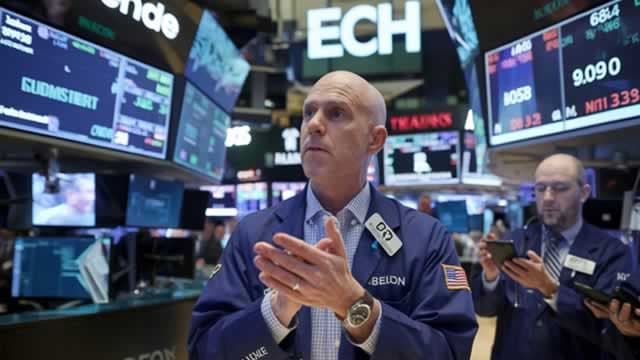
Markets are closed Friday, but we'll still get the March jobs report in the morning. Nicole Bachaud and John Blank both agree that "30,000 is the new zero" when it comes to job improvement, believing persistent inflation raises the bar for employment.
Operator: Welcome to the Precipio Q4 2025 and Year-End Shareholder Update Conference Call. [Operator Instructions]. Please note that the conference is being recorded. Statements made during this call contain forward-looking statements about our business. You should not place undue reliance on forward-looking statements as these statements are based upon our current expectations, forecasts and assumptions and are subject to significant risks and uncertainties. These statements may be identified by words such as may, will, should, could, expect, intend, plan, anticipate, believe, estimate, predict, potential, forecast, continue or the negative of these terms or other words or terms of similar meaning. Risks and uncertainties that could cause our actual results to differ materially from those set forth in any forward-looking statements include, but are not limited to, the matters listed under Risk Factors in our annual report on Form 10-K for the year ended December 31, 2025, which is on file with the Securities and Exchange Commission as well as other risks detailed in our subsequent filings with the Securities and Exchange Commission. These reports are available at www.sec.gov. Statements and information, including forward-looking statements, speak only to the date they are provided unless an earlier date is indicated, and we do not undertake any obligation to publicly update any statements or information, including forward-looking statements, whether as a result of new information, future events or otherwise, except as required by law. Now let me hand the call over to Ilan Danieli, Precipio's CEO. Please go ahead. Ilan Danieli: Good afternoon, and thank you for joining our 2025 fourth quarter and year-end shareholder call. I'd like to thank everyone who submitted questions ahead of time. We will do our best to address them during the call. But before we begin our financial review and for those of our shareholders that are relatively new to Precipio, I'd like to take a moment to reflect on the impact our work has on patients every day. Behind every diagnostic test we run is a patient waiting for answers often during one of the most difficult moments of their lives. Our test helps physicians determine the most appropriate treatment options for their patients battling cancer, and those answers must be provided quickly and accurately. While today's discussion will focus primarily on financial performance and operational progress, it's important to remember that these results ultimately represent something that is beyond dollars and cents. It represents our contribution to helping patients and their families navigate their battle against cancer. Now let's turn to a review of our performance in 2025. 2025 was a year of financial and strategic inflection. At the beginning of last year, we set out to achieve an important objective for Precipio, transition from a cash-using company to a self-sustaining business with positive cash flow. I'm pleased to report that in 2025, we achieved that inflection point. During the year, we also achieved several other important milestones, continued revenue growth, improved gross margin and operational leverage, the exercise of all remaining financial warrants, removing any related overhang and the completion of the repayment of Change Healthcare loan, allowing the company to move towards a clean balance sheet. For many years, like most emerging diagnostic companies, we had to manage the business with a constant constraint of conserving capital and extending our runway. That discipline shaped our company into the highly efficient organization that we are today, but it also meant that many decisions had to be made with shorter capital preservation in mind. Today, we enter a new phase of the company's development. The discipline remains, but we are now increasingly able to deploy resources towards growth initiatives and long-term value creation. The company is moving from focusing primarily on stabilization to one increasingly centered on growth and execution. And during the call, we'll highlight several examples of that shift. Now let me turn to our financial results for the year. For fiscal year 2025, Precipio delivered $24 million in revenue, representing a 30% increase year-over-year compared to 2024. This level of growth reflects the continued expansion primarily in our Pathology Services division as well as strengthening demand for our specialized cancer diagnostic services and molecular testing technologies. Equally important, this growth demonstrates the operational leverage embedded in our business model. A large portion of our cost structure, including laboratory infrastructure, scientific personnel and operational systems is already in place as a fixed cost. As a result, incremental revenue can be absorbed efficiently without requiring proportional increases in operation costs. Therefore, more dollars can go directly to the bottom line. In other words, revenue growth increasingly translates into improved margins and stronger cash flow. This operational leverage has been a key driver of the improvement in our financial performance throughout the year. While I'm pleased with the progress we made in 2025, I want to emphasize that we believe we are still in the early stages of realizing the full financial potential of this model. Let's begin with our Pathology Services division, which continues to serve as the operational and financial backbone of the company. Throughout the year, we experienced strong organic growth in this division, driven by both acquisition of new customers and increased testing volume from existing customers. One of the most encouraging aspects of this growth is that it has been achieved without requiring significant additional capital expenditures or laboratory staffing increases. Our laboratory infrastructure remains well below its maximum capacity, meaning the incremental case volume flows efficiently through the system and contributes directly to the improved margins and cash generation. Beyond revenue generation, the Pathology division also provides a unique strategic advantage for Precipio as it relates to our Products division. Because we operate a full clinical laboratory, we have direct access to incoming patient samples and a real-world testing environment. This allows us to develop, validate and refine diagnostic products rapidly and efficiently before we introduce them to the market. Few diagnostic companies possess this dual with the capability of operating both a clinical laboratory and the product development platform under the same roof. And we believe this integrated model provides Precipio with a meaningful competitive advantage. Looking ahead, our objective for the division remains straightforward, continue growing organically while allowing it to serve as a stable cash-generating foundation for the company. Now let's turn to the Products division, which we believe represents the company's greatest long-term opportunity. First of all, it's important to acknowledge that the Products division revenues did not grow as expected this year. There are a few reasons for this. And on this call, I'd like to talk about 2 main causes. First, we experienced several customer operational fluctuations. While we did add new customers during the year, we also had pauses from several other customers due to their internal factors ranging from machine downtime to lab tech maternity relief. This caused temporary loss of revenues and subsequent fluctuations, which essentially canceled out some of the growth from new customers. The good news is we learned from all these situations, and we implemented additional business continuity measures that are intended to reduce these fluctuations in the future. For example, as part of our process when we now onboard a new customer, we may establish at the customer selection, our lab as a backup testing facility to be used if the customer experiences a temporary operational interruption. If activated, our clinical laboratory is then used as the customer send-out lab. This means that if they are down for any reason, the samples get sent to our lab in accordance with the customers' instructions, which helps support continuity of patient testing during those service interruptions. This provides continuous, consistent service to their clinicians, something that's always important to any laboratory, and it provides continuity of revenues to us. The second reason for the lack of substantial growth was the limited commercial team we had in place. We had one senior executive spending part of their time on product sales plus another junior sales rep person. This team proved to be insufficient for the growth we were targeting. But at the start of 2024, that's all we could afford. That's an example of the company playing defense. But with the shift towards our cash position came a change in the form of now playing offense. Towards the end of 2025, as we saw our business swing to profitability, we focused on strengthening the project commercial team. In January 2026, we hired an industry veteran experienced Chief Commercial Officer, plus 2 seasoned experienced business development officer professionals full time. So we went from barely 1 person working on the commercial growth of the product division to 3 dedicated full-time and experienced team member. This team will focus on both direct sales as well as developing the relationships we need with our distributors to get into tougher to access customers. I'm confident that with this team, we will be making a lot of progress. Having said that, during 2025, we saw encouraging progress in this division. Product revenues were impacted by several factors, including the relapse and subsequent return of several customers to full operational volume, the acquisition of new customers and organic growth from existing customers expanding their test menu by adopting additional HemeScreen and Bloodhound panels. We expect to see the impact of all those factors during 2026. One important characteristic that our platform continues to demonstrate is the following: once laboratories adopt our technology, they tend not only to stay with it, but also expand their usage over time. We also continued strengthening our distributor partnerships, which represent an important pillar of our long-term growth strategy. Distribution relationships will eventually allow us to reach a significantly larger number of laboratories than we could through direct sales alone, providing more scalable pathway for expanding the adoption of our technology. As many of you know, onboarding a new customer -- new laboratory customer in the diagnostic industry involves several steps, including validation studies, workflow integration, IT and regulatory review. These processes can occasionally delay the start of revenue. However, we continue to see a growing pipeline of laboratories progressing through the onboarding process, each representing potentially substantial recurring revenue as they move into full clinical expansion. Now turning briefly to margins. Overall gross margin improved year-over-year from 41% in 2024 to 45% in 2025, primarily driven by higher case volumes in our Pathology Services division, a more favorable case mix towards higher-margin tests and continued improvement of operational efficiency. In the Products division, margins were temporarily impacted by strategic investments made during the year, including expansion into a larger facility and additional manufacturing in Q3 resulting in gross margins of 30%. However, in Q4, we saw a leap to 90% gross margin for our products. Now I know this is a surprising number, especially leaping from 30% in the previous quarter. Let me take a moment to explain this operationally. First of all, as a reminder, historically, we were consistently at around 40% to 50% gross margins. And in Q3, we dropped to 30% because of the additional expenses that were burdened into the manufacturing costs. So I'd like to treat the 50% margin number as our baseline given our covered production volume. Here's why Q4 margins dropped to 90%. As part of our production planning in Q4 2025 and looking to Q1 2026, we anticipated 2 disruptions to our production schedule. The first was downtime due to year-end holidays and staff taking time off. The second was equipment maintenance expected in Q1 of 2026, where our production machines would be down for approximately 2 to 4 weeks. Therefore, in order to ensure we had adequate inventory for our customers, in addition to the scheduled production runs to fulfill orders in Q4, we produced significantly more inventory to cover expected Q1 2026 demand. Keep in mind, when we produce these products, they are intended for sale to our product customers as well as consumed in our own clinical lab. As a result of this larger, more concentrated production run, we inadvertently achieved a much higher margin of 90%. While this was unusually high due to manufacturing circumstances, this is an illustration of the scalability of our products manufacturing capabilities and the impact to margin we can expect to achieve in the Products division as we scale up. As volumes grow, we expect division to demonstrate the strong margin profile typical of successful diagnostic product companies. Beyond financial performance, 2025 included several important operational and commercial achievements. I'd like to share a few of them with you. We continued the expansion of the HemeScreen and Bloodhound molecular platform. We published an exciting joint academic study with one of the leading cancer centers in the country, Memorial Sloan Kettering Cancer Center in New York, demonstrating the novel clinical value of our Bloodhound BCR-ABL product. We presented a poster at the AMP conference, the Association of Molecular Pathology in collaboration with Wayne State University, showcasing the clinical value of our HemeScreen cytopenia panel. We made improvements in customer onboarding processes. We expanded our manufacturing capacity, and we strengthened the company's financial position through debt repayment. We believe that each of these milestones contributes to building a more scalable and durable business. Moving now to market interaction. In 2025, we also began to interact more with the public markets. In 2024 and before, we remain relatively silent and didn't really engage with investors. And if an investor reached out to us requesting a call with management, we typically politely declined and responded that management is not currently speaking directly with investors. But as our story developed and our performance improved, in 2025, we began responding to those inquiries and engaging with investors, both in one-on-one meetings as well as in various public forums and conferences. During 2025, we had more than 50 unique interactions with investors, family offices, institutional funds and analysts. I believe that while the 300% share price appreciation we saw in 2025 was primarily due to the company's business and financial performance, it's also due to the increased engagement with investors. We plan to continue to engage with the market this year. Looking ahead to 2026, our focus is on growing the products business. With our new dedicated and experienced product sales team as well as process improvements we've implemented, we will focus on accelerating the adoption of our HemeScreen and Bloodhound products, converting our pipeline of laboratories into active revenue-generating customers and expanding the number of institutions utilizing our platform. We expect to see continued growth in the pathology service side of the business as well, further generating cash that will be reinvested primarily into the products business growth. One example of an opportunity for us is in AML or acute myeloid leukemia testing, particularly where most hospital laboratories currently rely on external reference testing and where turnaround time of testing results can have a direct critical impact on patient lives. Today, most hospital laboratories across the country do not perform AML testing internally and instead send the patient samples to external reference laboratories. For AML testing, these reference labs typically deliver results to the clinician in 7 to 10 days. And this is despite the AML guidelines requiring results delivered within 5 days. With several targeted therapies tied to specific mutations tested, receiving immediate results is a critical life and death decision. The problem is there is a severe mismatch between the clinical situation facing the doctors and their patients and the diagnostic options available to meet most of these situations. Therefore, we see an unmet need for testing workflows that can better support timely clinician decision-making. By using the combined strength of our pathology services division and our blood AML assay, we will be launching a service that combines rapid molecular testing. And when I say rapid, I mean next-day results, followed up by a comprehensive analysis 5 days later. We believe this further -- this service could further differentiate our platform and expand both our services opportunity as well as introduce laboratories to the products we offer. This is just one example of the superior service our technology enables us to provide. Further details will be announced as we launch this offering. We see significant opportunities to expand the share of our Products division within an estimated $500 million addressable market annually in the U.S. As we execute on that strategy over the next 3 to 5 years, we expect the company's revenue mix to move from its current approximate 90-10 weighting towards pathology service to a more balanced revenue mix between pathology services and products. In summary, while there is still work ahead, we believe the foundation we have built is strong and the opportunities ahead of us significant. In 2026, our focus will be on growth execution, commercial momentum, increased market share and ensuring that our progress is communicated clearly to the market. I'd like to thank our employees, customers, partners and shareholders for their continued support and trust. We look forward to updating you again next quarter as we continue executing on our strategy and building long-term value for our shareholders. Thank you, and have a great evening. Operator: The conference has now concluded. Thank you for attending today's presentation. You may now disconnect.

Zhiyong Liu: Ladies and gentlemen, good afternoon. NCI 2025 Annual Results announcement will officially start. Thank you for the investors, analysts and friends from the media for your participation from online and offline platform. I'm the host of the meeting. First, let me introduce the senior management participating in today's meeting. They are Chairman, Mr. Yang Yucheng; President, Financial Principal, Mr. Gong Xingfeng; Vice President, Mr. Qin Hongbo; Vice President, Mr. Wang Lianwen. We also invited Mr. [indiscernible], NCI AM President and NCI AM Hong Kong Chairman to participate in the meeting. We also have the honor to invite the independent directors of the company to participate online. This meeting is divided into 2 parts. The presentation and Q&A session. We will provide simultaneous interpretation. Let's move to the presentation part. Please welcome Mr. Yang Yucheng to introduce 2025 business performance of the company. Yucheng Yang: Dear investors, analysts and media friends, welcome to 2025 annual results announcement of NCI. We thank you for your long-term support to our company. The year 2025 marks the final year of 14th Five-Year Plan and it is also an extraordinary year for NCI. Facing a highly stressful and complex internal and external environment, our employees have worked hard throughout the year. Our business performance has reached new heights, building on a high base. Multiple key indicators such as total assets, gross written premium, EV net profit, share values and total market value have all reached record highs, presenting the most outstanding performance since the company's establishment. The company's operation is characterized by excellent performance, optimal structure, rising value, stable returns, abundant vitality and strong resilience. In 2025, the company's total assets was close to RMB 1.9 trillion, up by 12.2%. Gross written premium was RMB 195.9 billion, up by 14.9%. EV was RMB 287.8 billion, up by 11.4%. Net profit was RMB 36.3 billion, up by 38.3%. The company [indiscernible] promise to shareholder returns and share the fruits of its business development with investors. In 2025, the combined cash dividends of the company reached RMB 2.73 per share, totaling RMB 8.5 billion, up by RMB 600 million compared with last year, up by 7.9%. Since its listing 15 years ago, the company has distributed dividends to shareholders totaling RMB 44.5 billion. Relying on excellent performance, our stock price has continued to strengthen through the year with the increase leading the sector in both markets. The total market value surpassed RMB 200 billion. In 2025, the company's comprehensive strength reached to a new level and achieved fruitful results. The operating revenue reached RMB 157.8 billion, up by 19% year-on-year. Net assets reached RMB 111.5 billion, up by 16%. ROE reached 34.7%, up by 8.8 percentage points. New business value reached RMB 9.8 billion, up by 57.4%. NBV margin was 16.2%, up by 1.5 percentage points. The total investment (sic) [ total investment income ] was RMB 104.3 billion, up by 31%. Total investment yield was 6.6%, up by 0.8 percentage points. Core solvency has remained adequate. We have embarked on a high-quality development path of growth in premium and value and optimization of structure and quality. Both premiums and business value have seen comprehensive strength. FYP from long-term business increased by 48.9%, FYRP rose by 36.7%, and NBV margin and EV have all achieved significant improvements. From structure perspective, FYRP in FYP exceeded 60%. Renewal premiums continued to play stable, rising low. We have won the battle of transformation to par insurance. Par insurance proportion over our regular payment business increased quarter-by-quarter. In the fourth quarter, it reached 77%. 13-month persistency ratio was 97.1%, up by 1.4 percentage points. 24-month (sic) [ 25-month ] persistency ratio was 93.3%, increased by 7.1 percentage points. Surrender rate was 1.5%, decreased by 0.4 percentage points. The company's service to national strategies reached new highs. We improved our management system for serving national strategies, established special groups and formulated implementation plan. The investment in serving the 5 major areas in finance exceeded RMB 360 billion. For inclusive finance, we improved inclusive finance products, underwritten 46 people's welfare projects. Investment in the inclusive field has reached RMB 55.6 billion, while pension finance, the second and third pillars of pension have been vigorously developed. The total premium on the third pillar commercial insurance annuity exceeded RMB 60 billion. For technology finance, we provided over RMB 1.2 trillion in risk protection for 14,000 technology enterprises with investments reaching RMB 140 billion. The company has leveraged its patient capital advantage to support technological innovation. Our medium- and long-term fund entering market project was selected as an outstanding case in the 2025 CCTV Finance. For green Finance, the focus was on investing in areas such as green bonds and public REITs for clean energy with investment reaching RMB 75.1 billion. we have been awarded as outstanding ESG case by the Publicity of Education Center of the Ministry of Ecology and Environment. For digital finance, we supported for the development of digital industry enterprises with investment balance exceeding RMB 68 billion. By 2025, we have fulfilled social responsibilities and demonstrated the commitment of state-owned enterprise. New achievements were made in rural revitalization with a total investment over RMB 70 million. For 9 consecutive years, a public welfare project to care for sanitation workers have been carried out, benefiting 6.7 million people. Resources will eventually be exhausted, but the culture endures and thrives. The 2025 was designed as the year for promoting the company's corporate structure. The company practiced a new era of corporate structure. Our corporate value is company first (sic) [ customer first ], hard work as foundation, openness and inclusiveness and success in action. Our NCI professional iron army spirit was professional iron army, pursuit of excellence, benevolence and virtue, inheritance and innovation through organizing honor evaluation, speech contests, special lectures by renowned teachers. We have widely carried out 150 cultural promotion activities among employees. And agents held the 2026 Agent Summit and rewarded outstanding teams and individuals and the inspiration of the corporate culture. Enthusiasm of high morale sales team is high and coherent of the company has reached a new high. Our brand awareness and reputation has been improved. Sponsored high-speed rail over 20 marathon events provided full support for Suzhou Super League and WTT Chinese tournament, launched the brand IP, Xinli Bao, demonstrating a brand image that substantial brand vitality and strength with stable operation and outstanding service. The cohere and influence of the company culture has been enhanced, ranking among the Fortune Global 500 and top 50 global life insurance company. After more than 2 years of hard work, the company has made a considerable and gradual progress in all aspects. The dividend reform have been released. The momentum of value growth has been strong. Business structure has been optimized. Quality of development has been enhanced. Looking back to development in the past year, we have carried out the following key tasks. We strengthened strategic planning and made systematic in-depth arrangements, attached importance to top level design. In the beginning of last year, we initiated the formulation of the 15th Five-Year Plan on the basis of thoroughly analyzing market changes and industry transformation trends. After extensive research and 3 rounds of seminars, we proposed the development vision of building a first-class financial service group in China with insurance business at its core. We formed 3 strategic lines, customer-centered, team-based, and employee partner-oriented. We aim to provide enduring protection, better life and greater health customers, create a culture of love and fulfill the dreams of entrepreneurs for our team, strive for growth, consistently innovate and support and realize the idea of serving the country and people of our employees, like better products, better services and better life with NCI. We clearly focus on the coordination of fronts, promote reform and innovation, moving towards the direction set by our strategy centering on strategic main lines, deepening and solidifying the coordinated development of insurance plus service plus investment and further promoting professional market-oriented systematic reform, launched a series of combined measures for reform and development one initiative in market competition. From a grasp of flagship products, promoted transportation (sic) [ transformation ] to par products, we made efforts to optimize our business structure. We have established a dedicated team with highly competitive products as the driving force. We provided this systematic support for the transformation in terms of team training, ecological collaboration and assessment guidance. Over the past year, the company's par insurance has been gradually made breakthrough and reached a favorable state, achieving FYP of RMB 11.9 billion, an increase of nearly 12x year-on-year. Substantial and significant progress has been made in product transformation. We'll be making efforts to enhance the competitiveness of our products, establish diversified product matrix centered on customers, and covering the entire life cycle in which a variety of wealth management products and pension products. Launch innovative products such as [indiscernible], deeply integrate insurance claim settlement with medical service and nursing services, achieve a transformation from traditional claim settlement to product service ecosystem. Adhering to the concept of finance for people, we improved the inclusive product system, launched over 20 inclusive products and rural revitalization products covering multiple groups, built a comprehensive high-quality and refined diversified product system. We deepened our efforts in China and team building accelerating breakthrough in business transformation. In individual training, we have strengthened the system base management by self-dependent operation. We advanced build a high-performing team with strong units, Longteng Fengwu and WLP Entrepreneurship Support Team. These efforts have solidified the foundation for our team. We have built an ecosystem scenario and benefit system, established one-stop digital marketing platform, development of the new modern marketing concept of product plus service plus scenario plus technology. The company's FYP from long-term insurance in the individual channel grew by 43.8%. NBV grew by 19.4%. The workforce size stabilized. Average monthly comprehensive productivity per capita rose by 43%. We have elevated the bancassurance channel to a strategic level seizing the opportunity. We continue to deepen product transformation and team building based on significant optimization of cost structure. Total bank premium reached RMB 72.1 billion, growing by 40%. FYP from long-term business reached RMB 37.9 billion, up by 52%. NBV reached RMB 5.27 billion, a substantial increase of 111%. The bank channel contribution to new business value has surpassed that of the individual channel, accounting for a significant share. We improved our service ecosystem and advanced service empowerment system from scratch from basic to excellent, upgraded our major service brands that cover the areas. This ecosystem is designed to deliver excellence in medical care, health management, senior living and cultural tourism, providing diversified personalized service to clients and families, enhance service capabilities and improving client engagement service. It covered over 4 million individuals with increasing awareness and usage. Through the development of this service ecosystem, we aim to upgrade the empowerment experience, guiding the team to transition from traditional marketing to the modern marketing concept of products plus service plus scenario plus technology, help agents enhance their self-dependent operational capability and realize their entrepreneurial dreams, increase our investment in AI and technology to enhance customer service capabilities, levering technology to empower operation, providing ultrafast service to agents and clients. The company's one-minute completion rate for policy service stands at 96%. We paid out more than RMB 42 billion in maturities and annuities over the year and RMB 14.7 billion in claims. We launched 11 large model intelligent agents and NCI Digital Human Ambassadors. All have empowered service and improved business growth. We have enhanced our investment research capabilities, built a comprehensive edge on the investment side, strengthening our ability to deliver enduring protection. In 2025, our total investment income reached RMB 104.3 billion, up by 30.9%. Total investment yield was 6.6%, up by 0.8 percentage points, ranking among the industry leaders. The company improved investment management and asset liability correlation. We continue to improve investment attitude. We expanded our team of investment professionals cultivated and recruited outstanding talent, established investment research and asset allocation system capable of capturing policy market and industry opportunities. We increased allocation to OCI, long-term equity investment and PE, addressing the past shortcoming of having a base by lacking an active base on the fixed income asset income. We invested in convertible bonds, bond funds and other diversified assets, reducing negative interest spread and reinvestment risks. In response to the requirement for long-term capital to the market, we established 3 pilot funds with China Life for a total contribution of RMB 46.25 billion. We strengthened the development of our investment ecosystem, enhanced coordination with various institutions, good use of financial resources, reinforced investment risk management, controlled credit risk, managed market risk, optimized multilayer risk buffer system, built robust investment management capabilities, striving to achieve excess returns on the basis of long-term stability, focused on strengthening foundational management to solidify the company's high-quality development, build powerful quarters, clearing the role of head of office for design institution for execution. Took the lead in strengthening strategic guidance, resource allocation, upgraded strong foundation project committed to lay a solid foundation for long-term benefit. Empowered branches across 6 dimensions, helped them upgrade and elevated their overall competitiveness. Optimized resource allocation, launched reenergizing talent initiative, improved talent allocation with a focus on efficiency. Established a profit assessment evaluation system for branches and worked diligently to enhance return on investment, improved risk control system, established penetrating full coverage and integrated risk control framework, refined authorization system, achieved group level management goal of clear authority and responsibility. The year 2026 marks the beginning of the 15th Five-Year Plan and the company's 30th anniversary. Demographic shift, technological innovation, industrial upgrading and transfer of household wealth allocation will accelerate transformation, imposing higher demand for the company's operations. At this starting point, we will keep in mind our original aspiration and mission of finance for the people and for the country, take corporate culture at the soul, take strategic planning as the directional guide, seize market opportunities, improve the synergy across the 3 fronts, focus on core business, continue to deepen reforms, enhance our development capacity and persistently build a powerful New China Life. First, integrate and serve the broader national agenda. We will practice the big insurance philosophy committed to the vision of becoming a first-class financial service group in China with insurance at its core, fulfill our social functions, inject more patient capital into the strategy of achieving technological self-reliance and self-strengthening, expand the supply of pension finance, inclusive finance, accelerate digital transformation, focus on core business and strengthen our life insurance business, adhere to a value and profit centered approach, optimize business mix and revenue structure, drive optimization of business profit sources, develop par insurance and other floating return products, enrich the supply of long-term and health products, create a closed loop of health insurance and health management, accelerate channel transformation and team development, enhance the core competitiveness of life insurance business, elevate organizational development to a strategic level, enhance the value of bancassurance channel, build an integrated online/offline Internet ecosystem, upgrade the profit model of group insurance business, leveraging the powerful synergy of One NCI. We will transform the company's strength into market competitiveness, establish a new model marketing concept and practice new marketing model, enhance capabilities and standards in serving customers, build a service ecosystem that's more quality-driven and more closely aligned with customer needs, become a comprehensive financial service provider for customers. We will use our concrete action, put in practice the value proposition of finance for the people, delivering enduring protection, better life and great health. We will be a modern insurance company that's professional, warm, mission-driven and worthy of long-term trust. Fifth, leverage the advantages of patient capital and long-term capital. We will optimize the asset allocation structure, improve the investment research system, build a multilateral investment portfolio, high-value asset allocation, enhance investment management, asset liability coordination, with long-term value creation, become true patient capital and capital. Sixth, we remain committed to laying a solid foundation for long-term benefit. We will build a stronger culture, which will lead the branch office to become stronger. We will balance development and security, strengthen implementation and improvement of risk control system. We will increase technology investment and reinforce product scenario AI empowerment. Going forward, we will adopt operators' competitive stance and a spirit of striving for excellence, pursue through innovation, enhance long-term competitiveness, achieve a solid start to the 15th Five-Year Plan. The above is my presentation about the company's business performance. Zhiyong Liu: Thank you, Mr. Yang. Next, we move to the Q&A session. [Operator Instructions] Zhong Xin Sun: I'm [indiscernible] from Soochow Securities. First, I'd like to congratulate on your star performance in last year. I have 2 questions. First is about liabilities. We can see you have reached a record high last year. And I want to ask on a high base last year, how do you comment on the growth expectation in 2026? And what is your product strategy? And also, I want to ask about the participating insurance. What is your goal and plan for the transition to participating business? And the second question I want to ask about the asset. In the past 3 years, we are in a low rate environment and the net investment yield of the peer company is going down. And I want to -- and we can see the total and comprehensive investment yield lead industry in 2025. And I want to ask the management team, how do you view the interest rate and equity market? And what is your strategy in your asset allocation? Zhiyong Liu: Thank you for your question. First, let's invite Mr. Gong to answer your first question. Xingfeng Gong: For 2025, we have yielded remarkable results. The GWP increased by 15%, FYRP grew by 15%. And 2024 and 2025 has realized a very fast growth and laid a high base for our future growth, but we are confident on a high base, we can maintain a steady growth. In 2026, we will further serve the national strategy and to embark on the road of high-quality growth road featured both value and volume growth and structure and quality improved, and we will focus on the key areas that drive the value growth, speed up the channel development transition and to consolidate our business capabilities. And in 2026, we will provide the best business performance to celebrate our 30-year anniversary and reward the trust of our customers and the support of the investors and all walks of the society. In 2026, we will stick to the customer-centered development strategy. For the individual insurance channel and the Bancassurance channel group channel as well as the Internet channel, we will make full efforts to strengthen the combo sales of products to meet the diversified demand of the customers. In the past, we have done a good job in the sales of whole life insurance, and we are confident to make efforts on the sales of the participating and health insurance, and we will return to the assets of insurance to consolidate our business quality and to realize sound growth of both NBV and premium income. And more specifically about the product definition as well as the competition strategy, I want to emphasize the following. First, we will implement the new marketing concept of integrating the scenario product service and technology by virtue of the high-quality medical resources, we will focus on the treatment, medical care and nursing at the center and provide multi tiered and diversified products, combining the insurance products and health service, and we will combine the wealth management products with the aged care community and the tourism resources to build our insurance plus aged care community and also strengthen asset management, strengthen the coordination to empower the floating benefit products. And in 2026, we will emphasize the sales of participating whole life insurance, but this is not the sole product we will provide. We will also introduce measures to promote the other wealth management products, including the annuity insurance and health insurance. And also, we will fully leverage on the tax benefit policies and pension policies of the country and to introduce products, and we will include the important products, including the whole life annuity and aged care pension products to include in the individual pension products. And we will provide whole life cycle health solutions to customers, including the prevention beforehand in process control and rehabilitation afterwards, and we will provide diversified product pipeline, and we will seek the policy opportunities and sales and provide and explore the products, including the participating health insurance, the consumption and medical care insurance, the specific medicines, the disability and unit-linked products, et cetera. And about the transition to participating business, I want to emphasize in 2025, we are determined in this transition and have a good start. For example, in the sales, we have made breakthroughs. And last year, the sales of participating business is RMB 12 billion. And given that we haven't sold the participating business for many years, and this is a hard result and especially in the third and fourth quarter last year, we have strengthened our efforts and yield expected results. And on the other hand, in terms of our management system, we have effectively coordinated resources of the front and the back office and introduced incentive policies, trainings, products, publicity, compliance support and asset liability matching measures to establish a sound management portfolio and system for the future participating business. But in 2025, it's just beginning. 2026, we will continue our participating business transition, focusing on the product portfolio expansion. For example, we will strengthen sales of annuity insurance products, strengthen the product innovation and seek the policy opportunities as participating health insurance. And we will try to sell the right products to the right customers, avoid the misleading sales. And also, we will try to coordinate the asset liability management, and we will try to reward the customers with sound business performance and let the customers have a higher sense of gain and satisfaction. Thank you. This is my answer. Hongbo Qin: Recognition for our business performance in 2025. Our total investment yield reached 6.6%. After considering some other indicators, we could make it to 6.9%. This is due to the fact that we have continued to uphold the long-term value investment. Your question regarding 2 areas. First, on the interest rate trend and second on the equity market. First, about the trend in interest rate, we believe in short term, it will experience fluctuations. The credit spread will tighten -- term spread will widen. Short-term funding condition will be loose and have more certainties, but actual long-term bonds will more fluctuate. Long-term and short-term interest rates will diverge in low interest rate environment. How to get favorable returns? We need to consider the interest rate trend rightly. About equity market, we are confident for the medium and long-term development of China's capital market. We pay attention to 3 themes. First, outperforming sectors in up cycle. Second, those to the national strategies, especially new productive forces. Third, high dividend strategy in low interest rate environment. Based on our judgment about the capital market. For the [ SAA, ] we will carry out the following principles. First, asset liability matching principle. We will think about the future of liabilities, make sure the investment return can cover the liability cost. Second, we will continue to uphold diversified allocation philosophy. In fixed income equity and alternative assets, we will make a rationale structure, enhance the profitability elasticity. Second, return orientation. In the market fluctuations, we will pay attention to margin safety, grasp seize opportunities and bring sound investment returns to customers and customers. The uncertain macro environment and financial market will pose both challenges and opportunities to the company. We will follow the macroeconomic changes and policy changes. We will be keen to bring stable return to the market. Unknown Analyst: I'm from Shanghai Securities. I have 2 questions. NCI has established 3 pilot funds with peers. What's the actual result? Will you further increase your diversification asset allocation? How -- second question is how do you view AI's impact on the company? What's your future plan for AI empowerment? Unknown Executive: Thank you for your question. Regarding 3 pilot funds, we started from March 2024, to now, in the past 2 years, we have achieved both social result and economic results. We have been fully carried out the central government decision under guidance of [ IRA, ] we responded to the requirement to enter the market. With peers, we established 3 pilot funds. Our total investment reached RMB [ 46.25 ] billion. The pilot fund is conductive to the asset liability management. About your second question about diversification of investment. This is our key strategy. We will based on the following 3 considerations. First, in the low interest rate environment, we must make diversified investments to increase our long-term returns. Second, in the 15th Five-Year Plan, our company is undergoing a transformation with the improvement of capital market. We have been presented with opportunities to participate in the capital market. We have improved our professionalism, including our improvement in the front office and back office, which all lay good foundation for us to engage in diversified investment. We are confident we can provide sustainable returns to shareholders and customers. Xingfeng Gong: Thank you for your question. This is a very fancy question about AI. I'd love to share with you our view about our thinking about AI. For 2025, from the top level to the grassroot operations, we are confident, we all embrace AI. AI is not a vision of the future, but fundamentally reshaping the industry. The key in the transformation does not only make can -- make tailor-made pricing but also enable us to provide customized service and real-time responding, also enable the real-time warning and monitoring. In the past year, we have been impacted fundamentally by AI. In customers, AI make us know customers really. Second, in operation, AI makes us reshape the service process. Third, for risk management, AI let us grow our risk bottom lines. We have awarded 12 authoritative roles from authorities about such as [ PBOC, ] China Academy of Information and Communication Technology. We have got business continuity management system certification and passed the DCMM [indiscernible] recognition. AI makes our service better, better the illustration system. AI proposed 258,000 proposals for improvement in qualification inspection. We put on [ 111 ] AI agents with 97% solvency ratio. Accuracy ratio hit 100%, covering 3,500 counter staff and over 100,000 agents. Those measures improved our digital customer engagement capabilities. For 2026, we will make measures in 4 areas. First, we will implement the 15th Five-Year Plan in technology. Second, in expansion of AI applications, we will build 7 virtual employees covering 7 areas through the large small model synergy, we would like to have digital productivity equivalent to 3,000 people, make machines do their own stuff and make people do more valuable stuff, data value deeper. We would empower data from visibility to true value, make data core assets to drive business performance. This year, our focus is on the development of corporate cloud. We aim to establish a cloud multi-chip infrastructure resource framework. Technology empowerment has been through every corner of corporate operation. We will maintain our strategic results aim to make AI more productive for the 15th Five-Year Plan. Unknown Analyst: I'm analyst from [indiscernible] Securities. Congratulations on your remarkable results in the asset and liability side. And for the asset, you have evident mark of sound performance. And I have 2 questions about liability in the past 2 years. Just now Mr. Chairman Yang and Mr. Gong have mentioned you have realized fast growth and high-quality growth of NBV. And I want to know what are the main drivers behind this. And in 2026, you have speed up your transition to participating business. And in this process, how can you strike realized growth of both NBV and NBV margin? And the second question about Bancassurance channel, which has been a hot topic since last year, and I want to know your distinguished competitiveness and advantages, and I want to know your strategy in 2026 to realize further high-quality growth of the Bancassurance channel. Zhiyong Liu: First, let's welcome Mr. Gong to answer the first question. Xingfeng Gong: You've asked about the NBV growth and the drivers behind this. The main driver is to implement the high-quality growth philosophy in 2023 to 2025, we have realized 3 consecutive years faster growth. And for numbers, we can see 2026 is RMB 3 billion; 2024, over RMB 6 billion. This year is over RMB 9 billion. The growth rate is 25%, 107% and 57%. Those growth rates is hard one. And we can see in this process, we have constantly implemented the internal driven high-quality growth philosophy and introduced a series of reform measures that can lay a solid foundation for long-term growth. And the growth of NBV is a result of those reform measures. And the second is we improved the product competitiveness, which is a top priority for us. We believe and we also want better product stay with NCI. And we want to introduce comprehensive and acquisitive product portfolio for customers and to truly help the customers and the agents be more confident about NCI and our products. Third is we improve the sales capabilities of our agent force. And from the recruitment, we emphasized the targeted recruitment, especially recruiting those high-performing agents and to increase the quality and quantity of the team. Since the team nurture, we can see we have more efforts to improve the productivity of our agents and improve the retention rate of the agents and help the agents to grow with our company. And the third is we introduced combo measures. And in the past 2 years focusing on the mass customers, the high video customer, we have introduced a series of service ecosystem and services. And we introduced 5 service brands to serving different kinds of customers. And those combined and the combo service and products can make our customers gain more sense of gain and to make the sales easier. And lastly, as we emphasized the management of the business quality, and we focus on the management of persistent ratio. 13 months persist ratio rose to 97% and 25 persist ratio passed 93%, the highest level in the past 5 years, which has enabled the long-term and sustainability of our business and bring higher margin and NBV value to us. And for the influence of transition to participating business and its impact on the NBV, I want to say that we will continue to put forward the transition to participating business, and we are determined to promote the transition. And this is also in line with the regulations adequacy of promoting the floating benefit products. And also, we hope that the customers can share the development results and performance of our company. For the NBV margin, it will have certain impact on the NBV margin. The NBV margin [indiscernible] is lower than the traditional product and pose certain challenges to the growth of NBV and NBV margin. And we are fully aware of that and are prepared of that. We have introduced a series of measures to improve the NBV and realize steady growth. First is we will further grow our business based on high business income last year, we will further stimulate the enthusiasm and morale of our team and the staff to increase their capabilities and the confidence to sell and hope that we can have a higher growth of the volume. Second is we will further optimize the business structure, grow the assets business of insurance. We will further diversify our product mix and to diversify the profitability drivers, and we will make up for the weaknesses in terms of the health insurance and long-term annuity insurance, et cetera. For those efforts, hopefully, we can have a higher leverage effect to promote the NBV growth. Through this, we want to reshape the channel competition. And now we are facing a fast-changing environment. There's a higher requirement from the regulators as well, and the company will strengthen the growth of the team quality and quantity and improve the core competitiveness of the Bancassurance channel in their channel distribution and productivity and to contribute higher to the NBV growth. And also, we will grow the Internet channel and establish a new driving force for NBV growth. And last is to reduce the cost and to optimize the cost efficiency and the efficiency of the resources. And we believe with all those efforts, we can further promote the growth of NBV in 2026. Unknown Executive: Thank you for your attention to the Bancassurance channel in NCI. In recent years, our bank insurance business has posted strong growth. It has become an important engine to drive the company's growth in size and value, especially for 2025. We elevated the Bancassurance to a strategic level and live up to expectations. It made good achievement in 2025. FYP reached RMB 37.93 billion, up by 52.3%. FYRP almost RMB 18 billion, up by almost 30%. NBV up by 110%. Compared with our peers, our premium and regular premium moved up in the rankings and improved our market share. Take a look at the internal structure, Bancassurance channel FYP and NBV contribution has already made half contribution, enhanced its important role. Our bank insurance channel is rich in heritage and constantly revolving. We pay attention to both premium and value. We have accumulated advantages and move stable in market competition in 2025. Our differentiated competitiveness relies on stable progress. First, we made stable progress in customer management. We know for life insurers, our key competitiveness lies in customer management. We built a comprehensive refined diversified product system, meeting customers' diverse needs for service and based on the whole life cycle ecosystem. We collaborate with banks upgrade experience for customers. For investment, we do play to professionalism, which laid a solid foundation for the transformation of the Bancassurance channel. For customers engagement, our insurance plus service plus investment model has built a foundation for long-term development. Second, we made progress for channel cooperation. We have 56 bank partners include SOE local commercial banks. On the basis of broad coverage, we pay more attention to deep cultivation. We join hands with banks to make better user advantages and synergy, make 1 plus 1 more than 2. I was glad to see our ranking with large banks have been improved, active uplets up by 40%. We have seen the good result between asset and liability synergy. Third, we have made stable progress in team development. Based on strong foundation initiative 2.0 initiative reform of building high-performing agent team with strong units third principle, workforce growth rate exceeded 20%. On the basis of that, our average per capita productivity rose by 17%. Our professional arm for the channel with the bank partners and toward winning results, which all win recognition from our bank partners. Looking to 2026, the bank market will have new features. We have reached consensus on the following 3 areas. First, premium will continue to grow. Customer needs will become more diversified. Bank demand for fee income become increasingly rigid. Life insurer pay more attention to Bancassurance channel and all those indicators for next year, FYP is expected to grow. We have already seen it in the first quarter of this year. Second, market requirements will significantly improve for the consistency policy. Last week, [ IRA ] made further requirements and detailed requirements for the consistency policy, improved consumer protection mechanism, customers' expectation for product and service will be stronger. I believe bank will impose more higher requirements for the life insurance. All those new requirements will pose challenges and opportunities for the company's comprehensive strength. Third, market landscape is accelerating divergence. The market will rapidly evolve to market concentration, massive effect will become significant. For those with more professionalism and higher capability manage asset liability management, we will grasp market opportunities and move towards high-quality development. We believe 2026, China's Bancassurance market will mark on stable growth. For next year, we will grab opportunities in the market, give full play to the synergy of NCI, promote the insurance plus service plus investment model. We hope to promote stability through progress by the 2026 market. We aim to promote stability through progress. We need to do more in the following 3 areas. First, further deepen cooperation with banks. Together with banks, we will together carry out fair articles in finance and for winning results. Second, strengthen technology empowerment, enhance team professionalism and comprehensive service; third, expand ecosystem, customer diversified whole life cycle protection needs. 2026 marks the 30th anniversary of NCI. We will keep up with the time and make our bank brand more brilliant, pay attention to the premium growth and value, contribute more to the high-quality development of our company. Thank you. Zhiyong Liu: Let's welcome the questions from Xinhua News Agents. Unknown Attendee: First, congratulations on your sound performance in 2025. First is now we can see the macro economy and environment as well as life insurance experience profound changes and what are the opportunities and challenges facing NCI. And this year is the beginning of 15th Five-Year Plan as well as your 30th anniversary and what are your key strategic measures? Zhiyong Liu: Thank you for your question. Next, let's welcome Mr. Yang to answer this question. Yucheng Yang: Thank you for your question. This year marks the beginning of the 15th Five-Year Plan as well as the 30th anniversary of the NCI. This is a meaningful question. Just now in the presentation, I've mentioned 2025 is remarkable year for NCI. In this year, we have fully our strategy improved the coordinated development model of insurance plus service investment and introduced the strategic main lines of customer center team as the foundation and the employee as the partner. We have emphasized the reform and focus on the top-level design mechanism, business transformation, product service, investment management, talent, resources allocation, the operation technology and branding culture, et cetera, and to promote the systematic market-oriented and professional reform to release the constant dividend for us. And just now you mentioned, we've seen that in 2025, the total assets, premium income, EV, the net profit, shareholder reward has reached record high since we established in the past 30 years, we can see now NCI is a country with rich heritage, strong strength and sense of responsibility and mission. And also, we have vibrant and full of cohesion and execution. And first, I'd like to answer the question about opportunity and challenges in the [5 ]-year period. There's a huge change of domestic and international macro economy, and there's huge changes for the life insurance sector for its position and business model. We believe there are both exists, but the opportunities is greater for the first opportunities that we are embarked on a new journey for the Chinese modernization. The [ 5-year ] plan has put forward a great point for the high-quality growth and the plan for the modern industrial system and the independent technology growth and greater protection and better livelihood, those major tasks, which is in line with the function of insurance sectors and explore great potential for the value growth of the sector, which is the biggest opportunity for the insurance industry. The second is we will see the opportunity from the greater targeted areas of finance. Now the aging population has posted systematic changes of the risk protection demand, especially together with the transmission of the economy and the structure, we can see there's a greater potential and importance for life insurance to serve the economy and serve the targeted area of finance. We will provide the coordinated service from the risk protection, wealth management, medical care, the tourism and commercial insurance, et cetera. And also this provides great growth potential who grasp the opportunity in the pension finance will seek the next 10 golden years. And the third opportunity is from the wealth management. The new guidelines of the insurance sector was included has set forth that the wealth management will be included into the main business of insurance, which is extended the meaning of insurance and there is a diversity demand for the wealth preservation and preservation and -- which was regarded as the deposit migration, and we are experiencing the golden opportunities and the period which will show greater advantage of life insurance, which can provide stable yield the reservation and succession. And for the challenges, first is how can we respond to the low rate environment and the risk spread losses. And now the rate yield is in a low level and the financial exposure to the NSA real estate is decreased and a lot of premiums come to insurance company. How can we transform those premium into the long-term return to customers that can rise through the cycles and fluctuations is a challenge and post higher requirement for the operation and investment of insurers. And instead of company, I've always emphasized that we should have the responsibility of respect every premium and deliver sound service and secure every investment to deliver our commitment to customers of bringing the enduring protection. The second challenge is that how can we serve the customer with our professional meticulous and efficient service and to bring the long-term value to our company. And this means we need to promote the virtuous circle between the insurance plus service plus investment and provide the whole life cycle service covering the product, medical care, health care, et cetera. And we should also apply the technology and operation to improve their customer experience to further grow the development energy and EV embedded value of our company. And this is my answer to your first question. And about -- the question about the opportunities and challenges facing NCI. And next, I would like to answer your question about our strategic priorities in the 15th Five-Year Plan. The Board and management team of NCI emphasized the strategic planning. Since March last year, we started the formulation of the 15th Five-Year Plan, established a leading group and working group. And we have hold 3 large-scale seminars to discuss the strategy and conduct a series of research and seek opinions and suggestions from our whole system and introduced the coordinate development model of insurance plus service plus investment practice of -- practice large insurance philosophy and build a strong and we will strive to build the leading insurance sector with life -- with insurance as the core. And we have formulated our general master plan and over 10 key sub plans, including the marketing, training product, service investment, operating and technology as well as several plans for the subordinate entities as well as the subsidiaries. And through the thorough and extensive research and discussion, we have established our development model and focusing on our vision of building the leading financial service sector with life insurance at its core. And our general master plan has formulated and the sub plan has also covering a lot of areas of our business as well as the plans for the branches and subsidiaries. And in the next 5 years, the blueprint is clear and specific. And as a company who has a rich heritage and are aspirational about our future, we have accumulated many development foundations and premises. For example, we have a strong asset and adequate solvency. And also, we have a nationwide distribution channel and institutions. We have a strong investment capability and asset matching liability management. We have the talent and excellent brand and culture. And next, we will fully give full play our advantage and to bring the blueprint into a reality. And in the next -- and realize a blended development in the next several years, and we will focus on the 4 areas. First is to practice the strategy of customer-centered to improve the competitiveness of life insurance business. And this is also important direction of experience in the past 3 years. And in the future, we will integrate those philosophy into all areas of our product. And in terms of product team service, operation and technology, we will take efforts and increase our capabilities to create competitive products to enrich our scenario-based ecosystem-driven and high retention services, and we'll stick to high-quality and cost-efficient service and bring more friendly scenario-based operation experience to customers. And also, we will based on our strong investment capability and performance to build our brand credit and to lead the market and improve their sense of game. We will try to lead the market and improve their sense of game. We will be committed to the main business of insurance and grow the business. And this is an important criteria in a low rate environment to test the capability of the operation for insurance and also important assets for the company to serve the national strategy, and we will improve the proportion of health and long-term traditional insurance and to optimize the product structure, business structure and income structure and to shift from the interest lines to value-driven and to return the policy to the assets of business to return the service to customer, return the team to professional development, and we will strive to improve the core competitiveness of our life business. Secondly, we'll focus on the strategic priorities and to increase our competitive barrier, and we will implement the team as the foundation strategic main line to take effort to increase the organizational development. We have upgraded our fundamental law, our system-based operation to build a WLC training system and increase the volume and productivity of our agent team. And also, we have nurtured a series of star agent and to create a specialized large-scale and high-quality entrepreneurial agents, and we will build individual insurance and dual engine growth model for channels, and we have a strong foundation and we will further seek the opportunity from the policy of aligning fee experience with assumptions and migration and accumulation of people's wealth, and we will improve the cooperation with banks and build stronger Bancassurance outlets and team to improve its volume and value contribution and to be a top performer at all aspects, and we will strengthen the investment in technology, including AI and big data and to promote its integration with the team product service investment and compliance, and we will upgrade this strong foundation project to 3.0 version and to grow 1,700 subordinate entities of our company. And through our sustained and persistent efforts, hopefully, with another 3 years, we can build a stronger foundation with vibrant and strong competitiveness. We have 1,700 subordinate entities. These are the foundation for our company. And the third is we will follow the coordinated development of insurance plus service plus investment to provide comprehensive financial service covering whole life cycle of our company. And this is key to our comprehensive development, but also critical to deliver our commitment of bring enduring protection, better health and life to customers, and we will strive to practice the new marketing philosophy of integrating product service plus scenario plus technology to establish a coordinated customer management system with a closed loop. And for the service and we will optimize and improve our service ecosystem covering 10 areas, including medical care, health care, financial, entertainment, culture, et cetera, and to create excellent medical care, health care engine, travel and we should with the spirit of the servant to provide comprehensive and professional risk management and service to our customers since the policy taking effect. And we will provide a comprehensive and active service as well, including the health management and wealth management to meet diversified needs of them and to create a new curve for our growth. And for the investment, we will increase our investment capability and diversified the investment strategy, and we will be a major force in serving the real economy and serving the wealth of the people, and we will be committed to our promise of providing enduring protection. It's easy for insurers to provide service for 1 or 2 years. But providing enduring protection is in essence and key to the life insurance and the life insurance needs to have enough capability, strength fund to cash out and to deliver the commitment to the customers. So we are determined to deliver this commitment. It's easy to give protection for 1 or 2 years, but it's not easy to deliver enduring protection for decades. So we need to accumulate strength in terms of our fund. And comprehensive strength and to have strong investment capability, the management team of the company in the past 3 years emphasized a lot about the investment capabilities. We can see the investment yield and return has increased a lot in the past 3 years. We believe our asset is the asset of the time. And now the investment of insurance is shifting its priority from the traditional bank real estate and asset to the investment in the equity and technologies as well as the new productive forces, we will seek the opportunities in the 15th Five-Year Plan basis of the investment in the fixed income assets, we will impress the investment in the equity asset, technology asset to improve our professional and stable investment portfolio and structure and to shift our investment advantage into the market competitiveness of our company and to shift the long-term capital and patient capital into the high energy strategic capital. And this is the third aspect about our strategic priority. We will strengthen the quality development of insurance plus service plus investment and will be the comprehensive insurance and financial service provider covering the whole life cycle of the customers. And first, we will stick to inform innovation to build innovative NCI. We will bring the reform to the end and to follow this medical professional and market-oriented reform and to promote the innovation in terms of our philosophy, system management pattern, the operation model, product service, talent, data and technology as well, et cetera, to the barriers to that finding our development to play the full advantage of coordinated and NCI to further release the dividend of reform, and we will create a learning-oriented and service empowered organization to establish our long-term competitiveness and strength for the future growth. And lastly, I want to say under the leadership of the product committee of NCI and with the joint efforts of our whole system in the past 3 years and with 3 years reform, we are more proactive in serving the real -- the general picture of national development and the comprehensive strength of our company has realized breakthroughs after 3-year effort and the reform, we are more proactive in our effort serving the national development strategy. We have a stronger foundation for a better environment for our future development and especially a series of development and reform measures and results has bring us greater [indiscernible] and solidarity for our company and our corporate culture and have stimulated the enthusiasm of all the NCI employees and staff and from the headquarters to subordinate entities from -- even to the sales outlets, we are confident and determined to seek further growth. This year marks the 30th anniversary of our company and also 30 years hard working of NCI. And we will try to deliver the corporate culture of customer first, striving as foundation open and inclusive and excelling excellence and try to seek excellence and be innovative and to build enterprises with our pursuit of care and excellence, and we hope to build a century old enterprises with strong condition and trustworthy to customers. And this question is an excellent question. This year, we will -- this year is the 30th anniversary of our company. And in the past 3 years, we have hardworking and dedicated efforts to seek growth for our company. And we will implement and practice our corporate culture in the new time and we will seek excellence and try to pursue the excellence and excel ourselves in the future, and we will try to build our company trustworthy to our customers. And hopefully, we can contribute our strength to build a strong financial China and serving the Chinese monetization. This is my answer. Thank you. Unknown Analyst: My question is regarding investment. Mr. Yang just mentioned that NCI has attached great importance to investment that regulator has encouraged insurance company to enter the capital market. We noticed NCI has increased equity investment share. My question is whether the company will still further increase equity investment share on the basis of relatively high equity investment share, what's your view regarding the impact of the equity market volatility to investment return and net profit? Zhiyong Liu: Thank you for your question. Regarding equity investment. the company has placed great importance on the value and strategy in our active asset in overall portfolio. We are confident of the China's overall capital market development. We will further continue to respond to the regulators' requirements for long-term assets to enter the market. We will consider our own asset liability management needs and make an overall judgment for the pace and the size of the capital market investment participation. Second, for your question, we have the 3 following considerations. First, we will make diversified asset allocation, including industry diversification, the allocation between A and H share market. Through portfolio, we reduced portfolio's overall sensitivity to any single market. Second, we need to focus on our own investment abilities in the past 3 years under the new leadership, we have great importance to the investment research abilities. From top to bottom, we enhanced our coordinated efforts in investment. Judging by the practice, our investment team can dig those targets with high dividend and low valuation. Third, which is also a very important part for the 15th Five-Year Plan for active asset combined with our transformation in liability side, we will make better asset liability synergy centering on key indicators, we aim to lower the impact of short-term capital market fluctuation to the overall performance of the company. Our long-term judgment will not be impacted. As patient and long-term capital, we are capable to navigate through cycles and preserve and appreciate in asset value. Unknown Analyst: I want to ask about the management team about the individual insurance channel, and I want to know will you change your position of the individual insurance channel. And I want to know your measures to promote high-quality growth of individual insurance channel. Zhiyong Liu: Mr. Gong will answer this question. Xingfeng Gong: We are certain that the position of individual insurance channel as the core channel of our company has not changed and will not change in the future. Individual insurance channel is the partner and entrepreneur of our company, and it is the most important partner and family of NCI. And they have proprietary advantage in serving the customers. And also, they have irreplaceable advantage in selling the long-term regular business and protection type products and also a core pillar of the company to rise through mid- and long-term economic cycle. And the life insurance channel is an important channel for us, and we will further invest -- promote the channel and invest resources to realize sustained growth and for the transition of the new marketing models just now we have talked a lot, and I want to further add that the essence of the new model of the modern marketing is that we're integrating the insurance plus benefits plus scenarios plus ecosystem plus technology. And through the integration of insurance products with those multiple factors, we hope to provide -- we hope to transition as a comprehensive supplier for customers. And next, I'd like to emphasize in terms of the service scenario and benefits. First is services means we hope to build a whole life cycle service ecosystem through the integrating of resources, including the legal trust education, et cetera, we can provide the core service, including the medical care, health care, aged care business, taxation, legal, entertainment, education, culture, covering the whole life cycle of the customers to build our economic mode. And for the scenario means we can show the service ecosystem and become a major carrier to meet the demand of the customers. And we will shift from hard occasions featuring strong conversion and weak engagement into the softer scenario featuring a lighter conversion and strong engagement through a more specific lifestyle-oriented scenario, we can improve the engagement and experience of our customers. And for the technology, we hope that through the AI and big data, we can have a more precise portrait of customers and have a more targeted introduction of benefits and tailored benefits to our customers and make the sales more efficient and targeted. And the team is an important carrier to implement our new marketing philosophy and realize our core strategy. And hopefully, we can give the confidence to our agents to engage with the customers, and we can further improve our ecosystem of service and the new marketing model has shifted the solely sale of policies into the model of providing comprehensive solution to our customers. And hopefully, we can build a professional arm with strong and professional sales capability, the ecosystem service capability and the technology application capability. And this is my answer. Thank you. Zhiyong Liu: Due to time limit, our last question. Unknown Attendee: I'm from Financial Times. The company has delivered strong service in services, establish 5 service brands. I would like to ask what are the actual contribution and changes for the product and service innovation. Unknown Executive: Thank you for your question. Just as Chairman and President mentioned, we have provided software service to customers. We have delivered good results from a few perspectives, which are conductive to the business performance and the company management. I would like to mention a few changes from the following areas. First, from the scenario creation, we have 10 areas covering services. We have made some efforts for 10 scenarios, each scenario could directly contribute to the policy sales from the top to the bottom regarding product plus service. In the past year, we proposed [indiscernible] and some very competitive service benefit products, which embodied the product service philosophy. This helps build a better brand, achieve better results for empowerment. Second, regarding customer benefits, we have 5 service brands. All of them achieved upgrade in 2025, which make us more competitive with peers. In order to have better customer experience, we accelerate layout in a number of areas, be it education of the care communities, which make us more attractive to customers and a strong tool for the agents to sell policies. Our President just mentioned for innovative channel agent empowerment, we believe our service empowerment has achieved some results. Services have been quite welcomed by agents. More agents have become more skilled in comprehensive development. Those agents benefit from the improvement of service trend. In the past year, under guidance of the new modern marketing philosophy, our product and service innovation have brought actual contribution and changes to business performance. We are confident to believe in the 2026, we have a lot of potential to dig, no matter benefits or services, we have joined a large number of competitive partners. We are sure to provide more services to customers. Zhiyong Liu: Next, I will answer questions from retail investors. First question is how would you see the solvency pressure, how to maintain adequate solvency. Currently, company has maintained adequate solvency. Comprehensive solvency margin ratio was above 200% and the objective pressure from the sustained downward shift from 750-day moving average treasury bond yield, the company's solvency adequacy ratio has become periodic pressure. We will take active measures. First, enhance internal capital generation. Improve our returns and lay a solid foundation for endogenous capital accumulation. Second, strengthen external replenishment. Third, optimize asset allocation structure, maintain a balance between asset return and risk and capital need. We are confident to maintain the solvency at an adequate level. Second question is, I'd like to know your market capitalization management situation. We attach great importance to market capital value management. We have formulated relevant rules. We constantly improve our investment tools. We deepen professional market-oriented systematic reform and strengthen to deepen our core business, achieved solid progress in high-quality development. Gross written premium, net profit to total assets have hit historic highs. [indiscernible] investment value has been enhanced. We improved our information disclosure mechanism, making more quality and high transparent, do a good job with investor relations, interacted with capital markets and retail investors smoothly through annual results announcement, roadshows, et cetera. We disclosed our operational information. We attach shareholder returns. In 2025, we again issued interim cash dividend. Combined with final dividend, our total dividend amounted to RMB 8.4 billion, up by 7.9%, hit historical highs, investors share company's business performance. Our share stock price rose by 46% and 150%, respectively. Our total capitalization surpassed RMB 200 billion in 2025. Thank you for your attention for our company due to time limit. This is the end of our annual results announcement. If you have further questions, welcome to contact our IR team. Thank you for your participation. Thank you. [Statements in English on this transcript were spoken by an interpreter present on the live call.]
Operator: Ladies and gentlemen, thank you for standing by. I'm Paulina, your Chorus Call operator. Welcome, and thank you for joining the Autohellas conference call to present and discuss the full year 2025 financial results. [Operator Instructions] The conference is being recorded. [Operator Instructions] At this time, I would like to turn the conference over to Mr. Eftichios Vassilakis, CEO; Mr. Vassilakis, you may now proceed. Eftichios Vassilakis: Yes. Good afternoon, everybody, and welcome to our call on the annual results of 2025. Thank you for being here. I'll make some brief comments, and then I'll turn over to Mr. Vitzilaios, our Controller, to describe the results of last year. And then after he goes through the numbers, I'll make some comments with regards to outlook. What we're happy to report on is that last year was once again a year of very solid numbers for us. Autohellas has reached a level of operation and profitability since '22 in essence, which is more or less double of what we had before COVID. So '22, '23, '24 and '25 have all been excellent years for us where we're able to develop our revenues and as I said, reach very high levels of EBITDA and final bottom line profitability. And 2025 was again a year at that level. The reason I'm highlighting the stability at these levels is because our sector, whether we define the sector as short-term rent a car, leasing or car trading, any combination thereof, typically, if we look at most of our competitors who are listed in different places in the world, we will see a significantly higher level of instability in their results with a high level of volatility depending on how things like rent a car prices, depreciation, real depreciation of used cars and/or the margins of the car trading business affect the industry. The fact that Autohellas has reached and retained levels of revenue around EUR 1 billion and actually levels of bottom line performance at where we've been for the last 4 years is for us a testament to the fact that the model is quite solid and can withstand a reasonable amount of pressure depending on how changing situations evolve. This is the reason that we'll be able to once again suggest to the AGM, propose to the AGM that we will distribute EUR 0.85 per share, which, of course, leads to a very interesting yield to our shareholders despite the fact that, again, we find ourselves over the last month and for a period that we, of course, cannot evaluate on our own in a situation of war in the Middle East, which, of course, is never good either for macro nor for confidence nor for the travel habits of people, which all affect industries like our own. So I will turn over to Zachos to give you the particulars of the year that we now have behind us. And I'll come back towards the end to make some comments about how we feel on the way forward to the degree, of course, that this can be described within a war environment in our -- not exact proximity, but not too far away from here either. Thank you. Zachos? Zachos Vitzilaios: Good afternoon, everyone. Thank you for joining the call. So I will begin with a concise overview of Autohellas Group performance in 2025, and we will highlight some key trends and drivers. So starting with the top line. As we said earlier, the consolidated revenue surpassed the EUR 1 billion, which is 5% above 2024, and it's a record revenue year because it's higher also than the previous record year of 2023. So the main growth driver was the strong demand in short- and long-term rentals in Greece, but there was also some continued positive momentum in the car trade. On the consolidated revenue, on top, we had the Italian Motion revenue production, which was EUR 170 million. This number is not consolidated. So if we look at the total footprint of Autohellas Group in revenue, this amounts to EUR 1.2 billion. Zooming in on a by-segment basis, as we said, the Greece rentals was the main driver. This segment has grown by 12% in 2025. One key driver is the international arrivals that increased 6% in 2025. There was some -- there was another seasonality improvement, which means that the first quarter and the last quarter were stronger, small numbers, but stronger performance. So having tourism as the main driver, the short-term rentals have also increased despite the high vehicle availability in the market and some price pressures that we experienced from the competition. We showed improvement in all the KPIs we have in the short-term rentals, like fleet utilization or customer satisfaction or revenue per car. At the same time, we had also long-term leasing being a key growth engine for another year. In the Greek market, the corporate or fleet registrations as we call it, have rose by 12%. So out of the total car registrations, 60% were fleet registrations. And this confirms a shift from owning cars to leasing cars and supports the leasing business. Now looking at the Auto Trade, where we operate in Greece, the market overall of car registration has increased by 5% and this growth, as we said earlier, is led by the corporate fleet sales. Autohellas Group has managed to retain the market share, although the profitability has softened a bit due to channel mix and some competition -- some intense competition. In 2025, we also added in our portfolio some Chinese brands, Changan and XPENG, that diversified and increased our portfolio. Looking at the international activity, the Balkans and Cyprus has also delivered a positive momentum in growth, both in long and short-term rentals and contributed to the group, while at the same time, in Portugal, where -- we operate only -- we do not have operating leasing. We only have Rent a Car. We faced some -- we faced a competitive environment. So our main focus there was to take some operational and fleet optimization actions. So now looking at the profit ratios, the EBITDA has followed the revenue increase. It reached EUR 295 million, which is 5% rise year-over-year. On the operating profit or EBIT, we managed to reach EUR 123 million (sic) [ EUR 117 million ], which was 5% down from 2024. And this was mainly due to the margin pressures we had in Auto Trade and the Portugal segment as we said earlier. Now on the net profit, we reached EUR 80 million compared to EUR 85 million we had in 2024. And in this number, this result is also supported by EUR 10 million of dividends, which we had also in 2024. This growth and stability that we said is reflected also in the balance sheet. Our assets have increased by EUR 200 million relative to EUR 100 million of increase in net debt and EUR 95 million of increase in equity. So we retained a strong balance sheet. This asset growth is mainly from fleet increase. We managed to reach 65,000 units under management. And we also performed a strong fleet renewal during the year, which means that we invested EUR 366 million in buying approximately 20,000 units. So overall, the group in 2025 demonstrated resilience. In some segments, we had some market share gains, and we try to optimize our fleet management and continue our investments to support our sustainable growth. Eftichios Vassilakis: Yes. Just 2, 3 things I want to highlight on top of what Zachos has mentioned. One is that during the year, we have progressed significantly in our switching forward into our IT modernization, which took a significant amount of effort and will continue into this year, but some main targets were reached to switch over. That's number one. Number two, beyond the investment in cars, we also continue to invest significantly in land, especially where relevant for logistics support of airport operations. So we have continued to develop our policy of effectively having land that we control that can support the efficiency and the size of our operation close to relevant airports, particularly in Greece. And at the same time, in Portugal, which is the only country that we operate where we don't have leasing operations and where we had a reasonably small footprint in terms of supporting facilities, we have moved forward to create facilities that can support either the operation and efficiency in terms of damage repair and servicing of the fleet or the reselling of the fleet at the end of the life of the vehicle -- at the useful life of the vehicle for the company. So both these elements to try to address the one area where we fell short of our expectations until now. So all in all, as Zachos described, a successful year, but it is behind us. We are already in 2026. In fact, in the early part of the second quarter, what can we say about the year that we're going through now other than the fact that we have obviously a very unwelcome war in the Middle East. Greece has been developing its tourism arrival post-COVID over the last 4 years, and last year was no exception. This year, once again, what we see is an additional investment by airline capacity towards our market, which existed prior to the beginning of the war and is still there as far as the second quarter of this year is concerned. There is a higher amount of airline seats planned for our country by about 7%, which is still there after the beginning of the war by about a month, which means that airlines tend to think that there will be some degree of shifting towards Greece from potentially other markets because if you consider that flights to the Middle East have been compromised, therefore, they should continue to present a shortfall if the net of receipts is the plus 7, that means that other markets -- airlines flying to and from other markets are still intensifying their pressure -- sorry, their presence in the country, and this should be positive for tourism development here. The market also from the point of view of expectation of hotel reservations, year-to-date, it's up by a single-digit number, although it is true that in March, a slowdown in reservations post war has been experienced. So all in all, initial indications for tourism are positive. Of course, it's hard to make predictions when things like the cost of fuel might weigh in, in the longer-term demand determination or even airline activity. So it's quite difficult to make longer-term predictions. In terms of how the Greek car market is behaving, the first 3 months of the year show a small increase in the market as well, no more than 3% to 4% and a continued shift towards different forms of renting the vehicle as opposed to straightforward acquisition, which is reasonably supportive. And at the same time, we see in terms of our own dynamic, a continued growth on the long-term rental activity, which is a continuation of the positive trend of last year. In terms of the auto trade market, it's very important to note that with a significantly higher number of brands now active in the market, I would say, in the last 2 years, we've had a total of around about 12 brands join the market that were not there. It's clear that incumbents with significant share will, to some degree, face additional competition and margin erosion, even potentially sales drop so that we are not -- we cannot insulate ourselves from that effect either. At the same time, our own new brands will take some time to mature in order to produce a positive result for the group. So we don't expect this to happen before the latter part of '27. So we are in an investment period, I would say, net-net in Auto Trade. And so we have, at the same time, a positive to look forward to, but a difficult period to cross until we get there in the Auto Trade market. In terms of our international activity, our plan for the year is to improve the contribution of that activity, particularly through the efforts of improving Portugal, as I mentioned earlier. The Balkans is also expected to remain strong. What is somewhat challenging now is what the performance of Cyprus will be. Cypriot market is definitely more affected from the tourism point of view than any of our other markets due to the relative proximity to the Middle East. So all in all, that should give you an idea of the initial elements that we see contributing or affecting our business. And of course, again, with some degree of uncertainty that we all experience in various areas of activity due to the continuation of the war and the effect it might have on the -- mainly through the fuel prices to demand. So I will stop there and ask you, invite you to make any questions, and we'll try to answer them as best we can to give you some more highlights. Thank you. Operator: [Operator Instructions] The first question is from the line of Svyriadi, Natalia with Eurobank Equities. Natalia Svyrou Svyriadi: I was wondering -- I have a couple of questions. Eftichios Vassilakis: Glad to see there's no questions at this stage. Next invitation is for the AGM on the 22nd of April. So if there are any developments in the demand side or on the cost side, in the meantime, we might make some additional outlook-related claims at that time. Otherwise, thank you for your attendance and looking forward to hopefully another strong year despite the challenges that are around. Thank you. Sorry, has there been a question? Can we [ defer ] on the other one? Are we still... Operator: The first question is from the line of Svyriadi, Natalia with Eurobank Equities. Natalia Svyrou Svyriadi: Hello, can you hear me now? I'm not sure you can hear me. Operator: Can the management hear us? Natalia Svyrou Svyriadi: I think they can't hear me. Operator: [Technical Difficulty] Ladies and gentlemen, thank you for holding. We are to resume the conference. The first question is from the line of Svyriadi, Natalia with Eurobank Equities. Natalia Svyrou Svyriadi: I hope you can hear me now. Eftichios Vassilakis: Yes, we can. Natalia Svyrou Svyriadi: Well, you answered most of the questions. So I just wondered if you have anything you could say about the Portuguese market, if you're thinking about there also on long-term leases once you're preparing with improving the footprint and everything. I was looking for some comments on the strategy ahead for this market, actually. And also, I was looking for some comments maybe for the Chinese brands. Well, I think you said that they need some time to mature. So I don't know if we could add anything there also. Eftichios Vassilakis: Yes. Okay. So Portuguese market, no, there is no short term -- there is no thought in the short term to enter the leasing market there. It's a very mature market. And -- but our priority there is to develop our infrastructure to the degree that we can compete much more effectively in the rent-a-car market first. So I would think for the next 2, 3 years, there is absolutely no chance that we will actually go in that direction. If we manage to be -- to have the capacity to serve more efficiently a higher number of cars, whether that is by supporting in servicing and damage repair or in retailing them as used cars, then you have the basis of trying something different, although I have to say competition in the leasing car market in Portugal is very, very, very mature. And so that will be a hard decision to take. So the improvement has to come from either the revenue or the cost side of the rent a car. And actually, the one thing that is clearly the case is that this year, both Spain and Portugal will be the highest beneficiaries in terms of relative tourism demand across the south of Europe for some pretty obvious reasons. They are at the edge of Europe and therefore, I would say, the most benefited from the crisis of the Middle East to the degree that anybody can be benefited. So that's one thing. On the Chinese cars, part of the reason that time is needed to mature is that what we are importing right now is only electric cars. Within the course of this year, by the end of this year, at least 2 of the 3 brands that we represent will have hybrids and plug-in hybrids, and that opens up the door for a significantly higher level of sales. So you've got 2 issues. One is to introduce the brands in the market, open the stores, establish the brands, make them known. But the second one is that when you're selling only electric, you are effectively facing after what is around 7% of the Greek market, whereas if you're also in the hybrid, then you're into 40% of the Greek market. So that's a significantly different play, and that's what we need beyond establishing those brands in order to have a significant contribution either to revenue or to -- or profitability. In fact, the Chinese brands that already have had some success in the market in terms of penetration, all of them sell also plug-in hybrids or hybrids that are not plug-ins, but they're not pure electric either. So I think that time and additional powertrains that are more popular in the country is what's going to be needed. Operator: The next question is from the line of Spyropoulou, Violeta with Eurobank Asset Management. Violeta Spyropoulou: I hope you're able to hear me? Eftichios Vassilakis: Yes, we can. Violeta Spyropoulou: Thank you for the results, comments and all the analysis you've given. Just two questions. First question is on the rent-a-car business and the evolution of margins. And this is also related to if you estimate that there will be some price pressures again this summer as you experienced you said in last year. And the other thing is connected to Chinese brands. So is there a year that you -- that could be breakeven or just small profits on that business because considering also the dominance of BYD there. Eftichios Vassilakis: I'll start from the end. There are -- the Chinese brands, yes, BYD is globally known, a few of the others are, but there's actually quite a few that are quite significant and produce excellent cars. So our belief is that at least 6 or 7 other Chinese brands will be significant in Greece and in Europe. And we believe that 1 or 2 of those might be among those we represent. So we're quite confident in that. However, it will take some time. So I think there's not very much to say. It's more things to do in that direction, including work that we have to do and the introduction of, as I said, a wider array of models there. The important thing about how we think about the car market and the auto trade is basically that we are building a platform which is able to support and accommodate a large number of brands through significant synergies in both logistics, back office and going forward, also in the retail side, multi-showroom facilities, which will be much more efficient in the promotion and support of smaller level of sales on a per brand basis. I'm sure you can understand why that could make sense. So that's point number two. And then going back to point number one, listen, there are always tremendous competitive pressures in rent a car in Greece. We're talking about over 2,000 car rental companies that have been functioning here forever. So the question is not whether there's going to be pressure in pricing, that's always there. There's 2 drivers. One is the demand in terms of what's coming into the country, and that seems to be positive, but there is a war caveat there. And second is how we manage several elements that determine cost, what determines cost and revenue utilization, how much we manage to use our cars which is very important, how well we buy cars. And here, you see that there is an element of what is happening in the car market, which is again helping rental car companies. What is that? The fact that now there's more competition in the car market means that we are actually able to buy cars in a more efficient way than probably 2, 3 years ago from others because we never only buy from ourselves, obviously, more like 30% comes from our own import companies, 70% comes from other people's import companies. So more competition in the car industry locally also means that we buy better. And we invest, as Zachos mentioned to you, $335 million last year in buying cars. So what degree of discount we get is very important. At the same time, the other thing that is important is how much real depreciation there is when we resell the car. And that is dependent on two things: a, the discounting when you buy it; and b, the stabilization of pricing in the used car market. And I think we're getting there to a point after a bubble that went up and down as well. So there are determinants of cost, which is a combination of how you buy and how you sell, which are, I think, progressing in the right direction on the balance. It's never all positive, but I think we've been through the worst part of the buying stage where an improved buying stage. And I also think the selling stage after a boom that followed the lack of supply in the market and then a drop is also stabilizing now. So in a nutshell, I think for a company as well represented in both sourcing capacity, funding capacity and logistics as we are, we will be able to deal pretty well with the balance of the issues that are there in the rent-a-car market as indeed we have for a number of years. So I'm pretty hopeful that we'll be fine both on the rent-a-car side and on the longer-term leasing, where as I said, the growth has been good for us in the last couple of years. And I think assuming we manage to contain the expansion of our fixed costs and we try to improve with certain actions, our efficiency in terms of how much throughput we have on a per facility basis, we will be reasonably successful again. Operator: [Operator Instructions] Ladies and gentlemen, there are no further questions at this time. I will now turn the conference over to Mr. Vassilakis for any closing comments. Thank you. Eftichios Vassilakis: So first of all, thank you for your patience during the momentary there loss of communication from your side to ours. Thank you for attending the call. As I said, we have our AGM in the 3 weeks. And if there's any more information to pass on in terms of demand outlook, in particular, we'll be happy to do it there. Thank you for supporting us, and talk to you soon. Operator: Ladies and gentlemen, the conference has now concluded, and you may disconnect your telephone. Thank you for calling, and have a pleasant evening.
Operator: Hello, everyone, and thank you for joining the D2L Inc. Q4 2026 Financial Results Call. My name is Lucy, and I'll be coordinating your call today. [Operator Instructions] It is now my pleasure to hand over to your host, Craig Armitage, to begin. Please go ahead. Craig Armitage: Thank you, and good morning, everyone. Listeners are reminded that portions of today's discussion will include statements that contain forward-looking information. Any such statements are subject to risks and uncertainties that could cause actual results to differ materially from a conclusion, forecast or projection in the forward-looking information. Further, certain material factors or assumptions were applied in drawing a conclusion or making a forecast or projection as reflected in the forward-looking information. For identification and discussion of such risks, uncertainties, factors and assumptions as well as further information concerning forward-looking statements, please refer to the company's annual management's discussion and analysis, and the most recently filed annual information form, in each case is filed on the company's profile on SEDAR+ at www.sedarplus.com. In addition, during the call, reference will be made to various non-IFRS financial measures, including adjusted EBITDA, adjusted EBITDA margin, adjusted gross margin and free cash flow. These non-IFRS financial measures do not have a standardized meaning prescribed by IFRS and may not be comparable to similar measures presented by other public companies. Please refer to the company's MD&A for the years ended January 31, 2026 and 2025 for more information about these and other non-IFRS financial measures, including where applicable, a reconciliation of historical non-IFRS financial measures to the most directly comparable IFRS financial measures from our financial statements. With that, I'll turn the call over to John Baker, Chief Executive Officer of D2L. Please go ahead, John. John Baker: Thank you, Craig, and thank you, everyone, for joining us for our Q4 earnings call. We released financial results after the markets closed yesterday, which you can find on the Investor Relations section of our website at d2l.com. Please note that the results we're discussing today are in U.S. dollars. I'm joined this morning by Josh Huff, our CFO, and we look forward to taking you through the results today and addressing any questions. Last year, fiscal 2026 was a strong year of execution and progress for D2L across our growth markets. We delivered 10% subscription and support revenue growth, ending the year at $198.4 million, increased ARR to roughly $220 million, generated $44.4 million of free cash flow, and we strengthened our balance sheet with $119 million in cash and no debt. Last year, our platform supported more than 21 million users globally across our customer base of more than 1,500 organizations in over 40 countries. At the same time, the year was not without challenges. Namely, we experienced higher churn in our U.S. K-12 customer base. While K-12 is the smallest of our 3 main markets, this dynamic is weighing on near-term revenue growth. For context, K-12 represents 10% of our ARR at year-end and roughly half of that is in the U.S. To give investors a better view of the underlying performance in our core growth markets, higher education, corporate and international, we've included KPIs that exclude K-12 for some of our data points this quarterly update. Demand across these markets remain strong. ARR grew by 14% and almost 11% in constant currency. Our sales and marketing teams demonstrated another strong quarter of execution in a year that had lower-than-normal deal volumes in North America Higher Education. That said, we're seeing good demand signals across our core growth markets, pipeline generation exceeded expectations last year and remains healthy entering this new fiscal year, reinforcing our confidence in our future growth. Turning to the Q4 operating highlights. It was a solid quarter for new bookings and customer additions. In North America Higher Education, we saw a gradual improvement in market conditions with a modest uptick in full campus RFPs and an increased interest in continuing education and adult learning applications for upskilling. We believe our competitive position is stronger than ever and that's reflected in win rates consistently above 50%. This past quarter, we won business from all 3 of our main competitors with new customers that included Henry Ford College, a large community college in Michigan with a strong focus on workforce development. The University of Colorado: Colorado Springs, a public research university known for engineering, health sciences and expanding digital programs. And Okanagan College, British Columbia's largest regional post-secondary institutions, which serves over 20,000 learners. In K-12, we continue to provide great service to the largest school districts in North America. And in Q4, we added Hudson Global Scholars, a K-12 organization delivering U.S. curriculum and diploma programs to K-12 students globally. Internationally, we entered the new year with good momentum. Year-over-year, international ARR growth exceeded 15% in fiscal 2026, and we're seeing strong pipeline as we look ahead. Recent new customer wins include the University of Free State in South Africa, one of the largest public universities serving 37,000 students through a significant online learning presence. The University of Prince Mugrin in Saudi Arabia, a private institution focused on English language education. Whitecliffe College in New Zealand, a leading creative arts and design institution. And building on our market leadership in Singapore, we also added Singapore University of Social Sciences, which specializes in lifelong learning for working adults. After my recent trip to Singapore, it's clear our clients in that region are on the leading edge when it comes to adopting new AIs for this new era. In corporate learning, we're also expanding our customer portfolio to include a large statewide public health agency serving millions of residents. This win reflects the strength of our platform in supporting large, highly regulated organizations with complex needs. And we added the American Society of Interior Designers, which represents more than 25,000 professionals and educators nationwide. In addition to these new customers, we continue to win third-party recognition for D2L's product leadership. During the quarter, D2L Brightspace is recognized as the Top Learning Management System by Trading Industry and one of the Best Enterprise Learning Management Systems by Talented Learning. We also received multiple Brandon Hall Group awards for both D2L Brightspace and D2L Lumi. We appreciate the efforts of the D2Lers, who have partnered with our clients so closely to build amazing learning experiences that helped us win these awards. Now before I talk about the latest AI milestones, I want to frame this through the lens of D2L's long-term vision. For more than 25 years, we've been unified in our mission to transform the way the world learns, and we've done that through multiple technology shifts, the move to mobile, then to cloud, and we've learned to stay focused on what matters the most to educators and learners. Over this period, we've had the vision to deliver personalized learning at scale, and we see AI as a powerful enabler of the work that we're doing with our clients. We're implementing AI in the way that our customers have asked for within the core learning platform that always sits at the center of teaching and learning. D2L Brightspace is a system of record and a system of engagement for more than 21 million users, many use it for hours each day. And because our customers operate in a regulated mission-critical environment, we've built a foundation of responsible AI, giving them a trusted platform that is built to operate safely and reliably at scale. And we're in the center of a broader ecosystem that supports thousands of third-party products. In 2025, for example, there were 2.1 billion integration links from our platform into partner sites. With this as a foundation, our AI strategy is focused on embedding AI into the core workflows educators and learners use every day to improve outcomes while at the same time, delivering better efficiency. This past year, we've had a 4x expansion of AI capabilities across more workflows for educators supporting new languages and into new experiences for learners, such as tutoring, feedback and just-in-time interventions. We continue to see strong interest from customers for D2L Lumi. ARR was more than $3.5 million at the year-end, up from roughly $2 million at the end of Q3. And the attach rate is accelerating, reaching over 40% now for new higher education customers. Importantly, our position as an AI-first next-generation platform is resonating in our markets. It's helping us win new customers and secure renewals, supporting both a high retention rate and increasing win rate. And it's against this backdrop that we see an opportunity to accelerate our market share gains globally, and we're investing to capitalize on this momentum. In addition to customer-facing applications, we're increasingly developing AI through all aspects of the company on a foundation of responsible adoption. We have extended AI into internal workflows across engineering, go-to-market, customer support and customer success. And we're already seeing a positive impact among all of our teams. For example, our Learning Services group cut the cost of converting old Word documents into engaging, highly interactive learning by over 80%. What took days is now taking minutes, and it has a big impact on the quality of learning for students. These innovations are focused on supporting higher revenue per employee over time while improving customer outcomes. This operational leverage will become more visible as these improvements continue to scale, supporting margin expansion and increasing profitability in future years. With that, I'll turn the call over to Josh to walk through our financial results and our outlook in more detail. Over to you, Josh. Josh Huff: Thanks, John, and good morning. As John noted, we had a solid fourth quarter, highlighted by healthy bookings and continued strength in pipeline generation, which in part was offset by churn within our U.S. K-12 customer base. Total revenue increased 5% in Q4 to $55.8 million and 6% for the full year to $217.5 million. Subscription and support revenue increased 9% in Q4 to $51.1 million, driven by new customer growth and expansion from existing customers and was partially offset by U.S. K-12 churn. For the fiscal year, subscription and support revenue increased 10% to $198.4 million. Annual recurring revenue grew by 10% to $219.8 million and 7% on a constant currency basis. We saw continued strength in new ARR bookings from our global higher education and corporate markets. Q4 ARR growth was approximately 11% in these markets combined on a constant currency basis. Q4 professional services and other revenue decreased 27% to $4.7 million in part due to a $0.9 million onetime revenue adjustment in the prior year and a generally cautious spending environment in the U.S. market. Turning to margins. This is an area where we've made significant progress over the past several years. And in fiscal '26, we expanded margins while absorbing additional costs related to the database technology migration. In the second half of the year, this database technology migration had an approximately 200 basis point impact on adjusted gross margin. We expect the impact to scale down over the course of fiscal '27 as the work is completed, putting us back on the path to gross margin expansion in fiscal '28 and beyond. Adjusted gross margin for Q4 was 68.7% compared to 69.6% and in the prior year period, and subscription and support gross margin was 71.9% versus 73.2% last year. For the full year, adjusted gross margin expanded 60 basis points to 69.6% and subscription and support gross margin improved 50 basis points to 73.3%. In terms of earnings and cash flow in the quarter, adjusted EBITDA in Q4 was $8.1 million compared to $9.4 million in the prior year period, primarily reflecting the year-over-year comparison in professional services and the database migration costs. For the full year, adjusted EBITDA increased 17% to $32.9 million with an adjusted EBITDA margin of 15.1% for the full year. Free cash flow was $12.2 million in the quarter, up from negative $0.6 million in the same period last year, reflecting strong working capital management in the current period. And for the fiscal year, we are pleased to report free cash flow grew 63% to $44.4 million as the company continues to scale its profitability and optimize working capital management. Below the line, our Q4 net loss was $1.4 million versus prior year net income of $19.9 million, with the change being explained primarily by a $15.8 million nonrecurring income tax recovery in the prior year and a noncash fair value adjustment of $4.3 million on the loan receivable from SkillsWave Corporation. For the full year, income was $9 million. Lastly, our financial position remained very strong at fiscal year-end with no debt and $119.2 million in cash and cash equivalents on our balance sheet. In terms of uses of cash, in Q4, we repurchased and canceled approximately 350,000 Subordinate Voting Shares under our NCIB program, bringing the total for the fiscal year to nearly 1 million shares as of January 31, '26, for an aggregate price of $11 million, representing the cancellation of 3.6% of the opening Subordinate Voting Shares outstanding and roughly doubling the utilization of the NCIB this year. We continue to put great focus and effort into growing our annual recurring revenue balances, both from new customer acquisitions as evidenced by some of the examples John provided as well as our ability to grow and retain our existing customers. Growth in ARR is a strong indicator of future growth in revenue and future margin expansion through operating scale. In the current year, our overall ARR growth and related metrics were impacted by our U.S. K-12 market. Excluding this market, our ARR grew 11% year-over-year on a constant currency basis or 14% on a reported basis, and our GRR was 94.4%, and net revenue retention was 103.7%, metrics that collectively give us confidence in our ability to invest into our growth drivers and deliver corresponding strong returns and outcomes. Looking forward, for the current fiscal year, we are guiding to subscription and support revenue of $212 million to $214 million or growth of 7% to 8%. Total revenue of $231 million to $234 million or growth of 6% to 8% and adjusted EBITDA of $33 million to $35 million, implying an adjusted EBITDA margin of 15% at the midpoint. We expect revenue growth and adjusted EBITDA margin to increase as fiscal 2027 progresses, enabling performance to improve in the second half of the year relative to the first half of the year. While we continue to make operating efficiency improvements, the overall operating margin guidance for fiscal '27 is affected in part by the flow-through of the U.S. K-12 churn, at a time when we are seeing strong investment returns, in our core growth markets of global higher education and corporate. In fiscal '27, we are carefully balancing near-term operating efficiency with appropriate investment levels to most effectively meet our medium-term objectives and position the company for our long-term goal of market leadership. Furthermore, in addition to the fiscal '27 guidance, we reiterated our medium-term target operating model of 10% to 15% revenue growth and 18% to 20% adjusted EBITDA margin by fiscal '28. We recognize that our fiscal '27 outlook remains below these targets, reflecting the impact of near-term headwinds we discussed today. From a revenue perspective, our confidence in accelerating growth is rooted in several factors: one, our strong ARR growth and new customer acquisition in our core growth markets as evidenced by 11% year-over-year constant currency ARR growth in our global higher ed plus corporate markets; two, a gradual improvement in overall global higher education activity levels where D2L operates with very high competitive win rates; and lastly, progress in customer expansion, including upsell of add-on solutions developed organically or added inorganically. From an adjusted EBITDA perspective, we have high visibility into margin expansion, driven by increases in gross margin as technology migration costs moderate and operating leverage as revenue grows, supported by scale and productivity gains across the organization. We are excited about the progress we are making as a business and confident in our path forward as we work towards our goal of becoming the market leader for learning globally. With that, we will open the call to questions. Operator? Operator: [Operator Instructions] The first question today comes from Erin Kyle of CIBC. Erin Kyle: I just want to start with the ARR growth. You noted 14% ARR growth ex K-12 or almost 11% in constant currency. So you called out a healthier pipeline, a slight uptick in RFP activity. I just want to know where you think -- how sustainable you think that growth rate is exiting Q4? And maybe what's embedded in the fiscal 2027 guidance, excluding K-12? Josh Huff: Yes. Thanks, Erin. Good question. We're pleased with the progress in Q4, as we highlighted, specifically within global higher ed and corporate, we continue to see strong bookings, and as we look forward, we expect that to continue. If you look back over the past 2 to 3 years, we've sort of been operating within that range. And we expect to continue to be in that kind of low double-digit range as we look forward in F '27. We still have some of the offset coming from the U.S. K-12 market as we disclosed. But as we look forward, that core growth rate that effectively is on 90% of our ARR, we're confident in continuing into the future. Erin Kyle: That's helpful. And maybe I'll switch gears just to the net cash balance. You ended the year with close to $120 million in cash, no debt. So how should we think about buyback pace in fiscal 2027 versus pace of reinvestment and possibly potential M&A from here? Josh Huff: Yes, good question. Again, we were pleased with the free cash flow generation in the quarter as well as the year now exceeding $40 million on a full year basis. And that's equating to a strong balance sheet, as you mentioned, which is giving us flexibility from a capital allocation perspective. We continue -- as we look over the near and medium term and long term, we see a mix of growing the business through M&A as a way of complementing the organic growth. But we also see a very attractive price point from a buyback perspective. We've been using the NCIB more significantly in the past year, we more than doubled the usage of the NCIB. We're increasing the level of usage and the capacity here in F '27. And we also recognize that there are additional ways to buy back stock, and we actively evaluate that as well. Erin Kyle: Maybe I'll just squeeze a quick follow-up on that one. On M&A, if that is something you're considering, maybe you can just give us some color on maybe what type of targets you'd be looking at? Would it be more tuck-in acquisitions or something more substantial and kind of geared towards the corporate market, and growing that opportunity or more in the higher education space? John Baker: That's a great question Erin. I think we continue to evaluate a number of different opportunities in that space. As you can imagine, for us, it's really important to bring in companies that can really help us solve really important problems for our clients. A good example would be the H5P acquisition that we did a couple of years ago now that enabled us to really open up not only higher education as a market, but really plays well in our corporate marketplace as well. So things that have a natural halo effect across all of our key growth markets is ideal, something that's driving an accelerated growth, helping us expand our gross margin, helping us contribute to EBITDA. These are ideal candidates for us to tuck into D2L. And we're looking at a broader M&A set, as you can imagine, in the year ahead. Operator: The next question comes from Gavin Fairweather of ATB Cormark. Gavin Fairweather: In your prepared remarks, you talked about displacing all of your major competitors this quarter. I'm curious, what the key deciding factor was on the Canvas takeaway. John Baker: I think when you look at the factors for all 3 takeaways really from all of our 3 main competitors, it's fairly consistent. It's having a very clear road map for the future in terms of where the technology is going. It's providing exceptional support to the customer to help them through the transition, and having the capability that's going to be needed for the next generation of learning. Many of these clients are trying to also support at this stage, many modalities of learning, on-campus, online, staff upskilling, supporting the workforce market, in the core education market that we're serving today, being able to support all of those at once with one common platform is a compelling differentiator. And then there's a number of others, too, Gavin. We're still seeing pretty consistently our win rate tick up well above 50% in higher education. And I think the thing that's really standing out for a lot of our clients is the innovation that we're putting into the platform. AI is also helping. It's not showing up in RFPs yet, but it's certainly contributing as the UX in our platform, leveraging AI is just so much easier to create quizzes, create content, create interactive learning experiences, take old courses that might be using Word documents or PowerPoints or PDFs and turn them into a really engaging modern web experiences for students to really drive better outcomes that deliver better retention, better learning experiences. So I feel like we're winning on all fronts, to be honest, Gavin. I think the work that we have ahead of us is really trying to drive that replacement cycle for all 3 of these competitors, position all of them as legacy technology and help our clients really recognize that we are the leader when it comes to AI and this next wave of learning, and it's built on a strong foundation of responsible AI, leadership on learning science and really delivering an amazing learning experience for students. Gavin Fairweather: Appreciate that. Very helpful. And in your prepared remarks, you also talked about leaning in on sales. Maybe you can just talk about which regions or business lines are getting further investments and what you're seeing in kind of the demand and competitive environment that's telling you to lean in now? John Baker: Well, the leading indicator for us is really pipeline. And over the course of the last year, we've seen pipeline continue to perform incredibly well, exceeding our expectations for the full year, also trending well even into the new year here. And so we are definitely seeing good momentum on that front. Our win rate continues to tick up in our core markets. So we're excited about that actually across all of our markets. So we think there's a real opportunity to lean in now to both education and into corporate. And so both key growth markets are actually getting investment at this stage. Gavin Fairweather: Just lastly for me, just on K-12. Can you just touch on the renewal book for fiscal '27? And kind of how much of that 10% of ARR is kind of up for renewal this year? John Baker: Yes. Well, maybe I'll split this with Josh. What's interesting with K-12 is you've got a sort of a story of 2 markets. K-12 U.S. has seen some challenges with retention, and we'll get into that in a second. That's about 5% of our ARR. That said, we still have some great U.S. clients. We're actually growing it. Hudson Global Scholars is a great example of a real thought leader in the space adopting us as a platform. And what's also interesting is the pipeline continues to build. So we feel confident on the rest of K-12 outside of the U.S. Those clients are engaging really well, adopting more, leveraging the platform in bigger ways. And so while it represents now 10% of our business, it's not the fastest-growing part of our business, it still feels very solid as a book of business. And I think long term, will be a market that we want to see bounce back from where it is today. Josh, I don't know if you want to get into the specifics. Josh Huff: Yes. No, that was a good answer. Good color. As John mentioned, from a renewal perspective, like given it is now roughly 10% of ARR, we typically see about 1/3 of the base be up for renewal in a year, and we see a similar dynamic this year. And as we progress through F '27, we'll start to see the impact of the pressure we've articulated start to moderate, and that's part of what gives us confidence effectively in F '28, is as we get into F '28, the core growth rate from our markets starts to effectively represent itself in our consolidated results in a more pronounced way. Gavin Fairweather: Congrats on the strong bookings. John Baker: Thank you. There's been a lot of hard work by the team, so I appreciate it. Operator: The next question comes from John Shao of TD Cowen. John Shao: So some of the customers talked to last year were actually a bit cautious towards AI. So right now, do you think you're spending enough time educating the market, so they're getting incrementally more comfortable with AI? John Baker: Yes. I think our client base certainly is getting more comfortable with AI. And the leading indicator for us is going to be the change in RFP activity that specifically called out AI functionality, which we've not yet seen pick up. Just want to be clear on that. We're seeing the occasional mention, but it's not consistent. That said, as we pointed in the call, 40% attach rate for new clients adopting our AI capability out of the gate, Lumi, which is impressive. Typically, when people are doing an RFP, they're just looking for the base product. And so now it's being attached of Lumi, Creator, all these other different add-ons continuing to grow speaks to how important this technology is to transform the experience for our clients. I also pointed out on an earlier call that we saw about an 80x increase in the adoption. So those clients have adopted. We saw about an 80x increase year-over-year with the utilization of our AI in the platform. We haven't seen 80x this year, but it's up closer to 8x increase in adoption for those that have adopted the platform again this year. So it's -- we're seeing some really good momentum within the adoption for clients. And I think as we continue to roll out more and more capability, I think you'll see that confidence continue to grow. And I think it's all rooted in the impact that we're having. And so if through these technologies, it makes it tenfold easier or even twice as easy to build really high-quality courses and create assessments that really lead to better outcomes for students. I think you'll see more clients needing this technology, not just desiring it. John Shao: I think that 40% attach rate is quite impressive. And how should we think about Lumi versus external AI model like ChatGPT? Do you think they're going to coexist this together? Or they're kind of mutually exclusive for your users? John Baker: I think you're going to see them coexist. I think OpenAI is really a great consumer app. And I think many users will use that. I think you'll see -- well, in our case, we use over 12 different models inside our platform to support all the different AI applications within Brightspace. And so you're going to see us harnessing these technologies. And then you're going to see us fine-tune models to support personalizing the learning and taking all of the data and the insight that we have around learning science and improving these AI models to provide a better experience on the learning side for our clients. And then I hope that you'll see us lean into this even more in the year ahead as we try to embrace new ways of thinking about AI. And if you think about it, at the heart of AI is learning. And so I hope that we've become a very significant player in the AI world as we go forward, not just in terms of the technology, but in terms of the human impact in terms of upskilling with our clients to support the transformations in the workplaces, to support preparing students for the next generation of jobs, the changing entry-level roles that people are going to have to find as they look for jobs. We're at the heart of solving many of these critical problems. And I'm quite excited with the team's motivation and excitement about digging in and getting this all done. Operator: The next question comes from Stephen Machielsen of BMO Capital Markets. Stephen Machielsen: I just want to dig in a bit on the growth algorithm, specifically the new logo adds versus expansions. Do you see that mix changing in your fiscal '27 assumptions? And does that mix need to change going into 2028 and getting back to that 10% to 15% growth? John Baker: Well, I think we might actually see a bit more action with our clients this year ahead because I actually do think the adoption of like products like Lumi, Creator+ and others will accelerate quite quickly. And so maybe slightly more with clients and new logos, but I expect a number of new logos to continue to accelerate in the year ahead, just given the pipeline and given the work that our teams are doing. And then beyond North America, in international markets, the teams are working really well to drive deeper penetration into existing markets and also start to open up new markets, which should see accelerated new logo growth as well, too. So I'm not saying one or the other is going to be my favorite child, but I really do think both should be firing at a good level this year, which will set up next year in terms of revenue rec really well. Josh Huff: Yes. We've been operating at a roughly 50-50 -- Stephen, just to add a bit of color. Sorry, there's a lag. We've been operating at a roughly 50-50 mix in F '26. We'd expect that to continue over the medium term. If you look back in the history of D2L 2, 3, 4 years ago, it was more of a 2/3, 1/3 new logo orientation. The existing customer upsell motion, as we've talked about for many quarters, is a strategic priority of the business and adding things like H5P, Creator+, Lumi to our portfolio that add incremental value to customers, but also help that upsell commercial motion has been a priority and is showing really good progress. But to answer your question, it's a 50-50 mix is sort of the way to think about it. Stephen Machielsen: Okay. That's very helpful. Now looking into the fiscal '27 EBITDA guidance, it implies that -- well, it doesn't really imply much in the way of operating leverage. Now I know there's additional expenses related to the database migration. But I'm guessing there's some investment in there as well. I wonder if you could give us a bit more color on where you expect that spend to go, and how much of that additional spend could fall off going into fiscal '28? Josh Huff: Yes. Thanks, Stephen. So a couple of things. As we mentioned, the second half profile does accelerate. So we'll exit the year with a margin profile that's higher than sort of the average full year guide of 15%. Mechanically, there's kind of two near-term headwinds. One is the database migration cost, which moderate as we exit the year, and that's about 100 basis points. And the second is just foreign exchange rates, specifically the strengthening of the Canadian currency, given a majority of our expenses are Canadian, and that has a roughly 100 basis point impact on our margin profile. And then if I just sort of pan out, as we've been working through strategic planning going into fiscal '27, we did carefully consider the right balance of investment and operating leverage in the near term. And seeing the progress in our core growth markets, as we mentioned, growing 11%, and NRR rate of 104%, and then also seeing good progress with Lumi, we made the decision to, in F '27, make what we feel is appropriate investment into those growth drivers where we're seeing strong return, while also balancing operational improvements that are, in some respect, being offset by those near-term headwinds I mentioned before. So that's sort of the mechanics of the F '27 margin profile. John Baker: I maybe just add -- Josh did a good answer there. But just maybe just add a bit more color. The work that we're doing on the gross margin improvement is progressing really well. I've been quite impressed with the team's work there is tracking well as we articulated before, trying to wrap that work up as quickly as we can in the first half of this year, and feel like the team is doing a good job on that front. And then there is a lot of AI investment, as you can imagine, that's going into both the product, but also in terms of internal adoption. And that should have a pretty big impact on our ability to confidently hit our numbers for next year for EBITDA. Operator: The next question is from Paul Treiber of RBC Capital Markets. Paul Treiber: You mentioned that the database migration has been going well. Just can you just dig a little bit deeper on it? And the point of my question is really around like the magnitude of the change that's involved, particularly have you been able to utilize AI to help smooth that transition because we've heard lots of stories of apps being vibe coded in the weekend and things like that. Like the migration has been going for a couple of quarters now. Just could you give us an -- explain the degree of complexity that's been involved in that migration? John Baker: I think we're actually through the bulk of it, Paul. This has been many years of us actually working on this transition. And so it's not vibe coded, just for clarity, like we did try to use a whole bunch of different technologies to help make the transitions from one version to another much easier, much faster. But -- this has been some of our best engineers working for many years to support this transition. That work is largely done. It's now a bit more of a pave path for the next quarter or 2. And so there is more work that we could do in the future. And so there are additional gross margin improvements that we can make over the following years. But what I like is many of our best engineers are going to wrap this work up and get back to some of the other things that are going to really add a lot of value to us as a company. And so yes, no vibe coding at this stage. But hopefully, we'll see more leveraging of AI in other ways. Paul Treiber: That's helpful. The second question is a big picture around R&D and with the use of AI internally, can you give us a sense, or what's your sense in terms of like the productivity gains that you've seen with it? And then how do you look at the balance between taking those productivity gains and using it to drive more product innovation versus letting some of that fall to the bottom line? John Baker: Yes. I think we're still early stages in terms of our own internal adoption of AI. So the teams that have embraced it, I'll give you a couple of examples, our Learning Services group have cut the cost -- internal cost of developing courses by over 50%. We're even now offering services to our clients to help them understand how they can do similar work using our tooling, using our team to help drive the cost of developing new programs and new courses by upwards of 50%, which is not small. Many of these clients will spend tens of millions on new program design in a year, and so they can do twice as much for the same spend, or they could cut and drive efficiency dramatically for their university or college or for their training organization. Very compelling. So I think that's an opportunity, not just a cost saver. And then internally, like we did have one of our teams leverage a lot of agentic AI and automation with AI and it managed to take the team as they saw natural attrition, we didn't let people go for clarity. But as we saw natural attrition, the team is now less than half the size it used to be, but it's 3x more productive. And so there are key workflows. There are key applications of AI within D2L that we want to see like that apply to many, many other parts of the organization to really improve the efficiency and automation. And maybe one last example, I can give you 100 examples, but one last example is where our big effort right now has been trying to take implementation for new clients. So we're removing all these folks from all of our main competitors. In the past, it used to take many, many months to convert a client over to us as a platform. And then recently, we've been saying 3 months, not 3 years. It takes some of our competitors 3 years to move from one system to theirs. In our case, it's now 3 months is our promise. And we're trying to get it down to 3 weeks. Like now that's an ambitious goal because as you can imagine, changing a big enterprise system like this is not easy. But the combination of people plus agentic plus AI is really going to help us solve a critical bottleneck, which, as you can imagine, if there's a replacement cycle to move to more of a modern AI-first learning platform, which we expect to create momentum around, we want to be able to capture that momentum as fast as possible. And so we're definitely leaning into this, this year. This is part of the investment that we talked about with Josh and myself earlier, is investing to see the deployment of more of these technologies across the broader organization. I don't think -- I can't think of a team that wouldn't benefit from leveraging these technologies in the future. Operator: The next question comes from Suthan Sukumar from Stifel. Suthan Sukumar: For my first question, I wanted to touch on corporate learning. It's good to see consistent traction here. Can you speak a little bit to some of the progress you've made on revamping your go-to-market process given the recent hires and where you stand on your product investment focus for employee learning use case and how that's tracking? And when do you expect that to start? When do you expect to make a more meaningful push on that front? John Baker: So I didn't quite catch that last part of the question there, the second part of the question. But I'm happy to speak to the first part first. But if you can sort of repeat the second part, that would be great. Suthan Sukumar: Sure. Yes. The second part was more around where you stand on from an R&D product perspective for the employee learning use case, and how that's tracking? And when do you expect to see more impact on that front? John Baker: Yes. No, those are all great questions. And so we -- as we've mentioned in the previous call, we're really -- if you look at our growth markets, education, higher education specifically, and corporate, in the past, we were very much focused on training organizations, think like professional accountants or nurses or other, interior designers is another one that we announced this week. That's all going well, and we continue to make investments both on the go-to-market and also in terms of R&D to support that push, and those are growing very well, as Josh pointed out. Employee training is relatively new. We have a lot of clients in that space already that adopted us, but we still think we need to put a little bit more investment from an R&D perspective into that market. The investment that we're making on the sales team underneath Kevin Capitani, and his leadership has been going well. The team is building out. I think I just approved another hire this week. And now it's about driving execution, we're even chatting with some clients later today. So I think that's going to go well this year. But the key now is making sure that the go-to-market motion really fires up and that we support it quickly on the R&D front. Now keep in mind, all of the R&D that we do for employee training is going to play incredibly well with our other markets because the functionality that we're building to close gaps there in that space are going to be features that are going to be loved by pretty much every other client that we've got. So I feel like it's a very worthwhile investment. Suthan Sukumar: For my second question, I wanted to touch on M&A. In this backdrop, do you see increased opportunity for acquisitions? And in general, how have your priorities changed? I'm kind of curious as to what might be becoming incrementally more exciting for you guys more recently. Josh Huff: Yes. No, it's definitely changed what we're looking at in terms of M&A. I do think M&A is still an important driver for us to accelerate growth and also to support our ambition from a profitability perspective. And I think our team is hungry for additional products, even though we've got a number of them already to be able to take it to our base because our clients have no shortage of challenges, they want us, like a company like ours to help them solve. And so I do think there's capacity for us to continue to push on that lever. And so in terms of what's different, I think we're thinking about the market differently in this new age of AI. We want to really look at things that are going to really help us strengthen the platform and that are very defensible in this new market. And so in our case, we're also seeing 1,000 applicants for a job. And so it's not about so much the talent, it's really about the combination of a great team, solving really important problems that really strengthen our platform story. Operator: The next question comes from Brian Peterson of Raymond James. Jessica Wang: This is Jessica on for Brian. Really good to hear about the positive commentary on pipeline generation coming out of last year. So I'm just thinking in light of that, how should we be considering the current pipeline mix, like a rough high-level view of it between what would be considered more like your early-stage interest or opportunities that are further along in the current procurement evaluation process? John Baker: By the way, I think it's Jessica, right? Is that right? Jessica Wang: Yes. John Baker: Yes. Thanks, Jessica. Sorry, you got introduced as Brian. I wasn't quite sure. So I think when you look at -- I appreciate it. When you look at our pipeline, we have -- it's basically across the board. We certainly have a lot more early-stage pipeline. But that pipeline is, as you can imagine, the team worked through it pretty aggressively to move it through the conversion stages. Conversions at each of the stages has continued to tick up, like we mentioned with the win rate at the final stage. It's still taking longer to take people through that journey, if you will, maybe slightly less than it was this time last year, but it's still a journey. There's no question, it's still a full court press. The team is working very hard to sort of convert everything. But what I do like is the pipeline is growing, conversion is growing. The teams really dialed in, in terms of really looking at the data in new ways and better ways. And I feel very good about our ability to go off and win that business that we're generating in terms of interest. So I'd say a gradual improvement, and we will hopefully pick up speed as we get through the year. Jessica Wang: And also sort of a follow-up. In the past, international markets have been slower to adopt cloud LMS as compared to the North American market. But as we're having the development in AI, have you even seen the new technologies helping with just expanding the market there internationally and winning deals? John Baker: Yes. That's a great question because it's a very much a challenge in international, right? Because you're right. They've been a lot slower to adopt cloud. But I think they've come around. We've announced a bunch of wins there internationally that historically, we wouldn't have seen because they were not ready for cloud in the past, but they are today. And then AI is, I think, a compelling driver internationally. But more importantly, responsible AI. They want to make sure that the partner they're working with are really thinking carefully about how to implement these technologies in the ways that are going to improve the educational outcomes for students and make the jobs of the faculty and the administration that much easier. And so it's not just AI. It's making sure that we implement it in ways that are really going to have a really positive impact, which is why we're putting so much work into developing efficacy studies and partnering closely. We just announced, for example, 5 different grants with the SUNY System to really look at different nuanced uses of this technology to support the classroom experience. And so it's that combination of these things that are really driving international adoption. And I think internationally, many of these schools want to leapfrog. They've been using old legacy platforms for a very long time, and they're ready for a change. And when they want the change, these clients tend to want to embrace a lot of different technologies, not just the core learning platform. And so I'm actually quite excited about the international market. And in some regions, not all, just for clarity, some regions have an abundance of capacity, but other regions where there's not a lot of capacity as and they have not learned how to build a lot of online courses, they're relatively new in. A good example would be India, who has just opened up the market for online. Our ability to go in and not only help them with a great platform, but also help them through the -- how do you actually build a great online program is highly impactful. There's a good case study that we just put out where we took a University from 0 online students to 50,000 just over a handful of years. And so that kind of growth doesn't happen without a great partner. And so I think our team is well positioned to support these clients globally. Operator: We have no further questions at this time. So I'd like to hand back to John for closing remarks. John Baker: Well, thank you, everyone, for joining us for the call today. We're really looking forward to updating you following our Q1 results. Have a great day, everyone, and Happy Easter. Operator: This concludes today's call. Thank you all for joining. You may now disconnect your lines.
Operator: Good afternoon, everyone, and thank you for participating in today's conference call to discuss AVAX One's financial and operating results for the fourth quarter and full year ended December 31, 2025. Joining us today are the company's Chief Executive Officer, Jolie Kahn; and Chief Financial Officer, Chris Polimeni. By now, everyone should have access to AVAX One's Fourth Quarter and Full Year 2025 earnings press release, which was issued earlier this afternoon at approximately 4:05 p.m. Eastern Time. The release is available in the Investor Relations section of the company's website at www.avavax-one.com. This call will also be available for webcast replay on the company's website. Following management remarks, we'll open up the call for your questions. Please be advised this conference call will contain statements that are considered forward-looking statements under the Private Securities Litigation Reform Act of 1995. These forward-looking statements are subject to certain known and unknown risks and uncertainties as well as assumptions that could cause actual results to differ materially from those reflected in these forward-looking statements. These forward-looking statements are also subject to other risks and uncertainties that are described from time to time in the company's filings with the SEC. Do not place undue reliance on any forward-looking statements, which are being made only as of the date of this call. Except as required by law, the company undertakes no obligation to publicly update or revise any forward-looking statements. For important risks and assumptions associated with such forward-looking statements, please refer to the company's SEC filings. I will now hand the conference over to Jolie Kahn, Chief Executive Officer. Thank you. You may begin. Jolie Kahn: Thank you, operator, and thank you, everyone, for joining us today. I'm pleased to welcome you all to our first earnings conference call as AVAX One Technology. The fourth quarter of 2025 was a transformational period for AVAX One as we completed our transition to an Avalanche-focused digital asset treasury strategy. While our 2025 results only reflect a partial quarter of this new model, it's worth noting that nearly half of our annual revenue was generated in the fourth quarter following the implementation of this strategy, which we believe validates both the strength of our approach and our ability to execute. We also made meaningful progress in building our AVX treasury expanding our staking activities and establishing the foundation for long-term on-chain yield generation. I'd like to start by briefly sharing my background and why we believe Avalanche is the leading institutional-grade blockchain designed to serve as the foundational digital settlement layer for the future of finance. I've spent more than 3 decades working at the intersection of corporate finance, securities law and emerging financial technologies, advising public companies, institutional investors and hedge funds on complex financings, mergers and acquisitions and public market transactions. In recent years, my work has focused heavily on digital assets and blockchain infrastructure, including serving as General Counsel to one of the largest Bitcoin mining companies from 2018 through 2023 and advising multiple public companies in the digital assets industry. That experience across capital markets, regulation and blockchain technology has given me a comprehensive perspective on where digital finance is headed and why we believe Avalanche represents one of the most important institutional grade blockchain platforms being built today. That perspective informs our strategy at AVAX One. And before discussing the company specifically, I'd like to step back and highlight the broader transformation underway across digital assets and global financial infrastructure. Digital assets have evolved beyond their early speculative phase and are increasingly being integrated into the financial system as programmable infrastructure for payment settlements and other capital markets activity. One of the clearest examples is the rapid growth of stablecoins, which now represent more than $300 billion in circulation and facilitate over $1 trillion in annual transaction volume. At the same time, we are seeing the early stages of a broader transformation in capital markets through the tokenization of real-world assets. Today, approximately $18 billion of assets are tokenized in various blockchains and institutional participation has accelerated significantly, particularly following the approval of spot Bitcoin ETFs in early 2024. As these trends develop, the capabilities of the underlying blockchain infrastructure become increasingly important. In our view, Avalanche is one of the most compelling platforms supporting the next phase of adoption with subsecond transaction finality and a unique subnet architecture known as the Avalanche layer-one that enables institutions to launch fully customizable blockchain environments. This architecture has attracted growing institutional engagement with organizations, including Apollo, Citi, JPMorgan and KKR exploring tokenization initiatives on Avalanche. This ecosystem continues to expand, supported by a global validator network, hundreds of decentralized applications and attractive staking economics. At the same time, the regulatory environment is evolving in ways that support broader adoption. Recent U.S. legislative initiatives, including the GENIUS Act and the ongoing work toward the CLARITY Act represent important steps towards establishing clear frameworks for stablecoins and digital assets within regulated financial markets. Taken together, these technological, institutional and regulatory developments reinforce our view that blockchain networks designed for institutional grade infrastructure will play an increasingly important role in the future of finance. For AVAX One, these are not just industry trends. They are the foundation of the strategy we are building. To strengthen our platform, we've assembled a group of experienced industry leaders and strategic partners with deep expertise across digital assets, capital markets and institutional finance. Our advisers include Anthony Scaramucci of SkyBridge Capital and Brett Tejpaul, Head of Coinbase Institutional and former Head of Digital Assets at Barclays, and we are supported by our sponsor, Hivemind Capital, a leading digital asset investment firm. AVAX One is built around several complementary strategies that enable us to participate directly in the growth of the Avalanche ecosystem while generating long-term shareholder value. The foundation of our model is taking our AVAX tokens, which are in protocol native rewards paid in AVAX enabling us to compound AVAX per share while maintaining direct exposure to the growth of the Avalanche ecosystem. In addition, we are looking to build our proprietary validator infrastructure on Avalanche. By operating validator modes, we can become an active participant in securing the network while creating the opportunity to earn delegation fees as other token holders take through our platform. Beyond these network native revenue streams, we are pursuing a disciplined fintech acquisition strategy focused on identifying established financial platforms that can benefit from migrating elements of their infrastructure onto Avalanche. By bringing financial workflows on chain, we believe these businesses can achieve faster settlement, improved transparency and greater scalability while generating cash flow to support continued platform expansion. We are also selectively participating in institutional-grade DeFi opportunities across the Avalanche ecosystem. As an example, earlier this month, we announced a partnership with Treehouse to expand yield generation on our AVAX holdings, deploying more than 800,000 AVAX into its liquid staking infrastructure. This deployment is expected to generate an approximate yield of 6% while providing additional flexibility to participate in broader on-chain financial activity. We believe these initiatives position AVAX One as a unique public market platform for participating in the growth of Avalanche and the broader expansion of on-chain finance. Looking ahead, we are entering 2026 with a fundamentally transformed operating model following the launch of our AVAX digital asset treasury strategy in November 2025. While last year reflected a transitional period, we saw meaningful momentum in the fourth quarter, and we're optimistic for what the year ahead holds for our business. With that, I will now turn the call over to Chris Polimeni, our CFO, to review our fourth quarter financial results. Chris? Christopher Polimeni: Thank you, Jolie. As a quick reminder, as we review our fourth quarter 2025 financial results, all comparisons and variance commentary refer to the prior year quarter unless otherwise specified. Total revenue for the fourth quarter of 2025 increased materially to $1.1 million compared to approximately $27,000 in the prior year fourth quarter, driven by the implementation of our new Avalanche digital asset treasury strategy, which generated approximately $607,000 in staking rewards in Q4 '25, coupled with a full quarter of Bitcoin mining in '25, which generated approximately $480,000 in revenue. Total operating expenses in Q4 '25 were $16.8 million compared to $2.1 million in Q4 '24. This increase was primarily driven by a $7.8 million non-cash unrealized loss on the market value of our digital assets as well as a $5.6 million non-cash impairment related to intellectual property related to a patent for fiber-rich flour we purchased in 2021. Excluding these noncash charges, operating expenses for the fourth quarter of '25 were $3.4 million. It's worth noting that the previously mentioned $3.4 million includes approximately $500,000 of certain onetime costs related to the pipe financing and strategic transformation implemented in the fourth quarter. These costs included items such as legal and professional fees as well as severance to former employees. Net loss for the fourth quarter of '25 was $16.6 million or $4.11 per diluted share compared to a net loss of approximately $1.9 million or $12.69 per diluted share in Q4 of '24. As of December 31, 2025, our cash and cash equivalents were $22.1 million compared to $490,000 as of 12/31/24. We believe this cash balance provides us with approximately 3 years of operating runway without the need to raise any external capital. As of December 31, '25, the last day of the fourth quarter, we held 13.9 million Avalanche tokens with a net value of $133.3 million as of March 26, 2026. Since the inception of our digital asset treasury strategy in November 25, we have generated approximately $2.5 million of AVAX tokens in staking rewards, which represents an annualized yield of approximately 5.5%. Looking ahead, we will maintain a prudent approach to capital allocation. In November, our Board authorized a $40 million share repurchase program. And through today, we've repurchased approximately 3.3 million shares. We continue to believe our shares are trading at a meaningful discount to the intrinsic value of the business and view that as an attractive opportunity to deploy capital. We've been opportunistic with these repurchases and expect to remain disciplined in how we allocate capital going forward. Balancing share buybacks with continued investment in Avalanche accumulation and staking initiatives with the goal of maximizing long-term Avalanche per share and overall shareholder value. We expect the full year benefit of Avalanche token accumulation and staking to meaningfully scale our revenue profile and drive positive EBITDA in 2026 under current market conditions. Our guidance reflects a material improvement in both revenue and profitability, supported by disciplined capital deployment and a structure designed to generate operating leverage across a range of digital asset price scenarios. Importantly, our model is designed to generate consistent operating cash flow through staking and related activities, allowing us to fund operations without the need to liquidate any digital asset holdings. This concludes our prepared remarks. We will now open it up for questions from the participants on the call. Operator, back to you. Operator: [Operator Instructions] Our first question comes from Devin Ryan with Citizens Bank. Noah Katz: This is Noah Katz on for Devin. First, I'd like to start off with a question on your M&A pipeline. Thanks for the color on your capital allocation priorities. You mentioned advancing opportunities to expand the footprint and generating cash flow for platform expansion. Can you talk about how the M&A search is going and what type of businesses you're interested in looking at on a deal profile and size level? And then off of that, what type of gaps are you trying to close on through these acquisitions? Jolie Kahn: So thank you for the question. First of all, we're not going to give specific numbers at this time. We're working on the strategy in conjunction with our Board and with Hivemind as our asset manager. Suffice it to say, we're looking at businesses that have a good strong history of operations and with positive EBITDA and looking for businesses in a price range that's relatively appropriate given the amount of cash that we have on hand and our desire to not further dilute the stockholdings of our current shareholders. Noah Katz: Okay. Makes sense. And then as a follow-up further on your capital allocation. We saw you completed the $3.3 million of share repurchases under the $40 million authorization. How do you prioritize between share repurchases and incremental Avalanche purchases? What would tilt you toward buybacks versus token buying? Jolie Kahn: Well, it really depends on where the market is. Right now, our stock is significantly undervalued in our opinion. So in those circumstances, obviously, it mitigates towards the repurchase of shares versus the purchase of Avalanche, but we have a very, very close conversation that goes on a periodic basis, at least once a week with our asset manager, and we make sure that what we're doing is consistent with our goals and with their advice given their expertise in the market. Operator: Our next question comes from Bill Papanastasiou with Chardan Capital Markets. Bill Papanastasiou: I just wanted to touch on the M&A pipeline as well. Without getting too granular, can you speak to whether some of the targets that you're looking at are currently or could intersect with the Avalanche platform? Or are you looking at this more from the sense of a diversification play for your overall strategy? Jolie Kahn: At the moment, we're looking at various technologies and businesses that would benefit from being on the Avalanche platform. If you look at the evolution of blockchain, originally, there was only Bitcoin, which was one asset and one chain. Then there was a second level of evolution such as Ethereum, which is one chain and multiple assets. The beauty of Avalanche is it's multiple chains and multiple assets, both. So there's a lot of flexibility. And with using the L1 layer, you basically can customize for all sorts of issues, including cybersecurity, different permission levels and the speed with which transactions take place on the Avalanche blockchain, you can go through a complex set of transactions literally in under 1 second. A good example is what California did with transferring auto titles. A good part of the California DMV is now running on a technology that runs on Avalanche. And literally transferring titles used to take weeks and months in some parts of California, those same transactions now can be done in a matter of minutes. So any sort of business along those lines where there's a need to have speed combined with enhanced compliance and also the ability to really customize how it works are all targets that we'd like to look at and that we think are very well supported and uniquely supported by Avalanche. Bill Papanastasiou: Appreciate that color. That's really helpful. And then just as a follow-up, perhaps you could just touch on your Bitcoin mining operations, if it wasn't already touched upon. What -- where do they stand today? And do you see the company continuing to mine Bitcoin into the kind of medium to longer term? Christopher Polimeni: Yes, we're going to continue to mine Bitcoin medium term at least. We're opportunistically looking at expanding on a very small scale, but maintaining profitability on a site-by-site location basis. So we do monitor the business. We're probably up to about 300 petahash in total in terms of our capacity. And we're just -- we're not going to invest a lot of money there, but we're doing it judiciously to maintain profitability. Operator: This now concludes our question-and-answer session. I would like to turn the floor back over to Jolie for closing comments. Jolie Kahn: Thank you. As we look ahead, we remain focused on executing our strategy and scaling AVAX One as a leading institutional platform within the Avalanche ecosystem and the broader on-chain financial economy. We believe the foundation we've built, combined with a lean operating model and disciplined cost structure positions us to drive long-term growth and profitability, expand our digital asset treasury and deliver enduring and increasing value for our shareholders. Thank you all for joining us today and for your continued support and confidence in AVAX One's vision. We're proud of what we've accomplished over the past few months and are very optimistic about the opportunities ahead. We look forward to speaking with you again on our next earnings call. Christopher Polimeni: Thank you, everyone. Operator: Ladies and gentlemen, thank you for your participation. This concludes today's conference. Please disconnect your lines, and have a wonderful day.
Operator: Good afternoon. This is the Chorus Call conference operator. Welcome, and thank you for joining the INWIT Full Year 2025 Financial Results Conference Call. [Operator Instructions]. At this time, I would like to turn the conference over to Mr. Luigi Minerva, Strategy, M&A and Investor Relations Director of INWIT. Please go ahead, sir. Luigi Minerva: Good afternoon, everyone, and thank you for joining us. With me today, I have Diego Galli, INWIT's General Manager; and Emilia Trudu, Chief Financial Officer. Before we begin, please allow me to draw your attention to the safe harbor statement on Page 2. Following a brief presentation of the full year 2025 results, we will open the floor to questions. Over to you, Diego. Diego Galli: Thank you. Good afternoon, everyone, and welcome to our third analyst call in 2 weeks. Today, no surprises. So in a way, no news is good news. And after this, we all deserve a good long weekend. In today's session, we share a solid set of fiscal year 2025 results with revenues up by 4% and EBITDA by 4.8%, confirming our dividend per share of EUR 0.55. A reminder of our 2026 guidance and medium-term baseline outlook as already communicated on March 19, a recap of our key strategic points of strength even in the current phase of tension with our customers. The telco sector in Italy continues to go through a challenging moment and neutral players can help, leveraging on sharing economics to deliver investments in digitalization in the most efficient way. The MSAs are structured in a way that creates value for both INWIT and its customers, thanks to the consolidation of the infrastructure and the unlocking of sharing synergies to the benefit of all parties. Our anchor Fast Broadband [ TIM ] sent us early termination notices. We have been clear that both heads have laid the ground and fall outside the legal framework of the MSAs. Legal certainty is fundamental not only for INWIT, but more generally for the industry in order to safeguard the ability to attract capital and execute the critical and strategic infrastructure investments that the country requires. Despite this challenging backdrop, we have delivered our 2025 guidance and our shareholders will receive a dividend per share of EUR 0.55, which at current levels implies an attractive dividend of 7.7%. We continue to expand our asset base and another solid set of industrial KPIs in the full year. We built about 800 new sites in the year, bringing the total to about 26,000. We added 2,800 new PoPs, tenancy ratio improving further to an industry-leading level of 2.4x. We delivered 1,600 real estate transactions, which continue to drive our efficiency gains. EBITDA was up by almost 5%, with margin up by 0.5 percentage point to 73%, supported by the lease cost efficiency plan. Recurring free cash flow was up by 2% year-on-year at EUR 634 million. Year-on-year growth reflects also higher cash leases and financial charges, partially offset by lower cash taxes. Leverage ratio stands at 5.2x, well within our target corridor. This reflects extraordinary shareholder remuneration of EUR 500 million, EUR 300 million share buyback and EUR 200 million special dividends on top of the EUR 500 million ordinary dividend. 2025 remained intense from a commercial perspective. We developed further the indoor coverage connectivity markets through DAS technology in a number of verticals. We continued with major projects like Roma Smart City. In summary, in the context of transition for the industry, INWIT continues to display a resilient growth trajectory and grow the asset base, affirming its leadership. We continue to support clients in their effort to improve the mobile network and stand ready to capture additional growth opportunities. However, Q4 showed the signs of a slowing market with anchors pulling from non-committed projects. Let's now skip a few pages to Slide 11. In this page, we show the industrial and financial progress of INWIT over the past few years. We had more than EUR 300 million in revenues, growing high single digit. Smart Infrastructure revenues up more than 4.5x. Cash flow was up in the double digits, nearly 3,500 new towers, tenancy ratio moving from 1.9x to 2.4x, land ownership tripled. All of this translated in a growing return on capital employed now exceeding 8%, confirming the soundness of INWIT business model with visible impact on our investments already in terms of cash flow generation and return on capital. Let me now hand it over to Emilia for a recap of our 2026 guidance. Emilia Trudu: Thank you, Diego. We reiterate our 2026 targets as communicated already on March 19. Revenues in the range of EUR 1.050 billion to EUR 1.09 billion, EBITDA margin of approximately 90%, EBITDA after leases margin above 72%, recurring free cash flow in the range of EUR 550 million to EUR 590 million, dividend per share at least in line with 2025 confirmed to EUR 0.55 per share. Leverage ratio at 5.5x, consistent with the structural target range of 5 to 6x. This reflects the current challenging market environment and ongoing complexities in anchor tenant relations. CapEx in 2026 remain elevated at around EUR 270 million due to the phasing of next-generation EU cash CapEx recognition plus investment for Smart City Roma plus land acquisitions and energy programs. The normalized 2025 total revenue space takes into account the lack of project-based noncommitted revenue components, which we have developed over time with operators capturing their discretionary flexible budget. Such discretionary budgets have been put on hold at this stage given the current context of limited budgets and conflictual relationships. Taking into account this one-off step-downs, in 2026, we expect low single-digit revenue growth driven from the following components: inflation CPI linked based on 2025 average index at 1.4%, anchor commitment, new towers, new PoPs and [ DAS ] in line with MSA commitments, well growth with steady pace with other MNOs and IoT. Smart Infra growth refers to DAS indoor across premium locations and projects in the smart city verticals. We have an efficient debt profile, 85% fixed, 15% floating with a current average cost of almost 3% and average bond maturity of 4.5 years. The first relevant maturity is in 2027 related to the EUR 500 million sustainability-linked term loan. This week, the agencies confirmed our ratings with updated outlook. Fitch ratings at BBB- investment grade in credit watch negative versus previously stable outlook. Standard & Poor's Global Ratings at BB+ with stable outlook versus previously credit watch positive. I will now hand it back to Diego for the final section of the presentation, including the medium-term outlook. Diego Galli: Thank you. Our medium-term baseline outlook, as communicated on March 19 consists of low single-digit annual revenue growth of around 3%. Half of it is inflation. Continued EBITDA margin expansion driven primarily by land acquisition, which could translate into an annual EBITDA growth of about 4% and all-in annual CapEx envelope of around EUR 200 million, including land acquisition, slightly more than 1/3 of the total. Of this, about EUR 20 million would be maintenance of CapEx and therefore, go into the recurring free cash flow definition. Dividend per share of at least EUR 0.55 at the current level, a financial structural leverage ratio target between 5 and 6x. In other words, even in the unrealistic scenario in which the market remains stuck over the medium term, we would still be able to have a decent organic growth, an attractive dividend and a solid balance sheet. The baseline outlook does not include the following potential upside: normalization of the industry dynamics, densification, both outdoor and indoor, opportunities to expand across digital infrastructure. At the same time, the baseline outlook does not include the downside risk of MSA's termination as we don't believe this is a likely or realistic outcome. The technological context for digital infrastructure assets continue to evolve. The traffic in Italy is growing at double-digit rates until 2030 or more than 2.5x from today's level. Towers are and will remain central in this evolution, part of the digital ecosystem that goes from passive [ infraive, ] small cell, thus IoT and edge computing. There is need for more investments in the network to close the gap. Mobile network investments cannot be postponed indefinitely. For towers or macro sites, we estimate a market potential between 7,000 to 12,000 new towers in Italy by 2030, and we plan on maintaining a leading market share on towers. Let me now reiterate a few important points that we discussed deeply during our ad hoc call last week following the receipt of MSA termination. We have been clear in our communication to the market that both acts have no legal ground and fall upside the legal framework of the MSAs. Our network of about 26,000 sites is the result of 40 years of work of TIM, Vodafone and INWIT, where we could take the benefit of the first-mover advantage to build top quality sites in the best available locations. About 75% of our network is not replicable. And when it comes to tower prices, it's important to compare apples with apples. It's not correct to compare fees related to the sales and leaseback transactions with pure hosting fees. MSA fees are intrinsically linked to the structure of the sales and leaseback transaction. Pure hosting fees are the result of normal demand supply competitive dynamics. In other terms, there is a captive segment of hosting that stems from the sales and leaseback transactions, which is not contestable for the entire period required to return investment. Preserving the captive segment protects the foundation of the industry, preventing potential opportunistic behavior that would destroy value across the entire value chain. As already shared, all our prices are in line with the market. With regard to the change of control clause, that's clear in the MSA, the clause was included in order to protect all 3 parties. The only relevant change in control event is the resolution in August 2022 of the shareholder agreement between TIM and Vodafone. TIM and Vodafone were up to the point jointly controlling INWIT. When TIM sold its stake in Daphne to Ardian in August 2022, joint control ceased with the dissolution of the shareholder agreement. TIM triggered the change of control clause and INWIT promptly notified it to TIM and Vodafone, locking in all parties for further 16 years until 2038. Out of clarity, the Vodafone events in 2020 consisted in intragroup transfers of the INWIT stake between entities fully owned by the Vodafone Group. Those events had no impact on the joint control of INWIT. Therefore, they are not relevant with regards to the change of control clause. As a matter of fact, if this share transfer would have been relevant with regards to the change of control of INWIT to the control of INWIT, the relevant party should have launched a mandatory tender offer. This didn't happen, obviously. We have clear and consistent legal opinions from the best law firms in the country on this. Let me now conclude. The towers business model is based on long-term contracts that create value for all parties, thanks to the sharing economics and network efficiency. The Italian telco market continues to be under pressure with low prices and subpar returns. Telcos are offloading challenges on the infra players, and this is -- and this was already visible in the final quarter of 2025. Still, we delivered the 2025 guidance, including the EUR 0.55 dividend per share, which implies an attractive dividend yield. Our 2026 guidance and the medium-term baseline outlook reflect the current challenging market conditions. Even in the unrealistic scenario in which the market remains stuck over the medium term, our baseline medium-term outlook means that we would still be able to have a decent organic growth, an attractive dividend and a solid balance sheet. The baseline outlook does not include the following potential upside, normalization of the industry dynamics, densification opportunities to expand across digital infrastructure. At the same time, as just said, the baseline outlook does not include the downside risk of MSA termination as we don't believe this is a likely or realistic outcome. We confirm that we continue to be open to constructive conversation with our clients. From our perspective, it's key to protect the integrity of the MSA as a long-term contract. We are open to optimize further the terms for new investments, and we aim to achieve a win-win outcome in terms of positive net present value and business development. With this, we thank you for your attention, and we aim to provide you with an updated business plan likely enough to as visibility allows it. We will now open the floor to Q&A. Operator: This is the Chorus Call conference operator. We will now begin the question and answer session. [Operator Instructions]. The first question is from Roshan Ranjit, Deutsche Bank. Roshan Ranjit: My question is quite simple. We've seen quite a lot of news flow over the last 1.5 weeks. And Diego, you mentioned this constructive dialogue. So since we've had the filings for the court hearing from yourself and from Swisscom, have you had dialogue with Swisscom on the MSA negotiation since. So over the last, I guess, week, have you been in discussions with them? Diego Galli: Yes. Thanks for the question. No, we are not having dialogue at this stage. Operator: The next question is from Rohit Modi of Citi. Rohit Modi: I have just one question, and apologies if you already replied to this in previous calls, but this is regarding the migration phase. Hypothetically, if both the [ MSAs ] managed to terminate the contract, are there any rights that INWIT has in the migration phase given that they'll continue to use the remaining towers as a part of migration period for foreseeable future or INWIT does have a right to terminate the contract and ask them to vacate the sites? Diego Galli: Thanks. On the migration plan, the framework is about a plan which has to be agreed between parties. The time is not shorter than 3 years. And all this will be in the spirit and logic and content of the all or nothing close. Let me also take the opportunity to highlight which -- the fact that we stress, which is about the lack of alternatives to our network and the fact that we have the majority of our sites, which are actually not... Operator: [Operator Instructions]. The next question is from [indiscernible]. Unknown Analyst: One question concerning 2026 guidance. Here, I would like to, let's say, just have a little bit of color concerning the discretionary spending that you're assuming on 2026 level of revenues. Diego Galli: Thank you. So on 2026, the base case is actually consistently with the overall baseline case is basically that the anchor tenants invest only on the committed contractualized initiatives. And we have a continued steady growth with the other customers, with the [indiscernible] with the other MNOs, and we continue gradually to develop and grow [indiscernible] in coverage to DAS and dedicated projects. Unknown Analyst: Okay. And the discretionary revenues that will have a negative contribution in 2026. What's -- I mean, this level of revenues in 2026, I mean, is that derisking for 100%? Or is it something still there? Diego Galli: Yes, the discretionary revenues is -- there is no discretionary revenues basically with the anchor tenants or all. So yes, it's actually the [indiscernible]. Operator: The next question is from Mathieu Robilliard, Barclays. Mathieu Robilliard: I had a question. I'm looking at Slide 14, and you show some growth driven by anchor commitment and all growth. I don't know if you can quantify that in terms of sites, how much that represents? And also, are the anchor commitments fully part of the MSA, the existing MSA? Or is it on top of it, it's a different contract that could go whatever happens with the legal decision? Diego Galli: Yes. Thanks for the question. In terms of towers, we are talking about a few hundred significantly lower than the last year where actually we deployed at about 800 towers per year. In terms of revenues, we are talking here about the MSA committed revenues. So contractualized contracted committed revenues where there is no dispute about. So it's -- I can say it's clean and certain and committed and in progress. Mathieu Robilliard: And if I could follow up. I mean, I think you had also some contracts with Open Fiber or maybe FiberCop in terms of growth or in terms of deployment of site for FWA. That's the topic #4 on your slide deck, right, all our growth? Diego Galli: Yes. Basically, the OLO growth is mainly the other MNOs such as Iliad, some of Wind3, as well as some fixed wireless access for Open Fiber. The main component is basically the MNOs component. In terms of revenues, it's the main component, as I said, is the other MNOs component. Mathieu Robilliard: Okay. And that is basically increasing tenancy rather than building sites. Sorry, very basic question, but... Diego Galli: It's basically secondary tenants is co-location on existing sites. Operator: The next question is from Giorgio Tavolini, Intermonte. Giorgio Tavolini: The first one is on the ground leases saving of EUR 10 million in Q4. I was wondering if it's related to a specific transaction. And back to [ Milo's ] question on discretionary revenues, how much was the exact amount in 2025 since I see the block in the presentation in the bridge for the full year 2026 guidance bridge? Diego Galli: Yes. On the discretionary revenues is on the few [indiscernible] range. And with regards to the lease cost, lease costs are continuously optimized through the program of land buyout as well as renegotiation of lease contracts and that is able to offset the impact of increasing asset base and inflation. Giorgio Tavolini: Okay. And for the discretionary revenues in 2025? Diego Galli: A few tens of millions. Giorgio Tavolini: A few tens of millions... Operator: The next question is from Ondrej Cabejsek, UBS. Ondrej Cabejšek: I have 2 questions, please. One is on the CapEx. If you can kind of walk us through the new level of roughly EUR 200 million as going back to the previous strategy update, the guidance was for CapEx to be closer to EUR 240 million over the midterm and higher in the near term. So I guess this is obviously the step down would be related to what's going on with the anchor tenants and therefore, lower growth on the top line. But maybe if you can give us a bit more detail around which of the envelopes from the full year '24 strategy update you are not cutting on and which envelopes of CapEx you are actually cutting on? And maybe the second question, if I may, are you a party to the, I guess, consultation process around the spectrum renewal, which I believe is going to be kind of finalized in the coming months or in the summer and then potentially making it into the budget in kind of late 2025? And if you are, how is the kind of reception of the regulators or authorities around the fact that maybe part of the investment that would -- or rather the fact that if there is a discount given to the anchors part of that capital that they are saved and they're supposed to be rolling out into new networks, they would potentially be directing towards duplicating infrastructure that is already there that you are providing. So are there already kind of some signals that this is not something that the authorities would be looking favorably at? Diego Galli: Thanks for the questions. With regards to the CapEx split, actually, the very relevant component will remain to be the land, land acquisition, which will account broadly 35% of the total. Then there is, let me say, half of the total envelope, which is related to growth, including CapEx for towers, for the smart infra [ so gas ] and special projects and the energy project. Then we have broadly 10% related to maintenance. Compared to the previous guidance, we have embedded in the current baseline outlook a lower number of towers, a significantly lower number of towers, and this is the main difference compared to the previous plan. With regards to the frequency renewals, that's an interesting topic. We clearly -- the industry, as we said, is under dramatic pressure. So we think it's relevant and it's important to have the frequency renewals which support the industry. Clearly, we think it's important that the support to the industry is to the whole value chain to the whole -- to the -- all operators, both the, let me say, the service cost as well as the infra cost. And so that's important in order to not only support the new investment, but also to preserve the existing infrastructure and the investments which have already been done. Clearly, in this context, but in general, as we said, we don't think that the duplication of infrastructure is an efficient way and creates efficiency and value in the industry. Actually, we think that consolidation of infra is the way to build efficiency within the industry. So continuous scale and optimization and consolidation will drive as did in the past, will continue -- is the way to continue to drive efficiency in the overall industry to the benefit of all parties. In terms of visibility, we think that there will be more visibility on the process in the second part of the fiscal year. Operator: [Operator Instructions]. Diego Galli: If there are no other questions... Operator: We do have a last question from [indiscernible]. Unknown Analyst: I just had one follow-up. So you were asked about the dialogue with Swisscom to which there hasn't been any. I just wondered if there have been any dialogue with Telecom Italia. And I guess maybe following up on that, is the lack of dialogue because you are simply dealing with this in a legal fashion and it's for them to negotiate? Or any color would be helpful. Diego Galli: Yes. I think that we received the termination notice between last, I think, Wednesday and Sunday or Monday, whatever. So just a few days ago. And clearly, we have been busy on filing responses and activating all the relevant legal steps. And now there is Easter, that's welcome. I think there is time for everything. For the time being, the dialogue has not been activated yet. But clearly, we are always open. Operator: Gentlemen, there are no more questions registered at this time. I turn the conference back to you for any closing remarks. Diego Galli: Thank you very much. So let me just thank you all of you for your attention and remark that we are confident that a realistic win-win outcome is actually achievable with our anchors. And with that, we wish you all happy Easter. Thank you, and happy Easter again. Operator: Ladies and gentlemen, thank you for joining. The conference is now over, and you may disconnect your telephones.
Operator: Good day, everyone, and welcome to the Algorhythm Holdings Full Year 2025 Financial Results Earnings Call. My name is Elvis, and I'll be your operator today. As a reminder, this call is being recorded. We have a brief safe harbor statement, and then we'll begin. This call contains forward-looking statements under U.S. federal securities laws. These statements are subject to risks and uncertainties that could cause actual results to differ materially from historical experience or present expectations. A description of some of these risks and uncertainties can be found in the reports filed with the Securities and Exchange Commission, including the cautionary statement provided in our current and periodic filings. Now I'll turn the call over to your host, Gary Atkinson, Company CEO. Please go ahead, Gary. Gary Atkinson: Thank you. Good morning, ladies and gentlemen, and thank you for joining our 2025 year-end earnings call. My name is Gary Atkinson, CEO of Algorhythm Holdings, and I'm joined this morning by our CFO and General Counsel, Alex Andre. We're excited to share the momentum behind SemiCab, our AI-powered logistics platform and the significant traction that we've gained this year. Over the past 6 weeks, we've seen an extraordinary surge in attention, both from the media and from within the logistics industry, all around our technology and its potential to solve one of freight's most persistent and costly problems today, which is empty miles. This wave of exposure has accelerated our commercial sales pipeline, attracted industry veterans to our company and expanded our reach to key enterprise decision-makers at a scale that we had never anticipated. Before diving into updates, I want to briefly reframe the core problem that we've been setting out to solve and why we believe SemiCab is positioned to lead the next wave and freight technology. Firstly, the global truckload market is the backbone of the world's economy. It is estimated to be a $3 trillion a year industry. However, it's still very deeply inefficient. Today, roughly 1 in every 3 miles that a truck drives is driven empty, resulting in close to $1 trillion in avoidable waste and inefficiency every year. The SemiCab platform is purpose-built to address this problem. Our collaborative AI platform continuously optimizes freight movement across multiple enterprises using our core planning, predicting and execution engine to build continuous movements or as we call, round trips to reduce waste. And finally, we've been seeing the results -- in real-world production environment, we've shown that we can reduce empty miles by more than 70%, and we have the capability to handle 4x the freight volume without adding any additional headcount when compared to traditional freight brokers. Put simply, we're building a platform that can reshape how $3 trillion of freight flows globally, eliminating up to $700 billion in inefficiency. It's very rare to find a solution that simultaneously helps shippers save money, improves fleet utilization for carriers and can reduce carbon emission for the environment. This is the kind of systemic change that SemiCab can enable. And I believe we're on the verge of a larger shift that is starting to take place a movement towards freight as an orchestrated network as opposed to the current environment of freight as a series of independent transactions. I will talk briefly about some of the growth and some of the full year highlights and then turn the call over to Alex, who will then discuss the financial results. In 2025, we secured 4 new Fortune 500 clients in India and converted 5 pilot programs into multimillion-dollar contract expansions. That momentum has pushed our annualized revenue run rate to nearly $10 million by year-end, and it is already meaningfully higher in the first quarter of 2026. In addition to that, during the first quarter of '26, we have already achieved 2 new customers, MTR Foods and Coca-Cola India, plus an additional contract expansion in India. To date, every single one of our pilot customers that has joined our network has come back to us looking for an expansion, whether it's a geographic expansion through more lanes or more volume. These expansions are driven by real recurring demand from globally recognized shippers. The shift from pilot to scale is accelerating, and we expect this trend to continue. With that, I'll now turn the call over to Alex, who will now walk you through some of the results for the 2025 year. Go ahead, Alex. Alex Andre: Thank you, Gary. Hello, everyone. The annual report that we filed with the SEC earlier this morning presented our financial results for the years ended December 31, 2025, and '24. Our 2025 financial results were heavily impacted by 2 major transactions that we completed this year. First, on May 2, we acquired SMCB Solutions Private Limited, which owns and operates our SemiCab India business segment. The financial results of SMCB are reflected in our financial statements for the period of May 2, 2025 through December 31 of '25. Second, on August 1, we sold our legacy consumer electronics business. Under applicable GAAP provisions, we reflected all financial results attributed to the consumer electronics business as discontinued operations in our financial statements. As a result, our balance sheet, income statement and statement cash flows only reflect the financial results of our continuing operations, including the operations of SemiCab. The financial results of the consumer electronics business for all periods reported in our financial statements are reflected in select line items referencing discontinued operations. Moving on to our 2025 financial results. Sales for the year ended 2025 increased 1,370% to $4.4 million from $300,000 last year, primarily due to the acquisition of SemiCab's Indian subsidiary, SMCB on May 2. During the 8 months that we owned it during 2025, SMC -- SemiCab delivered $4.4 million of revenue. SemiCab's legacy U.S. business was responsible for $300,000 of revenue that we generated during 2024. We recently announced that SemiCab's annualized revenue run rate had increased almost $10 million during December '25. During the next 12 months, we expect our revenue to increase substantially with SemiCab's annualized revenue run rate expected to increase to between $15 million and $20 million by the end of 2026. This will be largely attributable to growth in our SemiCab Indian managed services business, but will also reflect some revenue that we expect to begin generating from SemiCab's new SaaS business that we announced this past fall. Gary will discuss each of these business segments further later during this call. Gross loss for 2025 was $1.3 million compared to $194,000 last year. Gross loss is a function of the revenue that SemiCab generates from the managed services that it provides in India and the freight handling and servicing costs that comprise its cost of sales that it incurs in connection with the provision of those services. Under the managed services model, SemiCab pays for access to trucks and generates revenue by using these trucks to complete shipments for its customers. It enters into contracts for access to trucks when it enters new territories in India, then begins generating revenue in these territories as it acquires customers there and is awarded more routes. It takes time for SemiCab to acquire customers and expand its routes to fully utilized trucks that has under contract. During this time, SemiCab incurs cost for the trucks that it has under contract, while its revenue scales more gradually as it begins to acquire customers. Consequently, gross margins are negative. As it obtains customers in these territories and is awarded more routes from its customers, SemiCab more fully utilizes the trucks it has in their contract. As the truck utilization rate increases, a greater amount of revenues generated by the trucks, spreading a larger revenue base over the relatively same cost of the trucks it is using in these territories. As the network matures in each region and the truck utilization rate improves, the growth in revenue begins to outpace the increases in trucking costs. This drives a sharp improvement in gross margins. We view this initial ramp-up period as a necessary investment in long-term scale and profitability. We expect gross loss as a percentage of revenue to decrease over the next 12 months as the growth in revenue that SemiCab generates from obtaining new customers and routes exceeds the increase in cost of sales that it incurs as it enters into contracts for access to additional trucks. Operating expenses for 2025 decreased almost 20% to $6.6 million from $8.2 million last year. The decrease was due primarily to a decrease of $3.6 million for impairment of goodwill that we recorded during 2024, partially offset by an increase of $2 million in general and administrative expenses. We expect general and administrative expenses to increase over the next 12 months as we continue to invest in the growth and development of our SemiCab business. Net loss from continuing operations for 2025 decreased $3.7 million to $15.2 million from $18.9 million last year. Of these amounts, $6.5 million of our 2025 net loss and $8.9 million of our 2024 net loss consisted of onetime noncash charges for warrants that we previously issued and capital raising transactions. The decrease in net loss from continuing operations was due primarily to an increase of $5.2 million for cost of sales, partially offset by an increase of $4.1 million for revenue and a decrease in other expenses. We expect our net loss from consuming operations to decrease over the next 12 months due to the previously described increase in revenue that we anticipate to generate and our expectation that we will not incur any future losses related to warrant issuances. However, we expect this decrease to be partially offset by increases in the expenses we will incur in connection with the growth and development of our SemiCab business. Finally, we are pleased to report that our balance sheet has strengthened significantly over the past 12 months. We had cash on hand of $6.1 million at December 31, '25 d had $10.9 million of cash on hand as of March 25, 2026, putting us in a strong cash position to support the growth and development of our business for the remainder of 2026. Additionally, we reduced our liabilities by almost 50% between December 31 of '24 and December 31 of '25 through a reduction of our outstanding liabilities. This reduction in our liabilities substantially improved our ratio of liabilities to total assets on our balance sheet. That concludes my overview of our 2025 financial results. Gary? Gary Atkinson: Thank you, Alex. Before I open it up for questions, I want to draw a distinction between our 2 complementary business models. Firstly, we have our managed services business in India and secondly, we have our recently announced Apex platform, which is our global SaaS offering. Our managed services business in India, as Alex mentioned, is generating all of our revenue today. There, we work with the India business segments of notable enterprise shippers such as Procter & Gamble, Unilever, Kellogg's and recently announced Coca-Cola. In this managed services model, we don't own any of the trucks or employ any of the drivers. We act as a virtual carrier, sourcing trucks and directing their continuous movements through our platform. Contrast that with the new SemiCab Apex platform. We're bringing the same multi-enterprise network model directly to shippers and to 3PLs worldwide through a scalable technology-first subscription model. Apex differs from managed services in the sense that it is high margin and asset light. It delivers recurring SaaS revenue with strong gross margins. It's also very easily globally deployable. It's relevant wherever empty miles are a problem, which is everywhere. It's also very easy to implement, and this is an extremely important point. We are not a TMS system. The SemiCab platform sits adjacent to existing TMS systems and can be integrated simply without a heavy IT lift. I believe Apex represents our future. It's a platform capable of powering millions of loads while saving shippers money, keeping carriers' trucks fully utilized and reducing unnecessary fuel consumption and reducing CO2 emission. We're laying the groundwork to generate recurring platform fees on every optimized truck movement across every geography. We're excited for what lies ahead, and we're grateful for all of your continued support. And with that now, I'd like to turn the call over for any questions. Operator: [Operator Instructions] Our first question today comes from Theodore O'Neill of Litchfield Hills Research. Theodore O'Neill: Okay. Gary, so on the SaaS business, can you give us some high-level overview of what the pipeline into that looks like, inquiries? And if you've got a -- if you're building a dedicated sales team to support that product? Gary Atkinson: Yes. Thanks, Theodore. I appreciate that question. So clearly, with all of the recent media attention that we received over the last 1.5 months or so, it's been really transformative for the business. And not just from a visibility perspective, but we're now talking to some of the largest logistics service providers in the world. I mean these are some of everyday household brands that are delivering packages to everybody's front door. And speaking with key C-level decision-makers that, I think, quite frankly, probably wouldn't have been talking to us months ago. So the attention has been profound to what it is able to do for our SemiCab Apex platform. And that's really what makes me the most excited. So we have a very strong pipeline now of commercial sales opportunities with some of these largest LSPs. Now that being said, these guys, they don't move quickly, right? These are not the types of companies that will be turning around and jumping into commercial agreements that quickly. So these are sort of medium-term opportunities that are in the pipeline, but those are the types of deals and agreements that I think will be just transformative, particularly as we're talking about the Apex SaaS platform with all of these guys. And the margin profile, I think you -- that was part of your question, is definitely materially different from what we see in managed services. With Apex, we're looking at closer to the traditional 90% SaaS margin, and it can scale very quickly. So hopefully, that answered your question, Theodore. Theodore O'Neill: And what about a dedicated sales team for this? Gary Atkinson: Yes. So that's the other advantage that we've seen here over the last few weeks is we've actually had quite a strong inbound flow of communication from some industry executives that had seen all of the media attention. And these are guys that have been inside the industry long enough where they've been -- they've seen how inefficient this empty mile problem is. And I know a lot of different technology companies over the last 10 to 15 years, they've been trying to solve this problem. And I think for a lot of these guys, it's been sort of a passion project. And when they saw what we've been doing and having conversations with Ajesh and Vivek, the founder and co-founder of SemiCab and had a chance to do a demo of the platform, we've been able to attract some really high-caliber talent to the company to help lead up some of the sales efforts. So again, these things take time, but we're very, very optimistic about where the Apex platform can go here in the near-term future. Theodore O'Neill: Okay. And my other question -- the question I have for you is on the restricted cash, what's the -- what are the restrictions there? And how do you access that? Gary Atkinson: Yes. Do you want to tackle that, Alex? Alex Andre: Sure. The restricted cash consists of some of the cash that we received from Streeterville, and it's being held in a reserve account until such time as they are able to purchase securities from us. And as that occurs, these funds get released to us. So they have been releasing those funds to us over time since we first engaged in that transaction back in November. Operator: From Chardan Capital Markets, we have Jim McIlree. James McIlree: You mentioned that it will take some time to roll out Apex. And I'm curious about 2 things. One, if you can put a range around how much time you think it will take for customers to roll it out? And then secondly, maybe more importantly, what are the obstacles or objections that the customers have? Are they -- do they require to test it for some short or extended period of time? Can it only work on certain vehicles. Do they -- are they concerned about service and support? Are they concerned about your balance sheet? Just general things like that, what are the customers -- the pipeline customers worried about before they... Gary Atkinson: Yes. No, that's a great question. I appreciate that, Jim. So I think -- and I want to clarify something because I know that there's been a bit of a misconception, too. In terms of the Apex platform, it's already rolled out. It's already developed. It's -- the product itself is available today for customers to utilize. As I mentioned in my prepared remarks earlier, there -- it's not a heavy -- it's not a TMS system. So we're not talking about a long multi-month expensive integration cycle to get the platform up and working. It's a relatively light TMS adjacent platform that's cloud-based that customers can basically connect to through some simple APIs. So it's not a -- this is not a technology restraint in terms of having customers use it. It's really more of a commercial agreement cycle that has to happen. I will say that we've had strong engagement and strong response. I think part of what our sales cycle looks like as we -- when we engage with prospective customers, we ask them for real historical shipping data, whether it's 6 months or a year of data. And then we basically take that data and we have our SemiCab AI optimizer engine that just ingests all of that low data into it. And then it's able to spit out and say, look, if this customer had given us all of their shipping loads over that period of time, we could have saved x million number of miles. We could have driven down their freight spend by x millions of dollars over that period. And so we basically bundle all of that data back up and we give it back to the customer. And that's really been, I think, a very profound selling tactic that it's hard. It's hard for a shipper to ignore those types of cost savings that could be accessible to them without any loss of service. It's not like they would see any degradation in service in terms of pickups or deliveries. It's the same quality of service that they would be used to seeing but just done more efficiently. So it's been, I think -- I'm not going to say an easy sell, but it's becoming easier. One thing I will say, though, that has been, I think, probably the best takeaway from all of this media attention is, I remember, I went to a conference back in January. It was a large logistics conference, and we were there pitching and doing demos of our SemiCab platform. And when we would engage with customers and we'd start talking about multi-network or multi-enterprise collaborative shipping networks, I could just see their eyes glaze over. There wasn't a lot of sort of it was almost dismissed as being too theoretical. And I think now what we're seeing after all the recent media attention is people are really now -- and people within the industry are now looking at our platform and saying, yes, like we think that the multi-enterprise network is kind of the next key change. It's the next step-up in where freight technology is going. And so there's kind of been a broader kind of acceptance and adoption around what we're doing, whereas before it was just perceived as maybe being too theoretical. So it certainly helped just the industry-wide perception as to what we're doing. So hopefully, that answers some of your questions, Jim. James McIlree: Yes, it does. Can I just press you a little bit on timing in terms of what you think the customers might require for their testing before they roll out? Because I'm assuming they're going to test it first. So they would test it for a month, 6 months? Or is that discussion taking place yet? Gary Atkinson: Well, yes. I mean I think it's hard to give a broad -- like it's not a one-size-fits-all response. I think every customer, depending on how large or small they are, will have different appetites. I mean, certainly, when you're dealing with, let's say, a top 5 logistics service provider in the world that's multi-billions of dollars of market cap, they're going to be a little bit more cautious. They're going to take a little bit more time. They're going to test. And the nice thing about our platform is we can enable sort of this concept of a private cloud network and a public cloud network. So if we're dealing with a large enterprise shipper that has their own dedicated fleet where they own their own assets, we can basically open up a private cloud for them. They can put all of their own assets on that network and it's completely private. It's not open to what anybody else can see. And what we've seen there is that you'd be shocked or at least I've been shocked at just how much inefficiency can happen within a large Fortune 500 shipper that's moving consumer goods all over the country. There's a tremendous amount of opportunities to make them more efficient. So it's really hard for me to give you kind of an exact time line just because we don't have anybody that's sitting there pen in hand ready to sign contracts today. But there are many, many conversations that are ongoing. They're all, I think, very optimistic. And I think every customer is going to have a different approach as to how quickly they want to jump in. So it's just -- it's hard to give a date. Operator: And next, you'll hear from Brian [indiscernible]. Unknown Analyst: Gary, good morning. you've really addressed my initial question. So just, I guess, sort of a follow up on a few things you said. Obviously, there's been significant media attention, which is great. And you've also seen the dramatic increase in your cash position. As you think about the next 12 to 24 months or so, what are maybe 1 or 2 key drivers that you believe could have the biggest impact on future revenue growth? Gary Atkinson: Well, yes, that's a great question, Brian. I appreciate that. So I think, obviously, from what we've -- a lot of the questions that I've touched on here is sort of the SaaS model and how quickly we can turn on that high-margin business. So I think internally, that's the thing that I know we're all excited about. That's the SemiCab team is excited about. That's where we're investing into sales channels and pipelines and hiring people to support those types of SaaS opportunities and partnerships. So that's the one thing that I think I would encourage everybody to be looking out for, and that's where we're going to be driving most of our attention is let's start landing some SaaS contracts. That's what we're trying to do here. And that's going to be what I believe to be transformative to the financial profile of the business, right? I mean that's recurring revenue, much higher multiple, and it's sticky. I believe that when a customer starts utilizing this, I think when they fully understand. I mean, when we say to a customer, we can reduce their empty miles by upwards of 70%, I mean, that's -- for anybody inside the industry, that's like jaw-dropping type of numbers. I mean we've seen it now where we've had some lanes where empty miles have been 10% or less. So when you take that type of technology and you get it into an enterprise customer that has huge, huge scale, I mean, the amount of efficiency opportunities and savings is just really -- it's mind blowing. And I think the platform has a lot of blue sky to capture all that. And there's, I think, a tremendous amount of value that can get unlocked here. So that's -- we're still in the early stages. We're probably in the first or second inning. But I'm just -- again, I think there's just a lot of excitement and enthusiasm around what this technology can unlock. Operator: And that concludes our question-and-answer session. Gary, back over to you for any additional or closing comments. Gary Atkinson: Okay. Perfect. Well, again, I want to thank everybody for taking the time today to learn more about Algorhythm Holdings and doing a deeper dive into our 2025 year-end financial results. Also particularly appreciate all the good questions today. So we've just recently concluded our first quarter ended March 31, and we'll be looking forward to sharing all of those results with you all next month. So take care, everybody. Thank you, and we'll talk again soon. Operator: That concludes our meeting today. You may now disconnect.
Sven Doebeling: Good morning, everyone, and thanks for joining us for the Adler Group 2025 Results Call. Speakers today, as usual, are our CEO, Dr. Karl Reinitzhuber; and our CFO, Thorsten Arsan. Both will guide you through today's presentation and then answer your questions. Please note that this call is being recorded and will be made available on our website where you can also find today's presentation. For me, today marks my first results call with you since I took over the role as Head of Investor Relations and Communications at the end of 2025. I look forward to staying in close contact with you going forward. You will find my contact details on the last slide of this presentation. And with that, I'll hand it over to Karl. Karl Reinitzhuber: Good morning, everyone, and thank you, Sven. Before we start with the Q4 numbers, let me give you an overview of our recent asset disposals on Page 4. As communicated in our press release from 9 February, we continue to make good progress on the disposals of our development projects and Q4 was a particularly eventful quarter. In December '25, we closed UpperNord Tower, which had been signed in April. Furthermore, we closed Quartier Kaiserlei in January '26 and Benrather Garten in March '26, following their signing in Q4 '25. The proceeds from these 3 transactions were used to further reduce the first lien new money facility in the first quarter of '26. In addition, we signed Holsten Quartier in Hamburg during October '25. The first closing of this transaction happened yesterday. We have received more than 80% of the purchase price. The remaining proceeds for a smaller part of the plot will be received within -- with the second closing in the coming months. Sales efforts for the remaining projects will continue with high priority throughout the year. Some of the sales processes are well advanced, and we expect further signings in the coming weeks. As we continue to experience good momentum in the disposal of our development assets, let me reiterate my take on the market environment for residential development and new building in Germany from the Q3 investor presentation. Now my perception is that the environment for residential developers has continued to stabilize over the recent months. Municipalities are more supportive of new housing projects, while construction costs are not rising above the CPI. Financing remains challenging, but transactions get done. Just to be clear, we do not expect any material price uplift for our remaining developments. Still, we are building a solid track record of disposals through focused and competitive sales processes. The effect of the increased interest rates driven by the Iran war remains to be seen. But as of today, this seems not to immediately impact the German residential development business as their perspective is more long term. We made also progress in disposal of our nonstrategic yielding assets in Berlin. We sold Kornversuchsspeicher and 2 more buildings in Berlin for an aggregate amount of EUR 33 million. Parkhaus Loschwitzer Weg closed in December '25 and both Kornversuchsspeicher as well as Hedemannstrasse closed yesterday, and we received the purchase price. We continued the disposal of our noncore assets in Eastern Germany and North Rhine-Westphalia, thereby reducing the remaining units outside of Berlin from 117 down to 49. Further disposals of these noncore assets are in the pipeline. We also signed 6 condominium units in Berlin for a total sales price of EUR 2 million. With EUR 245 million, our disposal holdback basket remains almost fully filled, unchanged versus 3 months ago. We will return the net proceeds from the recent closings of approximately EUR 125 million in the coming days to the [indiscernible] investors and banks. Let me now turn to our key figures on Page 6. First, to the financial overview. Our net rental income came in at EUR 132 million. Compared to the prior year period, net rental income decreased substantially as a result of the disposals of BCP and the North Rhine-Westphalia portfolio early in '25. Net rental income for '25 came in well within our net rental income guidance in the range of EUR 127 million to EUR 135 million. The adjusted EBITDA from rental activities amounted to EUR 72 million with a slightly higher margin compared to last year. The adjusted EBITDA total was negative as the Development segment did not contribute positive earnings. As more and more development projects are being sold and we are downsizing the organization, the negative financial impact from the development business is becoming smaller as well. Our group's equity position stands at EUR 0.9 billion. The LTV increased slightly to 76.3%, in line with our expectations. Our cash position amounts to EUR 214 million. Thorsten will provide more color on financials later in the presentation. Next, to the portfolio performance. Overall, our Berlin-anchored yielding portfolio continued its strong operational performance, fully in line with what we have seen throughout the year. We are happy with the performance of our rental portfolio in the recent quarter, particularly with the 3.6% like-for-like rental growth. We'll have a closer look at all KPIs on the following slides. Let me first discuss our revaluation results realized in the second half of '25. We continue to see a different dynamic for yielding assets and for development projects similar to the first half. Valuations for our yielding assets continue to stabilize with another slight increase of 0.6% reported for HQ '25. On the other side, there was a negative like-for-like valuation of development assets of minus 6.5% in H2 '25. Values are still under pressure due to continuously rising construction costs as well as flat values for new build residential apartments in Germany. Let's now proceed to portfolio and operational performance on Page 8. At the end of December '25, we were holding on to 17,504 rental units. This is a decrease of 191 units compared to September, driven by the disposals in Q4, which I mentioned before. As a reminder, our portfolio is fully Berlin anchored with more than 99% Berlin assets. Only 49 units are located outside of Berlin, and we expect to sell these units within the coming quarters. In terms of value, the GAV of our yielding portfolio remained stable at EUR 3.5 billion with a marginal increase in valuations offsetting disposals. The GAV per square meter increased slightly to EUR 2,875, up from EUR 2,847 in Q3. Moving on to Page 9 to update you on yielding portfolio revaluation and rental. Now as in previous periods, our semiannual portfolio valuation was conducted by CBRE. After 3 consecutive years of like-for-like value declines, our portfolio recorded a positive like-for-like fair value change of 0.6% in H2 '25 following plus 0.4% in H1. In 2025, valuations have been marked up by an aggregated 1%, a further validation of the stabilization in the residential real estate market. Rental growth outpaces the development of valuations, leading to an increase in rental yield from 3.5% to 3.6%. Again, it remains to be seen how the interest rates and the real estate markets will move in the coming months with war in the Middle East and Ukraine and a rather fragile world economy. Let's now move on to Page 10 to further discuss our operational KPIs. We achieved 3.6% like-for-like rental growth year-on-year, well in our target of around 3% per year. This is substantially higher than the 1.8% we reported last year in December with 2024 being subdued due to the timing of Mietspiegel and CPI-related adjustments in '23 and '24. Rent increases for almost 1,000 rental units became effective in the fourth quarter. Over the last 12 months, we have increased the rents of over 9,000 of our residential units, thereof half CPI indexed and half Mietspiegel-based leases. This is more than half of our portfolio. The rental growth of 3.6% is a healthy and sustainable level that reflects increases on current rental contracts as well as ongoing reletting activities. We are confident to report a rental growth number north of 3% again at year-end '26. The government of the State of Berlin has announced recently that a new Berlin Mietspiegel will be published midyear '26. We can expect some tailwind for '26 and even more for '27 from that new Mietspiegel. Average rent increased from EUR 8.29 per square meter per month reported a year ago to EUR 8.61 in December '25. This is the first time that the average rent for last year is not distorted by the North Rhine-Westphalia portfolio, which had structurally lower rents compared to our Berlin assets. These units were excluded in the prior year figures. On a like-for-like comparable basis, the average rent grew from EUR 8.30 to EUR 8.61. Turning to our vacancy. Our operational vacancy rate remains at a very low level of 1.3%, matching the rate for our Berlin assets a year earlier. This confirms the continuous demand for rental apartments in Berlin, driven by continued population growth and the very limited new housing supply. Now I would like to hand it over to Thorsten, who will walk you through the financials, starting on Page 12. Thorsten Arsan: Thank you, Karl, and also a warm welcome from my side. At the end of 2025, our yielding portfolio was valued at EUR 3.5 billion and our development portfolio at around EUR 500 million based on externally appraised values. This brings our total GAV to EUR 4 billion at the end of December 2025, slightly down from EUR 4.2 billion in September 2025. This change was primarily driven by the signing and closing of 3 development projects, Holsten, Offenbach and Benrather Garten, as stated earlier. Moreover, as mentioned before, the development projects saw a like-for-like devaluation of minus 6.5% compared to the previous quarter. This lowered the GAV by around EUR 36 million compared to Q3 2025. In yielding assets, there was a slight decrease in value resulting from disposals of 68 of the remaining rental units based in Eastern Germany, 121 rental units in Berlin and 6 condominium units also in Berlin. The decrease in value resulting from disposals was more or less compensated by the positive revaluation result of plus 0.6% during the second half of '25. Let's now move on to the financial update on Page 13. Let me briefly walk you through the debt repayment update. As you know, we continue to use ongoing inflow of disposal proceeds to deleverage our capital structure. In Q4 2025, we made a partial redemption under the first lien new money facility, returning EUR 6 million to investors. This repayment was from proceeds received from condo sales in Berlin. We made further partial redemptions of the first lien new money facility in Q1 '26, amounting to EUR 51 million in total. This including EUR 11 million repaid on 2nd of January '26 following the closing of UpperNord Tower, EUR 17 million repaid on 15th of January from the closing of the Offenbach development project in Parkhaus and EUR 23 million repaid on 20th of March after the closing of Benrather Garten. As already mentioned by Karl, we will return net proceeds from the recent closings of approximately EUR 110 million in the coming days, alongside with the repayment of bank debt of EUR 15 million. Turning to the 2026 maturities. The remaining EUR 50 million Adler Real Estate bond falling due in April '26 have been repaid on March 16 from disposal proceeds in line with the new money facility. As already outlined in Q3, we also successfully completed the prolongation of a EUR 9 million secured bank loan, extending the maturity from March '26 to Q4 '28. This is another good example of constructive discussions with our lending banks, especially where assets in Berlin provide strong collateral. The remaining EUR 80 million of 2026 bank maturities discussions are well progressing. These are standard bilateral talks with the respective lenders. And based on the tone so far, we expect to reach prolongation agreements well ahead of maturity. Overall, the picture remains unchanged with the continuous inflow of disposal proceeds and supportive dialogue with banks. The 2026 maturity profile is largely addressed, and we remain focused on reducing the first lien facility with further disposal proceeds. Let's now move on to Page 14 and take a look at our current debt KPIs. With limited redemptions of the first lien new money facility in Q4, our total nominal interest-bearing debt remains at EUR 3.7 billion. Our LTV increased slightly to 76.3% as we had expected. The weighted average cost of debt decreased by 0.1% points to 7% at the end of December, and our average debt maturity is around 3.4 years with the vast majority of our financing maturing only in 2028 or later. Based on our request, S&P withdrew its rating of the remaining Adler Real Estate bond 2026 notes in Q4 2025. There was no obligation to maintain this rating, and the notes have been fully redeemed earlier this month. All other ratings, including the issuer rating of B- with stable outlook remain unchanged. Let's turn to the debt maturity schedule on Page 15. The debt maturity picture looks largely unchanged compared to 3 months ago. Looking ahead, our next significant maturity is in 2027, where we have a total of EUR 89 million secured loans. Discussions with the lenders of the 2027 bank maturities are progressing, and we are confident these will be addressed well ahead of maturity. As you can see on this slide, 97% of our financial debt matures in 2028 or beyond. Let's turn to LTV on the next page, Page 16. LTV increased this quarter by 280 basis points as anticipated, mainly due to the usual impact from interest expenses, both paid and accrued and CapEx. As always, as a reminder, kindly notice that our bond LTV covenant with a threshold of 90% is calculated differently, leading to a lower figure than stated here. Let's continue with cash on the next page, Page 17. At the end of the fourth quarter, our cash position stood at EUR 240 million, in line with our expectations. You see the development of the cash position in the usual format on this slide. On the cash inflow side, we realized proceeds from various disposals as discussed earlier. Yielding asset disposals include proceeds from the closing of condominium and smaller asset sales. Development asset disposals include proceeds from the completed sale of UpperNord Tower and office development projects. These were largely returns to investors of the first lien notes as highlighted earlier. The net decrease in our cash position resulted primarily from interest expense, debt repayments and capital expenditures spent on our development assets, particularly construction activities around our forward projects. And with that, back to you, Karl. Karl Reinitzhuber: Thank you, Thorsten. Let me now conclude this presentation with some final remarks and our guidance for 2026. Now for the year 2026, we expect net rental income in the range of EUR 124 million to EUR 129 million. As you can see in the bridge, this decrease compared to 2025 reflects the impact of our strategic disposals, particularly the North Rhine-Westphalia portfolio in February '25 and is partly offset by rental growth. Finally, let me summarize some key points relevant for '26. We have seen clear signs of stabilization and gradual recovery in yielding asset values over the last 18 months. As mentioned before, we cannot foresee the directions of interest rates and real estate markets on the back of the Iran war. We are delivering on our strategy. We continue to strengthen our Berlin portfolio. Disposals of development projects are progressing, and we adjust our organization to the small business. With no bond maturities until '28, Adler Group has good flexibility to determine its next strategic steps. The Board of Directors is being advised by Evercore, a leading international investment bank and strategy adviser to evaluate strategic options for the Berlin residential portfolio and the related financing structures. This open-ended review represents a key strategic focus for the company in '26, and we will keep you updated on this process. The debate on expropriation of private housing in Berlin is a growing concern in our reasoning. Even if the process of the expropriation initiative is not expected to commence before the Berlin election in September '26, we closely monitor the events and the legal assessment. And with that, I would like to thank you for dialing in. We are now looking forward to your questions. Sven Doebeling: Thank you Karl and Thorsten. And I hand it over to our operator [ Moritz ] to open up for Q&A. Operator: [Operator Instructions] So it looks like there are no questions. So I would now like to turn the conference back over to Karl Reinitzhuber for any closing remarks. Karl Reinitzhuber: Yes. Thanks, Moritz. Well, thanks, everyone, for joining today. We will publish our first quarter report on May 28, and the respective results presentation will take place on the same day. Thorsten and I look forward to speaking to you then. All the best for everyone. We close the call.
Operator: Good morning, and welcome to Lumexa Imaging's Fourth Quarter and Full Year 2025 Earnings Call. [Operator Instructions] Please note that this conference is being recorded. I would now like to introduce Sue Dooley, Lumexa Imaging's Head of Investor Relations. Sue, please go ahead. Sue Dooley: Thank you, and good morning, everyone. We appreciate you joining us today. Leading today's call are our Chief Executive Officer, Caitlin Zulla; and Tony Martin, our Chief Financial Officer. Before we begin, I want to note that we will be discussing non-GAAP financial measures that we consider helpful in evaluating Lumexa Imaging's performance. You can find details on how these relate to our GAAP measures, along with reconciliations in the press release that is available on our website. We will also be making forward-looking statements based on our current expectations and assumptions, which are subject to risks and uncertainties, including factors listed in our press release and in our various SEC filings. Actual results could differ materially, and we assume no obligation to update these forward-looking statements. With that, I'd like to now turn the call over to Caitlin. Caitlin, please go ahead. Caitlin Zulla: Thanks, Sue. Good morning, and thank you all for joining us today on our first earnings call as a public company. The fourth quarter of 2025 marked a strong close to an important year for Lumexa Imaging, and we delivered steady and consistent growth in revenue and EBITDA that exceeds our preliminary earnings announcement. We generated consolidated revenue of $267.7 million, up 7.9% over Q4 of last year. Adjusted EBITDA of $63.8 million represented an 18.6% increase over Q4 of last year and delivered a 23.8% adjusted EBITDA margin. We completed 1.4 million advanced imaging exams system-wide in the quarter, which is a 7.7% increase year-over-year. 2025 was a year marked by several meaningful achievements for Lumexa Imaging. Here are a few of the highlights. We advanced our growth plans, achieving a record number of de novo openings and driving strong same-center growth. We launched a successful rebrand of the company, rolling out our new name, Lumexa Imaging to better represent our shared purpose, our innovative spirit and our commitment to bringing greater access and exceptional care to more patients and more communities. We completed our IPO, bringing greater awareness of our company to the investment community, broadening access to our value creation opportunity and by using proceeds to reduce our leverage profile, freeing up more cash to support our plans for profitable growth. I'd like to take a moment to reflect on the fundamentals of our business and the reason I believe we have a strong runway for continued growth. Our straightforward value proposition continues to resonate with patients, providers and payers as demonstrated by our high patient Net Promoter Scores, which are consistently over 90. We provide enhanced access to high-quality imaging that helps move patients through treatment in more convenient settings and at meaningfully lower cost than hospital outpatient department or HOPD sites of care. We benefit from several long-term demand tailwinds, including aging populations with complex and chronic conditions, new treatment paradigms that require advanced imaging, increasing rates of preventative screening and an ongoing migration from hospital and inpatient settings to outpatient imaging amidst a fragmented and capacity-constrained industry landscape. Our commercial efforts are directed at higher growth and higher reimbursing advanced imaging modalities, including MRI, CT and PET scans. We also offer routine modalities like X-ray and ultrasound, which are strategic and position us as a convenient and comprehensive solution for patients, even though those modalities are a less meaningful driver of our financial results. We are deploying a focused and disciplined profitable growth algorithm grounded in same-center growth, geographic expansion, strategic service line expansion and delivering efficiencies across our company, including select AI-enabled solutions. And by leveraging technology, including our existing tech stack as well as innovations being developed in coming months and years, we are well positioned to drive better outcomes and efficiencies. We turn the page to 2026 with confidence fueled by strong execution and a sense that at Lumexa Imaging, we are in the early innings of capitalizing on the opportunities ahead of us. We are inspired by our mission to expand access to high-quality imaging through elevated compassionate care, improving lives and advancing health care across the country. Next, I would like to take a moment to review the key strategic initiatives we have in our sights for 2026. First, driving same-center growth is our primary strategic focus. As a reminder, increased procedure volume generally accounts for approximately 2/3 of our revenue growth and the remaining 1/3 is attributed to rates, driven by both increases in both rate per unit and acuity mix or percentage of advanced modalities. Our commercial team is laser-focused on driving same-center growth. To bring this to life, I'll share a couple of examples from the fourth quarter. In Orthopedic, we launched a targeted marketing and sales outreach campaign, which drove incremental growth from one of our highest referring specialty provider categories during their peak surgical season. Another area where our teams are driving momentum is mammography. Approximately 85% of our screening volume comes from existing patients who returned for their annual exam, reflecting high levels of patient trust and retention. Leveraging our CRM capabilities and proactive scheduling during patient visits, we were able to meaningfully increase our annual screening compliance rate. We also initiated marketing efforts to drive a healthy increase in new mammography patients in 2025. When annual compliance rates increase, more instances of breast cancer are detected and treated early, saving lives and lowering the cost of health care. As we drive more demand within our existing centers, we are also taking steps to become more efficient to meet this growing outpatient imaging volume. Here are a few examples. With the benefit of an AI-enabled faster scanning technology, we increased schedule throughput by nearly 40% while also improving image clarity since introduction. Our FastScan integration and rollout was approximately 50% complete across all of our centers by the end of 2025, and we expect to reach about 2/3 adoption by the end of 2026. Another innovation we are integrating is virtual cockpit for remote MRI scanning. This technology allows us to minimize the impact of machine downtime, flex our staffing schedules and extend hours to serve our patients. Our next strategic priority for 2026 involves geographic expansion. We aim to achieve this through new de novo openings, JV partnerships and carefully selected M&A. We view de novo openings as foundational to driving future growth. In 2025, we opened nine new centers, a record for our company. As a reminder, our typical de novo ramps and reaches breakeven in about one year, and our 2024 and 2025 cohorts of centers are tracking right in line with those expectations. Looking ahead, we plan to open 8 to 10 de novos annually and are agnostic as to whether those are in wholly owned or joint venture structures. We opened our first de novo of the year in February and currently have very good line of sight to reaching our 2026 goal for new sites. We look forward to providing you with more details as the year unfolds. Joint ventures represent the next area of our strategic focus for 2026. Joint ventures are a key differentiator, aligning health system priorities with our expansion strategy. Health systems are increasingly seeking ways to participate in the rapid site of care shift to outpatient imaging and opportunities to grow their outpatient ambulatory footprint. Our JV model provides a highly effective entry point. Through the clinical, commercial and operational excellence we demonstrate, particularly in de novo development, Lumexa Imaging is well positioned to help systems execute against these ambitions while remaining focused on their broader enterprise priorities. In return, these partnerships accelerate our presence in any given market. We are cultivating a robust pipeline of potential partners with multiple ongoing conversations at various stages. I'd like to highlight a recent example that illustrates the power of our approach to joint ventures. In the back half of last year, we entered into a new partnership with the University of Pittsburgh Medical Center. Through this, we're working with UPMC to help them achieve their goals of providing access to lower cost, high-quality and more convenient imaging. At the same time, we are broadening our own footprint to include Pennsylvania, expanding our reach to 14 states. It's early on in our partnership, but we are actively advancing site location planning. We are energized to have been chosen as a partner by this results-oriented and forward-thinking health system. When it comes to M&A tuck-ins, we are continuously evaluating accretive opportunities and will remain very disciplined in our approach. At the end of the fourth quarter, we completed one small tuck-in acquisition of a new facility in North Carolina, an extension of our strong partnership with Atrium. Another strategic priority for 2026 involves offering new strategic service lines to drive acuity mix and achieve efficiencies through innovation. Two areas I'd like to highlight as examples are mammography with cardiac screening known as breast arterial calcification and PET. We recently launched breast arterial calcification or BAC screenings as a cash add-on assessment for cardiac health at our mammography locations in South Jersey. Cardiovascular disease is one of the leading causes of death for women with over 60 million women in the U.S. living with some form of heart disease. As noted in a study published in the Journal of the American College of Cardiology, BAC can be used as a biomarker to evaluate calcium buildup in the breast arteries, which may indicate increased cardiovascular risk. Acceptance of this add-on has been strong since inception. PET is another strategic area of focus for us and was a contributor to our growth and increase in acuity mix in 2025. Our Lumexa Alzheimer's Center of Excellence helps identify patients who may benefit from emerging onset dementia therapies with amyloid PET exams. Patients who receive this therapy need up to five MRIs for side effects monitoring. Improved pet access is a valuable way we can enable their care. Our full year PET volumes increased mid-teens on both a consolidated and system-wide basis. BAC and PET drive both volume and rate for us, and we're in the process of expanding these strategic service lines to other geographies. I'd like to take a moment to speak about our approach to innovation. At Lumexa, we take a partnering approach to leveraging technology and incorporating artificial intelligence across our business. We believe this approach allows us to accelerate adoption, benefit from reduced capital intensity and enjoy the flexibility to leverage the best proven solutions as they rapidly come to market. In the fourth quarter, we reached an agreement to partner with Ferrum Health, a leading AI convener. Simply put, Ferrum acts as an AI clinical imaging app store, providing us access to FDA-cleared apps through a single integrated pathway. Through this partnership, we can quickly turn on, evaluate and measure the effectiveness of hundreds of AI applications that we can implement across modalities and workflows while protecting our data and our insights. We're driving best-of-breed technology across our entire company. Our centralized back-office teams are also participating in this push for innovation as well, using emerging agentic and generative AI functions to increase efficiencies. Wrapping up, I'm pleased with our Q4 results, and our team is energized by the success to deliver on our strategic priorities for the year to come. We believe we're in the early stages of capitalizing on the significant opportunity ahead of us and that Lumexa is well positioned to deliver profitable growth this year and beyond. I want to say a huge thank you to our dedicated team members and our radiologists. Our accomplishments are a direct result of their hard work and commitment to providing the highest quality imaging experience for our patients who rely on us. I'll now turn the call over to Tony to review our fourth quarter in more detail. Tony? J. Martin: Thank you, Caitlin, and thank you all for joining us today to discuss our results. On today's call, I'll review the financial results and speak to some key drivers of our performance in the quarter. I will then provide our outlook for full year 2026. To supplement my review of our GAAP financials on today's call, I will cite some system-wide metrics to help you better understand our overall performance and the breadth of our business. System-wide metrics include all centers that we operate, including the 102 that we wholly own as well as the 86 centers that we operate in our eight joint ventures with health systems. Our health system JV centers' revenues and expenses are not included in our GAAP revenues and expenses due to our minority ownership position, but they are important drivers of our performance because we do record our pro rata ownership share of their net income and their cash flows in ours, and we pick up our pro rata share of their EBITDA and our adjusted EBITDA. Details of our JV financial performance are included in our quarterly financial statement disclosures. We ended 2025 with a strong Q4 performance, one that exemplified our long-term growth algorithm and our focus on advanced modalities, including MRI, CT and PET. Consolidated revenues for the full year of $1.023 billion increased 7.8% compared to 2024. System-wide revenues increased 8.2% compared to 2024. We also delivered adjusted EBITDA of $230.2 million, which increased 14.6% compared to 2024, representing an adjusted EBITDA margin of 22.5%. Our cash flows were strong and delivered a more than half turn reduction in leverage ratio during a year in which we opened a record 9 new centers, with leverage coming down an additional 2 turns to 3.5x levered in December as a result of our IPO and related debt refinancing. Turning to our fourth quarter financials, starting with revenues. In the fourth quarter, consolidated revenues came in at $267.7 million, an increase of 7.9% compared to the same period last year. This growth was most heavily driven by our return in network with a large payer in New Jersey. We also saw an increase in the volume of procedures in other locations and a continued mix shift toward advanced imaging, which has higher rates. We experienced strong system-wide performance across all of our outpatient sites, both wholly owned and in JVs. As shown in our financial tables, system-wide revenue growth was 10.6% in the quarter. Revenue per unit, which includes both scan and read revenue, also benefited from modest increases in contracted rates with payers who appreciate our lower price point compared to hospital-based services. Our outpatient revenues also grew as we ramped four sites added in 2024 and the nine new sites we opened across 2025. Additionally, our professional fee revenues, which comprise our second operating segment, were $66.8 million, reflecting growth of 10.6%. Finally, management fee and other revenues were $57.2 million. These revenues consist of two primary components. First, we're paid a management fee by each of our health system JVs to operate the outpatient centers in those JV structures. Second, we employ center employees and directly pay for certain IT and other services on behalf of the JV sites and essentially lease them back to the JV without an associated margin. We call these pass-through revenues. We disclosed the amount of pass-through revenues in a table accompanying our quarterly earnings release. Expenses related to the refinancing of our debt and other transaction costs in our IPO year resulted in a GAAP net loss of $28.7 million for the quarter compared to a net loss of $25.1 million in the fourth quarter of last year. Adjusted EBITDA for the fourth quarter was $63.8 million compared to $53.7 million in the same period last year, representing an increase of 18.6%. Adjusted EBITDA margin was a healthy 23.8%, up 150 basis points from the prior year fourth quarter, underscoring the scalability of our operating model and strong execution of margin expansion initiatives. I'll remind everyone that adjusted EBITDA reflects our pro rata ownership share of EBITDA of all our centers, both the ones we wholly own and those in health system JVs. A quick note on stock-based compensation. Our stock-based comp can be viewed in two components. First is the expensing of shares that were issued as part of the purchase price for some businesses we acquired during 2020 and 2021. These costs will be fully amortized during 2026. Second is the expensing of equity instruments granted to management and employees, which is expected to continue to be part of stock comp beyond 2026. Turning to the balance sheet. We ended the quarter with $58.8 million of cash and cash equivalents compared to $26.1 million at the end of 2024. We've materially strengthened our balance sheet. As I described earlier, we delevered over half a turn simply through the operation of the business during 2025 despite opening a record nine de novos. Then in December, we used $406 million of net IPO proceeds to pay down debt, which reduced our leverage ratio by 2 more turns. In December, we also received improved credit ratings from both S&P and Moody's to B+ and B2, respectively, and we refinanced our term loan at a more favorable interest rate. The result of this balance sheet strengthening activity is an anticipated annual cash savings of more than $50 million. Sometimes people ask about the debt of our unconsolidated health system JVs. We'll always disclose that figure in our quarterly reporting. But I'll note here that the total at year-end was $69 million, attributed mainly to financing of equipment purchases at the centers. That number is not included in our balance sheet or our computation of leverage ratios for lenders. But if we were to include our pro rata ownership share of this debt, our leverage ratio would only increase by about 0.15x. We consider our JVs to be capital-efficient business models that support our growth objectives and generate significant cash flows for us and our health system partners. Our business continues to generate strong cash flow. Before moving to guidance, I want to reiterate our three capital allocation priorities. First, we plan to fund de novo facility growth, equipment upgrades and investments in strategic service lines. Second, we may make carefully chosen strategic tuck-in acquisitions. While these are part of our growth matrix, our 2026 guidance is not dependent on future M&A. And third, over the longer term, we aim to reduce our leverage profile to below 3x. Given the durable cash generation of our business, we believe we're well positioned to execute on these three priorities. Put another way, we believe our business provides the flexibility to naturally delever even while fully funding our ongoing capital needs and growth strategy. Now turning to our outlook for full year 2026. Unchanged from our pre-announcement earlier this month, we continue to expect revenue to be in the range of $1.045 billion to $1.097 billion and adjusted EBITDA to be in the range of $234 million to $242 million, which includes approximately $7 million of public company costs that were not incurred in 2025. At the midpoint, the adjusted EBITDA growth rate, excluding the addition of these costs in our first full year of operations as a public company would be 7%. And today, we're adding guidance for adjusted EPS, which we expect to be between $0.71 and $0.77 per share. We expect continued growth in volumes with advanced modalities growing faster and representing an increasing share of the mix. This is important as advanced imaging drives higher revenue per procedure and higher margins. Other modalities impact our profits, but some drive profit more than others, and our marketing efforts reflect that. For example, X-ray volumes were 15% of our system-wide volumes in 2025, but only 5% of our revenues. We do not provide quarterly guidance, but as we think about Q1, I want to share some additional color that may be helpful in framing expectations. From a seasonality perspective, the first quarter is typically our lowest for revenue and adjusted EBITDA. And then our results ramp throughout the year with the fourth quarter consistently being our strongest, driven by patients seeking care ahead of annual deductible resets. With Q1 2026 largely behind us, we want to note some atypical timing dynamics. First, we believe our strong Q4 performance was in part due to some pull forward of volumes from January into December. Second, New Jersey, Texas and three other Southern states were impacted in Q1 by storms, causing some impact to volumes. While we were able to recover a portion of these volumes within the quarter, we anticipate these dynamics to result in Q1 adjusted EBITDA being approximately flat compared to Q1 of 2025. We believe we can make up the remaining lost volume throughout the course of 2026, and we remain confident in our full year guidance. As we set our sights on the longer term, in alignment with the discussions we had at the time of our IPO, we believe we're building a durable growth engine fueled by de novo growth, same-center sales expansion and expanding strategic service lines. We're in the early days of implementing our growth initiatives. And as new centers ramp and acuity mix shifts with industry tailwinds supporting our growth, we believe we can consistently deliver revenue growth at least in line with that of the market. Further, our attractive unit economics give us confidence we can consistently grow our adjusted EBITDA at a rate higher than our revenue growth. Wrapping up my review of our financials. 2025 was an exciting year of milestones and profitable growth, and we put the building blocks in place for long-term shareholder value creation. Echoing Caitlin, I'm pleased with our performance in the quarter, ending the year on strong footing. I also want to recognize that none of it would have been possible without the hard work of our dedicated team. Operator, would you please open the call to questions. Operator: [Operator Instructions] Our first question comes from the line of John Ransom with Raymond James. John Ransom: So as we think about 2026, how do we think about the growth in advanced imaging versus routine? Does it look like 2025? I know there was a distortion from the Blue Cross tuck-in. And then as you think about the rhythm of opening your new centers, how do we think about the quarterly rhythm of that as we move through the year? Caitlin Zulla: Thank you so much, John. Yes. So we remain focused on continuing the growth of our advanced imaging. We are incredibly proud of the strength that we were able to show in fourth quarter and throughout the year. As we said in our prepared remarks, throughout the year, advanced imaging grew 8% on a same-center basis, 7.1% on -- excuse me, on a consolidated basis and 7.1% system-wide. We will continue to see that growth at a rate higher than our routine. When we think about routine, it really is combined of three different modalities. You have your ultrasound, your mammography and your X-ray. X-ray, just by the nature of the speed and the accessibility, it is the largest end. It's the biggest number. It's the biggest piece. And obviously, we provide that for strategic reasons. But as Tony shared in his prepared remarks, it is not correlated to the overall performance of the business, and you saw that in Q4. So we'll continue to focus on the strength of advanced and excited to see that continue to grow. And then answer your questions about de novos, thrilled to say that we've already opened up this year, on track to deliver that 8 to 10. We've got really good visibility in terms of pacing, expect it to be more second half of the year weighted with more of the openings, but we will have some additional openings in the first half as well. Operator: Our next question comes from the line of Whit Mayo with Leerink Partners. Benjamin Mayo: Tony, any help on cash flow and CapEx for the year? And then how much of the CapEx is expected to be the equipment upgrades? Just any thoughts would be helpful. J. Martin: Sure, Whit. Yes, as I've discussed in the prepared remarks and previously, it's a strong cash-generating business, thankfully. We're able to carry out all of our growth initiatives while delevering each year. And that really sets us up, especially after the IPO, bringing down our debt and generating even more cash to be used in the future to kind of continue that delevering. As to how that's played out in 2025, we will be filing our 10-K not later than March 31, which will have more details on how -- what the spend consists of. But we do remain heavily focused on the de novos as a huge chunk of that spend, investing in the existing centers for growth. And then there is a maintenance component that is kind of the minority of the spend, but is necessary to ensure that we continue to have what we need at the existing sites. Benjamin Mayo: Okay. Well, just back on the cash flow this year, just trying to think about the bridge from '25 to '26. Would it be just simplistically easy to look at just the EBITDA growth and then adding back the $50 million of interest savings to get to a reasonable number? Or are there any other variables or considerations that we should think about? J. Martin: At this point, we're not really guiding on cash flow. And so I'll caveat whatever I say about that, at least for the moment in our young, early journey as a public company. But yes, high level, the company is experiencing the EBITDA growth you described, a lot of interest savings. 2026 will continue to be kind of a high capital spend year just because of the continuation of what we did in 2025 in terms of the growth CapEx and ensuring that the fleet is fully up to current needs for us. So we've spent a little more on maintenance than usual, and we'll probably continue to do that in 2026. But directionally, you're thinking about it the right way. Operator: Our next question comes from the line of Benjamin Rossi with JPMorgan. Benjamin Rossi: Just on the rate side within your 2026 guidance, what are you factoring for pricing in 2026? And how are you thinking about expectations for rate growth across your main books for commercial, Medicare and Medicaid payers this year? Caitlin Zulla: Thank you so much, Ben. Yes, Tony, maybe I'll let you talk a little bit about how we assume our growth algorithm. J. Martin: Sure. Sure. Over time, our growth is driven about 2/3 by volume and 1/3 by rate. And that kind of drives the 7%-ish same-site growth that we have in the outpatient segment. If you look at our consolidated financials, we show top line revenue growth a little bit less than that because we do have a second segment, which is a lot smaller than the outpatient segment, and it grows a little bit less, more like 5%. And we've talked about how that fits into our overall strategy to drive that business. So that creates a kind of a blended growth rate of more like 6% -- 5% to 6% top line. But that outpatient business is more like 7%, 2/3 of it by volume, heavily by growth in advanced modalities. So the growth in the advanced kind of -- it represents about half of what we experienced in terms of rate increase because those just reimburse higher, 3x to 4x higher. So as we have more business in that, it generates some rate growth. And then the kind of the remaining half of what we call rate growth is driven just by escalators in contracted rates in the commercial book. And that's -- we believe we're actually kind of thinking of that very conservatively at this point. Operator: Our next question comes from the line of Andrew Mok with Barclays. Andrew Mok: Just wanted to follow up on the cash flow and CapEx. Can you give us a sense for total system-wide CapEx expected for 2026? And help us understand how that's expected to flow through the P&L and cash flow statement, especially on the nonconsolidated portion. J. Martin: Sure. We're not, at this point, putting a number out there in terms of how much that's going to be numerically. I think it does flow through a combination of ways on our cash flow statement. For our consolidated sites, it's in our investing activities to the degree we use our own cash. There's also a supplemental disclosure that talks about CapEx that we fund just by capital leasing those assets, which involves no cash outlay. So you'll see that in our 10-K when we file in terms of what the 2025 numbers are. The amounts we spend on the health system JVs are burden the cash distribution that we get from them. So that's something we'll talk about more as we get a little bit more mature as a company. We're keeping our guidance metrics pretty limited at the moment, but we're going to be happy to show more about that in the future. Andrew Mok: If you're not giving 2026, can you share where total system-wide CapEx landed for 2025? J. Martin: I believe -- I don't know that that's going to be in our 10-K explicitly. But I think in our talks during the -- during our going public process, system-wide, we were spending something north of $100 million with our pro rata share of that being significantly less because for the part we spend in the health system JVs, we split it pro rata with our health system partner. Operator: Our next question comes from the line of Ryan Daniels with William Blair. Matthew Mardula: This is Matthew Mardula on for Ryan. So, in your prepared remarks, you touched up on this regarding Q4 results. But since a majority of patients come from referring physicians, how is the team positioned for this year to increase patient referrals to your imaging centers? And are you planning to do any more initiatives or changes to build as well as increase physician relationships for this year? Caitlin Zulla: Yes, Matt, thank you so much. So we have a strong engagement strategy with our referring physicians. We have over 120 sales reps that are embedded in our markets that engage with over 100,000 referring physicians. So incredibly engaged. When we think about -- we first focus on our highest referring specialties, your ortho, your neuro, your ENT, your pain, your urology and your gastro. We highlighted a specific campaign we did on orthopedics in Q4 in our prepared remarks, very much because that is their busy season as well. And so orthopedics need imaging, and we were able to provide that for them. We also have marketing efforts, specifically as we think through women who canceled their mammograms during the snow days in Q1. And so a very targeted outreach to make sure that we are rescheduling and getting our patients back on the schedule to get their mammograms. So we'll continue to have a high level of engagement with our referring physicians and making sure we've got targeted messaging and strategies to meet their needs. Operator: Our next question comes from the line of Stephen Baxter with Wells Fargo. Stephen Baxter: Thanks for the color on Q1. That's helpful. It would be great to potentially understand how you're thinking about it on potential volume impact or maybe same-store revenue impact from the weather and kind of pull-forward dynamics. And then as you're thinking about the balance of the year outside of Q1, any sense of how much you're assuming of the volumes that you haven't recovered yet that you might actually get versus what kind of just leaks out and doesn't ultimately occur? Caitlin Zulla: Yes. Thanks so much, Stephen. I appreciate the question. As we said a bit in the prepared remarks and obviously saw at SCA and USPI, Q4 was always our highest quarter related to deductible reset. And so really proud of the efforts that the team put in to drive strength in Q4. And obviously, we'll be replicating that as we think about 2026. We think about kind of the impact in Q1, about 50-50 kind of 50% acceleration in Q4 and then about 50% of it being about weather impact. Team is actively engaging. Certainly, we know any patients that had scans on the schedule and we're -- our call center -- centralized call center is reaching out to reschedule them. And then we have our sales team engaging with referring physicians who also had a backlog. So we feel really confident that we'll be able to continue to drive the volume growth. We're seeing strength post storm, especially in the advanced no growth. And the combination of our strong sales efforts as well as just the operational strength of our team, feel confident in the full year guidance. Stephen Baxter: Great. Yes, that's very helpful. And then maybe also if you could potentially provide a comment on maybe some of the current macro conditions. Obviously, people are watching closely when it comes to things like oil prices and gas prices and things of that nature. I guess how are you thinking about that? Like is there any exposure within your own P&L that we need to be mindful of? And then as you think about the money you're spending on capital, I guess, how are you thinking about potential downstream impacts to the capital projects that you might have? Caitlin Zulla: Yes. Thank you so much, Stephen. We are very much keeping an eye on all things macro and all things within our supply chain. And right now, we see no risk at all to Lumexa Imaging. We've specifically received some questions regarding helium. Just as an example, helium has actually been in shortage for several years, and we have strong service contracts with our original equipment manufacturers that give us fair pricing. We also have a number of secondary sources and all of those have fixed rates, same with gadolinium. And just in terms of context, some of the newer MRs require actually less helium than older models. And so the equipment refreshes that we've been doing intentionally over the last few years provide us further security. So no concerns at this time that you need to be thinking of. Operator: [Operator Instructions] Our next question comes from the line of Brian Tanquilut with Jefferies. Jack Slevin: You got Jack Slevin on for Brian. Caitlin, I wanted to ask some really interesting commentary around your rollout of FastScan and other throughput initiatives. Can you maybe talk a little bit about -- I heard the progression of we're going to get to 2/3 by the end of this year. But can you -- are there any early reads on sort of what that means from an efficiency standpoint or sort of the volume inflection you've been able to see as you've rolled that out across the first half of the portfolio? Caitlin Zulla: Yes. Thanks so much, Jack. Appreciate the question. So we are very excited about FastScan. It's an initiative that we have been working on over years, proud to be at 50% of our MRI fleet with FastScan at the end of last year. Very simply, FastScan truncates the amount of time it takes to do an exam. So, for an ankle MRI on a Siemens, it takes it from 22 minutes down to 8. It is better for the radiologist because the image is higher quality. And then it is better for the patient because they have to spend less time in the claustrophobic MRI tube. And then, of course, it's better for us because it opens up additional scheduling capacity, typically about 40%. We are very measured in all capital deployment and including FastScan, we can get FastScan capabilities either by acquiring a new machine or by providing bolt-on software. It's about $150,000. So obviously, a meaningfully lower price point. And we always want to make sure that we will be able to drive a strong IRR that will meet our investment thresholds. So we make sure we have that business case approved before we roll it out. So excited for the continued growth, and that's a big part of giving us the confidence that we'll be able to drive the insight growth in 2026 and beyond that we've shared in our growth algorithm. Operator: Our next question comes from the line of Pito Chickering with Deutsche Bank. Pito Chickering: I guess going back to sort of 1Q, you guided sort of flat EBITDA year-over-year, but your guidance was maintained for the year. So, originally, we're modeling quarterly guidance -- quarterly EBITDA growth of about 6.7% at the midpoint of the range, excluding the $7 million of public costs for every quarter this year. Now first quarter is flat. So just mathematically, we should be modeling sort of 9% quarterly EBITDA growth from 2Q to 4Q. I'm just sort of curious what you -- it seems like a big step up for the rest of the year with a flat first quarter. I guess what gives you guys conviction EBITDA growing at 9% for the rest of the year? Caitlin Zulla: Sure. I think, Pito, thank you for the question. I think broadly, we have great momentum in the business. So we have strength of our advanced mods. We have the record year of de novo openings in 2025 that are ramping well. The pacing of last year was more first weighted than second half, and we already have the one open in 2026. We also have multiple ongoing JV conversations at various stages. It gives us confidence in the broader need for our service and our model. And then we have the tuck-in acquisition that we shared in December, and we're building a pipeline of acquisition opportunities. And then on top of that, we've got conviction and proof points in advancing our strategic service lines like our breast arterial calcification, great uptake in New Jersey and great clinical results for our patients, first and foremost. And so we'll be thinking about how we expand that as well. Tony, anything else you'd add about how we think about pacing throughout the quarters? J. Martin: Yes. As we discussed, it is a seasonal business and ramps, and it happens in kind of different rates year-to-year depending on things like weather and depending on how significant deductible reset driven behavior is. So that will change, but we do ramp up every year quarter-by-quarter. And weather events and other disruptions in individual sites happen with referring physicians being closed down for a couple of days or us being closed down for a couple of days. So we have a playbook that we use to get that volume back. It's part of doing business in this space. All health care services providers have those playbooks, and we certainly do and have put them to work. So we do expect to kind of pull that rest of that volume in at some point, and that adds to our conviction in our annual guidance. Operator: Our last question is a follow-up from the line of John Ransom with Raymond James. John Ransom: Just a couple more for me. What was the professional fee revenue in the fourth quarter and for the full year? J. Martin: For the fourth quarter, it was $66.8 million. John Ransom: Okay. J. Martin: And the full year figure, I think I put in my prepared remarks, but I certainly have it. John Ransom: I can get that. I mean I can get that offline. J. Martin: Yes, and that will certainly be in our 10-K. We're going to be filing that not later than the 31st. But yes, we can certainly get that. John Ransom: And then my other -- and then what was the professional fee -- last year, fourth quarter professional fee? J. Martin: Yes. It -- the growth rate was 10.6% year-over-year. So I'll answer your question that way. John Ransom: Does professional grew that much? J. Martin: Yes. John Ransom: Okay. All right. And then secondly, we've kind of been back and forth on how to manage -- or excuse me, how to model management fee plus pass-through. So, in your disclosure, we had thought about management fees as being 10% of the revenue of your unconsolidated. So it looks like management fees are higher than that, and that probably includes some stuff in your other revenue segments. But how do we think about managing -- modeling management fees? And what kind of margin does that business generate? Because I know you don't break out the costs, but just help us model that versus the pass-through in 2026. J. Martin: Yes. Good question. And I'm glad we're able to highlight the pass-throughs because that's a big chunk of revenues that doesn't really drive anything in an EBITDA standpoint. So your question about what to focus on in terms of modeling it makes a lot of sense to me. I think what you've seen in the recent trend is the best indicator of the future on that. It is from a pure management fee standpoint, driven by a percentage of the revenues of the underlying JVs, which you can see the growth rates that are happening at that level. It is -- there is a little bit of other revenue in that as well for some other services we provide. So I think that combination is not likely to change a whole lot in terms of how it's growing and how you're looking at it. John Ransom: So grow it sort of in line with consolidated revenue growth -- or I'm sorry, with system-wide revenue growth? J. Martin: I think, generally speaking, that's how we look at it, yes. Operator: I would now like to hand the call back over to Caitlin Zulla for closing remarks. Caitlin Zulla: Thank you for the questions today, and thank you for your continued interest in Lumexa Imaging. As you've heard throughout the call, we are entering 2026 with strong momentum, a clear strategy and deep confidence in our ability to execute. Our team remains focused on delivering exceptional patient care, expanding access to high-quality imaging and driving disciplined, profitable growth. I want to close once again by thanking our dedicated team members and our radiologists. Their commitment to our mission and to the patients and the communities we serve continues to be the foundation of our success. We appreciate your time today and look forward to updating you on our progress in the quarters ahead. Thank you. Operator: This concludes today's conference. Thank you for your participation. You may now disconnect.
Operator: Good day, and welcome to the FitLife Brands Fourth Quarter and Full Year 2025 Financial Results Conference Call. [Operator Instructions] It's now my pleasure to turn the floor over to your host, Dayton Judd, CEO of FitLife Brands. Sir, the floor is yours. Dayton Judd: Good afternoon. I'd like to welcome everyone to FitLife's Fourth Quarter 2025 Earnings Call. We appreciate you taking the time to join us this afternoon. Joining me on the call is FitLife's CFO, Jakob York. Ryan Hansen, our EVP, who typically joins these calls, is on vacation this week. The fourth quarter is the first full quarter that includes the financial results for Irwin Naturals, which we acquired on August 8, 2025. As has been our practice, we will provide summary financial results, including revenue, gross profit and contribution for Irwin for approximately the first 2 years of our ownership. All of our previous acquisitions were completed more than 2 years ago. So the performance of all other brands is now reported under legacy FitLife. That said, we will continue to provide commentary about individual brands when it makes sense to do so. I will start by providing some general commentary about the full year 2025, after which I will provide commentary about the fourth quarter more specifically. And at the end of my prepared remarks, I will provide some high-level commentary on what we are seeing in the business so far during 2026. So to begin, first, for the full year 2025. 2025 was a strong year for all of our brand groupings other than MRC, whose challenges we have discussed previously. Legacy FitLife, excluding MRC and MusclePharm, delivered organic revenue growth of approximately 6%. Wholesale revenue was flat, although we did benefit during the first quarter of 2025 from the restocking of GNC's distribution centers. Online revenue for legacy FitLife during 2025 increased approximately 16%. MusclePharm delivered organic revenue growth of approximately 5% during 2025, with revenue growth occurring in both the wholesale and online channels. MRC revenue declined approximately 15% during 2025. And obviously, we are excited about the Irwin acquisition, which happened in August of last year. Although we didn't own Irwin for the full year of 2025, let me provide some historical numbers and context for how we are thinking about this business. First, Irwin previously generated a significant portion of its revenue from Costco in the United States. However, Costco U.S. discontinued the final Irwin product in early 2025, several months before the acquisition. Second, Irwin historically sold a meaningful amount of CBD products with gross revenue from CBD during the 12 months prior to the acquisition totaling approximately $4.8 million. Subsequent to our acquisition of the company, for a number of reasons, we made the decision to discontinue all CBD products. We have been selling our remaining inventory and expect to be completely out of CBD later in 2026. And third, Rite Aid, another major customer for Irwin, went into bankruptcy and liquidation prior to our acquisition of the company. If we remove Costco U.S., CBD and Rite Aid from the financials, Irwin's net revenue for the full year of 2024 would have been $54 million, and its revenue for the full year of 2025 would have been $54 million. In other words, if you normalize the numbers to reflect the customers and products that represent the go-forward business, the brand was flat from 2024 to 2025. If you do the same math just for the fourth quarter of 2025, which was our first full quarter of ownership, Irwin delivered organic growth of approximately 6% compared to the fourth quarter of 2024. So to recap, all of our brand groupings experienced organic growth in 2025 with the exception of MRC. Now regarding the fourth quarter of 2025. Total revenue was $25.9 million, an increase of 73%, primarily as a result of the acquisition of Irwin, partially offset by weakness in legacy FitLife. Wholesale revenue was $15.5 million or 60% of revenue, an increase of 213% compared to the fourth quarter of 2024. Online revenue was $10.5 million or 40% of total revenue, an increase of 4% compared to the fourth quarter of 2024. Excluding the amortization of the inventory step-up related to the Irwin acquisition, gross margin was 37.0% compared to 41.4% during the fourth quarter of 2024. The decline in gross margin is primarily due to the acquisition of Irwin, which has historically operated at a lower gross margin than most of our other brands. We expect Irwin's margins to increase over time and I'll provide more detailed commentary later in the call regarding the opportunities for improvement. Contribution, which we define as gross profit less advertising and marketing expense, increased 47%, driven primarily by the addition of Irwin, partially offset by lower contribution from legacy FitLife. Net income for the fourth quarter of 2025 was $1.6 million compared to $2.1 million during the fourth quarter of 2024, with the decline driven primarily by transaction-related expense and amortization of the inventory step-up associated with the acquisition of Irwin. Adjusted EBITDA was $3.5 million, a 14% increase compared to the fourth quarter of 2024. With regard to brand level performance, I'll start with legacy FitLife. We mentioned on our third quarter earnings call in mid-November that we were starting to see broad-based weakness across our portfolio of brands. That weakness accelerated late in the fourth quarter and into the first quarter. From a macro environment perspective, given the backdrop of economic and political volatility, we know there are broad-based consumer confidence concerns, particularly for discretionary products. Consumer sentiment remains near all-time lows and consumer discretionary spending has been declining since late last year and is at the lowest level it has been in the past 4 years. Total legacy FitLife revenue for the fourth quarter of 2025 was $13.3 million, of which 68% was from online sales and 32% was from wholesale customers. This represents a 14% year-over-year decrease in wholesale revenue and a 10% year-over-year decrease in online revenue or a 12% decrease in total revenue. The declines were primarily attributable to MRC and MusclePharm with the other legacy FitLife brands delivering organic growth of 4% during the fourth quarter. Gross margin for legacy FitLife declined slightly from 41.4% to 40.7%. Contribution declined 18% to $4.3 million and contribution as a percentage of revenue decreased to 32.5% compared to 34.9% in the same quarter of 2024. Excluding MRC and MusclePharm, the other legacy FitLife brands delivered higher revenue, higher gross margin and higher contribution as a percentage of revenue compared to the fourth quarter of 2024. Moving on now to Irwin. We don't report Irwin's historical performance prior to the acquisition in our financials. But as mentioned previously, normalizing for the loss of Costco U.S. and Rite Aid as customers and the decision to exit CBD, Irwin delivered organic growth of approximately 6% during the fourth quarter of 2025 compared to the same quarter in 2024. Total Irwin revenue was $12.6 million, of which $11.2 million or 89% came from wholesale customers and 11% came from online sales. Gross margin for Irwin during the fourth quarter was 28.0% and contribution as a percentage of revenue was 26.6%. Adjusting for the amortization of the inventory step-up, Irwin's gross margin and contribution as a percentage of revenue would have been 33.2% and 31.8%, respectively. We mentioned on our third quarter earnings call in November of last year that we began selling Irwin products on Amazon in mid-October. I am pleased to report that Irwin's Amazon business scaled nicely throughout the fourth quarter, delivering approximately $60,000 of revenue in October, $300,000 of revenue in November and almost $500,000 of revenue in December. Irwin's growth on Amazon has continued in the first quarter of 2026, but I'll provide more commentary on that shortly. Now let me provide a few additional high-level comments and some forward-looking remarks, and then we can move into Q&A. Regarding the balance sheet, we began paying scheduled amortization on our term loan during the fourth quarter. In total, we paid down approximately $1.9 million of debt during the fourth quarter, bringing our debt balance to $44.7 million. We further reduced the balance on our revolver by $1.4 million during the first quarter and we made another scheduled amortization payment on our term loan of approximately $1.5 million yesterday. We are ahead of schedule on our debt reduction, and we'll continue to deploy excess free cash flow to further reduce indebtedness. As mentioned previously, we have continued to experience weakness across most brands and channels during the first quarter. We have identified and are working on 5 priorities to address the recent soft performance that we expect will favorably impact revenue and cost in the future. First, we expect to be able to significantly improve Irwin's supply chain. Prior to the acquisition, we knew that Irwin's supply chain was one of its biggest challenges, but that also means it represents a significant opportunity. I will highlight a couple of specific areas. First, Irwin has historically had to dispose of approximately $2 million of obsolete inventory every year, which gets expensed through cost of goods sold. The primary driver of this is the combination of high MOQs, which are customary for softgel products and a short selling window driven by 2-year dating on Irwin's products. In the wholesale channel, retailers typically require a minimum of 12 months of shelf life for all products that are shipped to them. And if our products only have 24 months of shelf life at the time that they are manufactured, the selling window is only 12 months and realistically, a bit less than that when we take into account packaging time and shipping time. We are in the process of transitioning as many of our products as possible, particularly the slower-moving products to a 3-year shelf life, which will double the amount of time we have to sell the products from 12 months to 24 months and thereby significantly reduce the amount of obsolete inventory that the company has to write off. In addition, expanding online sales provides additional flexibility as most online marketplaces have less stringent requirements regarding shelf life for inbound products. As a result, continuing to ramp up on Amazon and other platforms will create additional flexibility for us in this regard. Dramatically reducing this inventory obsolescence has the potential to increase Irwin's gross margins by as much as 300 to 400 basis points with a corresponding dollar-for-dollar impact on EBITDA. Additionally, Irwin has historically faced and continues to face stockouts, the impact of which was particularly pronounced during the first quarter. We hired a new VP of Operations for Irwin in February, and we are confident that throughout the course of 2026, we will be able to meaningfully improve Irwin's supply chain. Second, we are increasing our focus on new product development at Irwin. New product launches are important to maintain relevance in the nutritional supplement industry. We have maintained a robust product development pipeline with our legacy FitLife brands, but Irwin lagged on this dimension during the company's financial distress and ultimate bankruptcy. We have 3 new products currently in production, which we expect to launch in the third quarter and are working to build out Irwin's longer-range product development pipeline. Third, we are focused on driving awareness and demand generation for our products off Amazon, which we believe will also drive improved performance on Amazon. We have previously discussed the challenges we began experiencing in early 2025 on Amazon with Dr. Tobias. Beginning late in 2025 and into 2026, we have been experiencing weakness on Amazon for other brands as well. In general, our product listing pages continue to convert at above average rates. So the challenge is traffic and not conversion. We believe a significant part of the weakness we are experiencing on Amazon relates to continued evolution of the Amazon algorithms. It would take a long time to address this in detail in my prepared remarks but for those of you who are interested in the evolving dynamics of e-commerce marketplaces, I would encourage you to Google the recent shift from Amazon's A9 algorithm to what the Amazon community refers to as the A10 algorithm. For obvious reasons, Amazon doesn't provide details about their algorithmic changes, but it is becoming increasingly clear that Amazon is now prioritizing listings that bring external traffic and organic engagement to their platform. In other words, until recently, success on Amazon was primarily the result of optimizing within the Amazon ecosystem, using tools such as pay-per-click and other on-platform advertising. Now, however, it is becoming increasingly clear that success on Amazon is primarily a function of driving incremental traffic to Amazon by building off-Amazon awareness. We are seeing the correlation of this shift in the performance of our individual brands on Amazon. For example, our brand with the highest off-Amazon awareness and distribution is Irwin. And the Irwin selling account is currently our fastest-growing Amazon account. Additionally, some of our other brands with strong off-Amazon distribution are showing growth on Amazon. At the other end of the spectrum, our worst-performing Amazon account is Dr. Tobias, which has been an Amazon exclusive brand with almost no off-Amazon exposure. In short, we are observing that the more dependent the brand is on Amazon, the more it is struggling on the platform. We have been working since last year to improve our off-Amazon awareness for the Dr. Tobias brand, primarily through TikTok via brand ambassadors and influencers. We also recently finalized a partnership between the Dr. Tobias brand and Joey Chestnut, the world record holding competitive eater, perhaps best known for his hot dog consumption on July 4. We are excited about the partnership with Mr. Chestnut and believe it will resonate with potential consumers of Dr. Tobias' Hero Colon Cleanse product. With the help of a new Chief Marketing Officer that we hired in early February, we continue to expand our off-Amazon efforts across our most important brands. This effort will take some time, but we expect it will bear fruit in the long run. Fourth, we continue to expect long-term revenue benefits from leveraging Irwin's sales team to cross-sell other FitLife products into the wholesale channel. The sales process in the wholesale channel generally takes time as most retailers reset planograms once or potentially twice a year. However, our efforts are slowly beginning to bear fruit. We recently gained placement of 6 MusclePharm SKUs in a regional grocery chain beginning in the second quarter. In addition, conversations with other retailers are underway, and we expect to announce additional distribution gains in future earnings calls. And fifth, as has traditionally been our practice, we will continue to look for ways to operate more efficiently with regard to our SG&A. As has been the case historically, this will be more the result of a number of small improvements over time as opposed to large onetime efforts. For example, we exited our office lease for MRC in the Toronto area when the lease expired this past January since most employees were already working from home. In addition, our office lease for Irwin expires later this year and we anticipate that the new lease will be for a smaller space and at a substantially lower cost per square foot due to softness in the office rental market in the Los Angeles area. None of these individual SG&A reduction opportunities is anticipated to be material on its own. But in total, we expect them to be compelling. I've talked a lot about some of the challenges we are facing and what we are doing to address them. Before closing, however, I want to touch on one bright spot in our business, which is Irwin's continued growth in online revenue. I mentioned earlier that monthly revenue increased to approximately $0.5 million by the end of the fourth quarter. We are encouraged that the growth has continued throughout the first quarter with monthly revenue now approximately $0.8 million. In other words, in a few short months, this has become a business with roughly $9 million to $10 million of annual revenue on a run rate basis with higher margins than our traditional wholesale business. In addition, we think there is further upside since some of our best-selling products in the wholesale channel are not yet on Amazon, and we have been hurt somewhat by the out-of-stock situations I previously mentioned. And although we continue to see declines in subscriber counts on Amazon across most of our other brands, as we mentioned on our third quarter earnings call, we are seeing very strong subscriber growth for the Irwin brand with subscribers increasing from approximately 500 at the beginning of 2026 to over 3,600 today. In terms of outlook for the full year, we are going to hold off on providing any kind of formal guidance at this point in time, given the weakness in the first quarter and our uncertainty about how long the exogenous challenges will persist and how quickly our internal efforts will bear fruit. The online growth we are experiencing at Irwin is encouraging, but at this point, we just don't know whether it will fully or only partially offset the weakness we are experiencing elsewhere. So with that introduction, I will conclude my opening commentary, and we can go ahead and open it up for questions. Operator: [Operator Instructions] The first question today is coming from Ryan Meyers from Lake Street. Ryan Meyers: First one for me, and I realize this might be a bit of a difficult question to answer. But if we think about the revenue headwinds that you called out, Dayton, both Amazon and then just kind of the broader macro pressures, I mean, is there any way to think about which one of those 2 dynamics is maybe impacting the business more? Or it's just the best way to think about it is, look, these are headwinds, and this is kind of where the softness in the revenue is coming from? Dayton Judd: Yes. So good question. I don't have a good answer. I don't know how to bifurcate them. I can give you some data points that may help. We have access to POS data for the retailers. Depending on the retailer, it's not always perfectly up to date. But we saw -- if you go back over the last 6 months, right, the growth rate, and this is for supplements overall as a category, has been declining for about 6 months, and it actually flipped negative here in the last several weeks. If you look at that as just a raw percentage, it's much smaller than kind of the declines we've been seeing. So there are some other variables coming into play. It's hard for me to -- our out-of-stocks are kind of hard to quantify. It's definitely in the hundreds of thousands. Yes. So I guess I don't have a great answer for you, Ryan, other than there clearly is some general weakness. And then there clearly are some areas where we're down, and I probably can't blame kind of the market overall. So I don't know if that's helpful or not, but that's kind of what I got. Ryan Meyers: No, that's helpful. Appreciate the color there. And then thinking about gross margin, I think you guys gave the adjusted gross margin number of 37%. Is that the right way to think about the business going forward with Irwin? Or do you think that given some of the priorities you guys laid out, do you think you guys can get back into that 40% margin? Just how we should be thinking about the gross margins going forward? Dayton Judd: Yes, 40% is probably a stretch. So Irwin has kind of historically been in the low 30%, so usually not 30%, but also not 35% I think we can get Irwin up into the certainly mid, if not high 30%. If you look at historically, the Legacy FitLife business, we tended to be more low 40%. So I think for the combined business, over time, again, not next quarter or the quarter after that, but as we're able to address some of these things like the supply chain and the 2-year dating issues that I brought up, I think something closer to the high 30% is reasonable. Operator: The next question is coming from Samir Patel from Askeladden Capital. Samir Patel: So first off, with the understanding that you're not providing guidance for the year, at the time of the acquisition, you kind of laid out, I think it was $120 million in revenue and $20 million to $25 million in adjusted EBITDA. I guess when you're saying that you're not sure if Irwin, the online sales are going to offset kind of the weakness you see elsewhere, should we interpret that as, obviously, the most recent quarter, even if you account for seasonality, kind of puts us below the low end of that range. Are you basically saying that if Irwin online continues to go well, then maybe that gets us back into that range. But if not, then we're below that range. Is that kind of how you're thinking about it? Dayton Judd: Yes. I mean I'll characterize it maybe a bit differently. Look, if I knew -- if I had any confidence in what 2026 would look like, I would certainly tell you guys. But let me just give you the data points I have. So if you look at Legacy FitLife, for 2025, you can look at our financials, and I think the number for the full year for revenue was $62 million. I kind of walked through the math for Irwin, again, making the adjustments for losing Costco and Rite Aid as well as taking out CBD, and that number was $54 million. So at the end of 2025, the combined business was about $116 million. We've got an online business now that should add to that. Although some of that online business, as you recall, we were previously selling to some third parties who are then reselling the products on Amazon. So you kind of have to back out, I don't know, a couple, $3 million of the $116 million, right? And then to that, call it, $113 million, you would add again the Amazon business, and this assumes everything else in the business is flat. The reality is right now, though, that everything in the business is not flat, okay? The other data point I'll give you all is Q1 is not better than Q4. In fact, I'd say we're pacing a little bit down in Q1 compared to Q4. So I certainly hope and I would expect that the rest of the year doesn't look like Q4 and Q1, but I just -- I can't definitively say that it's going to be a certain amount higher in Q2, Q3, Q4. I don't know when things in the world will change. I don't know the exact timing of when we'll get everything back in stock and we need to get back in stock. So that's why I hold off on giving a number. So if the online -- the incremental online business, if it stays kind of right where it is and you subtract the, call it, $3 million of wholesale revenue that we gave up, we'd be about $120 million. And again, I don't -- I'm not saying I expect that because Q1, right, is proving to be as challenging, if not a bit more challenging than Q4. So those are the data points. And because I don't know, I don't want to tell you guys what's going to happen. I'd rather give guidance when I have a reasonable degree of confidence what that number is going to be. Samir Patel: Okay. And just to clarify a little bit further, when you refer Q1 kind of tracking similar to Q4, are you saying like on a year-over-year basis? Or are you saying like we're not seeing the typical -- I know that Q4 is typically the weakest quarter for supplements in Q1, new resolution stronger. So are you saying that sequentially, you're expecting Q1 to be flat to down from Q4? Dayton Judd: Yes. Q1 looks a whole lot like Q4. Samir Patel: Okay. Understood. And maybe talk a little bit more about the decision to exit CBD. Is that a margin decision? Or what went into that? Dayton Judd: No. In fact, margin would be the reason to keep it. CBD is an incredibly complex as it relates to the legal environment. So federally, there are very challenging guidelines about what you need to do in order to be able to sell CBD, stuff like the farm bill and whatnot. But then on top of that, the state-level regulations are even more complicated. And so if you're selling online and you're selling into 50 states, you have to be aware of and keep up with all of the regulations in the different states, which in and of itself was pretty challenging. Further compounding it, I would say we were undecided when we bought the business. We certainly didn't buy Irwin because of the CBD. But in the -- I think it was either October or November when the latest spending bill was passed against federally, that bill in our interpretation, essentially makes it -- I don't want to say impossible, but certainly very difficult to legally sell CBD. And so it's just not worth the complexity. And so for that reason, we're choosing to get out. We've had CBD topicals and we've had CBD ingestibles. There is no retailer because of the legal environment and some of the challenges out there, there's no retailer, no major retailer, I should say, brick-and-mortar or online that sells ingestible CBD. You can't buy it at Target, Walmart, you can't buy it on Amazon. You can buy it in local health food stores and whatnot. And so topicals, the only place we sell CBD in kind of a major retailer is we sell topical CBDs in CVS. And so we're just -- given just the legal environment and the fact that it wasn't growing for us anyway, it was declining, and it's particularly challenging to keep up with. We just decided to move on and focus on kind of what we know best. Samir Patel: Makes sense. And the final one, you mentioned the various initiatives that you have ongoing, and thanks for kind of scoping those in terms of the potential impact. What would you say on timing? I think you clarified on some of the leases and SG&A items and the distribution. But as far as, for example, the 3-year shelf life, how long will that take to get done? How long before you can kind of stop losing that $2 million a year off Irwin's P&L? And I guess more broadly, if you could go a little bit deeper into the demand generation side outside of TikTok, maybe in the things that you're doing to try and get shelf placement for some of your legacy products and also drive more traffic to Amazon? Dayton Judd: Yes. So on the dating, I think you'll start to see the impact of that in Q2 and beyond. So we have received at this point now our first -- some of our first products with the 3-year dating. And just to give you a bit more color on how that works, you don't just get to decide to kind of change your expiration date on the bottle. You've got to be sure that the product when it hits the 2-year mark or the 3-year mark, if someone were to open it up and send it to a lab and test it, that it still meets the label claim. And so to go from 2- to 3-year dating, that entails revising, updating all of your formulas, making sure you have enough in there that it will not just get to 2 years, but we'll get to 3 years, right? So almost every single product we've had to kind of update the formula. And that takes time, and it takes time to get our manufacturers on board, right, because they are part of the process of approving kind of what they're making and stamping the 3-year shelf life on it. So that said, we have started to receive our first products with 3-year dating and we'll continue to do so. We're starting with the products that are slower movers for us, where we're more likely to have to throw products away. We've got some very, very fast-moving products where it doesn't matter like moving to 3-year dating won't really help us because we turn it so quickly. It's just not a priority right now. So I think you'll start to see that flow through the P&L, hopefully in Q2. And what you'd see it in is certainly higher margin, but also just lower charge-off to inventory, right, lower inventory reserve and therefore, higher COGS. Your second question on the off Amazon. What we're doing there, it just varies across brands. We have been focused on Dr. Tobias first because it has the biggest exposure to Amazon. But we've talked about TikTok, and I don't want to provide numbers that get people too excited because it's definitely slow going, but we continue to see increased engagement, increased kind of GMV, increased sales on TikTok. There clearly is some spill over value. So when you sell more on TikTok, you see more sales or you see more branded search and hopefully more sales on Amazon. So it just takes time to scale in some of these other channels. It's no different than kind of marketing 101, what we've been trying to do with all of our brands from the beginning, except again, something like Dr. Tobias, which has had an Amazon focus. So I think I mentioned in the comments, I don't think it's coincidental that if I graph percent of revenue coming off Amazon and the growth rate for that brand on Amazon, where it's like linear, where we're seeing the best growth is where we have the highest off Amazon distribution. So that said, it is still a black box, right? I wish I could knew exactly what to do and exactly how the algorithms work, but you just kind of have to figure it out as you go. So I don't know if that answers your question, but that's what our focus is right now. Operator: And the next question is coming from Sean McGowan from Roth Capital. Sean McGowan: A couple of questions here. Is the impact of the inventory step-up complete, largely complete, where are we on that? Dayton Judd: It is done. So that's been fully -- the last expensing of that was in Q4. So in the Q1 numbers and beyond, you will not see any amortization of inventory step-up. Sean McGowan: Okay. And circling back to an earlier question about the kind of the gross margin opportunity at Irwin. I think you ended that comment with something that you're talking about the high 30s not right now, but eventually, did you mean consolidated gross margin or just Irwin itself in the high 30s? Dayton Judd: Yes. I was thinking consolidated, right? I think Irwin can get -- FitLife has been -- legacy FitLife has been low 40s lately. I think Irwin, I can get 300, 400 basis points out of that, and I think they're roughly 50-50. So if Irwin is, call it, 37 and legacy FitLife is 41, you get to kind of the 39. Again, I have not modeled it out. I'm giving you approximate numbers. I know I can get it higher because of the -- look, the biggest thing that $2-plus million of just throwing away product every year is shocking. We carry a similar amount of inventory on the FitLife side of the business. our reserve on the FitLife side of the business is a fraction, like 10% of the reserve on the Irwin side of the business. And because of the shelf life flexibility that we have, most of our products on the FitLife side, I can probably count on 2 or 3 fingers the number of products we have that is less than 3-year shelf life. So that will create a bunch of flexibility. And then I think I mentioned it in my prepared remarks, but not in the response to the question. But the other thing is as you sell more retail, right, as you sell more online, that also helps to kind of bolster the margin of it. So that's why we're confident that over time we can do better for gross margins for Irwin. Sean McGowan: And on that shelf life issue, at the risk of getting too much into the weeds, I was just wondering, you've only had this business since August. If it was that easy for you to fix it, why wasn't it done before? They just didn't pay attention to it. Dayton Judd: I don't know. I don't want to point fingers or cast blame. I think people have different priorities and look, the stock out, I mentioned stock-outs, that's related to the shelf life issue because I mentioned you've got about a 12-month sell-through period, right? And so if you want to avoid throwing inventory away, you try and time the delivery of your next purchase order for right around the time you run out because if you get it 4 months too early, you're still selling the old stuff and then you only have to all the new stuff, right, before it expires. And so you get in this game of trying to time your inventory purchases, and then you've only got 12 months to sell it, right? If you order too early your reserve, your obsolescence goes up, if you order to late or if it shows up too late, I should say, because you always order on time, but there's variability in supply chain. If it shows up too late, then you're dealing with stock-outs. So we think kind of this transition -- and I mean me talking about it makes it sound easy. Like this is not easy. This is lots and lots of people spending lots and lots of hours, right, and revising formulas and spending tens of thousands of dollars on testing and -- it's a lot of work to get to that point, but it's unequivocally worth the effort. Sean McGowan: Yes. But okay. And then looking at it from a different perspective, how can you be -- how will you be able to be confident that it kind of stands the test of time or a 3-year shelf life, if you haven't been able to actually experience that amount of time. Is the testing accurate enough? Dayton Judd: Yes. And the reason is, most of these products we've been making for more than 3 years and it's called retains. You have to keep a certain number of every production lot of every product you've ever made. So we can pull something off of our internal storage shelves that were made 3 years ago. We can test it and we can see how it tests out and we can know what the deficiency is. And then that tells you, you now know how much more you need to put in it when you make it, you know kind of the decay is the wrong word, but the extent to which certain products diminish over time. Vitamins are very, very tricky. Vitamins diminish more rapidly over time. And it's very hard to get 3- or 4-year dating on a multivitamin that has a lot of ingredients, right? But on a lot of other products, you can get 3-year dating. So you have to put in -- you have to increase what's called the overages, right, in the initial production, which, by the way, can increase your cost a bit because more raw materials into the product, but you make up for it in not having to throw a product away over time. Sean McGowan: Right. Okay. A couple more then. On -- my notes just tell me that Irwin in the first quarter of '25 before you owned it did around $18 million, but that would include some of the things that we should exclude on a pro forma basis. Can you share with us what that would have looked like excluding the cost. Dayton Judd: Yes. The adjusted net revenue. So if you -- again, the same math I explained in the kind of commentary at the beginning of the call, adjusted net revenue taking out Costco U.S. CBD and Rite Aid was $14.3 million in Q1 of 2025. Sean McGowan: Okay. That's very helpful. And then my last question, I feel like we have this question every time, but what's going on in the MusclePharm and what's the remedy there? Dayton Judd: Yes. Yes. I think we gave or you can kind of figure -- I don't have the revenue number in front of me, but I gave -- you have 2024 revenue, and I gave you the organic growth number for 2025 of 5%. So again, growing online, growing in wholesale, slow going. I mentioned in the call, we've got some initial wins from this kind of cross-selling effort that we've got going on and are in discussions on some others. The other thing though I would say is MusclePharm continues to be impacted by the dynamics in the protein market. So again, MusclePharm is probably 80% protein. I spent a lot of time talking about protein in the third quarter, but you can't get protein now in the second quarter unless it's off spec. Third quarter protein is now $11 a pound, for WPC kind of whey protein concentrates. So I mean it's just astronomically gone up in terms of cost. Look, I turned down probably $1.5 million muscle farm purchase order during the first quarter from an international customer, we've done business with before, that they're just bottom fishing and it would -- at the lowest -- it would have been the lowest gross margin we would have ever kind of sold products. So part of what you're seeing in the business, too, is trying to protect margin as opposed to just -- I can give you guys higher revenue. I can deliver higher revenue, but it's going to come at a cost. So we're trying to be smart about kind of who we're selling it to and trying to protect margin somewhat. So it's continuing along, and I'd say nothing dramatic to report in Q1 other than we're preferring to sell product to people willing to pay a bit more than some of our customers. Operator: [Operator Instructions] The next question is coming from James Bogan from Legends Capital. Unknown Analyst: I also was going to just ask about MusclePharm. I'm not sure what you can add. But when I initially invested, I remember that MusclePharm used to be a brand that sold like $150 million of stuff a year more or less, and now it's down to single-digit millions or whatever. And so I consider your company kind of a leverage play on MusclePharm until you -- until the recent acquisition of Irwin, of course. And so I understand you have this problem with protein. And I'm just wondering assuming prices stay where they are, we move resurging inflation. I'm just wondering what is the game plan? I mean you can sell to the good customers for a while, but eventually have to sell to everybody and push product. So I'm just wondering how this might play out or how you're gaming it or what sort of volumes you can generate or what you can do about passing this on to your customer without killing sales? I'm just wondering what the game plan is as I view MusclePharm is such an important brand that you're in the midst of rebuilding. Dayton Judd: Yes. Yes, thanks for the question, James. I think I may have commented on this somewhat in the third quarter call. I think -- not I think, you mentioned $150 million. I think at its peak, it was about $175 million wholesale that was 10, 15 years it was a long time ago and then it was a consistent and steady decay until we bought it in bankruptcy. I think what we've learned from MusclePharm is that it's been a really -- it's been a challenge. And the reason it's been a challenge, and I contrast it with Irwin, which we also -- that was an asset purchase out of bankruptcy. When we bought MusclePharm, they had 0 distribution, they weren't on a single store shelf in the United States anymore out. We bought the intellectual property and about 120,000 of inventory, right? So this was -- this was literally buying a brand that was essentially dead, right? It had some online sales through a third party. And the goal was, can we revitalize this brand? Can we regain lost wholesale distribution? And we have been at it now for 2.5 years, and we've gotten some, right? I can't -- I mean you can go look and see where it's sold, right? But there's some customers where we're growing 100% year-over-year, right? It's just not on any major store shelves, right? We got it in The Vitamin Shoppe with the Pro Series and did okay and some of them are still there, and some of those SKUs are no longer there, right? So we'll keep trying. We're going to keep trying to sell it. But anyone that has any expectation that this is going to be $175 million brand again? I would just encourage you to temper, right, your enthusiasm, right, our intention is to grow it. Unknown Analyst: Right, but I thought even if you could achieve a fraction of 1/4 of that. Dayton Judd: Yes. Our plan is to grow like we still want to grow it, right? But the thought that we could buy it and just get back into everyone that used to sell it from Walmart to Costco U.S. to everybody else, it didn't happen, and not for lack of trying, right? So the world and buyers in particular, move on. So once they kick you off the shelf, they're not very keen to bring you back. So that's how I would characterize the kind of the MusclePharm. Now that said, again, I hopefully, in the next earnings call, we'll have a couple of SKUs. We've been told we have a couple of MusclePharm SKUs getting into a national grocery chain. It's not 100% confirmed. We've been told to expect POs and store counts, and we'll see if that comes through. I don't want to talk about it prematurely, probably within the next month or 2, right? There will be something like that, that are on the next earnings call, we'll have something we can talk about. But also, those are singles. It's not a home run. It's not going to double the size of the business overnight. Unknown Analyst: And what can you do about the cost -- the input cost, that protein is what it is. Dayton Judd: It is what it is. I cannot get -- I mean protein is a global commodity, right? I have -- everyone is going to be paying the same price. In hindsight, I -- well, I will never buy another brand that is IP only, and I will never buy another brand that is protein-dominant just given kind of what we've seen and what we experienced. Now that said, I'd probably stop short of saying MusclePharm was a bad acquisition or a horrible acquisition, but it certainly wasn't a great one, right? It's going to be okay, in terms of the multiple of what we paid. But it's -- it's not the type of acquisition we'd be looking for going forward. Operator: [Operator Instructions] And the next question is coming from [indiscernible] 2by2 Capital. Unknown Analyst: I had a couple of questions on Irwin. First, I know Irwin lost [ 2 ] SKUs at Costco U.S. in early 2025. I wanted to ask, just on that front that you guys had any conversations about relisting. Is there any thing kind of going on that front? And then the second question is around online sales. I think we've already mentioned you're running at $9 million to $10 million in online sales, and you still have some SKUs that you plan to list do you have an update to you on kind of online sales for Irwin as well? Dayton Judd: Yes. So let me take -- the first question was the Costco SKU. So they had if I'm remembering correctly, 2 SKUs in Costco U.S., sorry, I'm talking about Costco U.S. here. The first 1 was lost quite a while ago. The second one, the last one was lost in the -- was discontinued in early 2025. Have we had discussions with Costco? Yes. We're not getting back in there anytime soon, which is why I gave you guys the numbers without the adjustments. Similar Rite Aid, right? We're not getting back into Rite Aid because it doesn't exist. There's a couple of other retailers where Irwin lost distribution in the kind of bankruptcy period where there's a chance we might get them back. And so I didn't make any adjustments for those. But Costco U.S., you should not plan on us getting back in there anytime soon. and Rite Aid is obviously not going to happen. So -- and I was mentioning this a bit with MusclePharm, but Costco is the extreme example of if you get kicked out of Costco the likelihood of getting back in is incredibly low. And the reason why is they carry -- I'll use protein as an example. They carry 2 or 3 powdered proteins, right? And they carry 3 or 4, right, ready-to-drink protein and so when they kick someone out and they give someone else that spot, right, it's going to take something miraculous for them to say, "You know what, let me kick out somebody who's actually performing and take another shot with a brand that didn't perform. So we've learned through MusclePharm and now through Irwin that it is very unlikely, right, to restore distribution in Costco. Particularly in the U.S. Now we do still sell in Costco Canada, and we haven't had any loss of distribution or any loss of SKUs in Costco Canada since we bought the company. So we're still optimistic about that. But Costco U.S. is kind of different story. And then I think your second question was about online sales and the potential from kind of where we are. Is that right? Unknown Analyst: Yes. Yes. Just you're kind of already hitting the $9 million to $10 million and you still have some SKUs you haven't taken online yet. Dayton Judd: Yes. So there's -- yes, our focus has been obviously getting on the listings that were already set up so that there's a seamless transition from other people who are selling to us continuing to meet that need. Setting up new products on Amazon can take some time. And the main reason for that is, Amazon -- to their credit, actually, this is, I think, it's hard because we have to pay a lot of money, but it's a positive for the supplement industry as far as selling on Amazon. You have to get your products tested you have to send them to a third party approved by Amazon and then that third party sends the test results directly to Amazon, right? So that Amazon knows that what you say you're selling is actually what you're selling. So we have a number of products that are kind of in that testing phase and will hopefully be set up here pretty soon. Some of those products, again, have quite good wholesale distribution. So we're optimistic that we'll see good uptake on Amazon. That said, in some cases, there are variations. So like Green Tea Fat Burner is a product we sell a lot of, across tens of thousands of stores in the United States. Some of the products we're setting up maybe a size variation or a slight formula difference or something like that. We're out there selling Green Tea Fat Burner, just not all of the different variations. Another potential upside, I have no idea how big it's going to be is we're not yet selling on Amazon Canada. So Irwin has a number of products that are registered with Health Canada that are sold to retailers in Canada. A bunch of different retailers up in Canada. We're not selling anything up in Canada, but we're, I think, pretty close to being able to open a Canadian storefront. So I think there's still upside. I mean the growth is slowing. I mentioned we went from kind of 500,000 or so in December. Just kind of looking at the app here, it was kind of more than 600,000 in January and closer to 700,000 in February. And we'll probably be right around 800,000 for March. So we're still seeing growth, not as dramatic as we did in the early days. But I think, again, in the long run, we'll continue to see growth there. We are dealing with out of stocks on Amazon. We have, again, some -- unfortunately, some of our high-moving SKUs that we sell to very large retailers in the U.S. we're out of stock. And we don't send stock to Amazon if we're shorting kind of our biggest and most important customers. But in the long run, I think we'll get past that, and I think we'll see continued growth on Amazon, but I can't -- I don't have a number that I can guide you to. Operator: And the next question is coming from Tyler Hill, Tyler is a private investor. Unknown Attendee: Given The recent traffic headwinds for brands like Dr. Tobias, how is the company pivoting its social or organic media strategy to help drive direct engagement outside of paid affiliates alone, and specifically, are you seeing any shift in improvements in the LVT or retention rates of the MRC portfolio compared to legacy brands? Dayton Judd: Yes, I missed part of that last question. Have you seen any improvement in what? Unknown Attendee: Improvements in that. Yes, the customer lifetime value or retention rates within the MRC portfolio compared to the legacy brands. Dayton Judd: Yes. I haven't seen recent updates on that. Our challenge has not been retention, although let me come back and talk about subscribers here in just a bit because I think that might be an interesting point for some of you. It's really just it's traffic, right? Like our conversion is the same or up almost across the board on our listings. So the challenge is traffic. But to your first question about -- so what are we doing off Amazon? I talked about TikTok. I mentioned we've hired a new CMO we've completely kind of restructured our kind of marketing team actually centralized marketing because it was kind of embedded in kind of different brands and different kind of acquisitions that we've done. But we've got someone now a couple of people that are -- we're doing a whole lot more in e-mail marketing. We're doing a whole lot more on kind of Shopify our own websites. We're going to do a lot more, we're -- Irwin we're doing a lot on social media advertising, right? If you're out there on Instagram or Facebook Hopefully, you're seeing Irwin ads. And if you're not go to our website and then go back to Instagram and you'll probably start seeing ads, SMS, so it's still early days on a lot of that, but it's -- again, marketing 101 is just stuff that we historically never had to do with Dr. Tobias because it was an Amazon-focused brand. I don't have anything to report, but we -- if our hypothesis is correct, that off Amazon distribution will help on Amazon, then it would behoove us to be talking to some of the big retailers that we know about some of the Dr. Tobias products, right? We sell 10,000-plus units probably more than that a week of Dr. Tobias and some Dr. Tobias products on Amazon. That's pretty good movement that some wholesale retailers may be interested in. Again, nothing to report, nobody's kind of given us any indication that they're bringing it in. But it's that type of stuff that we're looking at as we work to kind of get that brand back on track. Also you talked about kind of customer retention to subscribers. I want to give maybe an update on that. I think I mentioned subscriber growth, at least for Irwin, right, it's strong, it's scaling very nicely, but I mentioned subscriber counts are down across the rest of the portfolio. I've talked on our third quarter earnings call about that, right, that we had seen starting in late September, subscribers across the board, literally every account declining. What we've kind of discovered since then is Amazon made a change where previously, before the change, if you went to a product listing page on Amazon, much of the time the buy box defaulted to subscribe and save. In other words, the consumer didn't actively select. I want to subscribe to this product, Amazon, if they clicked add to cart and buy, they were subscribed. Amazon flipped the switch and we think it was again late September. And now if you go to any listing on Amazon, you will see that the default is kind of onetime purchase. So they were effectively -- I'm not sure the right word to use. I don't want to say duping people, but they were -- people were unknowingly subscribing to products And so that was result as Amazon as the platform was growing as brands were growing, your subscriber count was growing. So that -- and by the way, we've talked to a number of brands, lots of brands who sell on Amazon and everyone is seeing kind of declines. With Irwin, we're seeing increases, which is good, but that all went onto the platform after that change was made in September. So just kind of give you all an update on subscribers. So Tyler, did that answer your question? Or do you have a follow-up? Unknown Attendee: Yes. So that was kind of the main -- important question there, and I wasn't sure how different the shift from the Amazon changes in their algorithm versus Google itself actually changing and how it's being addressed in multiple ways. Dayton Judd: Yes. I'm not familiar with any recent changes in Google and meta or social, just because we haven't done -- we have advertised there in years past with other brands, but it hasn't been a focus. But to the extent you see more ads from us on those platforms, they will either drive to our website or in some cases, they will push to Amazon because again, that's what Amazon is looking for people that are bringing traffic to them, and they'll reward you for that. In fact, they have I think it's called a brand referral bonus or something like that, where if the click -- if traffic is coming from off the Amazon platform, it's normally like a 15% -- for supplement a 15% referral fee commission that you pay to Amazon. They'll give you a discount off of that if you bring traffic to them from off Amazon. So those are the dynamics at play right now. Operator: And there were no other questions from the lines at this time. I would now like to hand the call back to Dayton Judd for closing remarks. Dayton Judd: Well, thank you all for joining the call and for your interest in FitLife. If you have any follow-up questions, feel free to reach out to us. Otherwise, we will talk to you all again here in a few weeks for our first quarter earnings call. Thank you. Operator: Thank you. This does conclude today's conference. You may disconnect your lines at this time, and have a wonderful day. Thank you for your participation.
Sven Doebeling: Good morning, everyone, and thanks for joining us for the Adler Group 2025 Results Call. Speakers today, as usual, are our CEO, Dr. Karl Reinitzhuber; and our CFO, Thorsten Arsan. Both will guide you through today's presentation and then answer your questions. Please note that this call is being recorded and will be made available on our website where you can also find today's presentation. For me, today marks my first results call with you since I took over the role as Head of Investor Relations and Communications at the end of 2025. I look forward to staying in close contact with you going forward. You will find my contact details on the last slide of this presentation. And with that, I'll hand it over to Karl. Karl Reinitzhuber: Good morning, everyone, and thank you, Sven. Before we start with the Q4 numbers, let me give you an overview of our recent asset disposals on Page 4. As communicated in our press release from 9 February, we continue to make good progress on the disposals of our development projects and Q4 was a particularly eventful quarter. In December '25, we closed UpperNord Tower, which had been signed in April. Furthermore, we closed Quartier Kaiserlei in January '26 and Benrather Garten in March '26, following their signing in Q4 '25. The proceeds from these 3 transactions were used to further reduce the first lien new money facility in the first quarter of '26. In addition, we signed Holsten Quartier in Hamburg during October '25. The first closing of this transaction happened yesterday. We have received more than 80% of the purchase price. The remaining proceeds for a smaller part of the plot will be received within -- with the second closing in the coming months. Sales efforts for the remaining projects will continue with high priority throughout the year. Some of the sales processes are well advanced, and we expect further signings in the coming weeks. As we continue to experience good momentum in the disposal of our development assets, let me reiterate my take on the market environment for residential development and new building in Germany from the Q3 investor presentation. Now my perception is that the environment for residential developers has continued to stabilize over the recent months. Municipalities are more supportive of new housing projects, while construction costs are not rising above the CPI. Financing remains challenging, but transactions get done. Just to be clear, we do not expect any material price uplift for our remaining developments. Still, we are building a solid track record of disposals through focused and competitive sales processes. The effect of the increased interest rates driven by the Iran war remains to be seen. But as of today, this seems not to immediately impact the German residential development business as their perspective is more long term. We made also progress in disposal of our nonstrategic yielding assets in Berlin. We sold Kornversuchsspeicher and 2 more buildings in Berlin for an aggregate amount of EUR 33 million. Parkhaus Loschwitzer Weg closed in December '25 and both Kornversuchsspeicher as well as Hedemannstrasse closed yesterday, and we received the purchase price. We continued the disposal of our noncore assets in Eastern Germany and North Rhine-Westphalia, thereby reducing the remaining units outside of Berlin from 117 down to 49. Further disposals of these noncore assets are in the pipeline. We also signed 6 condominium units in Berlin for a total sales price of EUR 2 million. With EUR 245 million, our disposal holdback basket remains almost fully filled, unchanged versus 3 months ago. We will return the net proceeds from the recent closings of approximately EUR 125 million in the coming days to the [indiscernible] investors and banks. Let me now turn to our key figures on Page 6. First, to the financial overview. Our net rental income came in at EUR 132 million. Compared to the prior year period, net rental income decreased substantially as a result of the disposals of BCP and the North Rhine-Westphalia portfolio early in '25. Net rental income for '25 came in well within our net rental income guidance in the range of EUR 127 million to EUR 135 million. The adjusted EBITDA from rental activities amounted to EUR 72 million with a slightly higher margin compared to last year. The adjusted EBITDA total was negative as the Development segment did not contribute positive earnings. As more and more development projects are being sold and we are downsizing the organization, the negative financial impact from the development business is becoming smaller as well. Our group's equity position stands at EUR 0.9 billion. The LTV increased slightly to 76.3%, in line with our expectations. Our cash position amounts to EUR 214 million. Thorsten will provide more color on financials later in the presentation. Next, to the portfolio performance. Overall, our Berlin-anchored yielding portfolio continued its strong operational performance, fully in line with what we have seen throughout the year. We are happy with the performance of our rental portfolio in the recent quarter, particularly with the 3.6% like-for-like rental growth. We'll have a closer look at all KPIs on the following slides. Let me first discuss our revaluation results realized in the second half of '25. We continue to see a different dynamic for yielding assets and for development projects similar to the first half. Valuations for our yielding assets continue to stabilize with another slight increase of 0.6% reported for HQ '25. On the other side, there was a negative like-for-like valuation of development assets of minus 6.5% in H2 '25. Values are still under pressure due to continuously rising construction costs as well as flat values for new build residential apartments in Germany. Let's now proceed to portfolio and operational performance on Page 8. At the end of December '25, we were holding on to 17,504 rental units. This is a decrease of 191 units compared to September, driven by the disposals in Q4, which I mentioned before. As a reminder, our portfolio is fully Berlin anchored with more than 99% Berlin assets. Only 49 units are located outside of Berlin, and we expect to sell these units within the coming quarters. In terms of value, the GAV of our yielding portfolio remained stable at EUR 3.5 billion with a marginal increase in valuations offsetting disposals. The GAV per square meter increased slightly to EUR 2,875, up from EUR 2,847 in Q3. Moving on to Page 9 to update you on yielding portfolio revaluation and rental. Now as in previous periods, our semiannual portfolio valuation was conducted by CBRE. After 3 consecutive years of like-for-like value declines, our portfolio recorded a positive like-for-like fair value change of 0.6% in H2 '25 following plus 0.4% in H1. In 2025, valuations have been marked up by an aggregated 1%, a further validation of the stabilization in the residential real estate market. Rental growth outpaces the development of valuations, leading to an increase in rental yield from 3.5% to 3.6%. Again, it remains to be seen how the interest rates and the real estate markets will move in the coming months with war in the Middle East and Ukraine and a rather fragile world economy. Let's now move on to Page 10 to further discuss our operational KPIs. We achieved 3.6% like-for-like rental growth year-on-year, well in our target of around 3% per year. This is substantially higher than the 1.8% we reported last year in December with 2024 being subdued due to the timing of Mietspiegel and CPI-related adjustments in '23 and '24. Rent increases for almost 1,000 rental units became effective in the fourth quarter. Over the last 12 months, we have increased the rents of over 9,000 of our residential units, thereof half CPI indexed and half Mietspiegel-based leases. This is more than half of our portfolio. The rental growth of 3.6% is a healthy and sustainable level that reflects increases on current rental contracts as well as ongoing reletting activities. We are confident to report a rental growth number north of 3% again at year-end '26. The government of the State of Berlin has announced recently that a new Berlin Mietspiegel will be published midyear '26. We can expect some tailwind for '26 and even more for '27 from that new Mietspiegel. Average rent increased from EUR 8.29 per square meter per month reported a year ago to EUR 8.61 in December '25. This is the first time that the average rent for last year is not distorted by the North Rhine-Westphalia portfolio, which had structurally lower rents compared to our Berlin assets. These units were excluded in the prior year figures. On a like-for-like comparable basis, the average rent grew from EUR 8.30 to EUR 8.61. Turning to our vacancy. Our operational vacancy rate remains at a very low level of 1.3%, matching the rate for our Berlin assets a year earlier. This confirms the continuous demand for rental apartments in Berlin, driven by continued population growth and the very limited new housing supply. Now I would like to hand it over to Thorsten, who will walk you through the financials, starting on Page 12. Thorsten Arsan: Thank you, Karl, and also a warm welcome from my side. At the end of 2025, our yielding portfolio was valued at EUR 3.5 billion and our development portfolio at around EUR 500 million based on externally appraised values. This brings our total GAV to EUR 4 billion at the end of December 2025, slightly down from EUR 4.2 billion in September 2025. This change was primarily driven by the signing and closing of 3 development projects, Holsten, Offenbach and Benrather Garten, as stated earlier. Moreover, as mentioned before, the development projects saw a like-for-like devaluation of minus 6.5% compared to the previous quarter. This lowered the GAV by around EUR 36 million compared to Q3 2025. In yielding assets, there was a slight decrease in value resulting from disposals of 68 of the remaining rental units based in Eastern Germany, 121 rental units in Berlin and 6 condominium units also in Berlin. The decrease in value resulting from disposals was more or less compensated by the positive revaluation result of plus 0.6% during the second half of '25. Let's now move on to the financial update on Page 13. Let me briefly walk you through the debt repayment update. As you know, we continue to use ongoing inflow of disposal proceeds to deleverage our capital structure. In Q4 2025, we made a partial redemption under the first lien new money facility, returning EUR 6 million to investors. This repayment was from proceeds received from condo sales in Berlin. We made further partial redemptions of the first lien new money facility in Q1 '26, amounting to EUR 51 million in total. This including EUR 11 million repaid on 2nd of January '26 following the closing of UpperNord Tower, EUR 17 million repaid on 15th of January from the closing of the Offenbach development project in Parkhaus and EUR 23 million repaid on 20th of March after the closing of Benrather Garten. As already mentioned by Karl, we will return net proceeds from the recent closings of approximately EUR 110 million in the coming days, alongside with the repayment of bank debt of EUR 15 million. Turning to the 2026 maturities. The remaining EUR 50 million Adler Real Estate bond falling due in April '26 have been repaid on March 16 from disposal proceeds in line with the new money facility. As already outlined in Q3, we also successfully completed the prolongation of a EUR 9 million secured bank loan, extending the maturity from March '26 to Q4 '28. This is another good example of constructive discussions with our lending banks, especially where assets in Berlin provide strong collateral. The remaining EUR 80 million of 2026 bank maturities discussions are well progressing. These are standard bilateral talks with the respective lenders. And based on the tone so far, we expect to reach prolongation agreements well ahead of maturity. Overall, the picture remains unchanged with the continuous inflow of disposal proceeds and supportive dialogue with banks. The 2026 maturity profile is largely addressed, and we remain focused on reducing the first lien facility with further disposal proceeds. Let's now move on to Page 14 and take a look at our current debt KPIs. With limited redemptions of the first lien new money facility in Q4, our total nominal interest-bearing debt remains at EUR 3.7 billion. Our LTV increased slightly to 76.3% as we had expected. The weighted average cost of debt decreased by 0.1% points to 7% at the end of December, and our average debt maturity is around 3.4 years with the vast majority of our financing maturing only in 2028 or later. Based on our request, S&P withdrew its rating of the remaining Adler Real Estate bond 2026 notes in Q4 2025. There was no obligation to maintain this rating, and the notes have been fully redeemed earlier this month. All other ratings, including the issuer rating of B- with stable outlook remain unchanged. Let's turn to the debt maturity schedule on Page 15. The debt maturity picture looks largely unchanged compared to 3 months ago. Looking ahead, our next significant maturity is in 2027, where we have a total of EUR 89 million secured loans. Discussions with the lenders of the 2027 bank maturities are progressing, and we are confident these will be addressed well ahead of maturity. As you can see on this slide, 97% of our financial debt matures in 2028 or beyond. Let's turn to LTV on the next page, Page 16. LTV increased this quarter by 280 basis points as anticipated, mainly due to the usual impact from interest expenses, both paid and accrued and CapEx. As always, as a reminder, kindly notice that our bond LTV covenant with a threshold of 90% is calculated differently, leading to a lower figure than stated here. Let's continue with cash on the next page, Page 17. At the end of the fourth quarter, our cash position stood at EUR 240 million, in line with our expectations. You see the development of the cash position in the usual format on this slide. On the cash inflow side, we realized proceeds from various disposals as discussed earlier. Yielding asset disposals include proceeds from the closing of condominium and smaller asset sales. Development asset disposals include proceeds from the completed sale of UpperNord Tower and office development projects. These were largely returns to investors of the first lien notes as highlighted earlier. The net decrease in our cash position resulted primarily from interest expense, debt repayments and capital expenditures spent on our development assets, particularly construction activities around our forward projects. And with that, back to you, Karl. Karl Reinitzhuber: Thank you, Thorsten. Let me now conclude this presentation with some final remarks and our guidance for 2026. Now for the year 2026, we expect net rental income in the range of EUR 124 million to EUR 129 million. As you can see in the bridge, this decrease compared to 2025 reflects the impact of our strategic disposals, particularly the North Rhine-Westphalia portfolio in February '25 and is partly offset by rental growth. Finally, let me summarize some key points relevant for '26. We have seen clear signs of stabilization and gradual recovery in yielding asset values over the last 18 months. As mentioned before, we cannot foresee the directions of interest rates and real estate markets on the back of the Iran war. We are delivering on our strategy. We continue to strengthen our Berlin portfolio. Disposals of development projects are progressing, and we adjust our organization to the small business. With no bond maturities until '28, Adler Group has good flexibility to determine its next strategic steps. The Board of Directors is being advised by Evercore, a leading international investment bank and strategy adviser to evaluate strategic options for the Berlin residential portfolio and the related financing structures. This open-ended review represents a key strategic focus for the company in '26, and we will keep you updated on this process. The debate on expropriation of private housing in Berlin is a growing concern in our reasoning. Even if the process of the expropriation initiative is not expected to commence before the Berlin election in September '26, we closely monitor the events and the legal assessment. And with that, I would like to thank you for dialing in. We are now looking forward to your questions. Sven Doebeling: Thank you Karl and Thorsten. And I hand it over to our operator [ Moritz ] to open up for Q&A. Operator: [Operator Instructions] So it looks like there are no questions. So I would now like to turn the conference back over to Karl Reinitzhuber for any closing remarks. Karl Reinitzhuber: Yes. Thanks, Moritz. Well, thanks, everyone, for joining today. We will publish our first quarter report on May 28, and the respective results presentation will take place on the same day. Thorsten and I look forward to speaking to you then. All the best for everyone. We close the call.
Operator: Good morning, and welcome to PEDEVCo's Fourth Quarter and Full Year 2025 Earnings Conference Call. [Operator Instructions] Today's program is being recorded. I would now like to turn the call over to Laurent Weil of Elevate IR. Please go ahead, sir. Laurent Weil: Thank you, operator, and good morning, everyone. Welcome to PEDEVCO's Fourth Quarter and Full Year 2025 Earnings Call. With me today are Doug Schick, President and Chief Executive Officer; R.T. Dukes, Chief Operating Officer; and Bobby Long, Chief Financial Officer. Before we begin, I would like to remind everyone that today's discussion includes forward-looking statements subject to risks and uncertainties that could cause actual results to differ materially. For more information, please refer to our 2025 Form 10-K and other SEC filings. The company undertakes no obligation to update or revise any forward-looking statements. During today's call, we may discuss certain non-GAAP financial measures, including adjusted EBITDA. Reconciliation to the most directly comparable GAAP measures are available in our earnings release and 10-K filing. These non-GAAP measures should not be considered in isolation or as substitutes for GAAP results. I would also note that all per share and share count figures referenced today reflect the company's 1-for-20 reverse stock split, which became effective on March 13, 2026, and has been applied retroactively for all periods presented. As of March 27, 2026, the company had 30,300,621 shares of common stock outstanding. As many of you know, this is PEDEVCO's first earnings call as a combined company following the completion of the Juniper merger on October 31, 2025. Today, you will hear about both the reported results and the normalized earnings power of the combined platform, which we believe is the more relevant lens for evaluating the company going forward. Here is today's agenda. Doug will begin with opening remarks outlining the company's strategy and investment case, followed by R.T. with an operational update, and then Bobby will walk through our financial performance. After our prepared remarks, the management team will open the call for questions. With that, I will turn it over to Doug. John Schick: Thanks, Laurent, and good morning, everyone. Thank you for joining us today for our first earnings call as a combined company. 2025 was a transformational year for PEDEVCO. Through the closing of our merger with the Juniper portfolio companies on October 31, we built a scaled Rockies-focused energy platform, which we believe is unique in the public oil and gas space due to its extensive development inventory relative to its market cap. We went from producing approximately 1,500 barrels of oil equivalent per day to a combined rate that averaged over 5,300 BOE per day in the fourth quarter. Our proved reserves nearly doubled to 32.1 million BOE or approximately $27 per share on a post-split basis. We hold over 310,000 net acres across the D-J Basin, Powder River Basin and Permian Basin with an approximately 88% liquids mix and well over a decade of identified inventory. Our independent reserve engineers' valuation of our proved reserves provides a useful floor for the asset value discussion. And that valuation does not include over 1,000 additional identified drilling locations, a vast majority of which are high-impact wells that can be pad drilled to multiple formations to maximize efficiency and cash returns on capital deployed. I also want to underscore the alignment at this company. Insiders, including the management team own a significant majority of PEDEVCO, so we are focused on maximizing the value of the shares while minimizing risk. Our largest investor, Juniper Capital, is a seasoned oil and gas private equity firm that has been investing in the space for over 20 years. Juniper invested approximately $18.6 million of new equity at the merger, which demonstrates their strong commitment to the company's success. Turning to our fourth quarter results. It's important to note that because the merger closed on October 31, our reported results only include a partial contribution from the acquired assets. In the fourth quarter, we generated $15.4 million of adjusted EBITDA on over 5,300 barrels of oil equivalent per day of production, reflecting an initial period of combined operations. Bobby will walk you through the full bridge and our 2026 outlook, but the headline is this. Adjusted EBITDA in the fourth quarter grew 203% year-over-year despite a 16% decline in realized crude oil prices, reflecting both the impact of the merger and the underlying operational strength. This merger wasn't just about getting bigger. It was about building scale and adding capabilities to the team, which will allow for efficiencies and additional growth. We now have production and cash flow base that allows us to operate the business more efficiently and generate strong margins while utilizing our internally generated cash flow to further develop our extensive asset base. Importantly, the core business stands on its own. We do not have to do deals to be a good company because we have such an extensive development inventory already. From here, acquisitions are about building on our strong foundation and our focus for any acquisition will be to build upon what we already have, which is an efficient company that generates significant cash flow and owns a large amount of attractive development opportunities. And we will weigh every potential acquisition relative to our existing opportunity set. We have significant development opportunities across all 3 basins, and we'll pursue that development at a pace that reflects financial discipline. The management team and our large shareholders are focused on maintaining a strong company that can thrive in any commodity price environment. Looking ahead, our focus is straightforward. First, we will continue to optimize the business, driving down costs and improving margins across the asset base. We are also focused on prioritizing our extensive development opportunity set with the goal of maximizing the risk-adjusted returns on our capital deployed over many years. With over 1,000 identified drilling opportunities across 3 basins in over a dozen different formations, we have substantial optionality on where to deploy capital. I want to give investors a clear message of what we are focused on. First, you will see our cash realized per barrel produced improve over the course of 2026 as our ongoing optimization projects continue to improve our cost structure. Second, you will see us execute on a capital plan that generates strong returns on capital while maintaining a strong balance sheet. Finally, you will see PEDEVCO maintain and grow its deep inventory of development opportunities, which we plan to more fully detail over the coming quarters. As we think about 2026, the macro environment has become more constructive in the recent weeks with geopolitical developments supporting higher oil prices. That said, our approach does not change. We're not building a plan that depends on commodity prices moving in our favor. Our focus remains on maximizing the efficiency of every barrel produced and every dollar spent while generating consistent cash flows across cycles. If the current price environment holds, it provides incremental upside, both in terms of cash flow and the pace at which we can execute our development plan. But we will remain disciplined in how we allocate capital and we'll scale activity in line with what our business can support. With that, I will turn it over to R.T. Dukes. Reagan Dukes: Thanks, Doug, and good morning, everyone. I want to start with what we view as the low-hanging fruit, high-return activity we began immediately after the merger closed, which is our cost optimization on our existing production base, and then I'll cover key operational highlights. As we look ahead to 2026, a key priority for us is indeed the execution of a comprehensive cost optimization program across our assets. When we completed the transformative merger with Juniper's Rocky portfolio late last year, it significantly increased the scale and production of our company, and it presented an opportunity to optimize our overall cost structure. Specifically, we have identified around $10 million to $13 million in capital projects that we believe will drive meaningful lease operating expense or LOE reductions. This includes things like converting high-cost jet pumps to more efficient rod pumps as well as compression optimization projects, recompletions and well cleanouts. We expect these projects to reduce our LOE by up to $1 million per month, equating to $10 million to $12 million in annual savings. To give you a sense of where we stand, we've begun executing on a number of these optimization initiatives in the DJ Basin, including initial pump conversions and well work. This is an active ongoing effort with identified projects and a clear plan of execution. As we move through 2026, we expect to make steady progress across these work streams and begin to see the impact in our cost structure and margins. We will report on that progress each quarter. Now turning to operations. The DJ Basin is the largest production base of the combined company. We hold approximately 100,000 net acres across Southeastern Wyoming and Northern Colorado. The DJ contributed the large majority of Q4 and full year production and is where majority of the current 2026 capital budget is currently expected to be allocated. During 2025, in the DJ Basin, we participated in 32 wells, of which 31 began contributing production in late 2025 and 1 operated well will be completed in 2026. Of the 31 new wells that came online in late 2025, 2 of these wells were operated and 29 were non-operated. In the Permian Basin, we drilled and completed 4 operated wells in 2025. On the production side, there are a couple of points worth highlighting. The development work initiated before and around the merger close is now being realized. 31 of the 32 wells that were in progress at closing are online and producing, and the development program is performing well. That activity is contributing to elevated production in Q1 2026 as those wells are still in their flush production phase. In fact, it's important to keep in mind that Q1 will likely be a peak production quarter for 2026. Given the number of wells brought online in a short period of time, this is not a run rate that should be annualized for us for the year. As those wells move through their decline curves, we would expect production to settle closer to levels consistent with the merger time rate of approximately 6,400 to 6,500 BOE per day before accounting for natural declines in new activity. Through the merger, we added over 200,000 additional net acres in the Powder River Basin. This is a longer-dated position with meaningful resource potential across multiple formations, including the Parkman, Sussex, Niobrara, Turner, Mowry, Teapot, Shannon and Frontier. With breakeven oil prices in some of those formations as low as $30 per barrel, other active operators in this area are targeting many of them already on offset acreage with some of the largest and most sophisticated oil and gas companies like EOG, Devon, Oxy and Continental, amongst others. Our development timing in the PRB will be driven by commodity prices, cash flows and our expected returns, which are continually being revised based on results of third-party drilling near our assets. In the Permian, we hold approximately 14,000 net acres on the Northwest Shelf with the San Andres formation as our primary target. This asset provides a long-term, low-decline oil concentrated asset, providing steady cash flow. Production continues to perform in line with expectations. Across the portfolio, our focus is on maintaining flexibility, controlling cost and allocating capital to the highest return opportunities. With those highlights, I'll turn it over to Bobby. Robert Long: Thank you, Ark, and good morning, everyone. I will cover 4 areas today: our financial results for the fourth quarter and full year 2025, our 2026 outlook, the balance sheet and liquidity framework and our capital program. Starting with our fourth quarter results. We generated $23.1 million of revenue, $15.4 million of adjusted EBITDA and production of 483,159 BOE. These results reflect 2 months of contribution from the acquired assets following the October 31 merger close and provide the most relevant view of the combined platform. On a GAAP basis, reported results reflect several items tied to the merger and transition. For the full year, we reported a net loss of $10.4 million, driven by $7.5 million of nonrecurring merger costs, $8.1 million of deferred income tax expense, $1.4 million of interest expense on our credit facility, a $1.4 million note receivable write-off and $2.8 million of additional accelerated share-based compensation. These were partially offset by gains on derivatives and asset sales. Adjusted EBITDA removes the noncash and nonrecurring items and gives you a clear view of operating performance. Regarding unit economics, full year direct LOE was $11.62 per BOE, up from $10.36 driven entirely by higher cost of the acquired assets. As the optimization efforts take effect, we expect per unit LOE to decline through 2026 with meaningful improvement visible by midyear. Cash G&A, excluding merger costs, should settle in the $3.50 to $4 per BOE range as a larger production base absorbs overhead. Turning to our 2026 outlook. As noted in our earnings release, we are projecting full year 2026 adjusted EBITDA of $60 million to $70 million. That range is based on average realized oil prices of $65 per barrel and average realized gas prices of $3.50 per Mcf, and it reflects our current expected capital program. I want to be clear about what is and is not in that range. It assumes the base production profile plus the benefit of our cost optimization work. It does not assume incremental operated development beyond what has been planned. If we elect to pursue additional high-return development, there will be upside to that range. This highlights the flexibility of the company. With our deep inventory, we have many levers to pull to increase returns to shareholders. On to the balance sheet. At December 31, we had $87 million drawn under our senior secured revolving credit facility led by Citibank. The facility has $120 million borrowing base under a $250 million maximum commitment that matures October 31, 2029. Since year-end, we drew an additional $11 million, bringing the total to $98 million as of February 5, 2026, with approximately $25 million of total liquidity remaining. Our spring redetermination will provide an updated view on borrowing base capacity. Turning to the capital program. Our currently known capital expenditures for 2026 are $16 million to $20 million, approximately $6 million to $7 million for DJ Basin drilling and completion capital, including approximately $3 million of 2025 carryover and approximately $10 million to $13 million for the optimization projects R.T. described. Approximately 90% of the current capital budget is allocated to the DJ Basin. However, as noted previously, the amounts and allocation are likely to be revised over time. We expect to fund the program through operating cash flow, existing cash and facility availability. At $65 oil, we project a leverage ratio of approximately 1.2 to 1.3x net debt to EBITDA by year-end. Any decisions to expand the capital program will be governed by commodity prices, cash flow and our commitment to conservative leverage. In general, we are focused on maintaining leverage of 1.5x or less using conservative commodity price assumptions. We are not committing to a second half development acceleration at this time, though we are evaluating operating development options. As our cost optimization reaches full run rate and the combined platform generates a full year of cash flow, we expect the financial profile of this company to strengthen meaningfully into 2027. Thank you all for your attention. I will now turn it back to the operator for questions. Operator: And our first question for today comes from the line of Nicholas Pope from ROTH Capital. Nicholas Pope: Kind of curious about the capital program. Obviously, prices have been pretty elevated here for the commodities. I guess what would it take to pivot to more activity? I guess, specifically in the DJ Basin, like how drill-ready is PEDEVCO at this point to add more activity if kind of higher prices persist for longer and that becomes something you all would kind of like to pursue just more activity in the basin. What -- I guess, how ready are you? Are the pipes ready? Are the rigs ready? How long would it take to pivot to more activity if that's what you all decide to do at some point? John Schick: Yes. So Nick, considering the current price environment, we are doing extensive asset reviews on what our second half and 2027 development programs are going to look like. Particularly in the DJ Basin, there is flexibility to stand up a rig relatively quickly, like not in the next month, but in the next few months if that opportunity exists. Also, we have significant partner-operated type developments that could be coming at us in the second half and 2027 in the DJ Basin. So there's significant flexibility to increase the development program and CapEx program if prices warrant and if the curve -- if the backwardation in the curve kind of straightens out a little bit. Nicholas Pope: In terms of permitting, are you all -- what's the time frame to get prepared from a permitting standpoint? I guess maybe -- and is it different on both sides of that Colorado, Wyoming? John Schick: Yes, it's different on both sides of the border, right? In Colorado, it takes a lot longer, but we do have one permitted DSU, which is 6 to 7 wells that is actionable. And then we also have another DSU in progress right now. So that's 12 to 13 wells that could be ready in the next, call it, 6 months to 9 months. And then on the Wyoming side, we have some infill opportunities in our North Silo field. And then we also have all of our partner-operated projects in Colorado. That -- we don't necessarily control the development of those, but those -- some of those AFEs will likely be coming at us in the second half and into 2027 as well. Nicholas Pope: And kind of moving over to the Powder River Basin. I guess what steps are left in terms of evaluating the resource and the potential? I know, R.T. you hit a little bit on it, but I guess what risks remain in kind of understanding that resource? And maybe it sounds like maybe the 2027 or kind of beyond kind of plan to kind of target more activity up there. But curious what steps are remaining there to kind of understanding the potential. John Schick: There are some locations up there that are actionable sooner than 2027, '28. However, we're currently going through our asset reviews to really understand that asset and to -- we're working on a few different areas that we think are highly prospective, but we don't have any announcements on anything -- any development plan up there in the next 6 months. Operator: And our next question comes from the line of Dave Storms from Stonegate. David Joseph Storms: Just wanted to maybe start with some of the optimization initiatives. I know you mentioned the $10 million to $13 million that could be coming out this year. I guess how far along do you feel like you are in the identification of what can be taken out? Could we see other projects of this size over the coming quarters? And is there any place that you're looking -- maybe the first rock that you're looking under for those projects? John Schick: Well, the optimization projects began pretty much right before the beginning of the year. R.T., how -- what do you think the timing is on that? I mean we're -- we basically plan to have most of that work done by the third, fourth quarter of this year on the LOE side. On the G&A side, we're working through merger costs and things like that and combining the entities and getting everything rationalized. So that $13 million to $15 million of annualized EBITDA additions from optimization is really kind of a late 2026, 2027 event as we work through it through this year. Reagan Dukes: Yes, that's right, Doug. Really starting -- leading into winter, we backed off and then we're picking back up coming out of the winter up in Wyoming on our field optimization and continue throughout the year and into midyear 2027. David Joseph Storms: That's perfect. I really appreciate that. And maybe just following up on that. Post merger, you've had the company for a couple of months now. I guess maybe some of your thoughts around the scale and production capacity as it currently sits relative to maybe your expectations pre-merger. I know you mentioned that you're still at 6,400 to 6,500 BOE per day. But I guess, has anything else changed relative to where you thought you'd be, call it, last September, October? John Schick: Yes. I mean I think our -- when we did the merger, we had 32 wells in progress, right? And the majority of those wells have outperformed their type curves. So first quarter looks pretty good. As we stated in the script here, you can't extrapolate the first quarter over the entire year. However, we do think that we've got a very solid production base. And as far as growing the asset organically, for a small-cap E&P company, public E&P company this size, I don't think anyone has as large of an inventory as we do, a multiyear inventory, 10-year plus of inventory. As we stated earlier, most of the near-term stuff is going to be in the DJ Basin and then with the Powder Basin -- or the Powder River Basin kind of becoming our core focus in the next few years. David Joseph Storms: Understood. And if I could just maybe sneak one more in. I know you guys are still getting your arms around this acquisition. But would just love to hear what your thoughts are around any current M&A opportunities in the market. Has the macro environment made this less conducive? Do you have any appetite if you see something attractive? Just any thoughts around any future M&A. John Schick: Yes, sure. I mean when we partnered with Juniper to do this, our entire goal of the company was to consolidate a public company in the Rockies, right? And so we've got the DJ assets. We have the Powder River assets. There are extensive acquisition opportunities in the Powder River Basin, lots of small operators up there, lots of acreage that we could go acquire to build a much larger position, and we plan to do that. Of course, over time, as commodity prices change, acquisitions become either more difficult or less difficult. In higher price environments, you typically want to drill your own inventory a little more. In lower price environments, you want to be more -- you want to do more accretive acquisitions because you can kind of lock in your returns with hedging. So we're going to be active on all fronts, but acquisitions are opportunistic, right? And there are some out there, but we're going to be working to acquire, and we're going to be working to develop. Our goal here is to turn PEDEVCO from a small-cap company to a mid-cap company. Operator: This does conclude the question-and-answer session of today's program. I'd like to hand the program back to Doug for any further remarks. John Schick: Thank you, operator, and thank you all for your questions. 2025 was the year we built this platform. 2026 is the year we demonstrate its potential. We look forward to showing you our progress throughout the rest of the year. And thank you for your time, and thank you for your interest in PEDEVCO. Have a good day. Operator: Thank you, ladies and gentlemen, for your participation in today's conference. This does conclude the program. You may now disconnect. Good day.
Zhiyong Liu: Ladies and gentlemen, good afternoon. NCI 2025 Annual Results announcement will officially start. Thank you for the investors, analysts and friends from the media for your participation from online and offline platform. I'm the host of the meeting. First, let me introduce the senior management participating in today's meeting. They are Chairman, Mr. Yang Yucheng; President, Financial Principal, Mr. Gong Xingfeng; Vice President, Mr. Qin Hongbo; Vice President, Mr. Wang Lianwen. We also invited Mr. [indiscernible], NCI AM President and NCI AM Hong Kong Chairman to participate in the meeting. We also have the honor to invite the independent directors of the company to participate online. This meeting is divided into 2 parts. The presentation and Q&A session. We will provide simultaneous interpretation. Let's move to the presentation part. Please welcome Mr. Yang Yucheng to introduce 2025 business performance of the company. Yucheng Yang: Dear investors, analysts and media friends, welcome to 2025 annual results announcement of NCI. We thank you for your long-term support to our company. The year 2025 marks the final year of 14th Five-Year Plan and it is also an extraordinary year for NCI. Facing a highly stressful and complex internal and external environment, our employees have worked hard throughout the year. Our business performance has reached new heights, building on a high base. Multiple key indicators such as total assets, gross written premium, EV net profit, share values and total market value have all reached record highs, presenting the most outstanding performance since the company's establishment. The company's operation is characterized by excellent performance, optimal structure, rising value, stable returns, abundant vitality and strong resilience. In 2025, the company's total assets was close to RMB 1.9 trillion, up by 12.2%. Gross written premium was RMB 195.9 billion, up by 14.9%. EV was RMB 287.8 billion, up by 11.4%. Net profit was RMB 36.3 billion, up by 38.3%. The company [indiscernible] promise to shareholder returns and share the fruits of its business development with investors. In 2025, the combined cash dividends of the company reached RMB 2.73 per share, totaling RMB 8.5 billion, up by RMB 600 million compared with last year, up by 7.9%. Since its listing 15 years ago, the company has distributed dividends to shareholders totaling RMB 44.5 billion. Relying on excellent performance, our stock price has continued to strengthen through the year with the increase leading the sector in both markets. The total market value surpassed RMB 200 billion. In 2025, the company's comprehensive strength reached to a new level and achieved fruitful results. The operating revenue reached RMB 157.8 billion, up by 19% year-on-year. Net assets reached RMB 111.5 billion, up by 16%. ROE reached 34.7%, up by 8.8 percentage points. New business value reached RMB 9.8 billion, up by 57.4%. NBV margin was 16.2%, up by 1.5 percentage points. The total investment (sic) [ total investment income ] was RMB 104.3 billion, up by 31%. Total investment yield was 6.6%, up by 0.8 percentage points. Core solvency has remained adequate. We have embarked on a high-quality development path of growth in premium and value and optimization of structure and quality. Both premiums and business value have seen comprehensive strength. FYP from long-term business increased by 48.9%, FYRP rose by 36.7%, and NBV margin and EV have all achieved significant improvements. From structure perspective, FYRP in FYP exceeded 60%. Renewal premiums continued to play stable, rising low. We have won the battle of transformation to par insurance. Par insurance proportion over our regular payment business increased quarter-by-quarter. In the fourth quarter, it reached 77%. 13-month persistency ratio was 97.1%, up by 1.4 percentage points. 24-month (sic) [ 25-month ] persistency ratio was 93.3%, increased by 7.1 percentage points. Surrender rate was 1.5%, decreased by 0.4 percentage points. The company's service to national strategies reached new highs. We improved our management system for serving national strategies, established special groups and formulated implementation plan. The investment in serving the 5 major areas in finance exceeded RMB 360 billion. For inclusive finance, we improved inclusive finance products, underwritten 46 people's welfare projects. Investment in the inclusive field has reached RMB 55.6 billion, while pension finance, the second and third pillars of pension have been vigorously developed. The total premium on the third pillar commercial insurance annuity exceeded RMB 60 billion. For technology finance, we provided over RMB 1.2 trillion in risk protection for 14,000 technology enterprises with investments reaching RMB 140 billion. The company has leveraged its patient capital advantage to support technological innovation. Our medium- and long-term fund entering market project was selected as an outstanding case in the 2025 CCTV Finance. For green Finance, the focus was on investing in areas such as green bonds and public REITs for clean energy with investment reaching RMB 75.1 billion. we have been awarded as outstanding ESG case by the Publicity of Education Center of the Ministry of Ecology and Environment. For digital finance, we supported for the development of digital industry enterprises with investment balance exceeding RMB 68 billion. By 2025, we have fulfilled social responsibilities and demonstrated the commitment of state-owned enterprise. New achievements were made in rural revitalization with a total investment over RMB 70 million. For 9 consecutive years, a public welfare project to care for sanitation workers have been carried out, benefiting 6.7 million people. Resources will eventually be exhausted, but the culture endures and thrives. The 2025 was designed as the year for promoting the company's corporate structure. The company practiced a new era of corporate structure. Our corporate value is company first (sic) [ customer first ], hard work as foundation, openness and inclusiveness and success in action. Our NCI professional iron army spirit was professional iron army, pursuit of excellence, benevolence and virtue, inheritance and innovation through organizing honor evaluation, speech contests, special lectures by renowned teachers. We have widely carried out 150 cultural promotion activities among employees. And agents held the 2026 Agent Summit and rewarded outstanding teams and individuals and the inspiration of the corporate culture. Enthusiasm of high morale sales team is high and coherent of the company has reached a new high. Our brand awareness and reputation has been improved. Sponsored high-speed rail over 20 marathon events provided full support for Suzhou Super League and WTT Chinese tournament, launched the brand IP, Xinli Bao, demonstrating a brand image that substantial brand vitality and strength with stable operation and outstanding service. The cohere and influence of the company culture has been enhanced, ranking among the Fortune Global 500 and top 50 global life insurance company. After more than 2 years of hard work, the company has made a considerable and gradual progress in all aspects. The dividend reform have been released. The momentum of value growth has been strong. Business structure has been optimized. Quality of development has been enhanced. Looking back to development in the past year, we have carried out the following key tasks. We strengthened strategic planning and made systematic in-depth arrangements, attached importance to top level design. In the beginning of last year, we initiated the formulation of the 15th Five-Year Plan on the basis of thoroughly analyzing market changes and industry transformation trends. After extensive research and 3 rounds of seminars, we proposed the development vision of building a first-class financial service group in China with insurance business at its core. We formed 3 strategic lines, customer-centered, team-based, and employee partner-oriented. We aim to provide enduring protection, better life and greater health customers, create a culture of love and fulfill the dreams of entrepreneurs for our team, strive for growth, consistently innovate and support and realize the idea of serving the country and people of our employees, like better products, better services and better life with NCI. We clearly focus on the coordination of fronts, promote reform and innovation, moving towards the direction set by our strategy centering on strategic main lines, deepening and solidifying the coordinated development of insurance plus service plus investment and further promoting professional market-oriented systematic reform, launched a series of combined measures for reform and development one initiative in market competition. From a grasp of flagship products, promoted transportation (sic) [ transformation ] to par products, we made efforts to optimize our business structure. We have established a dedicated team with highly competitive products as the driving force. We provided this systematic support for the transformation in terms of team training, ecological collaboration and assessment guidance. Over the past year, the company's par insurance has been gradually made breakthrough and reached a favorable state, achieving FYP of RMB 11.9 billion, an increase of nearly 12x year-on-year. Substantial and significant progress has been made in product transformation. We'll be making efforts to enhance the competitiveness of our products, establish diversified product matrix centered on customers, and covering the entire life cycle in which a variety of wealth management products and pension products. Launch innovative products such as [indiscernible], deeply integrate insurance claim settlement with medical service and nursing services, achieve a transformation from traditional claim settlement to product service ecosystem. Adhering to the concept of finance for people, we improved the inclusive product system, launched over 20 inclusive products and rural revitalization products covering multiple groups, built a comprehensive high-quality and refined diversified product system. We deepened our efforts in China and team building accelerating breakthrough in business transformation. In individual training, we have strengthened the system base management by self-dependent operation. We advanced build a high-performing team with strong units, Longteng Fengwu and WLP Entrepreneurship Support Team. These efforts have solidified the foundation for our team. We have built an ecosystem scenario and benefit system, established one-stop digital marketing platform, development of the new modern marketing concept of product plus service plus scenario plus technology. The company's FYP from long-term insurance in the individual channel grew by 43.8%. NBV grew by 19.4%. The workforce size stabilized. Average monthly comprehensive productivity per capita rose by 43%. We have elevated the bancassurance channel to a strategic level seizing the opportunity. We continue to deepen product transformation and team building based on significant optimization of cost structure. Total bank premium reached RMB 72.1 billion, growing by 40%. FYP from long-term business reached RMB 37.9 billion, up by 52%. NBV reached RMB 5.27 billion, a substantial increase of 111%. The bank channel contribution to new business value has surpassed that of the individual channel, accounting for a significant share. We improved our service ecosystem and advanced service empowerment system from scratch from basic to excellent, upgraded our major service brands that cover the areas. This ecosystem is designed to deliver excellence in medical care, health management, senior living and cultural tourism, providing diversified personalized service to clients and families, enhance service capabilities and improving client engagement service. It covered over 4 million individuals with increasing awareness and usage. Through the development of this service ecosystem, we aim to upgrade the empowerment experience, guiding the team to transition from traditional marketing to the modern marketing concept of products plus service plus scenario plus technology, help agents enhance their self-dependent operational capability and realize their entrepreneurial dreams, increase our investment in AI and technology to enhance customer service capabilities, levering technology to empower operation, providing ultrafast service to agents and clients. The company's one-minute completion rate for policy service stands at 96%. We paid out more than RMB 42 billion in maturities and annuities over the year and RMB 14.7 billion in claims. We launched 11 large model intelligent agents and NCI Digital Human Ambassadors. All have empowered service and improved business growth. We have enhanced our investment research capabilities, built a comprehensive edge on the investment side, strengthening our ability to deliver enduring protection. In 2025, our total investment income reached RMB 104.3 billion, up by 30.9%. Total investment yield was 6.6%, up by 0.8 percentage points, ranking among the industry leaders. The company improved investment management and asset liability correlation. We continue to improve investment attitude. We expanded our team of investment professionals cultivated and recruited outstanding talent, established investment research and asset allocation system capable of capturing policy market and industry opportunities. We increased allocation to OCI, long-term equity investment and PE, addressing the past shortcoming of having a base by lacking an active base on the fixed income asset income. We invested in convertible bonds, bond funds and other diversified assets, reducing negative interest spread and reinvestment risks. In response to the requirement for long-term capital to the market, we established 3 pilot funds with China Life for a total contribution of RMB 46.25 billion. We strengthened the development of our investment ecosystem, enhanced coordination with various institutions, good use of financial resources, reinforced investment risk management, controlled credit risk, managed market risk, optimized multilayer risk buffer system, built robust investment management capabilities, striving to achieve excess returns on the basis of long-term stability, focused on strengthening foundational management to solidify the company's high-quality development, build powerful quarters, clearing the role of head of office for design institution for execution. Took the lead in strengthening strategic guidance, resource allocation, upgraded strong foundation project committed to lay a solid foundation for long-term benefit. Empowered branches across 6 dimensions, helped them upgrade and elevated their overall competitiveness. Optimized resource allocation, launched reenergizing talent initiative, improved talent allocation with a focus on efficiency. Established a profit assessment evaluation system for branches and worked diligently to enhance return on investment, improved risk control system, established penetrating full coverage and integrated risk control framework, refined authorization system, achieved group level management goal of clear authority and responsibility. The year 2026 marks the beginning of the 15th Five-Year Plan and the company's 30th anniversary. Demographic shift, technological innovation, industrial upgrading and transfer of household wealth allocation will accelerate transformation, imposing higher demand for the company's operations. At this starting point, we will keep in mind our original aspiration and mission of finance for the people and for the country, take corporate culture at the soul, take strategic planning as the directional guide, seize market opportunities, improve the synergy across the 3 fronts, focus on core business, continue to deepen reforms, enhance our development capacity and persistently build a powerful New China Life. First, integrate and serve the broader national agenda. We will practice the big insurance philosophy committed to the vision of becoming a first-class financial service group in China with insurance at its core, fulfill our social functions, inject more patient capital into the strategy of achieving technological self-reliance and self-strengthening, expand the supply of pension finance, inclusive finance, accelerate digital transformation, focus on core business and strengthen our life insurance business, adhere to a value and profit centered approach, optimize business mix and revenue structure, drive optimization of business profit sources, develop par insurance and other floating return products, enrich the supply of long-term and health products, create a closed loop of health insurance and health management, accelerate channel transformation and team development, enhance the core competitiveness of life insurance business, elevate organizational development to a strategic level, enhance the value of bancassurance channel, build an integrated online/offline Internet ecosystem, upgrade the profit model of group insurance business, leveraging the powerful synergy of One NCI. We will transform the company's strength into market competitiveness, establish a new model marketing concept and practice new marketing model, enhance capabilities and standards in serving customers, build a service ecosystem that's more quality-driven and more closely aligned with customer needs, become a comprehensive financial service provider for customers. We will use our concrete action, put in practice the value proposition of finance for the people, delivering enduring protection, better life and great health. We will be a modern insurance company that's professional, warm, mission-driven and worthy of long-term trust. Fifth, leverage the advantages of patient capital and long-term capital. We will optimize the asset allocation structure, improve the investment research system, build a multilateral investment portfolio, high-value asset allocation, enhance investment management, asset liability coordination, with long-term value creation, become true patient capital and capital. Sixth, we remain committed to laying a solid foundation for long-term benefit. We will build a stronger culture, which will lead the branch office to become stronger. We will balance development and security, strengthen implementation and improvement of risk control system. We will increase technology investment and reinforce product scenario AI empowerment. Going forward, we will adopt operators' competitive stance and a spirit of striving for excellence, pursue through innovation, enhance long-term competitiveness, achieve a solid start to the 15th Five-Year Plan. The above is my presentation about the company's business performance. Zhiyong Liu: Thank you, Mr. Yang. Next, we move to the Q&A session. [Operator Instructions] Zhong Xin Sun: I'm [indiscernible] from Soochow Securities. First, I'd like to congratulate on your star performance in last year. I have 2 questions. First is about liabilities. We can see you have reached a record high last year. And I want to ask on a high base last year, how do you comment on the growth expectation in 2026? And what is your product strategy? And also, I want to ask about the participating insurance. What is your goal and plan for the transition to participating business? And the second question I want to ask about the asset. In the past 3 years, we are in a low rate environment and the net investment yield of the peer company is going down. And I want to -- and we can see the total and comprehensive investment yield lead industry in 2025. And I want to ask the management team, how do you view the interest rate and equity market? And what is your strategy in your asset allocation? Zhiyong Liu: Thank you for your question. First, let's invite Mr. Gong to answer your first question. Xingfeng Gong: For 2025, we have yielded remarkable results. The GWP increased by 15%, FYRP grew by 15%. And 2024 and 2025 has realized a very fast growth and laid a high base for our future growth, but we are confident on a high base, we can maintain a steady growth. In 2026, we will further serve the national strategy and to embark on the road of high-quality growth road featured both value and volume growth and structure and quality improved, and we will focus on the key areas that drive the value growth, speed up the channel development transition and to consolidate our business capabilities. And in 2026, we will provide the best business performance to celebrate our 30-year anniversary and reward the trust of our customers and the support of the investors and all walks of the society. In 2026, we will stick to the customer-centered development strategy. For the individual insurance channel and the Bancassurance channel group channel as well as the Internet channel, we will make full efforts to strengthen the combo sales of products to meet the diversified demand of the customers. In the past, we have done a good job in the sales of whole life insurance, and we are confident to make efforts on the sales of the participating and health insurance, and we will return to the assets of insurance to consolidate our business quality and to realize sound growth of both NBV and premium income. And more specifically about the product definition as well as the competition strategy, I want to emphasize the following. First, we will implement the new marketing concept of integrating the scenario product service and technology by virtue of the high-quality medical resources, we will focus on the treatment, medical care and nursing at the center and provide multi tiered and diversified products, combining the insurance products and health service, and we will combine the wealth management products with the aged care community and the tourism resources to build our insurance plus aged care community and also strengthen asset management, strengthen the coordination to empower the floating benefit products. And in 2026, we will emphasize the sales of participating whole life insurance, but this is not the sole product we will provide. We will also introduce measures to promote the other wealth management products, including the annuity insurance and health insurance. And also, we will fully leverage on the tax benefit policies and pension policies of the country and to introduce products, and we will include the important products, including the whole life annuity and aged care pension products to include in the individual pension products. And we will provide whole life cycle health solutions to customers, including the prevention beforehand in process control and rehabilitation afterwards, and we will provide diversified product pipeline, and we will seek the policy opportunities and sales and provide and explore the products, including the participating health insurance, the consumption and medical care insurance, the specific medicines, the disability and unit-linked products, et cetera. And about the transition to participating business, I want to emphasize in 2025, we are determined in this transition and have a good start. For example, in the sales, we have made breakthroughs. And last year, the sales of participating business is RMB 12 billion. And given that we haven't sold the participating business for many years, and this is a hard result and especially in the third and fourth quarter last year, we have strengthened our efforts and yield expected results. And on the other hand, in terms of our management system, we have effectively coordinated resources of the front and the back office and introduced incentive policies, trainings, products, publicity, compliance support and asset liability matching measures to establish a sound management portfolio and system for the future participating business. But in 2025, it's just beginning. 2026, we will continue our participating business transition, focusing on the product portfolio expansion. For example, we will strengthen sales of annuity insurance products, strengthen the product innovation and seek the policy opportunities as participating health insurance. And we will try to sell the right products to the right customers, avoid the misleading sales. And also, we will try to coordinate the asset liability management, and we will try to reward the customers with sound business performance and let the customers have a higher sense of gain and satisfaction. Thank you. This is my answer. Hongbo Qin: Recognition for our business performance in 2025. Our total investment yield reached 6.6%. After considering some other indicators, we could make it to 6.9%. This is due to the fact that we have continued to uphold the long-term value investment. Your question regarding 2 areas. First, on the interest rate trend and second on the equity market. First, about the trend in interest rate, we believe in short term, it will experience fluctuations. The credit spread will tighten -- term spread will widen. Short-term funding condition will be loose and have more certainties, but actual long-term bonds will more fluctuate. Long-term and short-term interest rates will diverge in low interest rate environment. How to get favorable returns? We need to consider the interest rate trend rightly. About equity market, we are confident for the medium and long-term development of China's capital market. We pay attention to 3 themes. First, outperforming sectors in up cycle. Second, those to the national strategies, especially new productive forces. Third, high dividend strategy in low interest rate environment. Based on our judgment about the capital market. For the [ SAA, ] we will carry out the following principles. First, asset liability matching principle. We will think about the future of liabilities, make sure the investment return can cover the liability cost. Second, we will continue to uphold diversified allocation philosophy. In fixed income equity and alternative assets, we will make a rationale structure, enhance the profitability elasticity. Second, return orientation. In the market fluctuations, we will pay attention to margin safety, grasp seize opportunities and bring sound investment returns to customers and customers. The uncertain macro environment and financial market will pose both challenges and opportunities to the company. We will follow the macroeconomic changes and policy changes. We will be keen to bring stable return to the market. Unknown Analyst: I'm from Shanghai Securities. I have 2 questions. NCI has established 3 pilot funds with peers. What's the actual result? Will you further increase your diversification asset allocation? How -- second question is how do you view AI's impact on the company? What's your future plan for AI empowerment? Unknown Executive: Thank you for your question. Regarding 3 pilot funds, we started from March 2024, to now, in the past 2 years, we have achieved both social result and economic results. We have been fully carried out the central government decision under guidance of [ IRA, ] we responded to the requirement to enter the market. With peers, we established 3 pilot funds. Our total investment reached RMB [ 46.25 ] billion. The pilot fund is conductive to the asset liability management. About your second question about diversification of investment. This is our key strategy. We will based on the following 3 considerations. First, in the low interest rate environment, we must make diversified investments to increase our long-term returns. Second, in the 15th Five-Year Plan, our company is undergoing a transformation with the improvement of capital market. We have been presented with opportunities to participate in the capital market. We have improved our professionalism, including our improvement in the front office and back office, which all lay good foundation for us to engage in diversified investment. We are confident we can provide sustainable returns to shareholders and customers. Xingfeng Gong: Thank you for your question. This is a very fancy question about AI. I'd love to share with you our view about our thinking about AI. For 2025, from the top level to the grassroot operations, we are confident, we all embrace AI. AI is not a vision of the future, but fundamentally reshaping the industry. The key in the transformation does not only make can -- make tailor-made pricing but also enable us to provide customized service and real-time responding, also enable the real-time warning and monitoring. In the past year, we have been impacted fundamentally by AI. In customers, AI make us know customers really. Second, in operation, AI makes us reshape the service process. Third, for risk management, AI let us grow our risk bottom lines. We have awarded 12 authoritative roles from authorities about such as [ PBOC, ] China Academy of Information and Communication Technology. We have got business continuity management system certification and passed the DCMM [indiscernible] recognition. AI makes our service better, better the illustration system. AI proposed 258,000 proposals for improvement in qualification inspection. We put on [ 111 ] AI agents with 97% solvency ratio. Accuracy ratio hit 100%, covering 3,500 counter staff and over 100,000 agents. Those measures improved our digital customer engagement capabilities. For 2026, we will make measures in 4 areas. First, we will implement the 15th Five-Year Plan in technology. Second, in expansion of AI applications, we will build 7 virtual employees covering 7 areas through the large small model synergy, we would like to have digital productivity equivalent to 3,000 people, make machines do their own stuff and make people do more valuable stuff, data value deeper. We would empower data from visibility to true value, make data core assets to drive business performance. This year, our focus is on the development of corporate cloud. We aim to establish a cloud multi-chip infrastructure resource framework. Technology empowerment has been through every corner of corporate operation. We will maintain our strategic results aim to make AI more productive for the 15th Five-Year Plan. Unknown Analyst: I'm analyst from [indiscernible] Securities. Congratulations on your remarkable results in the asset and liability side. And for the asset, you have evident mark of sound performance. And I have 2 questions about liability in the past 2 years. Just now Mr. Chairman Yang and Mr. Gong have mentioned you have realized fast growth and high-quality growth of NBV. And I want to know what are the main drivers behind this. And in 2026, you have speed up your transition to participating business. And in this process, how can you strike realized growth of both NBV and NBV margin? And the second question about Bancassurance channel, which has been a hot topic since last year, and I want to know your distinguished competitiveness and advantages, and I want to know your strategy in 2026 to realize further high-quality growth of the Bancassurance channel. Zhiyong Liu: First, let's welcome Mr. Gong to answer the first question. Xingfeng Gong: You've asked about the NBV growth and the drivers behind this. The main driver is to implement the high-quality growth philosophy in 2023 to 2025, we have realized 3 consecutive years faster growth. And for numbers, we can see 2026 is RMB 3 billion; 2024, over RMB 6 billion. This year is over RMB 9 billion. The growth rate is 25%, 107% and 57%. Those growth rates is hard one. And we can see in this process, we have constantly implemented the internal driven high-quality growth philosophy and introduced a series of reform measures that can lay a solid foundation for long-term growth. And the growth of NBV is a result of those reform measures. And the second is we improved the product competitiveness, which is a top priority for us. We believe and we also want better product stay with NCI. And we want to introduce comprehensive and acquisitive product portfolio for customers and to truly help the customers and the agents be more confident about NCI and our products. Third is we improve the sales capabilities of our agent force. And from the recruitment, we emphasized the targeted recruitment, especially recruiting those high-performing agents and to increase the quality and quantity of the team. Since the team nurture, we can see we have more efforts to improve the productivity of our agents and improve the retention rate of the agents and help the agents to grow with our company. And the third is we introduced combo measures. And in the past 2 years focusing on the mass customers, the high video customer, we have introduced a series of service ecosystem and services. And we introduced 5 service brands to serving different kinds of customers. And those combined and the combo service and products can make our customers gain more sense of gain and to make the sales easier. And lastly, as we emphasized the management of the business quality, and we focus on the management of persistent ratio. 13 months persist ratio rose to 97% and 25 persist ratio passed 93%, the highest level in the past 5 years, which has enabled the long-term and sustainability of our business and bring higher margin and NBV value to us. And for the influence of transition to participating business and its impact on the NBV, I want to say that we will continue to put forward the transition to participating business, and we are determined to promote the transition. And this is also in line with the regulations adequacy of promoting the floating benefit products. And also, we hope that the customers can share the development results and performance of our company. For the NBV margin, it will have certain impact on the NBV margin. The NBV margin [indiscernible] is lower than the traditional product and pose certain challenges to the growth of NBV and NBV margin. And we are fully aware of that and are prepared of that. We have introduced a series of measures to improve the NBV and realize steady growth. First is we will further grow our business based on high business income last year, we will further stimulate the enthusiasm and morale of our team and the staff to increase their capabilities and the confidence to sell and hope that we can have a higher growth of the volume. Second is we will further optimize the business structure, grow the assets business of insurance. We will further diversify our product mix and to diversify the profitability drivers, and we will make up for the weaknesses in terms of the health insurance and long-term annuity insurance, et cetera. For those efforts, hopefully, we can have a higher leverage effect to promote the NBV growth. Through this, we want to reshape the channel competition. And now we are facing a fast-changing environment. There's a higher requirement from the regulators as well, and the company will strengthen the growth of the team quality and quantity and improve the core competitiveness of the Bancassurance channel in their channel distribution and productivity and to contribute higher to the NBV growth. And also, we will grow the Internet channel and establish a new driving force for NBV growth. And last is to reduce the cost and to optimize the cost efficiency and the efficiency of the resources. And we believe with all those efforts, we can further promote the growth of NBV in 2026. Unknown Executive: Thank you for your attention to the Bancassurance channel in NCI. In recent years, our bank insurance business has posted strong growth. It has become an important engine to drive the company's growth in size and value, especially for 2025. We elevated the Bancassurance to a strategic level and live up to expectations. It made good achievement in 2025. FYP reached RMB 37.93 billion, up by 52.3%. FYRP almost RMB 18 billion, up by almost 30%. NBV up by 110%. Compared with our peers, our premium and regular premium moved up in the rankings and improved our market share. Take a look at the internal structure, Bancassurance channel FYP and NBV contribution has already made half contribution, enhanced its important role. Our bank insurance channel is rich in heritage and constantly revolving. We pay attention to both premium and value. We have accumulated advantages and move stable in market competition in 2025. Our differentiated competitiveness relies on stable progress. First, we made stable progress in customer management. We know for life insurers, our key competitiveness lies in customer management. We built a comprehensive refined diversified product system, meeting customers' diverse needs for service and based on the whole life cycle ecosystem. We collaborate with banks upgrade experience for customers. For investment, we do play to professionalism, which laid a solid foundation for the transformation of the Bancassurance channel. For customers engagement, our insurance plus service plus investment model has built a foundation for long-term development. Second, we made progress for channel cooperation. We have 56 bank partners include SOE local commercial banks. On the basis of broad coverage, we pay more attention to deep cultivation. We join hands with banks to make better user advantages and synergy, make 1 plus 1 more than 2. I was glad to see our ranking with large banks have been improved, active uplets up by 40%. We have seen the good result between asset and liability synergy. Third, we have made stable progress in team development. Based on strong foundation initiative 2.0 initiative reform of building high-performing agent team with strong units third principle, workforce growth rate exceeded 20%. On the basis of that, our average per capita productivity rose by 17%. Our professional arm for the channel with the bank partners and toward winning results, which all win recognition from our bank partners. Looking to 2026, the bank market will have new features. We have reached consensus on the following 3 areas. First, premium will continue to grow. Customer needs will become more diversified. Bank demand for fee income become increasingly rigid. Life insurer pay more attention to Bancassurance channel and all those indicators for next year, FYP is expected to grow. We have already seen it in the first quarter of this year. Second, market requirements will significantly improve for the consistency policy. Last week, [ IRA ] made further requirements and detailed requirements for the consistency policy, improved consumer protection mechanism, customers' expectation for product and service will be stronger. I believe bank will impose more higher requirements for the life insurance. All those new requirements will pose challenges and opportunities for the company's comprehensive strength. Third, market landscape is accelerating divergence. The market will rapidly evolve to market concentration, massive effect will become significant. For those with more professionalism and higher capability manage asset liability management, we will grasp market opportunities and move towards high-quality development. We believe 2026, China's Bancassurance market will mark on stable growth. For next year, we will grab opportunities in the market, give full play to the synergy of NCI, promote the insurance plus service plus investment model. We hope to promote stability through progress by the 2026 market. We aim to promote stability through progress. We need to do more in the following 3 areas. First, further deepen cooperation with banks. Together with banks, we will together carry out fair articles in finance and for winning results. Second, strengthen technology empowerment, enhance team professionalism and comprehensive service; third, expand ecosystem, customer diversified whole life cycle protection needs. 2026 marks the 30th anniversary of NCI. We will keep up with the time and make our bank brand more brilliant, pay attention to the premium growth and value, contribute more to the high-quality development of our company. Thank you. Zhiyong Liu: Let's welcome the questions from Xinhua News Agents. Unknown Attendee: First, congratulations on your sound performance in 2025. First is now we can see the macro economy and environment as well as life insurance experience profound changes and what are the opportunities and challenges facing NCI. And this year is the beginning of 15th Five-Year Plan as well as your 30th anniversary and what are your key strategic measures? Zhiyong Liu: Thank you for your question. Next, let's welcome Mr. Yang to answer this question. Yucheng Yang: Thank you for your question. This year marks the beginning of the 15th Five-Year Plan as well as the 30th anniversary of the NCI. This is a meaningful question. Just now in the presentation, I've mentioned 2025 is remarkable year for NCI. In this year, we have fully our strategy improved the coordinated development model of insurance plus service investment and introduced the strategic main lines of customer center team as the foundation and the employee as the partner. We have emphasized the reform and focus on the top-level design mechanism, business transformation, product service, investment management, talent, resources allocation, the operation technology and branding culture, et cetera, and to promote the systematic market-oriented and professional reform to release the constant dividend for us. And just now you mentioned, we've seen that in 2025, the total assets, premium income, EV, the net profit, shareholder reward has reached record high since we established in the past 30 years, we can see now NCI is a country with rich heritage, strong strength and sense of responsibility and mission. And also, we have vibrant and full of cohesion and execution. And first, I'd like to answer the question about opportunity and challenges in the [5 ]-year period. There's a huge change of domestic and international macro economy, and there's huge changes for the life insurance sector for its position and business model. We believe there are both exists, but the opportunities is greater for the first opportunities that we are embarked on a new journey for the Chinese modernization. The [ 5-year ] plan has put forward a great point for the high-quality growth and the plan for the modern industrial system and the independent technology growth and greater protection and better livelihood, those major tasks, which is in line with the function of insurance sectors and explore great potential for the value growth of the sector, which is the biggest opportunity for the insurance industry. The second is we will see the opportunity from the greater targeted areas of finance. Now the aging population has posted systematic changes of the risk protection demand, especially together with the transmission of the economy and the structure, we can see there's a greater potential and importance for life insurance to serve the economy and serve the targeted area of finance. We will provide the coordinated service from the risk protection, wealth management, medical care, the tourism and commercial insurance, et cetera. And also this provides great growth potential who grasp the opportunity in the pension finance will seek the next 10 golden years. And the third opportunity is from the wealth management. The new guidelines of the insurance sector was included has set forth that the wealth management will be included into the main business of insurance, which is extended the meaning of insurance and there is a diversity demand for the wealth preservation and preservation and -- which was regarded as the deposit migration, and we are experiencing the golden opportunities and the period which will show greater advantage of life insurance, which can provide stable yield the reservation and succession. And for the challenges, first is how can we respond to the low rate environment and the risk spread losses. And now the rate yield is in a low level and the financial exposure to the NSA real estate is decreased and a lot of premiums come to insurance company. How can we transform those premium into the long-term return to customers that can rise through the cycles and fluctuations is a challenge and post higher requirement for the operation and investment of insurers. And instead of company, I've always emphasized that we should have the responsibility of respect every premium and deliver sound service and secure every investment to deliver our commitment to customers of bringing the enduring protection. The second challenge is that how can we serve the customer with our professional meticulous and efficient service and to bring the long-term value to our company. And this means we need to promote the virtuous circle between the insurance plus service plus investment and provide the whole life cycle service covering the product, medical care, health care, et cetera. And we should also apply the technology and operation to improve their customer experience to further grow the development energy and EV embedded value of our company. And this is my answer to your first question. And about -- the question about the opportunities and challenges facing NCI. And next, I would like to answer your question about our strategic priorities in the 15th Five-Year Plan. The Board and management team of NCI emphasized the strategic planning. Since March last year, we started the formulation of the 15th Five-Year Plan, established a leading group and working group. And we have hold 3 large-scale seminars to discuss the strategy and conduct a series of research and seek opinions and suggestions from our whole system and introduced the coordinate development model of insurance plus service plus investment practice of -- practice large insurance philosophy and build a strong and we will strive to build the leading insurance sector with life -- with insurance as the core. And we have formulated our general master plan and over 10 key sub plans, including the marketing, training product, service investment, operating and technology as well as several plans for the subordinate entities as well as the subsidiaries. And through the thorough and extensive research and discussion, we have established our development model and focusing on our vision of building the leading financial service sector with life insurance at its core. And our general master plan has formulated and the sub plan has also covering a lot of areas of our business as well as the plans for the branches and subsidiaries. And in the next 5 years, the blueprint is clear and specific. And as a company who has a rich heritage and are aspirational about our future, we have accumulated many development foundations and premises. For example, we have a strong asset and adequate solvency. And also, we have a nationwide distribution channel and institutions. We have a strong investment capability and asset matching liability management. We have the talent and excellent brand and culture. And next, we will fully give full play our advantage and to bring the blueprint into a reality. And in the next -- and realize a blended development in the next several years, and we will focus on the 4 areas. First is to practice the strategy of customer-centered to improve the competitiveness of life insurance business. And this is also important direction of experience in the past 3 years. And in the future, we will integrate those philosophy into all areas of our product. And in terms of product team service, operation and technology, we will take efforts and increase our capabilities to create competitive products to enrich our scenario-based ecosystem-driven and high retention services, and we'll stick to high-quality and cost-efficient service and bring more friendly scenario-based operation experience to customers. And also, we will based on our strong investment capability and performance to build our brand credit and to lead the market and improve their sense of game. We will try to lead the market and improve their sense of game. We will be committed to the main business of insurance and grow the business. And this is an important criteria in a low rate environment to test the capability of the operation for insurance and also important assets for the company to serve the national strategy, and we will improve the proportion of health and long-term traditional insurance and to optimize the product structure, business structure and income structure and to shift from the interest lines to value-driven and to return the policy to the assets of business to return the service to customer, return the team to professional development, and we will strive to improve the core competitiveness of our life business. Secondly, we'll focus on the strategic priorities and to increase our competitive barrier, and we will implement the team as the foundation strategic main line to take effort to increase the organizational development. We have upgraded our fundamental law, our system-based operation to build a WLC training system and increase the volume and productivity of our agent team. And also, we have nurtured a series of star agent and to create a specialized large-scale and high-quality entrepreneurial agents, and we will build individual insurance and dual engine growth model for channels, and we have a strong foundation and we will further seek the opportunity from the policy of aligning fee experience with assumptions and migration and accumulation of people's wealth, and we will improve the cooperation with banks and build stronger Bancassurance outlets and team to improve its volume and value contribution and to be a top performer at all aspects, and we will strengthen the investment in technology, including AI and big data and to promote its integration with the team product service investment and compliance, and we will upgrade this strong foundation project to 3.0 version and to grow 1,700 subordinate entities of our company. And through our sustained and persistent efforts, hopefully, with another 3 years, we can build a stronger foundation with vibrant and strong competitiveness. We have 1,700 subordinate entities. These are the foundation for our company. And the third is we will follow the coordinated development of insurance plus service plus investment to provide comprehensive financial service covering whole life cycle of our company. And this is key to our comprehensive development, but also critical to deliver our commitment of bring enduring protection, better health and life to customers, and we will strive to practice the new marketing philosophy of integrating product service plus scenario plus technology to establish a coordinated customer management system with a closed loop. And for the service and we will optimize and improve our service ecosystem covering 10 areas, including medical care, health care, financial, entertainment, culture, et cetera, and to create excellent medical care, health care engine, travel and we should with the spirit of the servant to provide comprehensive and professional risk management and service to our customers since the policy taking effect. And we will provide a comprehensive and active service as well, including the health management and wealth management to meet diversified needs of them and to create a new curve for our growth. And for the investment, we will increase our investment capability and diversified the investment strategy, and we will be a major force in serving the real economy and serving the wealth of the people, and we will be committed to our promise of providing enduring protection. It's easy for insurers to provide service for 1 or 2 years. But providing enduring protection is in essence and key to the life insurance and the life insurance needs to have enough capability, strength fund to cash out and to deliver the commitment to the customers. So we are determined to deliver this commitment. It's easy to give protection for 1 or 2 years, but it's not easy to deliver enduring protection for decades. So we need to accumulate strength in terms of our fund. And comprehensive strength and to have strong investment capability, the management team of the company in the past 3 years emphasized a lot about the investment capabilities. We can see the investment yield and return has increased a lot in the past 3 years. We believe our asset is the asset of the time. And now the investment of insurance is shifting its priority from the traditional bank real estate and asset to the investment in the equity and technologies as well as the new productive forces, we will seek the opportunities in the 15th Five-Year Plan basis of the investment in the fixed income assets, we will impress the investment in the equity asset, technology asset to improve our professional and stable investment portfolio and structure and to shift our investment advantage into the market competitiveness of our company and to shift the long-term capital and patient capital into the high energy strategic capital. And this is the third aspect about our strategic priority. We will strengthen the quality development of insurance plus service plus investment and will be the comprehensive insurance and financial service provider covering the whole life cycle of the customers. And first, we will stick to inform innovation to build innovative NCI. We will bring the reform to the end and to follow this medical professional and market-oriented reform and to promote the innovation in terms of our philosophy, system management pattern, the operation model, product service, talent, data and technology as well, et cetera, to the barriers to that finding our development to play the full advantage of coordinated and NCI to further release the dividend of reform, and we will create a learning-oriented and service empowered organization to establish our long-term competitiveness and strength for the future growth. And lastly, I want to say under the leadership of the product committee of NCI and with the joint efforts of our whole system in the past 3 years and with 3 years reform, we are more proactive in serving the real -- the general picture of national development and the comprehensive strength of our company has realized breakthroughs after 3-year effort and the reform, we are more proactive in our effort serving the national development strategy. We have a stronger foundation for a better environment for our future development and especially a series of development and reform measures and results has bring us greater [indiscernible] and solidarity for our company and our corporate culture and have stimulated the enthusiasm of all the NCI employees and staff and from the headquarters to subordinate entities from -- even to the sales outlets, we are confident and determined to seek further growth. This year marks the 30th anniversary of our company and also 30 years hard working of NCI. And we will try to deliver the corporate culture of customer first, striving as foundation open and inclusive and excelling excellence and try to seek excellence and be innovative and to build enterprises with our pursuit of care and excellence, and we hope to build a century old enterprises with strong condition and trustworthy to customers. And this question is an excellent question. This year, we will -- this year is the 30th anniversary of our company. And in the past 3 years, we have hardworking and dedicated efforts to seek growth for our company. And we will implement and practice our corporate culture in the new time and we will seek excellence and try to pursue the excellence and excel ourselves in the future, and we will try to build our company trustworthy to our customers. And hopefully, we can contribute our strength to build a strong financial China and serving the Chinese monetization. This is my answer. Thank you. Unknown Analyst: My question is regarding investment. Mr. Yang just mentioned that NCI has attached great importance to investment that regulator has encouraged insurance company to enter the capital market. We noticed NCI has increased equity investment share. My question is whether the company will still further increase equity investment share on the basis of relatively high equity investment share, what's your view regarding the impact of the equity market volatility to investment return and net profit? Zhiyong Liu: Thank you for your question. Regarding equity investment. the company has placed great importance on the value and strategy in our active asset in overall portfolio. We are confident of the China's overall capital market development. We will further continue to respond to the regulators' requirements for long-term assets to enter the market. We will consider our own asset liability management needs and make an overall judgment for the pace and the size of the capital market investment participation. Second, for your question, we have the 3 following considerations. First, we will make diversified asset allocation, including industry diversification, the allocation between A and H share market. Through portfolio, we reduced portfolio's overall sensitivity to any single market. Second, we need to focus on our own investment abilities in the past 3 years under the new leadership, we have great importance to the investment research abilities. From top to bottom, we enhanced our coordinated efforts in investment. Judging by the practice, our investment team can dig those targets with high dividend and low valuation. Third, which is also a very important part for the 15th Five-Year Plan for active asset combined with our transformation in liability side, we will make better asset liability synergy centering on key indicators, we aim to lower the impact of short-term capital market fluctuation to the overall performance of the company. Our long-term judgment will not be impacted. As patient and long-term capital, we are capable to navigate through cycles and preserve and appreciate in asset value. Unknown Analyst: I want to ask about the management team about the individual insurance channel, and I want to know will you change your position of the individual insurance channel. And I want to know your measures to promote high-quality growth of individual insurance channel. Zhiyong Liu: Mr. Gong will answer this question. Xingfeng Gong: We are certain that the position of individual insurance channel as the core channel of our company has not changed and will not change in the future. Individual insurance channel is the partner and entrepreneur of our company, and it is the most important partner and family of NCI. And they have proprietary advantage in serving the customers. And also, they have irreplaceable advantage in selling the long-term regular business and protection type products and also a core pillar of the company to rise through mid- and long-term economic cycle. And the life insurance channel is an important channel for us, and we will further invest -- promote the channel and invest resources to realize sustained growth and for the transition of the new marketing models just now we have talked a lot, and I want to further add that the essence of the new model of the modern marketing is that we're integrating the insurance plus benefits plus scenarios plus ecosystem plus technology. And through the integration of insurance products with those multiple factors, we hope to provide -- we hope to transition as a comprehensive supplier for customers. And next, I'd like to emphasize in terms of the service scenario and benefits. First is services means we hope to build a whole life cycle service ecosystem through the integrating of resources, including the legal trust education, et cetera, we can provide the core service, including the medical care, health care, aged care business, taxation, legal, entertainment, education, culture, covering the whole life cycle of the customers to build our economic mode. And for the scenario means we can show the service ecosystem and become a major carrier to meet the demand of the customers. And we will shift from hard occasions featuring strong conversion and weak engagement into the softer scenario featuring a lighter conversion and strong engagement through a more specific lifestyle-oriented scenario, we can improve the engagement and experience of our customers. And for the technology, we hope that through the AI and big data, we can have a more precise portrait of customers and have a more targeted introduction of benefits and tailored benefits to our customers and make the sales more efficient and targeted. And the team is an important carrier to implement our new marketing philosophy and realize our core strategy. And hopefully, we can give the confidence to our agents to engage with the customers, and we can further improve our ecosystem of service and the new marketing model has shifted the solely sale of policies into the model of providing comprehensive solution to our customers. And hopefully, we can build a professional arm with strong and professional sales capability, the ecosystem service capability and the technology application capability. And this is my answer. Thank you. Zhiyong Liu: Due to time limit, our last question. Unknown Attendee: I'm from Financial Times. The company has delivered strong service in services, establish 5 service brands. I would like to ask what are the actual contribution and changes for the product and service innovation. Unknown Executive: Thank you for your question. Just as Chairman and President mentioned, we have provided software service to customers. We have delivered good results from a few perspectives, which are conductive to the business performance and the company management. I would like to mention a few changes from the following areas. First, from the scenario creation, we have 10 areas covering services. We have made some efforts for 10 scenarios, each scenario could directly contribute to the policy sales from the top to the bottom regarding product plus service. In the past year, we proposed [indiscernible] and some very competitive service benefit products, which embodied the product service philosophy. This helps build a better brand, achieve better results for empowerment. Second, regarding customer benefits, we have 5 service brands. All of them achieved upgrade in 2025, which make us more competitive with peers. In order to have better customer experience, we accelerate layout in a number of areas, be it education of the care communities, which make us more attractive to customers and a strong tool for the agents to sell policies. Our President just mentioned for innovative channel agent empowerment, we believe our service empowerment has achieved some results. Services have been quite welcomed by agents. More agents have become more skilled in comprehensive development. Those agents benefit from the improvement of service trend. In the past year, under guidance of the new modern marketing philosophy, our product and service innovation have brought actual contribution and changes to business performance. We are confident to believe in the 2026, we have a lot of potential to dig, no matter benefits or services, we have joined a large number of competitive partners. We are sure to provide more services to customers. Zhiyong Liu: Next, I will answer questions from retail investors. First question is how would you see the solvency pressure, how to maintain adequate solvency. Currently, company has maintained adequate solvency. Comprehensive solvency margin ratio was above 200% and the objective pressure from the sustained downward shift from 750-day moving average treasury bond yield, the company's solvency adequacy ratio has become periodic pressure. We will take active measures. First, enhance internal capital generation. Improve our returns and lay a solid foundation for endogenous capital accumulation. Second, strengthen external replenishment. Third, optimize asset allocation structure, maintain a balance between asset return and risk and capital need. We are confident to maintain the solvency at an adequate level. Second question is, I'd like to know your market capitalization management situation. We attach great importance to market capital value management. We have formulated relevant rules. We constantly improve our investment tools. We deepen professional market-oriented systematic reform and strengthen to deepen our core business, achieved solid progress in high-quality development. Gross written premium, net profit to total assets have hit historic highs. [indiscernible] investment value has been enhanced. We improved our information disclosure mechanism, making more quality and high transparent, do a good job with investor relations, interacted with capital markets and retail investors smoothly through annual results announcement, roadshows, et cetera. We disclosed our operational information. We attach shareholder returns. In 2025, we again issued interim cash dividend. Combined with final dividend, our total dividend amounted to RMB 8.4 billion, up by 7.9%, hit historical highs, investors share company's business performance. Our share stock price rose by 46% and 150%, respectively. Our total capitalization surpassed RMB 200 billion in 2025. Thank you for your attention for our company due to time limit. This is the end of our annual results announcement. If you have further questions, welcome to contact our IR team. Thank you for your participation. Thank you. [Statements in English on this transcript were spoken by an interpreter present on the live call.]
Operator: Good afternoon. This is the Chorus Call conference operator. Welcome, and thank you for joining the INWIT Full Year 2025 Financial Results Conference Call. [Operator Instructions]. At this time, I would like to turn the conference over to Mr. Luigi Minerva, Strategy, M&A and Investor Relations Director of INWIT. Please go ahead, sir. Luigi Minerva: Good afternoon, everyone, and thank you for joining us. With me today, I have Diego Galli, INWIT's General Manager; and Emilia Trudu, Chief Financial Officer. Before we begin, please allow me to draw your attention to the safe harbor statement on Page 2. Following a brief presentation of the full year 2025 results, we will open the floor to questions. Over to you, Diego. Diego Galli: Thank you. Good afternoon, everyone, and welcome to our third analyst call in 2 weeks. Today, no surprises. So in a way, no news is good news. And after this, we all deserve a good long weekend. In today's session, we share a solid set of fiscal year 2025 results with revenues up by 4% and EBITDA by 4.8%, confirming our dividend per share of EUR 0.55. A reminder of our 2026 guidance and medium-term baseline outlook as already communicated on March 19, a recap of our key strategic points of strength even in the current phase of tension with our customers. The telco sector in Italy continues to go through a challenging moment and neutral players can help, leveraging on sharing economics to deliver investments in digitalization in the most efficient way. The MSAs are structured in a way that creates value for both INWIT and its customers, thanks to the consolidation of the infrastructure and the unlocking of sharing synergies to the benefit of all parties. Our anchor Fast Broadband [ TIM ] sent us early termination notices. We have been clear that both heads have laid the ground and fall outside the legal framework of the MSAs. Legal certainty is fundamental not only for INWIT, but more generally for the industry in order to safeguard the ability to attract capital and execute the critical and strategic infrastructure investments that the country requires. Despite this challenging backdrop, we have delivered our 2025 guidance and our shareholders will receive a dividend per share of EUR 0.55, which at current levels implies an attractive dividend of 7.7%. We continue to expand our asset base and another solid set of industrial KPIs in the full year. We built about 800 new sites in the year, bringing the total to about 26,000. We added 2,800 new PoPs, tenancy ratio improving further to an industry-leading level of 2.4x. We delivered 1,600 real estate transactions, which continue to drive our efficiency gains. EBITDA was up by almost 5%, with margin up by 0.5 percentage point to 73%, supported by the lease cost efficiency plan. Recurring free cash flow was up by 2% year-on-year at EUR 634 million. Year-on-year growth reflects also higher cash leases and financial charges, partially offset by lower cash taxes. Leverage ratio stands at 5.2x, well within our target corridor. This reflects extraordinary shareholder remuneration of EUR 500 million, EUR 300 million share buyback and EUR 200 million special dividends on top of the EUR 500 million ordinary dividend. 2025 remained intense from a commercial perspective. We developed further the indoor coverage connectivity markets through DAS technology in a number of verticals. We continued with major projects like Roma Smart City. In summary, in the context of transition for the industry, INWIT continues to display a resilient growth trajectory and grow the asset base, affirming its leadership. We continue to support clients in their effort to improve the mobile network and stand ready to capture additional growth opportunities. However, Q4 showed the signs of a slowing market with anchors pulling from non-committed projects. Let's now skip a few pages to Slide 11. In this page, we show the industrial and financial progress of INWIT over the past few years. We had more than EUR 300 million in revenues, growing high single digit. Smart Infrastructure revenues up more than 4.5x. Cash flow was up in the double digits, nearly 3,500 new towers, tenancy ratio moving from 1.9x to 2.4x, land ownership tripled. All of this translated in a growing return on capital employed now exceeding 8%, confirming the soundness of INWIT business model with visible impact on our investments already in terms of cash flow generation and return on capital. Let me now hand it over to Emilia for a recap of our 2026 guidance. Emilia Trudu: Thank you, Diego. We reiterate our 2026 targets as communicated already on March 19. Revenues in the range of EUR 1.050 billion to EUR 1.09 billion, EBITDA margin of approximately 90%, EBITDA after leases margin above 72%, recurring free cash flow in the range of EUR 550 million to EUR 590 million, dividend per share at least in line with 2025 confirmed to EUR 0.55 per share. Leverage ratio at 5.5x, consistent with the structural target range of 5 to 6x. This reflects the current challenging market environment and ongoing complexities in anchor tenant relations. CapEx in 2026 remain elevated at around EUR 270 million due to the phasing of next-generation EU cash CapEx recognition plus investment for Smart City Roma plus land acquisitions and energy programs. The normalized 2025 total revenue space takes into account the lack of project-based noncommitted revenue components, which we have developed over time with operators capturing their discretionary flexible budget. Such discretionary budgets have been put on hold at this stage given the current context of limited budgets and conflictual relationships. Taking into account this one-off step-downs, in 2026, we expect low single-digit revenue growth driven from the following components: inflation CPI linked based on 2025 average index at 1.4%, anchor commitment, new towers, new PoPs and [ DAS ] in line with MSA commitments, well growth with steady pace with other MNOs and IoT. Smart Infra growth refers to DAS indoor across premium locations and projects in the smart city verticals. We have an efficient debt profile, 85% fixed, 15% floating with a current average cost of almost 3% and average bond maturity of 4.5 years. The first relevant maturity is in 2027 related to the EUR 500 million sustainability-linked term loan. This week, the agencies confirmed our ratings with updated outlook. Fitch ratings at BBB- investment grade in credit watch negative versus previously stable outlook. Standard & Poor's Global Ratings at BB+ with stable outlook versus previously credit watch positive. I will now hand it back to Diego for the final section of the presentation, including the medium-term outlook. Diego Galli: Thank you. Our medium-term baseline outlook, as communicated on March 19 consists of low single-digit annual revenue growth of around 3%. Half of it is inflation. Continued EBITDA margin expansion driven primarily by land acquisition, which could translate into an annual EBITDA growth of about 4% and all-in annual CapEx envelope of around EUR 200 million, including land acquisition, slightly more than 1/3 of the total. Of this, about EUR 20 million would be maintenance of CapEx and therefore, go into the recurring free cash flow definition. Dividend per share of at least EUR 0.55 at the current level, a financial structural leverage ratio target between 5 and 6x. In other words, even in the unrealistic scenario in which the market remains stuck over the medium term, we would still be able to have a decent organic growth, an attractive dividend and a solid balance sheet. The baseline outlook does not include the following potential upside: normalization of the industry dynamics, densification, both outdoor and indoor, opportunities to expand across digital infrastructure. At the same time, the baseline outlook does not include the downside risk of MSA's termination as we don't believe this is a likely or realistic outcome. The technological context for digital infrastructure assets continue to evolve. The traffic in Italy is growing at double-digit rates until 2030 or more than 2.5x from today's level. Towers are and will remain central in this evolution, part of the digital ecosystem that goes from passive [ infraive, ] small cell, thus IoT and edge computing. There is need for more investments in the network to close the gap. Mobile network investments cannot be postponed indefinitely. For towers or macro sites, we estimate a market potential between 7,000 to 12,000 new towers in Italy by 2030, and we plan on maintaining a leading market share on towers. Let me now reiterate a few important points that we discussed deeply during our ad hoc call last week following the receipt of MSA termination. We have been clear in our communication to the market that both acts have no legal ground and fall upside the legal framework of the MSAs. Our network of about 26,000 sites is the result of 40 years of work of TIM, Vodafone and INWIT, where we could take the benefit of the first-mover advantage to build top quality sites in the best available locations. About 75% of our network is not replicable. And when it comes to tower prices, it's important to compare apples with apples. It's not correct to compare fees related to the sales and leaseback transactions with pure hosting fees. MSA fees are intrinsically linked to the structure of the sales and leaseback transaction. Pure hosting fees are the result of normal demand supply competitive dynamics. In other terms, there is a captive segment of hosting that stems from the sales and leaseback transactions, which is not contestable for the entire period required to return investment. Preserving the captive segment protects the foundation of the industry, preventing potential opportunistic behavior that would destroy value across the entire value chain. As already shared, all our prices are in line with the market. With regard to the change of control clause, that's clear in the MSA, the clause was included in order to protect all 3 parties. The only relevant change in control event is the resolution in August 2022 of the shareholder agreement between TIM and Vodafone. TIM and Vodafone were up to the point jointly controlling INWIT. When TIM sold its stake in Daphne to Ardian in August 2022, joint control ceased with the dissolution of the shareholder agreement. TIM triggered the change of control clause and INWIT promptly notified it to TIM and Vodafone, locking in all parties for further 16 years until 2038. Out of clarity, the Vodafone events in 2020 consisted in intragroup transfers of the INWIT stake between entities fully owned by the Vodafone Group. Those events had no impact on the joint control of INWIT. Therefore, they are not relevant with regards to the change of control clause. As a matter of fact, if this share transfer would have been relevant with regards to the change of control of INWIT to the control of INWIT, the relevant party should have launched a mandatory tender offer. This didn't happen, obviously. We have clear and consistent legal opinions from the best law firms in the country on this. Let me now conclude. The towers business model is based on long-term contracts that create value for all parties, thanks to the sharing economics and network efficiency. The Italian telco market continues to be under pressure with low prices and subpar returns. Telcos are offloading challenges on the infra players, and this is -- and this was already visible in the final quarter of 2025. Still, we delivered the 2025 guidance, including the EUR 0.55 dividend per share, which implies an attractive dividend yield. Our 2026 guidance and the medium-term baseline outlook reflect the current challenging market conditions. Even in the unrealistic scenario in which the market remains stuck over the medium term, our baseline medium-term outlook means that we would still be able to have a decent organic growth, an attractive dividend and a solid balance sheet. The baseline outlook does not include the following potential upside, normalization of the industry dynamics, densification opportunities to expand across digital infrastructure. At the same time, as just said, the baseline outlook does not include the downside risk of MSA termination as we don't believe this is a likely or realistic outcome. We confirm that we continue to be open to constructive conversation with our clients. From our perspective, it's key to protect the integrity of the MSA as a long-term contract. We are open to optimize further the terms for new investments, and we aim to achieve a win-win outcome in terms of positive net present value and business development. With this, we thank you for your attention, and we aim to provide you with an updated business plan likely enough to as visibility allows it. We will now open the floor to Q&A. Operator: This is the Chorus Call conference operator. We will now begin the question and answer session. [Operator Instructions]. The first question is from Roshan Ranjit, Deutsche Bank. Roshan Ranjit: My question is quite simple. We've seen quite a lot of news flow over the last 1.5 weeks. And Diego, you mentioned this constructive dialogue. So since we've had the filings for the court hearing from yourself and from Swisscom, have you had dialogue with Swisscom on the MSA negotiation since. So over the last, I guess, week, have you been in discussions with them? Diego Galli: Yes. Thanks for the question. No, we are not having dialogue at this stage. Operator: The next question is from Rohit Modi of Citi. Rohit Modi: I have just one question, and apologies if you already replied to this in previous calls, but this is regarding the migration phase. Hypothetically, if both the [ MSAs ] managed to terminate the contract, are there any rights that INWIT has in the migration phase given that they'll continue to use the remaining towers as a part of migration period for foreseeable future or INWIT does have a right to terminate the contract and ask them to vacate the sites? Diego Galli: Thanks. On the migration plan, the framework is about a plan which has to be agreed between parties. The time is not shorter than 3 years. And all this will be in the spirit and logic and content of the all or nothing close. Let me also take the opportunity to highlight which -- the fact that we stress, which is about the lack of alternatives to our network and the fact that we have the majority of our sites, which are actually not... Operator: [Operator Instructions]. The next question is from [indiscernible]. Unknown Analyst: One question concerning 2026 guidance. Here, I would like to, let's say, just have a little bit of color concerning the discretionary spending that you're assuming on 2026 level of revenues. Diego Galli: Thank you. So on 2026, the base case is actually consistently with the overall baseline case is basically that the anchor tenants invest only on the committed contractualized initiatives. And we have a continued steady growth with the other customers, with the [indiscernible] with the other MNOs, and we continue gradually to develop and grow [indiscernible] in coverage to DAS and dedicated projects. Unknown Analyst: Okay. And the discretionary revenues that will have a negative contribution in 2026. What's -- I mean, this level of revenues in 2026, I mean, is that derisking for 100%? Or is it something still there? Diego Galli: Yes, the discretionary revenues is -- there is no discretionary revenues basically with the anchor tenants or all. So yes, it's actually the [indiscernible]. Operator: The next question is from Mathieu Robilliard, Barclays. Mathieu Robilliard: I had a question. I'm looking at Slide 14, and you show some growth driven by anchor commitment and all growth. I don't know if you can quantify that in terms of sites, how much that represents? And also, are the anchor commitments fully part of the MSA, the existing MSA? Or is it on top of it, it's a different contract that could go whatever happens with the legal decision? Diego Galli: Yes. Thanks for the question. In terms of towers, we are talking about a few hundred significantly lower than the last year where actually we deployed at about 800 towers per year. In terms of revenues, we are talking here about the MSA committed revenues. So contractualized contracted committed revenues where there is no dispute about. So it's -- I can say it's clean and certain and committed and in progress. Mathieu Robilliard: And if I could follow up. I mean, I think you had also some contracts with Open Fiber or maybe FiberCop in terms of growth or in terms of deployment of site for FWA. That's the topic #4 on your slide deck, right, all our growth? Diego Galli: Yes. Basically, the OLO growth is mainly the other MNOs such as Iliad, some of Wind3, as well as some fixed wireless access for Open Fiber. The main component is basically the MNOs component. In terms of revenues, it's the main component, as I said, is the other MNOs component. Mathieu Robilliard: Okay. And that is basically increasing tenancy rather than building sites. Sorry, very basic question, but... Diego Galli: It's basically secondary tenants is co-location on existing sites. Operator: The next question is from Giorgio Tavolini, Intermonte. Giorgio Tavolini: The first one is on the ground leases saving of EUR 10 million in Q4. I was wondering if it's related to a specific transaction. And back to [ Milo's ] question on discretionary revenues, how much was the exact amount in 2025 since I see the block in the presentation in the bridge for the full year 2026 guidance bridge? Diego Galli: Yes. On the discretionary revenues is on the few [indiscernible] range. And with regards to the lease cost, lease costs are continuously optimized through the program of land buyout as well as renegotiation of lease contracts and that is able to offset the impact of increasing asset base and inflation. Giorgio Tavolini: Okay. And for the discretionary revenues in 2025? Diego Galli: A few tens of millions. Giorgio Tavolini: A few tens of millions... Operator: The next question is from Ondrej Cabejsek, UBS. Ondrej Cabejšek: I have 2 questions, please. One is on the CapEx. If you can kind of walk us through the new level of roughly EUR 200 million as going back to the previous strategy update, the guidance was for CapEx to be closer to EUR 240 million over the midterm and higher in the near term. So I guess this is obviously the step down would be related to what's going on with the anchor tenants and therefore, lower growth on the top line. But maybe if you can give us a bit more detail around which of the envelopes from the full year '24 strategy update you are not cutting on and which envelopes of CapEx you are actually cutting on? And maybe the second question, if I may, are you a party to the, I guess, consultation process around the spectrum renewal, which I believe is going to be kind of finalized in the coming months or in the summer and then potentially making it into the budget in kind of late 2025? And if you are, how is the kind of reception of the regulators or authorities around the fact that maybe part of the investment that would -- or rather the fact that if there is a discount given to the anchors part of that capital that they are saved and they're supposed to be rolling out into new networks, they would potentially be directing towards duplicating infrastructure that is already there that you are providing. So are there already kind of some signals that this is not something that the authorities would be looking favorably at? Diego Galli: Thanks for the questions. With regards to the CapEx split, actually, the very relevant component will remain to be the land, land acquisition, which will account broadly 35% of the total. Then there is, let me say, half of the total envelope, which is related to growth, including CapEx for towers, for the smart infra [ so gas ] and special projects and the energy project. Then we have broadly 10% related to maintenance. Compared to the previous guidance, we have embedded in the current baseline outlook a lower number of towers, a significantly lower number of towers, and this is the main difference compared to the previous plan. With regards to the frequency renewals, that's an interesting topic. We clearly -- the industry, as we said, is under dramatic pressure. So we think it's relevant and it's important to have the frequency renewals which support the industry. Clearly, we think it's important that the support to the industry is to the whole value chain to the whole -- to the -- all operators, both the, let me say, the service cost as well as the infra cost. And so that's important in order to not only support the new investment, but also to preserve the existing infrastructure and the investments which have already been done. Clearly, in this context, but in general, as we said, we don't think that the duplication of infrastructure is an efficient way and creates efficiency and value in the industry. Actually, we think that consolidation of infra is the way to build efficiency within the industry. So continuous scale and optimization and consolidation will drive as did in the past, will continue -- is the way to continue to drive efficiency in the overall industry to the benefit of all parties. In terms of visibility, we think that there will be more visibility on the process in the second part of the fiscal year. Operator: [Operator Instructions]. Diego Galli: If there are no other questions... Operator: We do have a last question from [indiscernible]. Unknown Analyst: I just had one follow-up. So you were asked about the dialogue with Swisscom to which there hasn't been any. I just wondered if there have been any dialogue with Telecom Italia. And I guess maybe following up on that, is the lack of dialogue because you are simply dealing with this in a legal fashion and it's for them to negotiate? Or any color would be helpful. Diego Galli: Yes. I think that we received the termination notice between last, I think, Wednesday and Sunday or Monday, whatever. So just a few days ago. And clearly, we have been busy on filing responses and activating all the relevant legal steps. And now there is Easter, that's welcome. I think there is time for everything. For the time being, the dialogue has not been activated yet. But clearly, we are always open. Operator: Gentlemen, there are no more questions registered at this time. I turn the conference back to you for any closing remarks. Diego Galli: Thank you very much. So let me just thank you all of you for your attention and remark that we are confident that a realistic win-win outcome is actually achievable with our anchors. And with that, we wish you all happy Easter. Thank you, and happy Easter again. Operator: Ladies and gentlemen, thank you for joining. The conference is now over, and you may disconnect your telephones.
Operator: Good morning, and welcome to the Acuity Fiscal 2026 Second Quarter Earnings Call. [Operator Instructions] Please be advised that today's conference is being recorded. I would now like to hand the conference over to Charlotte McLaughlin, Vice President of Investor Relations. Charlotte, please go ahead. Charlotte McLaughlin: Thank you, operator. Good morning, and welcome to the Acuity Fiscal 2026 Second Quarter Earnings Call. On the call with me this morning are Neil Ashe, our Chairman, President and Chief Executive Officer; and Karen Holcom, our Senior Vice President and Chief Financial Officer. Today's call will include updates on our strategic progress and our fiscal 2026 second quarter performance. There will be an opportunity for Q&A at the end of the call. As a reminder, some of our comments today may be forward-looking statements. We intend these forward-looking statements to be covered by the safe harbor provisions of the Private Securities Litigation Reform Act of 1995, as detailed on Slide 2 of the accompanying presentation. Reconciliations of certain non-GAAP financial metrics with their corresponding GAAP measures are available in our 2026 second quarter earnings release and supplemental presentation. both of which are available on our Investor Relations website at www.investors.acuityinc.com. Thank you for your interest in Acuity. I will now turn the call over to Neil Ashe. Neil Ashe: Thank you, Charlotte, and thank you all for joining us today. We demonstrated strong execution in our second quarter of fiscal 2026. We grew net sales, we expanded our adjusted operating profit and adjusted operating profit margin, and we increased our adjusted diluted earnings per share. We generated strong cash flow and allocated capital effectively. In Acuity Brands Lighting, we are managing our business aggressively in a soft lighting environment. We are aligning our cost structure to current market dynamics while continuing to serve customers effectively. Over the last 5 years, we've made meaningful progress accelerating our strategy of increasing product vitality, elevating service levels using technology to improve and differentiate both our products and how we operate the business and driving productivity. These efforts have expanded capacity in our manufacturing network and given us greater flexibility to evaluate our production costs. As a result, this quarter, we took certain actions, including targeted labor cost reductions, which Karen will discuss later in the call. We are managing gross profit margin through the combination of strategic pricing and product and productivity improvements. This enables us to deliver in this market environment and positions us well for the future. Now I want to spend a moment on our growth algorithm, which is designed to ensure that we outgrow the lighting market. We enter new verticals, we take share, and we grow with the market. Last year, we strengthened our floodlight portfolio with the acquisition of M3 Innovation. These solutions are used in education, municipalities and infrastructure and are designed to reduce total installation costs and enhance the user experience. We have won several notable projects that include retrofit and new construction across verticals, including parks and rec and education. One of our larger projects was an installation at Baldwinsville High School in New York. This project retrofitted an existing football field and installed our solution at a new athletics field. Combined with our lighting controls, we created dynamic control capabilities for a high-impact gameday environment across both facilities, all managed from a single control device. The industry continues to recognize the strength of our products and the value they bring our customers. This quarter, several products in our portfolio were awarded the Architecture MasterPrize by the Farmani Group, including the Eureka Junction, a made-to-order luminaire that can be configured to create custom installations that are compatible with our nLight controls for use in large shared interior spaces such as lobbies, atriums, reception areas and event venues. Multiple products were also awarded Product Innovation Awards by Architectural Products magazine, including the Juno Trac Linear Ambient family in our Design Select portfolio, that offers architects, lighting designers and installers versatile options for combining accent and ambient illumination within a single system, simplifying specification and expanding creative possibilities. Now switching to Acuity Intelligence Spaces, which continued to deliver strong sales and margin performance. Atrius and Distech control the management of the space, and QSC manages the experiences in the space. And over time, we will use data from both to enhance productivity outcomes through data interoperability. Taken together, this is how we can make spaces autonomous. Both Distech and QSC performed well this quarter. Within Distech controls, our Eclipse portfolio is a strategic differentiator. It is a comprehensive building automation platform that unifies hardware and software into a cohesive ecosystem for intelligent building management. The portfolio includes hardware devices and software used to manage how a building operates, including HVAC control, lighting and refrigeration. During the quarter, we released the ECLYPSE retrofit solution. a building controls upgrade designed for use in buildings with legacy wiring and control architectures. This solution allows newer ECLYPSE-based control capabilities to be deployed, providing IP-based performance, embedded edge intelligence and modern user interfaces without the associated cost or disruption of completely rewiring the space. We are also expanding our addressable market at QSC. Q-SYS is building the industry's most innovative full-stack AV platform that unifies data, devices and a cloud-first architecture to deliver real-time action, experiences and insights. Historically, the Q-SYS solutions were developed for use in large rooms and spaces. This quarter, we expanded our Q-SYS solution into smaller and medium-sized collaboration spaces with the introduction of the room suite modular system. This gives customers the option to increase their room capabilities using audio, video and integrated networking, all supported by Q-SYS Reflect. AIS continues to gain industry recognition. Earlier this quarter, the Q-SYS Room Suite modular system won the Best of Show Award at the ISE 2026 in Europe, the largest AV trade show in the world. While Q-SYS Loud speakers won in both the NAM Best of Show Award and in the NAM TEC awards. Distech Controls received the 2025 Global Company of the Year for excellence and integrated smart building solutions by Frost & Sullivan and won the smart HVAC Product of the Year category at the U.K. HVR Awards for our move. Now moving to our outlook. Acuity Brands Lighting remains the best-performing lighting company in the world. Given our performance year-to-date and our expectations for the lighting market for the remainder of the year, we now expect our full year ABL sales performance will be flat to down low single digits year-over-year. We will continue to control what we can control. We are focused on product vitality, elevating service levels, using technology to improve and differentiate both our products and how we operate the business and driving productivity. We are executing on our growth algorithm. We are managing gross profit margin through the combination of strategic pricing and product and productivity improvements. This positions us well for today and for the future. Acuity Intelligence Space is strategically differentiated. We have unique and disruptive technologies that are driving productivity for people experiencing spaces and for the people providing those spaces. Our focus will continue to be on growth. and we have the opportunity to expand margins over time. We are confident in the long-term performance of both the lighting and spaces businesses. We have demonstrated that we have dexterity in how we operate, enabling us to continue to execute in dynamic market conditions. Now I'll turn the call over to Karen, who will update you on our second quarter performance. Karen Holcom: Thank you, Neil, and good morning, everyone. Our strong execution delivered solid performance in the second quarter of fiscal 2026. We grew net sales, improved adjusted operating profit and adjusted operating profit margin and increased our adjusted diluted earnings per share. For total Acuity, we generated net sales of $1.1 billion which was $49 million or 5% above the prior year. This was driven by growth in AIS, which included an additional month of QSC sales, partially offset by revenue declines at ABL. During the quarter, our adjusted operating profit was $176 million, an increase of $13 million or 8% from last year. Adjusted operating profit margin during the quarter was 16.7%, an increase of 50 basis points from the prior year, with margin improvement at both ABL and AIS. Our adjusted diluted earnings per share was $4.14, which was an increase of $0.41 or 11% compared to the prior year. primarily reflecting higher profitability and to a lesser extent, lower diluted shares outstanding. ABL sales of $817 million decreased $23 million or 3% versus the prior year driven by declines in the direct sales channel. This was due in part to several large projects in the same period last year that did not repeat. Despite the sales declines, ABL delivered gross profit margin of 45.7%, an increase of 70 basis points compared to the prior year, driven largely by strategic pricing and product and productivity improvements. Adjusted operating profit increased $1 million to $142 million, and we delivered adjusted operating profit margin of 17.3%, which was an improvement of 50 basis points compared to the prior year. This is a result of the improvement in gross profit margin. As Neil mentioned earlier, this quarter, as a result of our productivity improvements, we took certain actions, including the reduction of labor. This resulted in a $6 million special charge. Now moving to Acuity Intelligence Spaces. Sales for the second quarter were $248 million, an increase of $77 million driven by strong growth in Distech and QSC, and as a result of the inclusion of an additional 1 month of QSC compared to last year. AIS delivered adjusted gross profit margin of 59.1%, an increase of 60 basis points compared to the prior year. Adjusted operating profit in Intelligent Spaces was $48 million, with an adjusted operating profit margin of 19.3%, which was up 60 basis points compared to the prior year. Now turning to our cash flow performance. In the first half of fiscal 2026, we generated $230 million of cash flow from operations which was $38 million higher than the same period in fiscal 2025, primarily due to higher profitability. During the quarter, we repaid another $100 million of our term loan, bringing the total repaid this year to $200 million. We now have $200 million of the debt remaining from the financing of the QSC acquisition. We increased our quarterly dividend during our January shareholder meeting by 18% to $0.20 per share, and we allocated $106 million to repurchase 318,000 shares. In summary, our execution remains strong. ABL is driving margin improvement in the current market environment and AIS continues to perform. We continue to generate strong cash flow and allocate capital effectively, aggressively taking advantage of market dislocations. Thank you for joining us today. I will now pass you over to the operator to take your questions. Operator: Our first question comes from Joe O'Dea at Wells Fargo. Joseph O'Dea: Can we just start on demand trends? And so when you think about what you've observed in ABL year-to-date and the prior outlook for up low single digits, you're now seeing kind of flat to down low single digits. Just additional color on these demand trends and in particular, what you're seeing in independent sales network, where things have trended softer regionally by end market? And then on the direct sales network side of things, the project business that didn't recur, whether you had line of sight to that or if that was a surprise? And then long-winded question, but just what you're seeing on market share trends with respect to kind of the softer market you see versus peers. I guess some questions out there, whether price has any impact on demand trends for you. Neil Ashe: Joe, anything else you want to add before we get started? Joseph O'Dea: I got a follow-up too. Neil Ashe: We'll save that for after we started. So let's first talk about general demand trends and I'd highlight really 2 things that we think are going on. The first, we've been highly consistent about, which is we believe that the market is looking for consistency or at least consistent direction around policy, around tariffs, around rates, et cetera. . The second is the impact of data centers and their flow-through on everything else. So they're creating a bit of a crowding out, both from a labor perspective, and I'm sure we'll talk about memory at some point in the call, but their impact on the market is being felt. The way that manifests is that we -- on the lighting side is there are a significant number of projects that or in queue and either our independent sales network or our direct sales network which are releasing at slower paces than they have historically. So our conversion rates are about the same, but the time to release is increasing. So we've talked about this in other quarters where we think there's sort of a gumming up that's going on in the marketplace. And that's really what we're seeing from a demand perspective. Second, yes, on the direct sales network, we expected this. We had large projects last year, as Karen mentioned in the prepared remarks, which did not repeat. There are -- and there are large projects in the future, which will come along. So those are largely infrastructure projects. We do think that those were at least mildly impacted. So this is not -- this obviously does not affect year-over-year, but they were mildly impacted by the government shutdown because basically, decisions, permitting and funding were stalled for a while. So there's a little bit of ripple effect that's going through that. And I believe your third question was around market share and price. So we have no indication that we are down in market share. And as we've talked about in strategic pricing, what strategic pricing means for us generally is that we price our products to the value that they deliver to the market. number one. Number 2 is we don't have necessarily a universal pricing strategy. In other words, at places in the market where we choose to be very competitive, we will be very competitive, and other places where we choose to take price, we will take price. The net of which is we're managing the relationship between top line and profitability while maintaining our market leadership position. So I think those were the 3 questions. Did I miss anything? Joseph O'Dea: No, you got all 3 parts, so I appreciate the color there. And then just a separate topic on the tariff side of things. Some news last night on potential for a presidential proclamation that finished products made with imported steel and aluminum could be tariffed at 25% instead of 50% on just the steel and aluminum content. I'm sure things that are in process in terms of working through but how you're thinking about that? It seems like something that would not have USMCA compliance protection. There's perhaps a 15% threshold below which you'd be exempt. So just big picture, how you're thinking about this development, any potential impact, are most of your products below that 15% steel and aluminum content? Neil Ashe: Yes. Obviously, we're reading about this at the same time everyone else is, and we haven't seen whatever the order would be. So this would be speculation. But let me take a step back and talk about tariffs generally because I think it's a topic worth diving in a little bit about. We have, in our opinion, the most dynamic, well-executed supply chain in the industry. So our ability to manage through the tariffs has largely been attributed to, a, strategy, b, hard work and c, kind of location and direction. So we've been able to manage through the process so far, largely through qualifying new suppliers, identifying appropriate location, reengineering products. In short, a tremendous amount of work by our team here. And as a result, I think we're in a really strong position versus our opportunity. So when things like this change, we adapt to whatever that change is. And what we've demonstrated is that we can adapt very, very quickly. Big picture, most of our steel and aluminum 232 does go through USMCA. So that would continue. And a large portion of our products are unaffected -- so because of the thresholds you described. Having said that, we haven't seen it yet. So that remains up for potential change if we see the order and it's somehow different than we expect. Operator: Our next question comes from Chris Snyder with Morgan Stanley. Christopher Snyder: I wanted to ask on ABL gross margin. I don't think anyone would have expected ABL gross margins to be up 70 basis points year-on-year despite volume declines and a lot of the very clear tariff pressure in the market. So can you maybe unpack a little bit the drivers there. I would imagine it's a combination of productivity and price cost. Kind of how is the company achieving that in an industry that's known to be so competitive, and then I guess just looking forward, what gives you confidence that ABL gross margin can continue to grow after all the expansion we've seen already in the last 3 years? Neil Ashe: Yes, Chris, I'll start, Karen, dive in if I leave anything out. So big picture, kind of this time last year, around this time last year, we talked about the impact of tariffs and our need to basically take a year to work through the productivity necessary to regain kind of where we were. So the quick summary, Chris, is that we're working through the productivity as we described to catch up the year of tariff impact on our gross profit margin. So sort of similar to the tariff answer I gave a second ago, it's a lot of hard work around product and productivity improvements. So that is the redesigning of products, that's the redesigning of our manufacturing footprint, that's the inclusion of some automation, it's a combination of things which are driving that. So as we look forward then around our product and productivity improvements, we're confident in our ability to continue down this path. So -- and it's not magic. It's hard work, but there's a lot that goes into that. So it's the impact of some of the technology investments that we're making in the line, it's the better smarter, faster operating system and how we reengineer basically everything that we do. So as we look forward, the combination of product changes of productivity in our facilities, of our material productivity will continue to drive the increases in gross profit margin. Christopher Snyder: I appreciate that. And I want to follow up on, I guess, it's been going on for a while, this intersection of kind of technology and industrials and it's -- I think it's intensifying now with AI and what that can mean. And I wanted to just ask you, Neil, just given your background, what does this intersection of AI and I guess, specifically building controls, what does it mean for Acuity? Do you view it as more opportunity than risk? And ultimately, why do you think Acuity is positioned to win as AI more increasingly penetrates the building? Neil Ashe: Yes, thanks for that question. I think I'll take a big picture perspective on this and then dive into the impact on both AIS and ABL. So as you mentioned, I've been through these transformations before, and they rhyme if they're not always completely consistent. And you've heard the truism that the impact in the short term is generally overestimated and the impact of the long term is underestimated. And my view is that, that will be true in spades in AI. I would say I and we are AI maximalist. We are incredibly positive on the impact it's going to have on our business. that I do believe, though, that with AI, it will be -- the benefits will be spread across everyone, so everyone will get some benefit and declare victory. There will be a subset, though, that have tremendous benefit. And those are the companies and organizations that have the scale, the resources and, most importantly, the ability to use technology to change their businesses. And the hard part is changing the business, and that's what we're really good at. So I think that, that positions us extremely well. Then the impact of that technology manifests itself really in 2 ways. It manifests itself in the products that we present to our customers and end users and in how we operate the business. So specifically to your question around AIS, that would be a good example of where the AI inserts into the products and services that we present to customers and end users. That will drive the data integration between Atrius, Distech and QSC. It will drive the data integration among the different components of each of Distech and QSC, for example. And we're well underway with that process now. Second, around ABL. This gives us a new tool to your -- the first half of your question to continue to drive the impact on the business through the reengineering of the processes which are core to the execution of the business. And that's a process we're underway with now, we're at the beginning stages of as well. So if you take the 2 together, then we have the opportunity to impact the -- both the products that -- and services that we provide to customers and users as well as driving the productivity in our business. So we're net very, very positive. I think the negative cases that are talked about generally, at least as it relates to kind of where we live in the market, put software aside for a second, are built on the premise that AI can do anything. And while that may be true, just because you can doesn't mean you should or you will. And so if we think about where our end users and customers are going to devote their resources, it's probably not going to be figuring out how to dim lights or connect cameras and displays in their corporate conference rooms or in their entertainment parks or in their NFL stadiums. So we feel really, really good about where we sit, number one, about our ability to capitalize on AI number 2 and number three, the ultimate defensibility of both of those. Operator: Our next question comes from Ryan Merkel with William Blair. Ryan Merkel: Neil or Karen, can you comment on if you're seeing any cost pressures? And are you considering raising prices in the second half of the year? Karen Holcom: Yes, Ryan, let me start with what Neil was talking about with the impact of data centers first. So with the impact of data centers, obviously, that's had some impact on labor availability, which is impacting demand, but it's also impacting memory availability. So when we think about that, we think about it as a supply shock, just like others that we've had in the past. And here's what we're focused on, similar to what we've done around tariffs. First, we want to make sure we have the right availability of components for our customers. And then second, we will make sure we cover the dollar impact of any of those increases. And then finally, over time, we'll make sure to address any margin impact just like we've done and Neil described with the tariff situation. So that's really where we're seeing a little bit of the pressure right now, but we will manage through it as we've done before. Ryan Merkel: All right. Got it. And then my second question is on AIS. Can you just comment on if the outlook has changed and what kind of demand signals you're seeing right now? Neil Ashe: Yes, I'll take that one, Ryan. The short answer is no. But the longer answer is we feel really good about how this business is coming together. So we are now anniversarying QSC as part of our organization. So it's kind of hard to believe it's only been a year. But they are fully integrated now as part of AIS. They are -- we are seeing the benefits. They are seeing the benefits of being part of Acuity. We are seeing the benefits of putting Atrius, Distech and QSC together. So we feel really, really good about where they stand. In terms of kind of long-term opportunity, both in the building space -- well, in the building space, in the integrated AV space and then in the consolidated space, we feel exactly the same as we have before. So the short answer is we feel really good about where we are. If we take the first half they're spot on from a top line perspective where we expect them to be, and we feel good about where they're positioned for the future. Operator: Our next question comes from Christopher Glynn with Oppenheimer. Christopher Glynn: A lot of interest in ground covered here today. I had a question on the ABL outlook for kind of flat to down now. That arguably suggests the second half shows a little more resilience in the year-over-year versus the second quarter or probably no worse. But it might be intuitive that the data center draw on the rest of the market might be intensifying. So just wanted to put some qualitative on that kind of top line indication you gave for ABL. Neil Ashe: Yes, I'll take that one and then Karen, if I leave anything off. So first, I'd say, basically, for the first half of the year, ABL is basically down about 1%, and we have really tough comps from all of the order ahead from this time last year, now that we're starting to anniversary. So that's the synopsis basically of what's going on at ABL. I think going into the year, it's fair to say we had expectations that then became hopes, which now we don't count on anymore that the market would start to normalize and free up a little bit. So you know everything that's happened between when we made that plan and where we are from a global macro perspective at this point. So that's largely what's going on. And then we're executing through that. I'd tell you an anecdote to explain kind of the impact of data center. So I was talking to one contractor who is actually a Distech supplier, a mechanical contractor who does a lot of data center work. And what he said to me was, I think, 3 things, which I found really interesting. The first is that they could devote 100% of their capacity to data centers, and they have twice the margin on data centers that they have on anything else. The second thing he said was they're not going to do that, though, because he recognizes that data centers won't last forever, and he doesn't want to alienate all his existing customers for the next stage. So people are starting to see or to balance for that. And then finally, he said, basically, all of his controls people, their business at this point is to rip everything else out and replace it with Distech because they think Distech performed so well. And the reference project he gave me was the at Atlanta Hartsfield. So it's the first time in 25 years, anything other than the legacy provider has been in Hartsfield and now Distech is. So that's a quick synopsis and the color of like the texture of how this is playing out on the ground. Christopher Glynn: Nice anecdote on Distech there. And then I just wanted to follow up on capital allocation. With the stock going down, it might have guessed you buy back more shares. You see really intent on eliminating the Distech debt, but optically, at least the leverage is negligible. So just curious how you're thinking about that. And then the third component that I didn't mention would be the pipeline. Neil Ashe: Yes. So spot on. When -- as Karen indicated in her prepared remarks, when we see an opportunity, we attempt to realize it on the share repurchase perspective. So yes, we're -- we've obviously blown through what we had set as our original expectations. And obviously, we will continue to do that as we see the stock where we think it's kind of at attractive levels. The second on the pay down of debt, that simply is a function of we have that much cash. So there's no reason to have a negative carry while we're there. We would be completely comfortable operating with leverage where we do find the appropriate use for that leverage, which gets me to the third point, which is acquisition pipeline. So we continue to have strong pipeline opportunities. Our focus continues to be on expanding AIS and making it a continuingly large part of the business. So our priorities remain the same. We'll invest to grow the current businesses. And that kind of through things like CapEx, made me through things like OpEx if we want to accelerate organic product development, number one. Number two, as you saw, we increased the dividend in January for the year. Number three, we have a strong pipeline for acquisitions. And then number four, when we see ourselves in situations like this where the multiple compresses so dramatically, we see an opportunity to repurchase and we do. Operator: Our next question comes from Brian Lee with Goldman Sachs. Tyler Bisset: This is Tyler Bisset on for Brian. I guess just first, can you provide any additional commentary on the cross-selling opportunity with QSC? And I guess, what has been the early customer feedback so far? And how are you envisioning the continued rollout of this product? Neil Ashe: Yes. So let me start first and foundationally, they are the leading full stack AV provider in the world. So we highlighted the ISE Best & Show Award because that literally the global center of the industry, which basically says they're -- that's the industry saying they're the best in the industry. So there's a strong foundational opportunity to continue to grow what they currently have. The opportunity for cross-sell is then kind of the cherry on top, if you will. So that is coming through in examples we highlighted in the last call, where, for example, we integrated some Distech products, the recent move with Q-SYS and the broader Q-SYS kit to provide a unique office solution in India. So second, we have, interestingly, a large overlap of customer base. So I like to -- I used to like to say about Distech and now I can say the same thing about Q-SYS which is that the smartest customers buy our products. So our end-user councils end up being a lot of the same folks. Interestingly, though, even in those, it's not necessarily the same individuals who are making those decisions. So we believe that the cross-sell opportunity ultimately is end user driven where the companies start to realize the benefit at a more senior level than these individual products have historically been evaluated. And that's what we mean when we talk about driving productivity for the people in the spaces and the people who are providing those spaces. So that's -- we see good traction on that. And then finally, we also see some traction around AIS and ABL cross-sells, which will be a topic for a later conversation. Operator: Our next question comes from Jeffrey Sprague with Vertical Research Partners. Jeffrey Sprague: I wonder if you could just kind of come back to the question of memory, and certainly, the color on data center crowding out contracting is certainly very interesting. I'm kind of more curious just on the kind of core supply side of memory, sort of the nature of memory that you yourself need for your business and whether or not you actually do have a secure source of supply here as things get much tighter. Neil Ashe: Yes. Thanks for the question, Jeff. As Karen mentioned, this is a supply shock, and we're starting to see a continuing cadence of supply shock. So I guess pretty soon, we're not going to have to call the shocks anymore, but we'll call them supply something else. In this case, and our playbook for dealing with this is, first, to ensure that we have availability, second, to cover the dollar cost impact through multiple ways. That's productivity and price. And then finally, regain the margin, and you kind of watched us do that with ABL. We're doing the same thing here. So yes, we've started by ensuring that we have availability. It's a dynamic market. This is a market that's changing on a monthly basis. But we are generally very well positioned for availability. And that's obviously the primary thing that we're going to be focused on. So our long-term view, I don't know that we have a different long-term view or any greater insight than what you've heard from the general market. I would say that our general view is that while it's really, really tight right now, it is still very fluid. So it is -- we expect it to be bumpy. So we've done things like extend some purchasing in advance, funding in advance so that we make sure that we have availability. And we're going to ride out a little bit to see where availability and price goes over the next kind of 6 to 12 months. Jeffrey Sprague: Is the reduction in your top line forecast specifically tied to not having as much memory as you would have needed to make that other forecast? Neil Ashe: No, there's no impact. Most of the memory would be at AIS, not at ABL. Jeffrey Sprague: Okay. Great. And then I was just wondering if you could maybe elaborate a little bit more on the restructuring actions. Is this another one of many that might be coming? Or should we view this as sort of a one-off action here? And what kind of payback do you see on the actions that you took here in the quarter? Neil Ashe: I'll start, Karen, you clean up. So big picture, I want to emphasize that we've done a lot -- this is all ABL related. We've done a lot over the last 6 years to increase our productivity. That increase in productivity has increased our -- as a result, has increased our capacity. So we have significant capacity. That positions us well for 2 things. One is to realize some short-term benefits when the market presents us with the need to, and then the second is to meet whatever opportunity is there is going forward. So specifically this time, we started to reduce some of the labor in our manufacturing facilities as a result of this productivity improvements and the current demand levels. That's the primary piece of what we did. Second, we changed a little bit of how we're operating the sum of parts of the go-to-market as well. which was more minor. So those are -- this was not an isolated action. So we will continue to view how our manufacturing network and our supply chain are positioned given this increase in productivity. But that will take us years, not quarters. Operator: Our next question comes from Robert Schultz with Baird. Robert Schultz: I'm on for Tim this morning. Neil, earlier in the call, you referred to the gap between quoting activity and releases. What do you think we really need to see for that gap to close? And just how would you frame current sentiment from agents within your independent sales network today? Neil Ashe: So I want to contextualize this and then I'll answer your specific question. So contextually, our conversion rate is basically the same that it's always been. So that's a 15-year observation, not a 2-quarter observation. So having said that, the time between quote and release of the projects is -- has gotten longer through this period than it has been in the past. So if you deconstruct that, that says, effectively, there's still a lot of projects in the pipeline and they're releasing at a slower rate. Our hypothesis is that this is related to things like labor and crowding out that we talked about earlier and maybe some uncertainties around the policies, tariffs, et cetera. So that's the nuts and bolts of how it happens or how it is happening. In terms of the independent sales network, their view is generally relatively positive. So we survey them regularly. We talk to them even more regularly. They are still in hiring mode, so they're adding headcount, which they are -- remember, they're independent small-, medium-sized businesses. So that comes out of their pocket. So I would say that their general view is that we will -- this will improve over time. Robert Schultz: Got it. And then just as it relates to the ABL guide and the revision in sales there. Is there any changes to what you guys are thinking about SG&A spend in the back half of the year? Neil Ashe: Well, obviously, we've already taken some actions around SG&A. And as we indicated, as Karen indicated in our prepared remarks, we are managing SG&A really aggressively through this period. So Karen, would you add anything to that? Karen Holcom: Yes. No, I think that's fair. As Neil mentioned, the charges that we took this quarter at ABL will impact a little bit of the SG&A spend as well, and we just continue to manage aggressively in this market. Neil Ashe: We also, though, will continue our investment in technology. So just to finish that point, Rob, we will continue our investment in technology. Obviously, I covered that pretty extensively earlier, but we will continue that investment. Operator: Our next question comes from Joe O'Dea with Wells Fargo. Joseph O'Dea: This one is a quick one. But just on the guide, you talked about ABL. Just in terms of AIS revenue, are you still looking for low to mid-teens growth there for the year? And then any change to the EPS guidance range? Karen Holcom: Yes, Joe, thanks for asking. Yes, no change to AIS growth still low to mid-teens and no change in EPS as well. Operator: And I'm showing no further questions in queue at this time. I'd like to turn the call back to Neil Ashe for any closing remarks. Neil Ashe: Great. Well, thank you all for joining us this morning. I would say that I am pleased and proud of the execution that our company is showing through this dynamic market environment. At ABL, we are clearly the market leader. We are managing gross profit margin despite lower sales. At AIS, we are differentiated and we continue to grow and change the industry. So I feel really good about where we are going forward, and we look forward to talking to you again in another quarter. Operator: This concludes today's conference call. Thank you for participating. You may now disconnect.
Operator: Good day, and welcome to the Lindsay Corporation Fiscal Second Quarter 2026 Earnings Conference Call. [Operator Instructions] Please note this event is being recorded. I would now like to turn the conference over to Mr. Randy Wood, President and CEO. Please go ahead, sir. Randy Wood: Thank you, and good morning, everyone. Welcome to our fiscal 2026 second quarter earnings call. With me today is Sam Hinrichsen, our Chief Financial Officer. Before commenting on our quarterly results, I'd like to address recent developments related to the conflict in the Middle East. We are closely monitoring the situation with our top priority remaining the safety of our employees and partners in the region. The MENA market has been a strong source of growth for our International irrigation business and deliveries tied to our most recent project are meaningful to our revenue. The project remains on schedule, and our supply chains are currently operating without disruption. Any future risk will depend on the duration of the conflict and the potential for broader geographic impact. At this time, we remain well positioned to continue supporting our customers and dealers across the region. Turning to our second quarter results. I'm very proud of our team's execution. Despite continued external headwinds in the agriculture industry, including trade uncertainty, higher input costs and weakening sentiment, our team demonstrated strong operational discipline. We remain focused on the levers within our control, particularly pricing, cost management and operational efficiency while continuing to invest strategically to position the business for long-term growth. In North America, our irrigation business customers continued to delay large capital purchases given current farm economics, which, as expected, resulted in lower unit sales volumes in the quarter. Demand remained soft, consistent with what we outlined last quarter. In our international business, revenues were flat to slightly down year-over-year, driven by lower sales volumes in Brazil and the timing of project revenue in the MENA region. In Brazil, high interest rates and limited access to credit continue to constrain growers' ability to finance capital equipment purchases. Additionally, local market feedback suggests the 2026 crop plan expected to be released in July will include lower financing rates than the prior year. As a result, many customers are taking a wait-and-see approach. Our Infrastructure segment performance reflects the expected impact of a difficult comparison to the prior year, which included the delivery of a $20 million Road Zipper project, which we did not expect to repeat. Excluding the Road Zipper project, our infrastructure business grew 6%, led by higher sales in road safety products. Turning to market outlook. As we mentioned last quarter, we expect softer market conditions to persist in the near term in North America. While customer quotations are down slightly versus prior year, we are not seeing the traditional pickup in spring order volume. Current market indicators, including input costs and overall farm profitability suggest the current trough environment will continue until there's greater clarity around trade impacts, profitability and resolution in the Middle East. In our international markets, we remain encouraged by the overall outlook for future growth, particularly in regions focused on improving food security and water resource management. Near-term recovery in Brazil will depend on grower response to the new crop plan and the availability of attractive financing. While we will closely monitor customer sentiment at the Agri Show later this month, we do not expect any meaningful market recovery until the new crop plan is released in July. We remain optimistic in Brazil and continue to see a compelling long-term secular growth opportunity in that market. Within our Infrastructure segment, we continue to see opportunities develop across the portfolio and the Road Zipper sales funnel remains strong. We do see opportunities for continued growth in road safety products, which has provided solid support to our results this year. During the quarter, we introduced 2 new products at the American Traffic Safety Services Association Trade Show. The AlphaGuard channeling device delivers speed, strength and flexibility, allowing it to be used in both emergency applications as well as everyday use. The Road Runner is a breakthrough truck-mounted attenuator that prioritizes speed of deployment and unmatched durability. The introduction of these new road safety solutions highlights our investment in innovation and the growing demand for efficient and safe roadway solutions. I'd like to now turn the call over to Sam to discuss our fiscal second quarter financial results. Sam? Samuel Hinrichsen: Thank you, Randy, and good morning, everyone. Total revenues for the second quarter of fiscal 2026 were $157.7 million, a decrease of 16% compared to $187.1 million in the prior year. The decline in our consolidated top line was driven by lower revenues in both of our segments. The year-over-year decrease in the infrastructure business reflects the absence of the $20 million Road Zipper project that was delivered in the prior year, which, as Randy mentioned, we did not expect to repeat. Operating income for the second quarter was $13 million compared to $32.1 million in the prior year, and operating margin was 8.3% of sales compared to 17.2% of sales last year. The decrease in operating income was driven by lower revenues, with the most significant driver being the previously mentioned lower Road Zipper project revenues. Net earnings for the quarter were $12.0 million or $1.15 per diluted share compared to $26.6 million or $2.44 per diluted share in the prior year. The year-over-year decrease in net earnings reflected the impact of lower operating income and a higher effective tax rate. Turning to operating segment results. Irrigation segment revenues for the second quarter, were $141.2 million, a decrease of 5% compared to the $148.1 million in the prior year. Results were largely in line with our expectations against the backdrop of a continued challenging agricultural environment. North America irrigation revenues were $71 million, down 8% from the previous year, as lower unit sales volume was partially offset by higher average selling prices. Demand in North America continued to be impacted by low commodity prices and overall tempered farmer sentiment. International irrigation revenues were $70.2 million compared to $71 million in the prior year. The marginal decrease was driven by lower sales volume in Brazil and MENA project timing which was partially offset by growth in other international markets. Irrigation segment operating income for the quarter was $19.5 million compared to $27.4 million in the prior year, and operating margin represented 13.8% of sales compared to 18.5% of sales last year. The compression in operating income was mainly a result of lower sales volume in North America, unfavorable regional mix and the impact of fixed cost deleverage. In our Infrastructure segment, revenues for the second quarter were $16.5 million compared to $38.9 million in the prior year. As expected, the year-over-year decrease was attributable to the absence of the $20 million Road Zipper project that was delivered in the prior year period. Excluding the Road Zipper project, revenues were up 6%, driven by continued growth in road safety products. Infrastructure operating income for the quarter was $1.2 million, down compared to $13.3 million in the prior year, and operating margin was 7.1% of sales compared to 34.1% of sales in the prior year. The decrease in operating income and margin was mainly driven by lower Road Zipper project revenues, which resulted in less favorable mix. Turning to the balance sheet and liquidity. At the end of the second quarter, our total available liquidity was $236.1 million, which includes $186.1 million in cash and cash equivalents and $50 million available under our current revolving credit facility. During the quarter, we continued to execute against our capital allocation priorities, returned cash to shareholders by completing $25 million of share repurchases and made progress on key strategic investments. We remain confident in the strength of our balance sheet and our ability to continue investing in the business to support future growth and drive productivity while returning capital to shareholders. This concludes my remarks. And at this time, I will turn the call over to the operator to take your questions. Operator: [Operator Instructions] And our first question for today will come from Nathan Jones with Stifel. Nathan Jones: I guess I'll just start with margins. The irrigation margins were a bit low even on the volume that we had there, I think. The incrementals were over 100%, not a big number on the revenue change. Can you just talk about what the inputs there, maybe some more color on the soft margin in irrigation, if you're seeing any increased pricing pressure from competitors? Or just what's going on there, please? Samuel Hinrichsen: Sure, Nathan. So if you think about the volume drop, particularly North America year-over-year, coming from an even lower base from last year, that will continue to drive fixed cost deleverage. So that's the main driver of that margin compression. Regional mix was slightly unfavorable due to the fact that we ship more internationally. But I would also just say the margin pressure from the overall competitive environment from input price inflation really globally has impacted margins. So it's really a combination of those factors. Nathan Jones: You mentioned the competitive environment there. Are you seeing more intense price competition from competitors as the volume is fairly low here? Randy Wood: Nathan, this is Randy. I'll take that one. And I think what you generally see in these soft markets, there's more propensity maybe from the smaller privately held family businesses, whether it's in North America, Western Europe, you certainly see a more competitive environment kind of ratchets up the pricing intensity. We would still say a rational pricing environment in general, and our approach is very strategic. So we might want to identify specific customer relationships that we know we have to protect. We're not going to use pricing as a method to drive market share increases. We certainly want to preserve the quality of the business. But for us, it's a strategic approach. But certainly, when volumes are tight, you do see that competitiveness ratchet up. Nathan Jones: And just one on the MENA project. I think you manufactured that in Turkey. You said that it's on schedule at the moment. Do you expect it to stay that way? Or do you -- does it stretch out? Does the war in Iran kind of delay any potential contract awards in that area as people wait and see how things are going to play out there? Just any comments you can give us on that? Randy Wood: Yes. You have hit on a couple of things. And we would say, certainly, there could be short-term delays in some of the other business in the region, whether it's project business or just regular retail business. I think everybody in the region is kind of on the edge of their seats waiting to see what happened. And specific to the MENA project, we're delivering now a lot depends on the length of the conflict. And if this is another 3 to 4 weeks, 5 to 6 weeks, and our view would be everything looks to be on track. We've confirmed with our logistics providers. We've confirmed with our supply chain on the inbound side. For us, it looks safe. And as predicted and as projected, provided this is not a prolonged conflict. If this goes months or several quarters, then we may have a different answer for you. But right now, based on what we see and the communication we've had with all of our suppliers, things look to be on track and proceeding as planned. Operator: Your next question will come from Ryan Connors with Northcoast Research. Ryan Connors: I wanted to actually go back and revisit the topic on pricing, because if I'm reading in the press release, you actually mentioned higher average selling prices as an offsetting tailwind to some of the headwinds in irrigation. So I'm reading that the pricing was actually positive. So I just wanted to kind of see -- should I interpret then the comments a minute ago, to say that you're holding up on your price and maybe walking away from some business where you feel it's not business you feel is priced appropriately? Randy Wood: I would say, yes, we certainly have a walkaway plan on anything, Ryan, whether it's a project sale or just a retail sale. But I think there's always two parts of the equation. I think pricing year-over-year was favorable, but you have to factor cost into it as well. And cost, in our view, exceeded the pricing opportunities we were able to get in the market, and that's resulting in the margin compression that you're seeing, a portion of it. Ryan Connors: Got it. Okay. Got it. And then one more on irrigation and then a quick one on infrastructure. There's been a lot of talk about significant shifting of acreage from corn to soybeans in North America given the economics. Does that impact you at all? Or are you sort of indifferent between those two? Randy Wood: I think we're largely indifferent in terms of what it means for direct machine sales, whether a customer grows one or the other in our regions. It's -- and there's a need for irrigation. It really doesn't matter. We'll apply both in the same way. But the bigger macro market impact could start to shift acres, could start to impact price, could start to impact farmer profitability. So I think right now, you see a small decrease in corn, a slight increase in soybeans. If you look historically, I mean, the June report is going to give us better data. Generally, we see corn acres increase between now and June and then soybean acres decrease. So I think a lot of the customers that we've talked to are kind of locked in on their inputs and their planting intentions. I don't know that there'll be a lot of significant shifts between now and when they get into the fields. But either way, from a direct sales perspective, no impact, but we will watch how it impacts the macro and the pricing on those commodities -- that could start to move the needle one way or the other. Ryan Connors: Got it. Very helpful. And then lastly, on infrastructure. It did seem that to us, the deleveraging on the margins did kind of catch us by surprise in infrastructure. Is there anything special that's dragging that down in the quarter? Or is that -- is this sort of the margin run rate that we should think about when we don't have the Road Zipper project of scale flowing through? Samuel Hinrichsen: So if you think about the Road Zipper, that, of course, just the sheer magnitude is the biggest single driver for the margin compression. And frankly, cost absorption, deleverage is a big chunk of this. So you're taking that significant product out of the results compared to last year. If you think about the Road Safety Products business, that's doing really well. That business is the smaller piece, of course, of our overall infrastructure business. So even that growth is a partial offset, but it can't offset the full impact from the Road Zipper project. So if you think about the other components in infrastructure, there are what I would call non-Road Zipper project components. They will continue to impact results. So there are more components than just road safety products and Road Zipper. So as you think of margin profile, of course, in the essence of a big project, it's going to be closer to what we've seen right now. Ryan Connors: Got it. Okay. And then I sneak one more in. On the -- any update quickly on the Nebraska capital investments, where we're at there and what the kind of margin impacts for not only '26, but as we move to FY '27? Randy Wood: Yes. I can say from a time line perspective, the weather was very cooperative in support of this winter. So our tube mill is up and running and turned over to full production. Construction of the new galvanizing facility is on track, on plan, and we would expect that to come online near the end of the calendar year, sometime in the first portion of our fiscal 2027 year. In terms of the depreciation impact, the efficiency gains, I think we've been pretty consistent that initially, it does appear that a lot of those efficiency gains we're going to have are going to be eaten up by the incremental depreciation that we're going to see on that investment and really for us to get the leverage and growth and profitability out of that investment, we are going to have to see some market recovery to support that. So to me, the similar answers we provided over previous quarters and no significant shifts in project timing. Operator: Your next question will come from Trevor Sahr with William Blair. And we'll move on. Our next question will come from Brett Kearney with American Rebirth Opportunity. Brett Kearney: I think you've done a good job discussing status of your Middle East, North Africa project in the context of the current environment. Obviously, you guys are on top of risks that could materialize there. But I wanted to talk about potentially on the opportunity side. About 4 years ago, today, when we saw -- the Russia-Ukraine conflict materialize. Subsequent to that was when you guys ultimately were able to experience a number of these international food security projects. Now this one has a different texture. It's not in the global grain production region, primarily centered on fertilizers. But as you look 12, 24 months from now, how are you seeing potential additional waves of food security projects in, call it, Africa, Central, South and Southeast Asia and your ability to potentially capture opportunities that might arise there? Randy Wood: Yes. I think it's an interesting observation, Brett. And you're right. If you go back to 2022, when the Russia-Ukraine conflict hit, we did see a surge in energy prices. We saw a corresponding surge in commodity prices. And I think you hit on one big difference this time around is that Iran is not a big grain producer. They're not a big exporter of grains. And I think that's one thing that probably changes the model going forward just a little bit. Certainly, the fuel cost, the fertilizer costs going through the Strait of Hormuz, that certainly has some short-term impact. Long term, it really depends how long this thing goes. And if we're still talking about it, and we're still dealing with the conflict 12 to 24 months from now, I think a lot of things can change. But in the near term, I don't know that this changes our long-term view of this market. We are still going to see some of the same countries interested in investing in food security, investing in GDP diversification for their local economies. So again, it comes back to duration. And right now, our plan would be faster resolution over the next several weeks, not something that's going to last several quarters for us. And we're still active in the region, still able to run the facility, keep our people safe. And I guess that bodes well for us competitively in the region as well. Operator: Next question will come from Trevor Sahr with William Blair. Trevor Sahr: Could you guys hear me? Randy Wood: We got you. Trevor Sahr: Okay. Sorry about that. I just wanted to ask quickly on Brazil, maybe just some more thoughts there, how the outlook might have changed throughout the quarter? And Randy, you mentioned that the upcoming crop plan in July, I believe you said it is expected to have lower interest rates for ag equipment. Is that something that's just expected? Or is that a hard kind of guarantee? Like how can we think about Brazil in the second half of your fiscal year here? Randy Wood: Sure. And I'll maybe start by saying long-term Brazil is still a very attractive market. Low penetration in terms of irrigation. Three crops a year really accelerates the payback. So we're still very, very bullish on Brazil. And what we're dealing with in the near term is credit, and that's been the narrative for the past several quarters. The feedback that we've got locally, I would say in Brazil, nothing is guaranteed. This is an election year, which can sometimes change and shift timing on some of the things that are shared verbally in the markets. But that crop plan last year was about 12.5%. And this year, the projections are it's going to be well under that. And how far under that, no guarantees until the plan is released. We are seeing some market movement in interest rates there. I think the Selic rate nationally was just lowered by 0.25 point just within the last couple of weeks. So there is indications locally that financing rates are going to come down. And when customers see that, they kind of wait and customers might think I could use a pivot today. But you know what, I can put a pivot on my next crop. If I can get a better interest rate, my payback is going to be much better. So the environment we're in, there's no certainty, but the prevailing attitude locally is rates are going to get better, and that's got customers kind of sitting on the sidelines. We did mention in our prepared comments, the Agri Show is the end of this month, and that generally is the largest show. It's a selling show where dealers and customers are working on designs, putting quotations together. So we're very anxious to see what customer sentiment is like at that show. I suspect we could come out of that with some very good feedback on customers ready to reenter the market. But until that crop plan is released and that money and funding is available in July, we could be in the same position through our third quarter that we've been in our second quarter. Trevor Sahr: That's great. Very helpful there. Finally, I just wanted to ask quickly on gross margin. I wanted to see if there was anything you wanted to call out besides weaker top line performance that resulted in the margin hit this quarter. And then additionally, any more clarity you can provide on margin for the latest international irrigation project would be helpful as well. Samuel Hinrichsen: As far as overall gross margins are concerned, again, the fixed cost deleverage at these current demand levels, that is a key driver. You think about the international mix, we don't expect that mix to fundamentally change in the second half compared to where we were in Q2. And of course, there's risk from an input price perspective and the timing of pricing actions. You think about the Iran situation, that is a fluid situation. If it drags on, if it has continued impact from an input price perspective, there could be challenges there. But I think those are the key drivers there. And -- sorry, what was your second question, the outlook for the second half? Trevor Sahr: Yes. Any comment on the second half? And then maybe if there's any update or more clarity on the margin of the MENA international project? Samuel Hinrichsen: Yes. Again, for the second half based on what Randy discussed, the overall outlook for specifically North America and Brazil is not a big change versus Q2. So we'd expect, especially the cost deleverage to continue. From a MENA project perspective, again, we're executing the project according to plan. Those margins are comparable to the previous year project. Of course, there are timing differences as we ramp up the project. But there's really no change there compared to what we had discussed before. Operator: Your next question will come from Jon Braatz with Kansas City Capital. Jon Braatz: Randy, just want to return to the capital investments you've been making. Back in 2024, you initiated Project Fortify spending $50 million on, I guess, in the Nebraska facility. And I guess I would have maybe expected a little bit of better margins in this downturn. And I guess my question is, how far along are you in beginning to accrue those a return on that investment? And are we near the -- are we going to begin to see those -- that return on investment shortly? Randy Wood: Yes. I think as I said earlier, Jon, we have now turned over the tube mills specifically, and that was the first tranche of the big investments. And it was designed to improve safety for our operators, improve efficiency and throughput but also to reduce our reliance on labor. And as you know, in Lindsay, Nebraska, if we had to bring in another 100 labors to respond to some upside in demand, that would be tough, that would be a stretch. So our plan was automate the equipment so that when we do have to respond to an upswing in the market or downswing in the market, we're not taking our labor headcount up and down as we maybe have in previous history when we had more labor-intensive labor practices. So right now, I think I said earlier in the call, we do need to see some market recovery to get the volume leverage on that investment. That will sustain itself as we launch the new galvanizing facility in early 2027. At current volumes, it's going to be tough to generate and see those incremental margins and those returns just because of the deleverage on a big investment and the depreciation that we'll see. Now when we get into the next up cycle as we grow and reach the peak of the market, I think that's when we're really going to be able to capitalize on it and identify it. But in the near term here, I think most of those savings are going to get diluted by the incremental impact of the depreciation. Jon Braatz: Okay. So basically, what remains is the galvanizing facility for 2027? Randy Wood: You got it. And that one won't be turned over in this fiscal year, so we won't see that incremental depreciation until we get into Q1 of '27. Operator: And this will conclude our question-and-answer session. I would like to turn the conference back over to Mr. Randy Wood for any closing remarks. Please go ahead. Randy Wood: Thank you. Overall, near-term market conditions remain challenging, but we are confident in our ability to execute and position the business for long-term growth. We will continue delivering the large MENA project throughout the third and fourth quarters, while advancing planned investments in our Lindsay, Nebraska facility, including the new galvanizing operation expected to come online in early 2027. Our leadership teams remain disciplined and experienced in managing through the cycles, and we will continue to closely manage spending while aligning investments with our strategic growth priorities. In addition, we see continued opportunity in our road safety business, and we remain focused on introducing new products into attractive end markets. We remain committed to creating long-term value for shareholders and look forward to updating you on our third quarter earnings call. Thanks for joining us. Operator: The conference has now concluded. Thank you for attending today's presentation. You may now disconnect.
Operator: Good day, and welcome to the Cheche Group Second Half and Full Year 2025 Earnings Conference Call. [Operator Instructions] Please note this event is being recorded. I would now like to turn the conference over to Crocker Coulson, Investor Relations. Please go ahead. Crocker Coulson: Thank you, Betsy. Hello, everyone. Thank you for joining us to review Cheche's second half and full year 2025 results. This morning, Cheche posted both the earnings release and a related updated investor presentation to our website, which you can find at ir.chechegroup.com. I'm very pleased to say that with us on the call today, we have Lei Zhang, Cheche's Founder and CEO; and also Sandra Ji, Cheche's CFO. After the prepared remarks are concluded, we're going to open up the call for your questions, and I'll be happy to address them. But before we begin, I'd like to remind you that some statements in this teleconference will be forward-looking within the meaning of the federal securities laws. Although we believe these statements are reasonable, we can provide no assurance that they will prove to be accurate because they're prospective in nature. Actual results could differ materially from those we discuss today. So we encourage you to review the most recent filings with the SEC for risk factors that could materially impact our future results. As I mentioned, the earnings release is available for you at ir.chechegroup.com. And again, we also encourage you to review the reconciliations of certain non-GAAP financial measures contained within that we're going to discuss on the call today. With that, it's my great pleasure to turn the call over to Lei Zhang, Cheche's Chief Executive Officer. Lei, over to you. Lei Zhang: Thank you, Crocker. Greetings, everyone. Thank you for joining us today to review Cheche's second half and full year 2025 results. 2025 was a defining year for Cheche Group, one that validated both the resilience of our business model and the power of the strategy transformation we have been executing despite ongoing fee rate compression driven by rapid growth of NEV premiums within our revenue mix. We delivered gross profit growth, dramatically reduced the operating losses and for the first time, achieved adjusted net profitability on a full year basis. They are not incremental results. They marked an inflection point on our evolution from a transactional insurance platform to an AI-powered intelligent insurance ecosystem. Let me begin with that I believe is the most meaningful headline from this period. Cheche Group achieved adjusted operating profitability for the full year 2025 and delivered positive net income in the second half of 2025. Our adjusted net income reached RMB 11.6 million or USD 1.7 million for the full year compared to an adjusted net loss of RMB 24.8 million in the prior year. That is a swing of more than RMB 35 million achieved while we focus on new capabilities and adopt a meaningful structural change on our revenue mix. This reflects disciplined cost management across every line of operating expenses, which we reduced in total by more than 19% year-over-year, even as we grew total written premiums placed by 11% and the total policies insured by 3 million. We demonstrated that scale and efficiency can do and work together [ at Cheche ] and we intend to continue building that foundation in 2026. The profitability story also has a structural dimension. NEV premiums, which carry a lower service fee risk than traditional auto insurance now represent 23% of our total written premiums for the full year, up from the 13% in the prior year. This shift initially creates revenue headwinds as we are mentioning, but it also drives higher gross margins as our AI-powered tools allow us to capture higher take rates in the NEV insurance market and deploy capabilities that command premium pricing. We expect the margin profile to continue improving. I also want to highlight the significant process -- progress we have made in translating our AI strategy into operational capability. We are actively deploying AI pricing model in the collaboration with several of China's leading insurance companies as well as through the data partnerships with intelligent connected vehicle manufacturers. Our insurance anti-fraud and risk control model, which was recognized in the prestigious Top 100 AI product of the 2024 last year is one example that integrates big data, artificial intelligence and the biometrics enabling insurers to identify fraud early, price risk more precisely and process claims with greater efficiency. This partnership position us to expand our footprint in the renewal insurance market. Beyond our insurer-facing tools, we are developing and testing AI agent to the fundamental change we engage with the car owners at the point of renewal. With AI agent, we can standardize scale and improve the dialogue with the car owners, deploying consistent intelligent real-time outreach that is more effective than traditional method and significant more cost efficiency. On the R&D side, our team leverage AI tools and LLM to accelerate product development and [ short development CIRCLES ]. AI tools are expanding our capability road map without proportional increase in the headcount and spending. Looking further ahead, we intend to extend the operational and analytical capability across the full auto insurance value chain from pre-policy risk assessment and pricing through in the policy risk monitoring and intervention to claims survey and loss assessment. Combined with our growing advantage in the driving behavior data from NEV ecosystem, we believe that position us to move the industry from the static pricing towards dynamic risk management and to build data-driven competitive mode and strength over time. The quality of our OEM partnership continue to deepen. We currently have a partnership with 16 NEV manufacturers. And as our business and relationships mature, our strategy focus on shifting from adding new relations to the deepening existing ones. That means expanding the [indiscernible] and the models we serve within the partnership and in the dealer channel progress and maximizing renewal premiums captured across installed base vehicles we already service. Our work with Volkswagen reflects our ability to partner with both domestic champions and the global automakers operating in China's intelligent connected vehicles market. We are building the full life cycle relationships with these partners, not transactional arrangements and the depth of those relationships is what creates the durable and recurring value for the CCG and our shareholders. Looking ahead, we expect to share additional partnership news in coming months that we believe will further demonstrate the strength of our position within China's most intelligent [ connected vehicles ] system. We are also preparing to announce a significant advance in our AI-driven auto pricing capabilities, a development that reflects our capabilities with data science and risk model and that we believe significantly expand our addressable market in the renewable reinsurance segment. We look forward to sharing more details in the near term. Let's turn to the progress we are making internationally, which represents one of our most important long-term growth vectors. Chinese automakers now export over 8 million vehicles annually. And as expanded globally, the demand for intelligent driving insurance and financial services infrastructure follows. Cheche Group is uniquely positioned to meet that demand, bringing the digital insurance capabilities and the financial technology capabilities we have built in China's most demanding market to automotive ecosystem around the world. We are also advancing our international road map across the border, Asia Pacific and Latin American markets, leveraging our fintech solution for automakers abroad, a toolkit our digital insurance and finance services infrastructure designed to support the Chinese automakers and their global partners as they build out new market operations. To summarize, 2025 demonstrated what the Cheche Group is capable of. We achieved adjusted profitability, deepen our AI capabilities, formed a landmark partnership with a global automotive leader and took our first meaningful step into the international markets. We entered 2026 with clear priorities, continue growing renewal insurance penetration through the AI-powered tools, expand our platform relationships with Huawei, Volkswagen and other NEV partners and invest selectively in the international expansion where we see the clearest path to profitability. We are confident in the trajectory of the business and grateful for the support of our investors and partners. I will now turn the call over to our CFO, Sandra Ji. Thank you. Wenting Ji: Thank you, Lei. I'd like to begin by touching on our second half and full year 2025 operational and financial highlights before taking any questions. First, as our operational update. Our total written premium placed for the second half 2025 increased 16.9% year-over-year to RMB 15.5 billion or USD 2.2 billion. For the full year 2025, the total written premium increased 11% to RMB 27 billion or USD 3.9 billion. The total number of policies issued increased from 9.3 million in the prior year period to 12 million in the second half 2025. For the full year, total policies issued grew from 17.3 million to 20.3 million. On the NEV side, our 16 partnerships generated 1.2 million embedded policies and RMB 3.7 billion in corresponding written premiums in the second half 2025, representing year-over-year growth of 61.8% and 63.9%, respectively. For the full year 2025, NEV embedded policies reached 2.0 million and corresponding premium reached RMB 6.3 billion, growing 85.3% and 91.0%, respectively. Our NEV premiums represented 24.1% of total written premium placed in the second half of 2025, up from 17.2% in the prior year period and 23.4% for the full year 2025, up from 13.6% in the prior year. Next is our financial results. The total -- the net revenues for the second half 2025 were RMB 1.7 billion or USD 237.5 million, representing a 9.4% year-over-year decrease. As Lei just mentioned, this decline reflects the higher proportion of NEV premiums within our mix, which carry lower service fee rates. We are actively managing this structural transition through AI enhanced pricing capabilities and the renewal market penetration. For the full year 2025, net revenues were RMB 3.0 billion or USD 430.4 million, a decrease of 13.3% year-over-year, driven by the same NEV mix dynamics. For the second half 2025, cost of revenues decreased 10% year-over-year to RMB 1.6 billion or USD 224.0 million, driven by lower net revenues and continued improvement in our gross margin profile. For the full year 2025, cost of revenues decreased 14% year-over-year to RMB 2.8 billion or USD 407.5 million from the prior year. The gross profit in the second half increased 0.5% to RMB 94.6 million or USD 13.5 million despite the lower net revenues, which is a direct result of our improved business structure. This is an important signal like even as revenue compresses through the fee rate transition, our gross profit is still growing. Gross margin expanded as the higher-margin NEV business represents an increased share of the mix. For the full year, the gross profit increased 1% to RMB 160.4 million or USD 22.9 million, with gross margin expanding as NEV business grew as a proportion of the mix. For second half 2025, the selling and marketing expenses decreased 18.1% to RMB 31.0 million or USD 4.4 million. General and administrative expenses decreased 16.5% to RMB 38.5 million or USD 5.5 million. Research and development expenses decreased 2.5% to RMB 18.9 million or USD 2.7 million. The total operating expenses decreased 14.4% to RMB 88.4 million or USD 12.6 million, while the adjusted total operating expenses decreased by 22.2% to RMB 77.1 million, which is USD 11.0 million. The total operating expenses for the full year decreased 19.6% to RMB 181.2 million or USD 25.9 million, while adjusted total operating expenses decreased 17.0% to RMB 156.9 million or USD 22.4 million. Operating income for the second half 2025 was RMB 6.1 million or USD 0.9 million compared to an operating loss of RMB 9.3 million in the prior year period. Adjusted operating income was RMB 18.5 million or USD 2.6 million compared to an adjusted operating loss of RMB 1.5 million in the prior year period. Operating loss for the full year 2025 narrowed dramatically by 68.6% to RMB 20.9 million or USD 3.0 million. The full year adjusted operating income was RMB 5.6 million or USD 0.8 million compared to adjusted operating loss of RMB 28.2 million in the prior year. Net income for second half 2025 was RMB 7.8 million or USD 1.1 million compared to a net loss of RMB 6.4 million in the prior year period. Adjusted net income was RMB 22.2 million or USD 3.2 million compared to adjusted net loss of RMB 0.3 million in the prior year period. Net loss for the full year 2025 was RMB 17.8 million, representing an improvement of 71.0% from RMB 61.2 million in the prior year. Adjusted net income was RMB 11.6 million or USD 1.7 million compared to an adjusted net loss of RMB 24.8 million in the prior year. This marks the first full year adjusted profitability in Cheche's history as a public company. Let's turning to our balance sheet. We reported RMB 160.8 million (sic) [ RMB 170.8 million ] or USD 24.4 million in cash, cash equivalents, restricted cash and short-term investments as of December 31, 2025. Looking ahead to the full year of 2026, we are anticipating an approximate range of RMB 3.0 billion to RMB 3.2 billion for net revenues, a range of RMB 28.0 billion to RMB 30.0 billion for total written premiums, a range of RMB 10.5 billion to RMB 12.0 billion for NEV written premiums. And we also expect adjusted net income to multiply several fold compared to the full year of 2025. I think that concludes our remarks. Next, we'll be happy to take any of your questions. Thank you. Operator: [Operator Instructions] Wenting Ji: Hello, operator, please go ahead. Operator: The first question comes from [indiscernible]. Unknown Analyst: [Foreign Language] Operator: It appears we've lost that questioner. The next question comes from Allen Klee with Maxim Group. Allen Klee: Congratulations on your progress and advances with NEV's and moving to profitability. In your guidance, you said that you're projecting 2026 NEV premiums increased between 66.7% to 90.5% year-over-year. Can you just highlight what in your offerings is going to result in such strong adoption, maybe highlighting how you're helping with pricing, risk and fraud? Lei Zhang: Okay. Thank you, Allen. This question, first, we think AI as a key tool for upgrading the company's innovation and operational capabilities. First at the R&D level, AI is being integrated across the entire workflow from requirements analysis and development testing and delivery, significantly improving our overall infancy and stability of outcomes. The second, at the business application level, our company will continue to promote the coordinated use of multiple AI tools and further leverage our advantage in the driving behavior data within the NEV ecosystem. This will gradually extend AI capabilities across the full insurance value chain from the pre-underwriting risk assessment and pricing to in-policy risk monitoring and intervention and intelligent claims inspection and loss assessment. Through this initiative, we aim to drive transformation of auto insurance from static pricing to the dynamic risk management while continuously strengthening our long-term competitive advantage. Allen Klee: Thank you very much. You also said on the call that internationally, there's a large demand, and you said you're going to advance across Asia and Latin America with fintech solutions. Could you explain what you mean -- what your fintech solutions are? Lei Zhang: Okay. In terms of global expansion, company has formed a strategic partnership with several automotive brands that focus on international growth. We have already established a solid presence in markets such as Australia, New Zealand, Latin America and the Middle East have successfully launched business operations in the collaboration with partners, including Guangzhou Auto Company and Chery and BYD and Great Wall Motor. By supporting Chinese automakers in their overseas expansion, we leverage our mature digital insurance capabilities and the financial technology capabilities to bring our technology to the international markets as a China solution, helping build a global financial and insurance ecosystem in such countries. Allen Klee: I just can comment. I was talking to somebody from Australia yesterday, and they said the demand for Chinese electric vehicle cars is dramatic, the waiting list, especially with what's going on with oil prices. Crocker Coulson: Lei, do you want to tell, Allen, where you're joining us from? Lei Zhang: Yes. Because the oil price has increased. Crocker Coulson: So Lei is actually in Australia today. Lei Zhang: Yes. Yes. I traveled to Australia for the Grad Wall Motor and Chery Auto into Australia. Operator: The next question comes from [indiscernible] with CITIC. Unknown Analyst: I'm curious about your ability to leverage AI internally to reduce operating costs. I'd also appreciate an update on how AI solutions are supporting internal operations. And any comments on plans for international expansion? Lei Zhang: [Foreign Language]. Operator: This concludes our question-and-answer session. I would like to turn the conference back over for any closing remarks. Crocker Coulson: Well, we'd like to thank everyone for joining us today. If you didn't have a chance to ask your questions or if you'd like to have a follow-up call with management, please feel free to reach out to me or the Cheche Investor Relations team, and we'll be more than happy to arrange a Zoom call at mutual convenience. Thanks, everyone, for joining us, and I look forward to coming back to you with future updates. Thank you, operator. Operator: The conference has now concluded. Thank you for attending today's presentation. You may now disconnect.
Operator: Greetings. Welcome to the Newsmax Fourth Quarter and Fiscal Year 2025 Earnings Conference Call. [Operator Instructions] Please note, this conference is being recorded. I will now turn the conference over to your host, Chris Odeh, Riveron Investor Relations. Chris, you may begin. Chris Odeh: Good afternoon, and welcome to Newsmax's Fourth Quarter 2025 Earnings Conference Call. I'm joined today by Chris Ruddy, Chief Executive Officer; and Darryle Burnham, Chief Financial Officer. On this call, Chris and Darryle will provide some prepared remarks on the most recent quarter and full year results, and then we will take some questions from the investment community. A recording of this conference call will be available on our Investor Relations website shortly after the call has ended. Please note that this call may include forward-looking statements regarding Newsmax's financial performance and operating results. These statements are based on management's current expectations, and actual results could differ from what is stated due to certain factors identified on today's call and in the company's SEC filings. Additionally, this call will include certain non-GAAP financial measures. Reconciliations of non-GAAP financial measures are included in the earnings release and our SEC filings, which are available in the Investor Relations section of our website. I will now turn the call over to Chris Ruddy, Chief Executive Officer of Newsmax. Chris? Christopher Ruddy: Thank you, Chris, and welcome, everyone, to our fourth quarter and full year 2025 earnings call. Fiscal year 2025 was a defining year for Newsmax and marked our first year as a public company. While many legacy television companies faced challenges in a nonelection year when audience levels, engagement and advertising demand typically normalize across the industry, Newsmax delivered strong growth and performed at the high end of our guidance range. This performance reflects the strength of our brand, the loyalty of our audience and the momentum of our multi-platform strategy. During the year, we expanded our distribution and reinforced our position as the fourth highest-rated cable news network while finishing #6 among all cable channels in total day ratings across the hundreds measured by Nielsen. We also exited the year with a strong debt-free balance sheet, providing a solid foundation to invest behind accelerated growth in 2026. For the full year, revenue increased 10.7% to $189.3 million, and broadcast revenue, which is key for us, grew 17.3%, driven by growth across advertising, affiliate fees, subscriptions and licensing. Affiliate fees specifically were up a solid 14.9%. This performance highlights the strength of our diversified revenue model and the sustained demand for independent values-driven journalism across all our platforms. We continue to see Newsmax as a high-growth company. At a time when many media businesses are contracting, our growth stands out, and we expect that momentum to continue into 2026. This performance is driven by our differentiated multi-platform model. We're not just a cable channel. We're not just a streaming FAST channel. We're not just a streaming plus service. We're not just a web digital company. We're all of these things and much more. We figured out how to integrate the digital media with the legacy TV media and how to move our brand across several platforms and do so synergistically, creating a scalable ecosystem poised for growth. This approach allows us to meet audiences wherever they are and leveraging our expanded distribution to further monetize engagement across multiple channels. While this model differs from traditional media businesses and may not always be fully reflected in how companies in our sector are evaluated, we believe continued execution and consistent growth will increasingly demonstrate the strength and durability of our unique multi-platform model. To put these results in context, it is helpful to revisit the priorities that guided us throughout 2025 and the progress we made against them. First, we expanded our cable and TV distribution footprint significantly. This year, we deepened domestic MVPD carriage agreements and relationships while accelerating international growth with Newsmax available in more than 100 countries by end of year. We expect this international licensing growth to continue throughout the year. In the fourth quarter of last year alone, we announced a slate of new international agreements, including launches in France, Israel and Cyprus as well as a brand license agreement to launch Newsmax Ukraine in the first half of 2026, which is currently underway. We also launched on Hulu TV and renewed our multiyear agreement with YouTube TV. Maintaining Newsmax in its base package and expanding Newsmax+ distribution through YouTube prime time channels beginning in 2026. Second, we scaled our audience and engagement across our various platforms. Newsmax, our cable channel, reached more than 58 million total viewers in 2025 according to Nielsen data. And we reach 50 million Americans regularly across all our platforms. We clearly are a top U.S. media property. We remain the fourth highest-rated cable news channel in the country, driven by consistent programming and a loyal diverse audience. That strong ratings performance fuels advertising demand and reinforces our distribution relationships. As our reach and ratings continue to grow, affiliate contracts are renewing at higher rates, another key driver of long-term growth. As our cable channel keeps getting stronger, we have seen encouraging growth on our streaming side with Newsmax2, our dedicated FAST channel. This channel is carried free on our app, on TV and on OTT streaming platforms such as Xumo, Pluto, Samsung Plus and almost all major platforms. Newsmax2 is also carried over the air as a Diginet channel in 64 markets across the U.S. We expanded into 18 additional markets in 2025 and are now present in 14 of the top 20 U.S. markets. We continue to invest in our programming, adding top-tier news talent, expanding broadcast hours and deploying other key resources with the goal of becoming the #1 news streaming channel. Legacy broadcasters lack both the capital and strategic focus to invest meaningfully in streaming news, positioning us in a very good position to capture this growing audience. Then there is our plus service, Newsmax+, our paid on-demand offering, which ended the year with more than 260,000 paid subscribers. This plus service not only benefits from our Newsmax and our Newsmax2 shows and talent, but also the addition of over 200 hours of new on-demand programming. This programming includes documentaries, films and family-friendly content, and we believe there is real space in the market for news and family-friendly entertainment app. Lastly, there is also our broader digital ecosystem with our social media following now surpassing 24 million, growing more than 17% year-over-year. Our third priority in 2025 was positioning Newsmax for long-term success as a public company. While the IPO process required significant time and resources, we completed it successfully while continuing strong operational growth. During the year, we also resolved a key legal settlement that removed a substantial overhang and absorbed much of the upfront costs associated with our transition to public ownership. These milestones give us improved visibility into our underlying cost structure. Combined with a strong cash position, they provide a solid foundation to invest and grow in 2026 and beyond. Looking ahead, we see meaningful opportunities in today's evolving media landscape. There remains significant white space for independent reliable journalism that resonates with audiences who have lost trust in Legacy Media. Our engagement metrics demonstrate that Newsmax has become a trusted alternative, gaining share and building a highly loyal audience. That loyalty reinforces our ratings, strengthens our distribution relationships and supports monetization across affiliate, advertising and subscription revenue streams. Newsmax has a proven track record of expanding its audience and growing revenue across both strong and more challenging market environments. While doing so with a more efficient cost structure than many of our peers. While traditional cable remains a vital part of our business and an important driver of audience growth across our ecosystem, we recognize that the future of news consumption is evolving rapidly. Viewers are increasingly turning to streaming and on-demand platforms, and Newsmax is uniquely positioned to lead in that environment. As mentioned, we were born as a digital media company, and that digital backbone continues to be one of our greatest competitive advantages. It was really key to us becoming a major cable property when others entered and failed. As the media landscape continues to shift, we will remain nimble and find and meet audiences where they are, delivering trusted values-driven journalism on all platforms for all people. Although we are encouraged by the growth of our free streaming platforms and digital presence, Newsmax+ remains a strategic focus as we work to unlock its full potential. We are not satisfied with our current subscription trajectory. However, we felt it need better content from our channels and more on-demand video content, and we have been moving those pieces into position. While we view the current pace of subscriber additions as a short-term headwind rather than a structural issue, we are taking deliberate steps to improve engagement, strengthen retention and translate expanded premium content into accelerated subscription growth. Investments in exclusive programming, product and tech enhancements are helping with expanded distribution and are central to this effort. Despite near-term subscription softness, we expect 2026 to mark a year of accelerated revenue growth for Newsmax. Notably, this acceleration is driven by underlying business fundamentals rather than political cycles. As we move beyond the transition year and gain improved cost visibility, we also anticipate stronger operating leverage and better alignment between revenue growth and our investment strategy. Our long-term vision is to establish Newsmax as one of the most trusted and influential news brands in America and around the world. We are building a multi-platform media company that started in digital, grew successfully into cable, the only company to do so and now engages massive audiences across streaming, mobile apps, social media, publishing and international markets. We entered 2026 from a position of strength with financial flexibility, improved cost transparency and a disciplined growth strategy. We are confident in the foundation we have built and in our ability to execute in the years ahead because, frankly, we have incredible support from our readers, our viewers, our advertisers and you, our shareholders. We are thankful to you and to them. I now turn it over to Darryle to walk through the financial performance. Darryle Burnham: Thank you, Chris, and thank you, everyone, for joining us today. As Chris highlighted, we delivered full year revenue at the high end of our guidance range and closed 2025 with solid momentum. Importantly, we exited the year with $131 million (sic) [ $131.3 million ] in cash and short-term investments and no debt, providing meaningful financial flexibility. With the majority of IPO-related and other onetime costs now behind us, we have improved visibility into our underlying operating structure. That clarity, combined with continued strength across affiliate revenues, supports our expectation for accelerated growth in 2026 and positions us to deploy capital with confidence. Turning to our full year results. In fiscal year 2025, we delivered $189.3 million in total revenues, representing a 10.7% increase year-over-year. Turning to our reportable segments. Total broadcasting revenues grew 17.3% year-over-year to $153.3 million in fiscal year 2025. Growth in broadcasting was driven by an increase in advertising revenue due to increased demand and pricing, expanded distribution, increasing reach across our streaming platforms, continued affiliate fee growth from new and renewed agreements with higher rates and incremental contribution from Newsmax+ subscriptions. Total digital revenues decreased 10.9% year-over-year to $35.9 million in fiscal year 2025. The decreases in advertising and subscription revenue are largely due to a more challenging prior year election comparison, partially offset by growth in product sales. As a reminder, our digital segment generates revenue from a mix of online advertising, including display, e-mail, other online placements and print, subscription products such as our health and financial newsletters, Newsmax magazine and membership programs and e-commerce primarily through the sale of nutraceuticals and books. Now turning to our revenue by component. Total advertising revenues increased to $120.3 million, a 10.2% year-over-year gain by higher linear television advertising resulting from increased demand and pricing, supported by expanded audience reach, partially offset by lower digital advertising following the election cycle. Affiliate revenues increased 14.9% year-over-year to $30.6 million due to new contractual relationships as well as rate increases to existing ones. Subscription revenues of $27.5 million were up 2.6% year-over-year with increases to Newsmax+, offset by reductions in digital publication subscriptions. Product sale revenues increased 20.7% year-over-year to $7.3 million, primarily driven by increased book sales, reflecting stronger performance across key titles within the company's publishing business. Other revenues, which largely represent licensing was $3.6 million, up from $2.3 million from the prior year, primarily driven by new international license deals. We reported a net loss of $99.5 million for the full year 2025, a 37.8% decline compared to a net loss of $72.2 million in the prior year, primarily reflecting $78.6 million in legal settlement expenses, along with stock-based compensation costs, noncash derivative and warrant liability adjustments and higher production and programming investments, partially offset by higher revenues and affiliate and licensing fee growth. Full year adjusted EBITDA was a loss of $6.5 million compared to a positive adjusted EBITDA of $10.2 million last year, reflecting continued strategic investments in content, talent, technology and public company infrastructure. We ended the year with $20.4 million in cash and cash equivalents and $110.9 million in investments, bringing our total cash and investment position to approximately $131.3 million. This compares to $82.4 million at the end of 2024 and reflects the strength of our balance sheet following our initial public offering and related financing activities. Now turning to our fourth quarter results. We delivered $52.2 million in total revenues, representing a 9.6% increase year-over-year. Breaking this down by revenue stream for the quarter, first, starting with our reportable segments. Total broadcasting revenues grew 12.6% year-over-year to $42.5 million in the fourth quarter of 2025, underscoring continued growth even in a nonelection year. Our growth in broadcasting was driven by affiliate fee revenue growth, increased demand and pricing for broadcasting ad revenue and licensing growth. Total digital revenues declined 2% year-over-year to $9.7 million in the fourth quarter of 2025. Growth in product sales was more than offset by declines in advertising and subscription revenue. Now turning to our revenue by component. Advertising revenues increased to $33.9 million, a 5.9% year-over-year gain, mainly due to an increase in our audience reach as we expanded our MVPD partnerships, offsetting a lower digital advertising coming out of an election year. Affiliate revenues increased 17.9% year-over-year to $7.8 million, driven by new contractual relationships as well as rate increases that went into effect earlier this year. Subscription revenues of $6.6 million were down 7% year-over-year, driven primarily by the post-election cycle normalization. Product sale revenues increased 64.2% year-over-year to $2.6 million, primarily driven by increased book sales. Other revenues was $1.2 million, up from $400,000 in 2024, attributed to expanded international licensing deals compared to the prior period. We reported a quarterly net loss of $3 million, a 56.5% improvement compared to a net loss of $6.9 million in the prior year quarter. This improvement in net loss was driven primarily by higher strategic investments in headcount, programming and production capabilities to support the ongoing expansion and enhancement of our content offering, stock-based compensation costs, offset by higher broadcasting advertising, affiliate fees, book sales and licensing revenue. Our quarterly adjusted EBITDA was $1.3 million loss, a decrease of $3.8 million from the amount reported in the same quarter last year, reflecting higher production and programming expense, increased personnel, legal, consulting and public company costs. Turning to our fiscal year 2026 full year guidance. We expect full year 2026 revenue to be between $212 million to $216 million, representing 13% growth year-over-year at the midpoint of the range, an acceleration on the growth we realized in 2025. It is important to note that we anticipate this growth to be structural and not cyclical. We do not anticipate political advertising to be a meaningful contributor to our outlook. Instead, growth is expected to be primarily driven by structural momentum, including affiliate fee expansion, reflecting rate increases and new distribution channels. At the same time, we will continue investing in premium content and digital monetization initiatives to support further upside across our platforms. From a profitability standpoint, we anticipate an improved operating profile driven by reduced legal and public company transition expenses. In closing, we are proud of the progress we've made in our first year as a public company and the strong finish to 2025. As we enter the new year, we remain focused on disciplined execution, thoughtful investment and driving long-term shareholder value. With our diversified revenue streams, scalable multi-platform strategy and enhanced access to capital, we believe Newsmax is well positioned to build on this momentum and deliver sustainable growth in the years ahead. Thank you for your time today. We look forward to updating you on our continued progress during the next quarter's earnings call. Now we would like to open the line for analyst questions. Operator? Operator: [Operator Instructions] And the first question today is coming from Thomas Forte from Maxim Group. Thomas Forte: So Chris and Darryle, congrats on a strong quarter and year. I have one question and one follow-up question. So my first question is, Chris, when you look at the current media environment, what gives you confidence you can continue to take market share and grow ratings? Christopher Ruddy: Tom, thank you for that question. If you look at this country and the media landscape right now, the country is clearly divided politically. We see it in the polling numbers of President Trump and major issues impacting the country. It's almost a 50-50 divide. On the left side of that divide, you see a lot of media organizations all competing for that audience. On the right side of that divide, especially in the television media world, the cable world, there's really only 2 competitors, Fox News and Newsmax, and it's a huge market. It's half the country. And so we think that there's huge market share for us to gain Fox is a very powerful player in that market. It was an early on started 30 years ago, over 30 years ago. The founder of Fox famously said, people said I was a genius, Roger Ailes. He said people said I was a genius. I said there should be a media organization that serves half the country. And Newsmax's view is that there can be more than one competitor in that field and we've proven it, and we continue to grow. So I think there's a lot of reasons that we're growing. But the fact that there's not blue ocean, but pretty darn close to blue ocean for us to grow in is really very positive for us. Thomas Forte: Excellent. And then for my follow-up, Darryle touched upon this in his comments on the outlook. But at a high level, how should we think about your operating performance in a year where there's midterm elections? Darryle Burnham: Well, any time there's elections in this country, there's a lot of engagement. The presidential, we always call the Super Bowl of elections that happens every 4 years. But remember, it's really already started in some ways. It used to start a few months before the primary period. Now it's almost continuous, but we're going to really see a ramp-up of the presidential. And the congressionals are going to be a huge battle. There's already indications. The Democrats are doing pretty good in the polls. The Republicans have a lot of work to do, but that's going to translate into a lot of dollars at both the local level, and we think some money will come into the national level. But we benefit not so much by the amount of money that comes in because of political advertising. A lot of that in the congressional election, frankly, goes into the state and local media. But we benefit by the huge amount of engagement that happens across the country because we're covering all of the elections in 50 states. So we think it will be a big, big benefit for us. Operator: And the next question will be from Michael Kupinski from NOBLE Capital Markets. Michael Kupinski: Congrats for a great finish for the year. Just a couple of questions here. In terms of your revenue guide for 2026, I know that you mentioned affiliate fee growth. I was wondering if you could just give us a sense of how much of the revenue growth is being driven by affiliate fee versus advertising revenues? And just maybe add some color in terms of the biggest delta affecting the revenue growth guide there. And then if you could just talk a little bit about your renegotiation cycles for your affiliate fees and maybe give us a sense of how many subscribers are coming up for renewals in 2026? Christopher Ruddy: I'm going to let Darryle answer that, but I will just say that most cable companies, cable channels get 70% to 80% of the revenues from affiliate fees and a very smaller share from advertising, some even do less than 20% in advertising. Newsmax has built our whole channel, our whole network almost entirely on advertising in the first 10 years of the company's history. It's only in recent years that we started getting cable fees. People said we would not get any cable fees. Every cable operator want every major system and everyone pays us a cable license fee. And those fees continue to grow. So we believe there's a lot of room for us to continue to grow, and Darryle can give a little more insight into that. But it's a very positive trend for us. Darryle Burnham: Thank you, Chris. Thank you, Michael, for the question. Yes, as Chris said, we actually believe that affiliate fees is a very positive contributor to us, especially for our guidance for 2026. The momentum in affiliate fee revenue is going to be coming from a lot of the renewals that we've been working with that really is kind of showing with our investment over the last several years. Now one of the things that I think is key is when you look at the affiliate fee momentum, it's clearly the biggest driver that we're looking at for 2026. As we've talked about in the past, a lot of our contracts dated back to when we first started having affiliate fees in 2023, and that gives us the opportunity for multiyear repricing when they come up for renewal, even in the declining ecosystem. Live news is still a very important component of the MVPDs trying to retain their subscriber base, and that is also something that works to Newsmax's advantage when we're going through the negotiations on the renewal of these affiliate fees. Now there is delays in monetization due to launch timing and subscriber availability and adoption. But overall, affiliate fees is definitely one of the major drivers for 2026 guidance. But we also think that there's going to be more than one revenue stream that's going to provide benefits to 2026. We think that continued growth in advertising is going to be important, as Chris said, that even though we're not going to get a huge expectation for political advertising for midterms, it does drive an overall increase in engagement in the news, and that should increase overall demand. And then we are seeing some opportunities with licensing as well. Michael Kupinski: Got you. And then I know that, obviously, your investment in programming has obviously been paying off. Obviously, your ratings have improved, your audience engagement has gone up. I was just wondering if you could just talk a little bit about the trajectory of programming and programming costs over the next 12 to 18 months. I know that you have interest in expanding field offices and going after some higher profile content and so forth. I was just wondering if you could just talk a little bit about your thoughts of the programming cost as you go into 2026. Christopher Ruddy: Well, we're not completely sold on the idea that if you pay somebody a huge contract that might be famous, they're suddenly going to bring a large audience. And there's very few individuals out there that are of the type and level that can bring audience. I think even Bill O'Reilly, who left Fox had a premium value at the time he left Fox and he his declined quite a bit since then. He sort of had some health issues and semi retired. So there's not many people like him. But if you look back at the founding of Fox, Bill O'Reilly was not a national name. He had been on a TV syndicated program, but he was not known, certainly in the news in the hard news genre of cable. Sean Hannity had never even been on television before. And many of the people at Fox were known names. In fact, the most famous person of Fox had the lowest rating was Paula Zahn and she only lasted about a year. So there's -- it's a funny thing where people are looking for really exceptional content now, we believe. Exciting personalities are looking for fresh personalities, and we are constantly on the look for those where we've been changing our lineup, taking some of our own talent and promoting them. Carl Higbie has been vying for #1 on our network. He starts at 6:00. He's a former Navy Seal, extremely popular in social media. Rod Schmidt is still #1 in our Nightly program. He was not famous before he came to Newsmax. Now he's very famous. So we feel like growing our own talent organically and matching them with people that are veteran journalists like Greta Van Susteren, who leads our 4:00 evening news program or after late afternoon news program is the best way for us to continue growing that. You're going to see more moves on our streaming channel, Newsmax2, we see a lot of potential growth for that channel. We also have a talent lineup there. So we're excited about it, but we're not necessarily buying into the concept that you just pay a big contract and you get an immediate audience. Darryle Burnham: And I might add a little bit Michael, but, I'm sorry, go ahead. Michael Kupinski: No, go ahead. I'm sorry. Darryle Burnham: I was going to say I might add a little bit that we do view 2026 as continued investment in programming and content. As Chris has detailed, and I think really as our results have detailed, the investment in the programming really pays off in a number of different areas. So we've talked in the past about how investment in programming on our N1 channel has a number of benefits across multiple revenue streams, right? It helps in terms of building the overall ratings and demand for the channel, which is going to increase advertising dollars. It helps because then the product that we're putting out for Newsmax+ is a higher quality product, and that would be something that people are also interested in. And we've talked a number of times about continuing to investment in N2, right, because N2 has a long-term strategic value to the company with FAST channels, and we continue to see investment in that. So Newsmax1 we get the benefit of not only the demand for advertising and the Newsmax+ subscription potential to make that a better value-driven product, but it also helps because then the higher ratings help with any kind of affiliate fee renewal negotiations. And then investment in Newsmax2 is obviously a long-term strategic objective for the company. And as Chris said, for Newsmax+ want to be the leading streaming platform on the national news level, and we've added over 200 hours of programming to that. So we do view continued investment in 2026 is important to the overall strategy of the company. And I think that some of the results that we've had in 2025 kind of bear out the fact that those investments are strategically important to the long-term future of the company. Christopher Ruddy: I would add that if you look at the investment of Newsmax into talent so far, we've been pretty darn good. Considering last year, as I mentioned in my introductory remarks, we were #6 of cable in total day. There's hundreds of cable channels rated by Nielsen. We were #6. We did not spend the billions of dollars that other cable channels did to build out their ecosystem. We spent a fraction of what Fox spent in its initial years. So I think we're on the right path, and we've shown and demonstrated by the ratings independent of us that we're doing the right thing, which is focusing on quality talent that resonates with the audience. We're going to do the same thing, as Darryle said, in our Newsmax+ service and the Newsmax2 channel, continuing finding talent that resonates with the audience. Michael Kupinski: It's certainly remarkable. Just if I may, just 2 quick questions. I was just wondering if just to chat a little bit about the litigation with Fox. And I know that you might not be able to comment specifically on the litigation. But I was just wondering if in terms of the litigation itself, if there were ancillary benefits to the litigation that maybe it shined a light on some of the industry practices that have happened in the industry and maybe that has helped you a little bit in your negotiations with affiliate fees and so forth. Christopher Ruddy: Well, I'm not sure it's helped with affiliate negotiations that we've had, but we've had a situation where we know that Fox was so fearful of us. They put in their agreements with other cable and MVPDs that they couldn't put Newsmax into their basic tier. And if they did, they had to pull down a lot of other Fox channels like Fox Business that have very little ratings and pay high fees. So -- and we know that was true in a number of these, especially the virtual MVPDs, companies like Sling and Hulu and others that they apparently have these agreements called drag-down rights, which were blocking mechanisms to -- if a company like Sling took us down in their basic tier, they'd have to spend $20 million or $30 million in fees to Fox to take all these channels that people didn't watch. And so they were very clever on how they did it. They didn't do it with all the operators, but they did it with some of the virtual MVPDs and we'll find out where else as we go through the litigation. We think it's extremely important to let Fox know that these bullying tactics won't work, that we're not afraid. We will take them on, and we want to ensure that in the future, we will be protected. We are seeking very significant damages as we prove that they had engaged in these practices, we believe are anticompetitive. And I might mention that if we do -- if we are found to be vindicated in the court proceedings, they will -- Fox will have to pay triple damages trouble damages to us. So we do see and we have a very respected law firm, Kellogg, one of the leaders in the antitrust area that's leading the litigation. So we think it's important for a number of reasons, including the future that we're not blocked, but also to make sure that we get reparations for any of the dealings that they did over the past 10 years to try to stop us. Michael Kupinski: One last question. You indicated you expanded to over 100 countries. I was just wondering what's the monetization strategy internationally? And when do you think international becomes a meaningful revenue contributor to the company? Christopher Ruddy: Well, the -- we have a two-pronged approach to licensing. One is we take our American channel, Newsmax and allow other cable and other operators and distributors around the world to run it. And in return, they would give us a share of their advertising or fees. So every deal is different and every country is different situation. The second option for us is people like the Newsmax brand, and there are countries where they want to have a Newsmax channel in local language. And we started this in Serbia with United Cable and it's morphed into Telecom. Serbia bought the license, which is the largest telecom company in the Balkans. And they have a channel that's the #1 rated, as I understand it, cable news channel in the Balkans is Newsmax Balkans. And we are very excited about the growth and potential there of additional licenses. We get much higher fees for the use of our name, and we cooperate with them on news, especially international news and other help. And we are looking forward to growing the number of those type of branded licenses in 2026. And we have a number of things in the works, obviously, but we do think that it will continue to grow. I mentioned in my introductory remarks, it's an area where we see a lot of activity right now, and I'm hoping to report to investors soon on some developments there that will be very positive. Operator: Thank you. This does conclude today's Q&A session, and it is also concludes today's conference. You may disconnect your lines at this time. Thank you for your participation.